
World · Jacobin · · 2h
Why Black Socialists Opposed Marcus Garvey
English (original) · Read in Deutsch ⇄
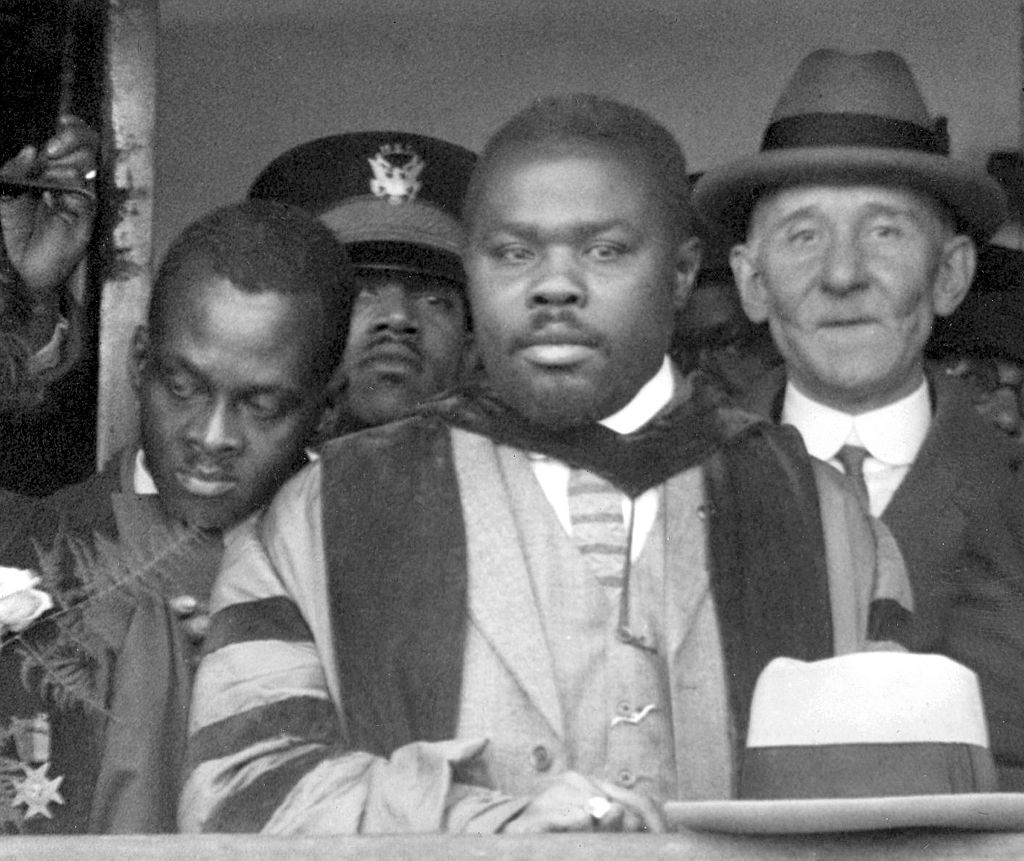
Africa loomed large in the vision of Marcus Garvey and his followers. In May 1920, the Universal Negro Improvement Association (UNIA) Executive Council decided to send a delegation to Liberia to explore the prospects for settlement and development. UNIA Resident Secretary in Liberia Elie Garcia wrote to President Charles D. B. King that they wanted to “establish trade routes, through a line of steamships, etc., to encourage emigration to build up the country, to transfer its Headquarters to Liberia, to bring with it medical and scientific units, etc.” He asked for “written assurance that every facility will be given it to procure lands for business, agriculture, and industrial purposes. In return the Organization with its vast membership will lend financial and moral support to the Government to help her out of her present economic plight.”
Hubert Harrison got a copy of the August 1920 “Confidential Report” from Garcia, where he saw evidence of conspiratorial plans against the government of Liberia. Garcia recommended that the UNIA hide its real intentions to get involved in political activity. It also indicated the thorny internal politics at play and how reluctant the Liberian government was to seriously engage with the UNIA’s schemes. Garcia characterized the Liberian elite as “degenerated and weak morally” and wary of “American and West Indian Negroes.”
A. Philip Randolph cut through the unseriousness of Garvey’s dream to redeem Africa. He saw no viable pathway toward building up an independent African state by disparate groups of UNIA members. “The redemption of Africa by Negroes who are unarmed, unorganized, uneducated, a minority in numbers to their oppressors, divided, both in and out of Africa by languages, custom, history, and habits, is a will-o’-wisp, an iridescent dream which could only be born in the head of an irresponsible enthusiast,” he charged. The tendency to paper over class and cultural differences among blacks in the United States was even more pronounced in the way Garvey thought of Africa. William Pickens, a prominent National Association for the Advancement of Colored People (NAACP) activist and Garvey rival, quipped that “there is no more in common between South Africa and North Africa than between Texas and Turkey.” In his eyes, Garvey “had not a grammar grade understanding of Africa.” Randolph wrote, “To him every African is a Negro and every Negro is black. To him there is a racial and nationality homogeneity in Africa; all tribes possessing one mind.”
Famed Harlem Renaissance poet Claude McKay rubbed shoulders with Garvey in Harlem’s political scene throughout the 1920s. After a brief involvement with the Liberty League, he became a Communist Party member. Writing for The Liberator in April 1922, McKay lambasted Garvey for the fact that he “talks of Africa as if it were a little island in the Caribbean Sea.” He sensed a combination of ignorance and patronizing arrogance in Garvey’s casual dismissal of the vast diversity of the continent, and his presumption that they wanted or needed him to save them. “Ignoring all geographical and political divisions,” McKay sneered, “he gives his followers the idea that that vast continent of diverse tribes consists of a large homogenous nation of natives struggling for freedom and waiting for the Western Negroes to come and help them drive out the European exploiters.”
It wasn’t long before African political figures, including some who were initially involved with the UNIA, began to speak out against Garvey’s designs for Africa. Madarikan Deniyi, who attended the 1920 convention as a delegate from Nigeria, wrote a letter a year later charging that the African Redemption Fund was a fraudulent scam of “poor and needy Negroes” for the purpose of paying his and other officer salaries. At a “Garvey Must Go” rally, Basutoland native Mokete Manoedi remarked, “We are not favorably impressed with the unmitigated presumption of this man Garvey, in electing himself provisional president of Africa.”
Though Garvey’s project ultimately centered around Africa, UNIA chapters in cities like Lagos and Sierra Leone were much weaker than those in the United States and Caribbean. He was never able to overcome the great social, political, and logistical barriers to establishing commercial networks in the continent. On June 30, 1924, the Liberian government officially banned UNIA members from entering the country. Thus ended Garvey’s African Odyssey.
Trial and Collapse
Garvey’s trial for mail fraud began in May 1923. Garvey chose to represent himself, providing yet another media spectacle. He was found guilty on June 18 but was released on bail during his appeal, after which he went on a speaking tour across the country. But in 1925, the higher courts upheld the original decision, and he spent two years in prison. Harrison was convinced that the jury got it right, writing that Garvey was guilty of “swindling members of his race by means of the . . . ‘Black Star Line’ whose fleet of ships to sail the seven seas existed mainly on paper and in the mind of Marcus Garvey.”
Of course, loyal Garveyites could blame the subsequent decline of the UNIA movement on Garvey’s persecution and treachery by enemies of the race. This ignores the much deeper issues with Garvey’s social philosophy, political vision, and organizational practices. While UNIA meetings, conventions, and parades gave the impression of a dynamic organization, little of the activity was geared toward dealing with the material issues confronting most ordinary black people. Ultimately, militancy is a posture and not always an indicator of ideology. As the black population became more urban and integrated in industrial life, issues like wages, working conditions, and housing became more salient and required collective solutions. But the UNIA had nothing to offer on this score. At heart, the rank-and-file member was meant to act as a largely passive consumer of UNIA products and ideology. Judith Stein aptly describes the UNIA program as “oscillating without design between the poles of retaliatory violence and individual self-help. . . . Most recommendations required little active collective implementation because they were exhortations to individuals.”
McKay captured the curious blend of reactionary and modern politics at work in the UNIA. In one sense, the Garvey phenomenon represented something new, for he didn’t exist as an appendage of the Republican patronage machine or mainstream civil rights organizations. Unlike many black leaders of the day, he understood the sensibilities of black proletarians, “for in the West Indies the Negro problem is peculiarly economic, and prejudice is, English-wise, more of class than of race.” But he admired the old European empires and modeled his dreams of an African empire after them.
“His spirit is revolutionary,” McKay wrote, “but his intellect does not understand the significance of modern revolutionary developments. Maybe he chose not to understand, he may have realized that a resolute facing of facts would make puerile his beautiful schemes for the redemption of the continent of Africa.” While his “stupendous vaudeville” may have been somewhat amusing, McKay felt he had “muddied the waters of the Negro movement for freedom and put the race back for many years.” In a similar assessment, Stein describes Garvey as “socially rebellious” but “ideologically conservative. His gestures defied the powerful, white and black, but the consequences of his actions confirmed their position at the top.” After the mail fraud trial, Harrison was reminded of Garvey in Eugene O’Neill’s play, Emperor Jones, “a fine picture of the psychology of the whole Garvey movement,” which depicts a delusional self-proclaimed king of a Caribbean island who eventually succumbs to his own paranoia.
Of course, his popular support did not vanish overnight, and in 1927, President Calvin Coolidge received a petition with over 70,000 signatures calling for his release. His sentence was commuted and expired in November 1927, after which he was deported to Kingston, Jamaica. Garvey attempted to continue political activity abroad, but changing political tides hindered his ability to resonate. In the 1930s, workers in the West Indies began to form trade unions, create labor parties, and launch large-scale strikes. In Trinidad, as the oil workers struck, Garvey claimed they didn’t have a right to strike and was told in clear terms he wasn’t welcome there anymore by the president of Trinidad’s UNIA branch. Writing in 1938, C. L. R. James said, “Today he is a staunch supporter of the British government and makes Tory speeches in Hyde Park about Africa, to the great annoyance of revolutionary British workers.”
In the United States, various spin-offs from Garvey ideology emerged, like the Ethiopian Pacific Movement and the Moorish Science Temple, but none took off in the way the UNIA once had. Hugh Mulzac expressed sorrow for the “scores of thousands of humble black men and women” who donated money to Garvey’s cause but “received in dividends only a transitory inflation of their racial pride.” Though the movement spread quickly, just as soon, “the torch flickered and was out, leaving us in darkness as before; poorer, sadder, and perhaps wiser. . . . Who knows?”
Read the full story at the source
Source: Jacobin