
Politics · Jacobin · · 2h
We Rely on Cleaners’ Work, So Cleaners Should Be Paid More
English (original) · Read in Deutsch ⇄
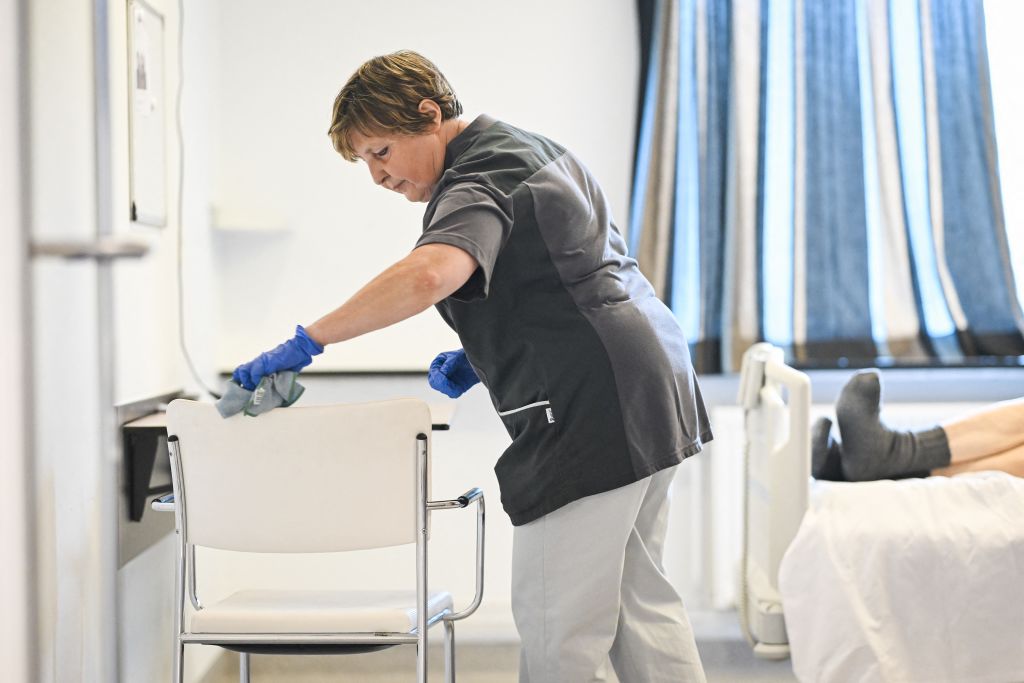
Starting from the late 1970s, neoliberalism’s outsourcing revolution changed the lives of millions of low-wage service workers like cleaners. Once formerly employed by municipalities, national governments, or other public authorities to clean schools, hospitals, or airports, they now found themselves working for private companies contracted in competitive procurement markets.
These workers have experienced job insecurity, rising workloads, draining shift work, and increasing isolation in the workplace. As procurement markets were designed to drive down prices, employers in labor-intensive sectors such as cleaning pressured fewer workers to deliver more. It was often at the expense of their health and of service quality itself.
The European Union is a prime example of this development. Today public authorities across the EU spend over €2 trillion — 15 percent of GDP — every year on goods and services provided by private companies. The rules that govern the awarding of these public contracts have resulted in a race to the bottom for the lowest price. However, after a decade-long struggle by cleaners, security guards, food service workers, and their trade unions, a reform of EU rules is now underway, and it could genuinely improve the livelihoods of millions of workers.
A new podcast, Unsung, released by UNI Europa, the European federation for service workers, dives into cleaners’ daily struggle in the workplace and the political struggle for reforms. For example, Hayat Elhore, a cleaner at the European Parliament in Brussels, pulls back the curtain on a typical day for a worker cleaning a building meant to symbolize democracy, and how she organized her coworkers to fight for better conditions. Lisa Stenson, a hospital cleaner in Ireland with over sixteen years’ experience, explains the pride of cleaning life-saving equipment like incubators, the terror of being assigned to the first COVID ward, and why cleaners are skilled workers who deserve to be paid properly.
Gail Rego interviewed the two for the first episode of the Unsung podcast, here published in abridged form.
Gail Rego
What is it like cleaning at the European Parliament, where a lot of the most powerful people in Europe discuss human rights and democracy every day?
Hayat Elhore
For me, working at the parliament is an honor. It’s where decisions are made, where votes happen. I think the main difference with other sites is the level of control at the parliament. There are frequent checks — sometimes even surprise inspections — and there can be fines too. That creates pressure for supervisors, but also for us workers in other places. The client knew us and came to speak to us at the parliament. We don’t always see the people we clean for — the officials, the MEPs [members of the EU Parliament] — because our shifts don’t always overlap.
Gail Rego
You also talk about loving the work: Why do you love it?
Hayat Elhore
I love my job because thanks to negotiations with my union and my employer, I was able to get daytime work that allows me to do my job professionally but also take care of my private life. That became very important to me when I had my first daughter at thirty-six. I wanted to be there as she grew up. I can wake up, see my children, take them to school, finish work, pick them up, help them with school, have dinner with them, and say good night. That balance makes me happy and motivates me to keep doing this work. And I also like when people say hello or thank you.
Gail Rego
Can you tell us what a typical day looks like for you?
Hayat Elhore
A typical day starts when I wake up at 5 a.m. I prepare everything in advance so I can wake the children, leave the house early, drop them at daycare, and then drive about an hour to work. I clock in, get changed, prepare my trolley, meet my colleagues in the corridors, check my schedule, prepare my products and start my tasks. Sometimes there are unexpected changes. Someone is absent. So we reorganize between us as a team. But in general, I work Monday–Friday and finish at 3 p.m..
Gail Rego
Has the workload and schedule always been like this?
Hayat Elhore
It’s changed a lot. Before, we might have had three hours for twenty offices. Now in three hours, it can be two floors, maybe fifty offices, because of competition and low prices. Everything is calculated by square meters, not by what is actually inside each room. We clean the rooms, the furniture, the toilets, the spaces. But we’re not robots.
Gail Rego
How does it impact your day-to-day?
Hayat Elhore
I would say the hardest part is the fatigue, the stairs, carrying all the materials, repeating the same movements. That leads to a lot of back and arm pain. It’s very physical. Some days there’s a lot to do and it has to be done quickly. By the end of the week, you really feel it.
Gail Rego
And how would you say that this pace affects your mental well-being? Do you get any interaction or feedback from others, for example?
Hayat Elhore
Many people don’t realize the time and work it takes for things to be clean. If we’re asked to clean something extra, it can take much longer than people think. For example, removing glue from a wall won’t take just ten minutes. It takes much more. But we still have our normal tasks waiting for us too. I think people sometimes assume that because we’re there, every request can be done immediately. When clients see the result and thank us, it makes us proud. If the employer or client is happy, then we’re satisfied too. That’s when we see our work as necessary in society, really necessary, and that it should be visible and respected like any other job.
Gail Rego
You’ve mentioned seeing unfair situations at work. How did that turn into getting involved with the union?
Hayat Elhore
I became interested in being a union representative because at the beginning there were not many young women in that role. Then, little by little, I met women who did not dare to speak. I saw things that were not right. I saw injustices. Many women, especially with migrant backgrounds, couldn’t express themselves easily in French or explain the difficulties they were facing. I wanted to be their spokesperson, to help them speak, to defend them, and to make things easier for them.
One of the things I do in this role is to fight for daytime work, especially for women with children. I’ve also defended workers who received warnings that could have made them lose their jobs. My role is to try to make sure that women who need this work, and who like doing this work, don’t lose it unfairly when there’s a heavy workload. Employers should look at well-being and solutions first before giving warnings. The work is very manual, very physical, and there is often not enough time to do everything properly.
Gail Rego
Your work as a union representative eventually helped build momentum for something larger. In October 2024, you and thousands of other cleaners from across Europe protested outside the European Parliament. What sparked that action, and what did you hope to change?
Hayat Elhore
One of our big demands was not to work until sixty-five, because of health, because of professional wear and tear. Many people simply cannot do this work until that age. Many are on long term sick leave with back problems, wrist problems, knee problems. Many women have worked part time or had career breaks so they wouldn’t have full pensions.
We also protested against unfair competition and low prices, because when a contract ends, another company often comes in cost-cutting. After six months, there can be reorganizations, and workers don’t know if they will keep the same hours or if they will have the same hours but with much more work. There’s also too much subcontracting, sometimes undeclared, and some employers abuse that.
Gail Rego
Lisa, can you tell us what cleaning as a skilled job looks like? The kind of training you’ve had to receive, how often you need to update that training and update your skills.
Lisa Stenson
In recent years, our hospital sent all the cleaning staff on a four-week, health-related cleaning skills course. It’s a Level 5 certificate, so we’ve suddenly become college-educated, in that we had an assignment, a skills demonstration, and a written exam. For me, if you have to go to college to do a job, you’re a skilled worker. Cleaning is a completely different job now than it was ten years ago. You can see even the demographics have changed. It was very predominantly female for a very, very long time. But now we have a lot more more young men who are putting themselves through college, and they’re coming into the hospital at the weekends and working with us. It’s completely different to be a cleaner.
Gail Rego
What does a typical workday look like for you?
Lisa Stenson
As soon as I go into my area in the morning, I check our our sign-off sheet from the day before, because I may not have been there. I check to see what my colleague might have done: if there’s something that she hasn’t checked off, I make that my priority first thing, so that it’s still done within the twenty-four-hour period.
My first port of call is to empty the bins, because they do fill up quite quickly in a hospital, and then check to see whether I need linen or anything like that. Not all cleaners where I work clean equipment, but I do in this specific area. I do my floors and my dusting, and when I have that cleaning done, I stock up whatever’s needed, milk or soothers or things like that. That brings me up to a breakfast time.
When you go back, you might have a couple of incubators to do, but you could be doing all the equipment, putting the “ready for use” stickers on them, up to maybe lunchtime. Then you go back into the main unit and clean everything like the incubators, blood pressure monitors, ECG [electrocardiography] machines, the resuscitator, as they need cleaning daily. Then you’re around the time for a tea break, then go back in the evening and do your cleaning again.
Gail Rego
Tell us a little bit more about the kind of pressure that you face.
Lisa Stenson
The job is quite physical, so if you’re doing a twelve-hour shift, you’re constantly on the move. We have to be audited. And if we get less than 90 percent in an audit, our area fails. So, there are extremely high standards. And sometimes that pressure can just be a little too much.
Gail Rego
What do you wish the patients, the visitors, nurses, doctors, or even the public understood about cleaning and what you do on the day-to-day?
Lisa Stenson
I sometimes feel like we’re very undervalued, that what we do is not fully appreciated. We’ve always said it where I work: the only time people notice what a cleaner does is when she doesn’t do it.
From COVID times, there was a renewed acknowledgement of what we’d done and of the work we’d carried out. There was a lot of thanks from management in the hospital and from our own management. They really did appreciate us and that made us all feel better about our role. But it’s disappeared again. We’re not getting any real recognition now for the work we carry out, even though we’re sent on training courses on how to do it properly. So we put a lot into our jobs, but we don’t get a lot of recognition for it.
Gail Rego
Did you have a say in the matter, in terms of being assigned to work in the COVID ward, and did it have an impact on your health?
Lisa Stenson
I could have said no. I was well within my rights, but I had a discussion with my manager. And somebody has to go. If you do it, people will follow. So I said, “Okay, I’ll do it.” It was terrifying. I did the day cleaning for about two weeks in the COVID ward. And then they wanted twenty-four-hour cleaning. So I went over to nights. While I was on nights, I suppose because of everything I was seeing going on, I lost about two and a half stone [approximately thirty-five pounds]. I couldn’t eat, I couldn’t sleep, so it had a really, really bad effect on my physical health. I never got COVID while I was working in the ward, but I got a load of other issues.
Gail Rego
You also became part of the Services, Industrial, Professional and Technical Union (SIPTU).
Lisa Stenson
I have been a SIPTU member since I started working in the hospital. As soon as you walked in the door, it was like join the union. So everyone joined the union. SIPTU has always had campaigns and Joint Labour Committees [JLC; sectoral, collective bargaining] to ensure that people who work in contract services — not just in cleaning but in catering and security — to ensure that they have the best possible rights and benefits and terms and conditions that it can possibly fight for. Every year in security and cleaning, there’s a JLC, and we get an increase to help ease the cost-of-living burden. And I do think if we didn’t have a union, we would have very little else. They listened to us. When we speak, they hear us, and they help us.
Gail Rego
Hayat, what advice would you offer to others trying to organize from within?
Hayat Elhore
My advice is to get informed, know your rights, and don’t be afraid. There are representatives, there are unions. And it’s important to be represented, and to reach out to representatives even when they don’t come to us directly: listen, support them and guide them.
Read the full story at the source →
Source: Jacobin