
Politics · Jacobin · · 1h
We Can’t Blame the Supreme Court for Congress’s Problems
English (original) · Read in Deutsch ⇄
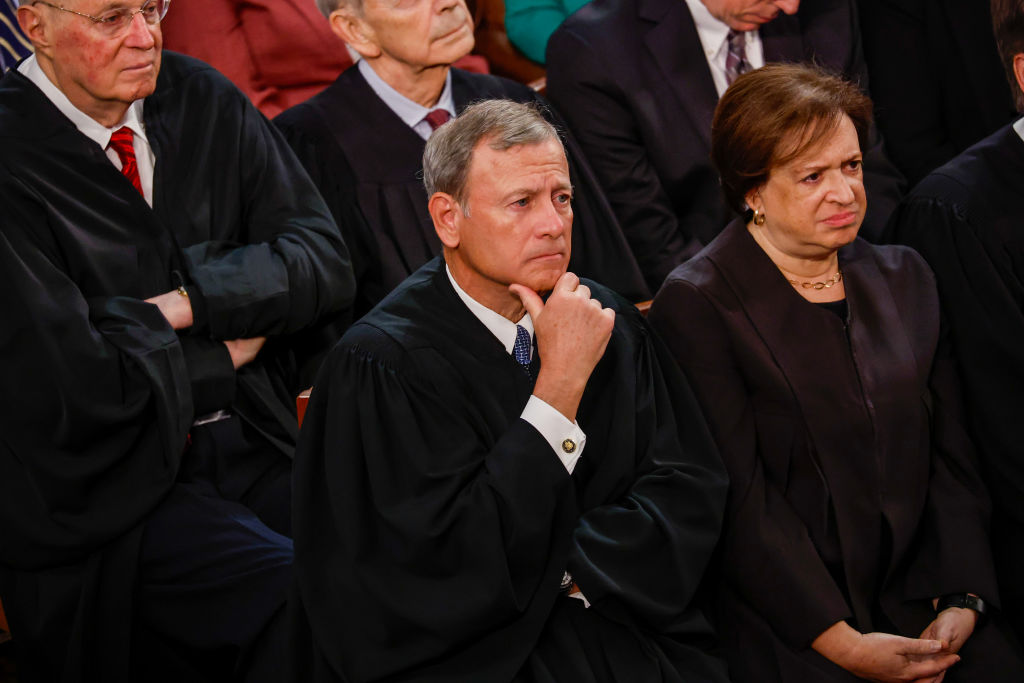
Almost everyone on the Left seems to have lost faith in the Supreme Court of the United States. This would have been improbable in 1954, after the Brown v. Board of Education decision, or in 1973, after Roe v. Wade, or even in 1992, after the court upheld the core holding of Roe in Planned Parenthood v. Casey. But after over twenty years of the conservative John Roberts serving as chief justice, including over half a decade of him leading a court with a 6–3 conservative supermajority, liberals and progressives no longer turn to the court with any real hope. If anything, they view it with hostility.
Some on the Left — most recently Lisa Graves and Leah Litman — have portrayed the Roberts Court as a wrecking ball that has “rewritten the Constitution” and “dismantled our rights.” Others think that the court has never really protected our rights and that we were deluded to ever trust such an inherently reactionary institution. While these tendencies have overlapped at various junctures, the more radical critiques of the court have generally been confined to the socialist left: the pages of Jacobin, rather than the Harvard Law Review.
Nikolas Bowie and Daphna Renan’s new book, Supremacy: How Rule by the Court Replaced Government by the People, is an exception to this rule. The authors are not only Harvard law professors but former clerks for two of the most celebrated progressive justices in the history of the Supreme Court: Ruth Bader Ginsburg and Sonia Sotomayor. Their book is not a tragic story of how the Roberts Court betrayed the great liberal traditions of Brown and Roe. It aims at something more fundamental: the almost unconscious and unanimous acceptance — by both conservatives and progressives — of the principle that the Supreme Court should be the final arbiter of all constitutional disputes.
While Supremacy makes a concise and cogent case for an alternative vision of “democratic constitutionalism,” it misdiagnoses the problem we face. Its image of a Supreme Court constantly determined to aggrandize its own power is based on a selective reading of the historical record. As a result, the book encourages us to attack an institution that is not really responsible for our predicament.
We are not cursed with a tyrannical judicial branch but a broken constitutional structure. The heart of this broken structure is the vesting of the preponderance of political power in a legislature that is designed to obstruct and delay rather than act. Our main task, constitutionally speaking, should be — and has been in the Left’s most successful moments — to push Congress to legislate on the most popular and pressing issues in American society. Attacks on the Supreme Court distract from this urgent priority.
The Origins of a Strange Alliance
The text of the Constitution is at best ambiguous about what “the judicial power” means. But as Bowie and Renan argue in Supremacy, the norm that seemed to emerge from early conflicts over the Supreme Court’s jurisdiction was that even if the court could and sometimes must hold state laws to be incompatible with federal law or the federal constitution (what the authors call “vertical review”), it had no authority to strike down acts of Congress (what they call “horizontal review”), which embody the will of the nation as a whole. This norm, the authors claim, represents the best balance between two vital democratic values: the empowerment of popular majorities and the defense of minority rights.
Today, however, “our country is less a nation of laws enacted by the people than it is a nation governed by the decrees of the Supreme Court,” which has “seized for itself power over the most important decisions a nation could make.” Bowie and Renan call this predicament “judicial supremacy.” They recommend a radical rebalancing: the repudiation or limitation of “horizontal” judicial review of laws passed by Congress, leaving the Supreme Court only able to “vertically” review state laws.
Bowie and Renan harbor no illusions about either the feasibility of this idea or the possible consequences of untethering Congress in this way. “It almost goes without saying that the Congress we have today is dysfunctional and unrepresentative,” they concede in the book’s concluding chapter. Their main objective is not to romanticize Congress but to demonstrate that “judicial supremacy has not achieved what its defenders say it has. In its scope and sweep, the Court’s actual practice undermines any claim that judicial supremacy is necessary to protect vulnerable minorities from acts of Congress.” If “judicial supremacy” has protected anyone, they argue throughout the book, it is the rich, the powerful, and the guardians of white supremacy.
Bowie and Renan marshal plenty of evidence to make their case. Most of it comes from the Dred Scott decision in 1857, which ruled that formerly enslaved people could never be American citizens, until the end of Reconstruction. Frederick Douglass is a central figure throughout the book — and he ought to be, given his crucial intellectual evolution from the condemnation of the Constitution for its compromises with slavery to the belief in its remaking through popular interpretation. Supremacy also illuminates how Dred Scott initiated an enduring alliance between racial reactionaries and the Supreme Court, leading a Republican-controlled Congress to boldly assert its right to determine the terms of Reconstruction without judicial interference.
Supremacy also discusses the early twentieth-century struggle between New Deal progressives and the Supreme Court, which culminated in Franklin Delano Roosevelt’s abortive 1937 court-packing scheme. Although Bowie and Renan sympathize with these progressives, they criticize many of them for attacking judicial review writ large rather than distinguishing between horizontal and vertical review. The failure to make this distinction, it is argued, made it difficult for some progressives to justify judicial nullification of state Jim Crow laws.
This was evident in Brown v. Board of Education, when the strongly FDR-shaped court “proceeded as if the only question before it was whether the justices in 1954 believed that school segregation was constitutional.” This “conjured the image of a judicial angel hovering over and somehow apart from American politics.” Leftists, determined as they were to eliminate the scourge of segregation from the country, thus found that their traditional enemy — the group of nine unelected men in robes — had become their friend.
If this strange alliance was damaged by Richard Nixon’s appointment of four justices to the court in just five and a half years, the 1973 Roe v. Wade decision gave progressives and liberals another motive for preserving judicial supremacy. As Bowie and Renan demonstrate, Democrats in Congress even abandoned a campaign to enshrine abortion rights in federal law because they were confident that the Supreme Court could do a good enough job after it (barely) kept Roe intact in 1992 — a perception that was reinforced by the confirmation of Ruth Bader Ginsburg to the court the same year. Arguably, at least some portion of the Left clung to the “guardian angel” image of the court forged during the Brown era until Roe was finally overturned in 2022.
The Source of the Court’s Power
Supremacy’s encouragement of the broad left to decisively bury any lingering hopes about the Supreme Court is uncontroversial. However, the book reaches this conclusion by exaggerating the power and villainy of the court. In Bowie and Renan’s account, the court’s dominant historical tendency is to advance the interests of slaveholders, robber barons, and modern-day oligarchs by usurping power that belongs to Congress. But other scholars have effectively argued that the Supreme Court has had power thrust onto it, largely because the elected branches like it this way: they can pass controversial issues onto the judiciary and blame it for problems that are, at bottom, their fault.
When Roe v. Wade was overturned, congressional Democrats didn’t apologize for failing to protect abortion access over the previous fifty years; they accused the Supreme Court of treachery. When Dred Scott infamously invalidated Congress’s effort to limit the spread of slavery through the Missouri Compromise, Republicans rightly assailed the court, but Dred Scott would never have occurred if Congress had actually confronted the slavery question in the first seven decades of the republic instead of constantly deferring and obfuscating it. Moreover, if we are going to criticize the court’s reasoning in Brown, we at least need to acknowledge that a Congress dominated by the Deep South had spent the first half of the twentieth century tolerating the Jim Crow regime while the court was mildly but meaningfully chipping away at it, particularly in the 1940s.
There is a larger problem here. Congress was set up to fail by the framers of the Constitution. Even at the best of times, the equal division of legislative power between a House of Representatives elected on majoritarian principles and a Senate elected on minoritarian ones for six-year terms (and initially not elected at all) makes lawmaking a tough task.
The British House of Commons recognized the obvious defects of such pure bicameralism by defenestrating the House of Lords in 1911. Likewise, the Australian Constitution draws much of its structure from the American model but gives the prime minister the power to force early “double dissolution” elections to both the House and the Senate if the Senate repeatedly obstructs legislation. This power was crucial to the passage of progressive legislation in 1974, including the seeds of Australia’s first universal health care scheme. No such mechanism existed to force anti-lynching bills through a reactionary US Senate in the 1920s; hence why civil rights activists tried their luck with the courts.
Still, it was not inevitable that the Supreme Court would profit from Congress’s design flaws. Supremacy gives us a defensible theory for how it did — namely, by aligning with the forces of racial and economic reaction. But it might be that the court only did this in the late nineteenth century because those forces were dominant in US politics at that time. Then, as the forces of racial reaction in particular lost momentum in the 1940s, ’50s, and ’60s — buckling under the pressures of accelerating urbanization, the economic and ideological disruptions of World War II, and Communist and Third World condemnations of “racialism” — the court became more liberal.
Many political scientists, going back to Robert Dahl in 1957, have observed the Supreme Court’s sensitivity to public opinion and to the politics of the elected branches. This sensitivity is essential to the court’s survival, because it relies on elected institutions to implement and enforce its decisions. As Alexander Hamilton famously put it in Federalist #78, the judicial branch “has no influence over either the sword or the purse.” This makes it “the weakest of the three departments of power. . . . it can never attack with success either of the other two.”
None of this literature is discussed in Supremacy, but the implication of the book is that Hamilton had it wrong. Many examples are offered of the Supreme Court attacking Congress, including the court’s nullification of the Missouri Compromise in 1857, the Civil Rights Act in 1883, the Keating-Owen Child Labor Act in 1918, the National Industrial Recovery Act in 1935, and section 4b of the Voting Rights Act in 2013. Such examples give the impression of a voracious institution determined to crush progressive legislation whenever it has the chance.
The reader gets no sense of the fact that, throughout its history, the Supreme Court has generally been reluctant to invalidate federal laws, striking down 172 as unconstitutional in whole or in part since 1789. It has struck down state and local laws at least five times as frequently. Even the Roberts Court has upheld federal legislation when conservative ideology could have dictated a different result, including the 1968 Gun Control Act, the “individual mandate” of the Affordable Care Act, and the Indian Child Welfare Act. The court declared back in 1819 that its default posture in cases of horizontal review would be to defer to Congress. Most of the time, it has stuck to this position.
Addressing the Real Problem
Although this doesn’t mean that the Supreme Court is harmless, it does call into question the urgency and value of an attack on horizontal review. Such an attack would only be necessary if the court were consistently obstructing progressive federal legislation. Supremacy does not prove that the Roberts Court is doing this. It contains no dedicated chapter on the Roberts Court and no sustained analysis of its decisions.
What kind of threat does the Roberts Court pose? To be sure, in line with Supremacy’s thesis, it has exercised horizontal review in potentially destructive ways, notably in the areas of voting rights and campaign finance. However, this court’s primary target seems to be the administrative state rather than Congress. Moreover, it has demonstrated how vertical review can seriously hurt the Left — a danger that is not raised at all in Supremacy. Notable examples include the court’s decisions preventing states from mandating “agency fees” to unions in public sector workplaces, declaring state laws granting union organizers access to rural workplaces “takings” of private property, and invalidating state gun control laws. Curbing the court’s authority to review acts of Congress won’t help with any of this.
The sad reality is that even if the Roberts Court wanted to go on a rampage against progressive federal legislation, it would have trouble finding any. For all his faults, John Roberts is not the reason why we don’t have federally guaranteed universal health care (including reproductive health care), paid parental leave, holiday pay, or a living wage. The basic theory of Supremacy would have us attack the Supreme Court for things it hasn’t done yet and may never do, all while Congress, the branch of government endowed with the greatest constitutional authority, continues its impressively consistent record of either avoiding or exacerbating our nation’s most pressing problems.
On rare occasions, however, Congress has served the Left in the past, but only under intense external pressure. Beyond the obviously critical force of the labor movement, two institutional mechanisms have helped build pressure on Congress: the presidency and the states.
The presidency’s potential role — activated most notably by the Left when FDR occupied the White House — is fairly direct: the president, though lacking in constitutional powers, heads one of the political parties in Congress, possesses a unique ability to act quickly, and can mobilize public opinion rhetorically. The states’ potential role (articulated in Heather Gerken’s theory of progressive federalism) is more indirect, involving experimentation with progressive policies that begins in one state, spreads to others, and eventually becomes so widespread that Congress follows. Although a conservative Supreme Court might try to thwart such experimentation, it is both a virtue and a vice of our constitutional system that states can find many creative ways to escape the reach of unfriendly federal courts. They only really relent when Congress takes their federal funding away. One virtue of having such powerful subnational political units was evident in the early twentieth century, when states such as New York (not to mention many cities) pioneered the economic and social policies that would later become central to the federal New Deal.
Perhaps it is uncomfortable for leftists to talk about activating the presidency while Donald Trump sits in the Oval Office, or to talk about using state power given the often reactionary history of federalism in this country. But uncomfortable conversations about these tools would be much more productive than our seemingly endless lamentations about the Supreme Court. Books like Supremacy, while admirably readable, are ultimately guiding us nowhere particularly useful.
Read the full story at the source
Source: Jacobin