
World · Jacobin · · 3h
Thomas Piketty’s Utopian Socialism
English (original) · Read in Deutsch ⇄
In June, the policy world held its collective breath as the World Inequality Lab, the outfit headed by Thomas Piketty, released a report meant to serve as a capstone to years of extensive research on the elusive goal of leveling global incomes. Christened the Global Justice Report (GJR), Piketty and his collaborators promoted it as the first data-driven synthesis of two long-standing progressive ambitions that had remained more aspirational than actionable: dramatically reducing income and wealth inequality both within countries and between them, on the one hand, and achieving planetary sustainability in the age of global warming, on the other. The GJR, in short, aimed to demonstrate that the sort of inequality studies that had made Piketty famous with the 2013 publication of Capital in the Twenty-First Century could be used to navigate the trade-offs posed by the climate crisis.
At first glance, there is much in the report with which socialists would agree. It envisions, to borrow John Maynard Keynes’s phrase, the euthanasia of the billionaire class within a quarter century, primarily through confiscatory taxation. It proposes to democratize institutions of international economic governance, long dominated by the same cadre of rich nations, by implementing a per capita voting formula and introducing an international currency that would mitigate the exorbitant privilege of the dollar. And as part of its overarching concern for planetary limits, it calls for a drastic shift in the translation of productivity gains away from ever-greater material output and toward more leisure time. This has been a long-standing socialist demand, one that capitalism’s drive for profit has delivered on fitfully and only under sustained pressure from below.
Yet when it turns from the highlights to the machinery meant to achieve them, the report falls short. Far from an ambitious but feasible program that could be selectively used to rally the global left, the GJR retreats into the realm of fantastical thinking. Piketty and his collaborators passingly acknowledge the political constraints on building lasting coalitions of the dispossessed but ultimately sidestep them. Not unlike the schemes of the utopian socialists of the nineteenth century, the GJR flounders on the same obstacle: its proposals cannot cobble together a political constituency powerful enough to overcome the fierce resistance they would inevitably provoke from entrenched elites.
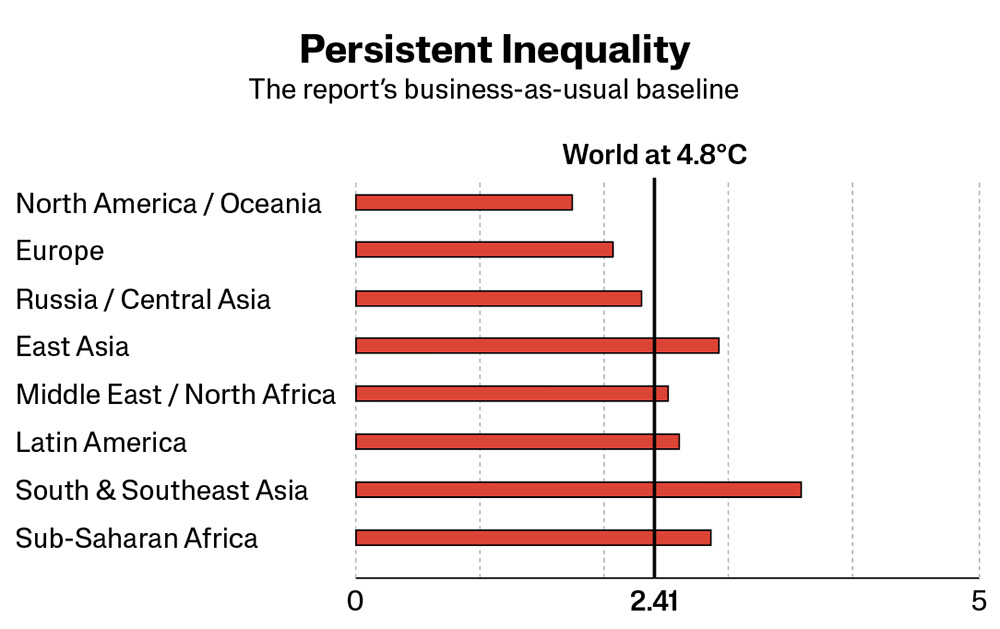
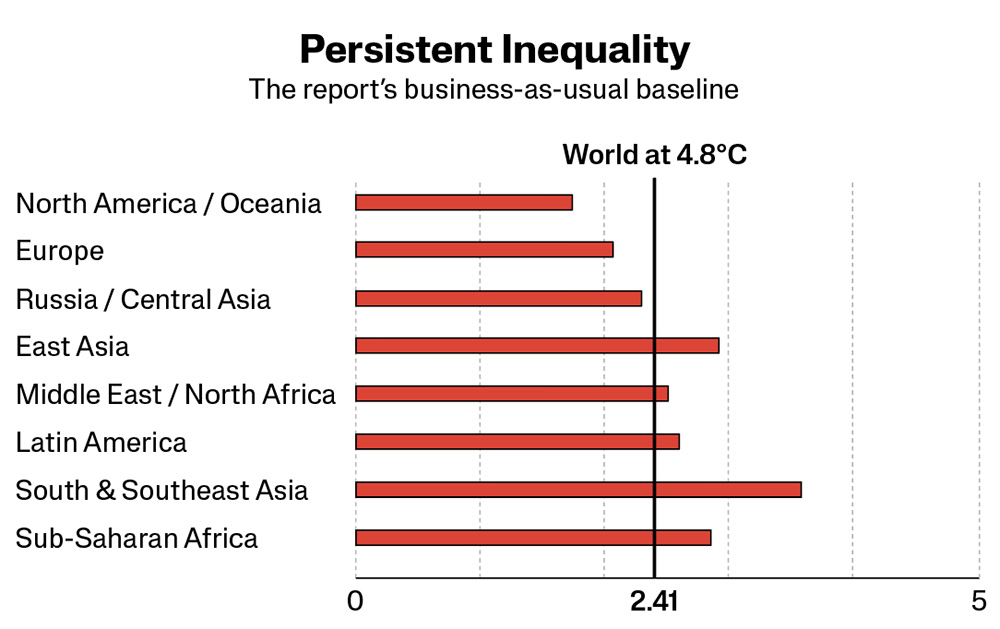
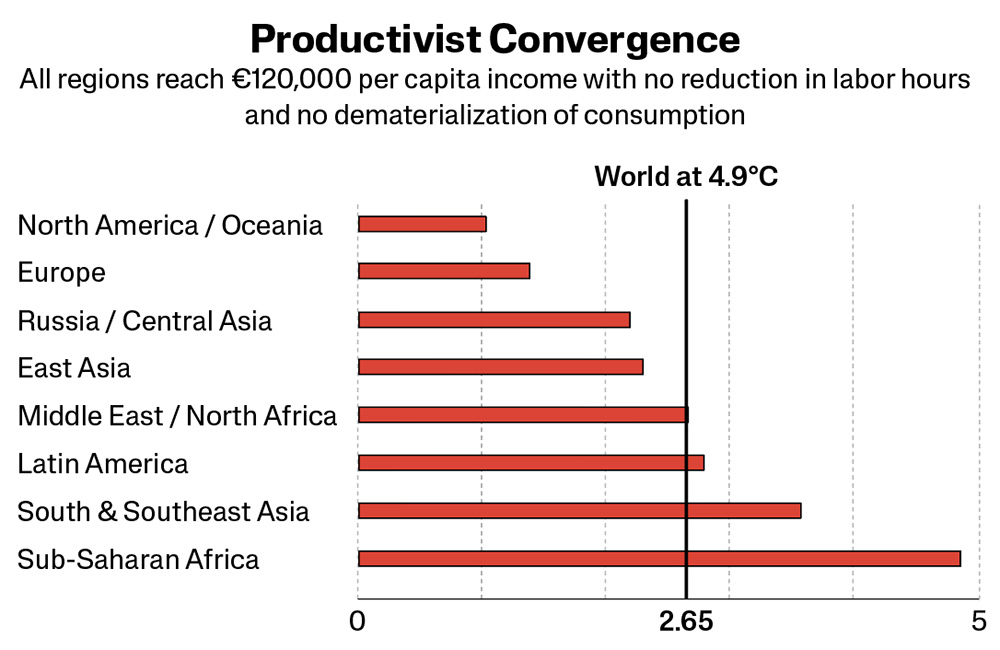
Briefly stated, the GJR sets out a pathway to global income convergence by the end of the century that at the same time limits greenhouse gas emissions to two degrees Celsius above the preindustrial threshold. It employs a novel input-output accounting model to simulate warming pathways and adds a redistributive dimension that narrows the range of acceptable scenarios. The working papers that form the basis of the report reveal this to essentially consist of one long and complex accounting exercise.
The input-output model first generates a maximum bank of future greenhouse gas emissions that the global economy can emit to remain within the two-degree target. It subsequently affixes a per capita income level that all countries could converge on that would respect this limit. Economic growth, both quantitative and qualitative, is thereby apportioned to each country based on a country-specific carbon footprint that the model determines would not run afoul of either goal of sustainability or equality. Once the apportionment is complete, the model backs out of the climate- and growth-enhancing investment shortfall that would be necessary to set the world’s economies on the path to sustainable equality.
Enter the GJR’s flagship proposal: the establishment of a mammoth Global Justice Fund with fiscal jurisdiction over the entire planet.
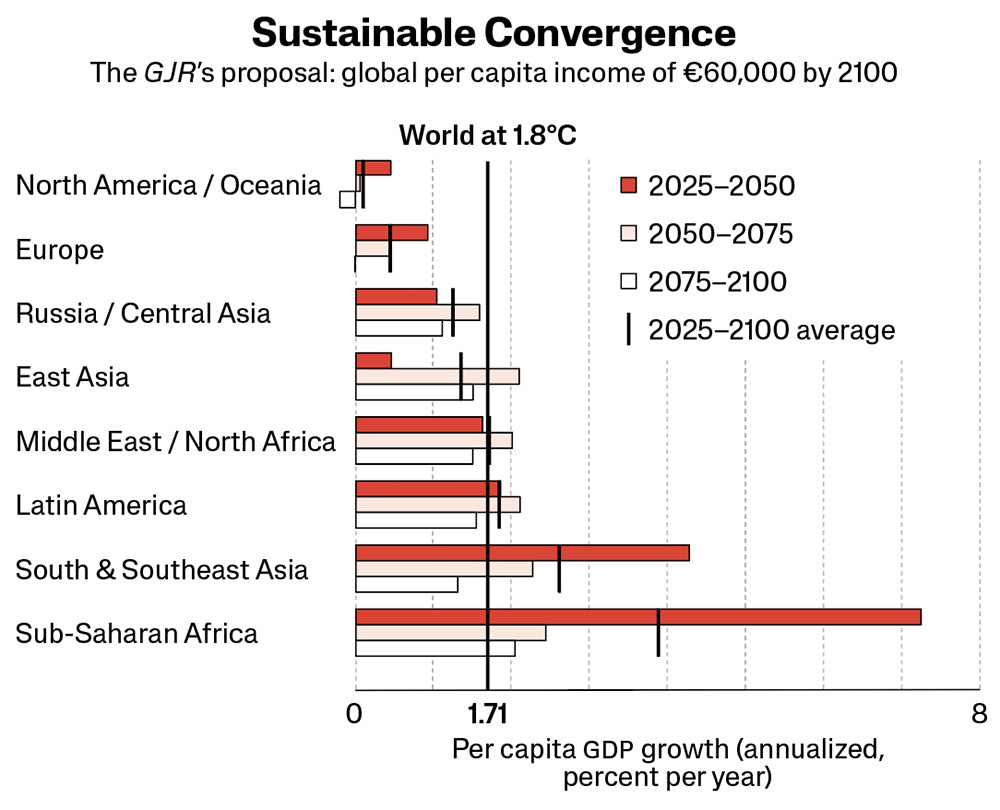
After all is said and done, the GJR’s model ascertains that the world can converge on a per capita income of €60,000 in the year 2100 while keeping warming to only 1.8 degrees Celsius above preindustrial levels. The poorest regions of the world, such as sub-Saharan Africa and South Asia, would grow at a blistering rate of 3 to 4 percent per year, whereas the Global North in its entirety would only be permitted a growth rate of 0 to 0.5 percent per year. Much, if not most, of that growth would be oriented toward so-called immaterial sectors, especially health and education. Quotas, among other consumption-shaping policy instruments, would keep a lid on spending on material sectors. The investment shortfall to achieve this level of convergence would equal approximately 10 percent of world GDP each year. The end point is set; the trajectory is mapped out — but how do we get there?
Enter the GJR’s flagship proposal: the establishment of a mammoth Global Justice Fund (GJF) with fiscal jurisdiction over the entire planet. Through confiscatory income and wealth tax schedules, targeted almost exclusively at the global top 1 percent, the fund would raise the investment needed to finance the transition through the late 2050s. By then, the report projects, the world’s billionaire class would have effectively disappeared, and enough revenue would have been accumulated in the proposed World Sovereign Fund (WSF) for future spending to become self-financing.
The rest of the story is straightforward. The GJF and the WSF would distribute their investments and dividends to nations according to the growth targets of the model, in the process providing incentives for countries to come up with projects that not only are climate-friendly — by expanding relatively immaterial sectors and reducing working hours — but also advance broad social goals, such as flattening gender differences in working hours and experimenting with communal or other alternative forms of property ownership. To prevent rich countries from dominating the system, the report proposes that the fund operate on a double-majority vote formula based on country population rather than the GDP-weighted one used today in institutions like the International Monetary Fund. It also calls for the United Nations to issue a new global currency, eliminating any single coalition’s disproportionate influence over the financial infrastructure of global trade.
Most criticism of the report has focused on the staggering collective action problems that the requirement of universal or near-universal participation in the GJF introduces. Indeed, in an anarchic world-system beset by the security dilemma, it is hard to imagine that enough rich or upper-middle-income countries would willingly give up a significant fraction of their tax authority and revenues for the project to even get off the ground.
The example of the European Union, which, unlike the GJF, does not have to aggregate such disparate national interests as those of Laos and Canada, is sobering in this regard. Seventy-five years after starting the process of economic integration, the EU lacks anything resembling the fiscal union (or capital market integration) that the GJF would require of the entire world. On the other side of the ledger, poor countries have an incentive to free ride on the emissions reduction efforts undertaken by their wealthier peers while ignoring the GJF’s strictures. The report’s authors offer the use of punitive tariffs and other economic sanctions to keep nonparticipants in line, but this simply reintroduces the obstacle in another guise. If the GJF cannot solicit the participation of the world’s most powerful countries with the deepest tax bases in the first place, with what authority could it credibly threaten to impose penalties on them?
Daunting as the challenge of corralling today’s heavily armed sovereign states without a world Leviathan may be, the critics still understate the severity of the problem by stopping there. It ought to go without saying that any movement toward the implementation of the GJF would solicit maximal resistance on the part of economic elites. No period in modern history has come remotely close to approximating the scale of downward wealth redistribution — within or between countries — that the fund proposes to accomplish in a mere handful of decades. This alone undermines the report’s repeated insistence that its projections are consistent with historical precedent, whether referring to the rapid growth of the Asian Tigers from the 1970s through the 2010s or the compression of incomes in the Nordic countries between the 1930s and the 1980s. More than two centuries of political experimentation have shown that capitalists have only been durably constrained by the unlikely, difficult, and fragile organizing of the laboring masses around shared material interests, not altruism. And it is here that the report digs its own grave by ignoring the legitimate concerns of workers in the Global North.
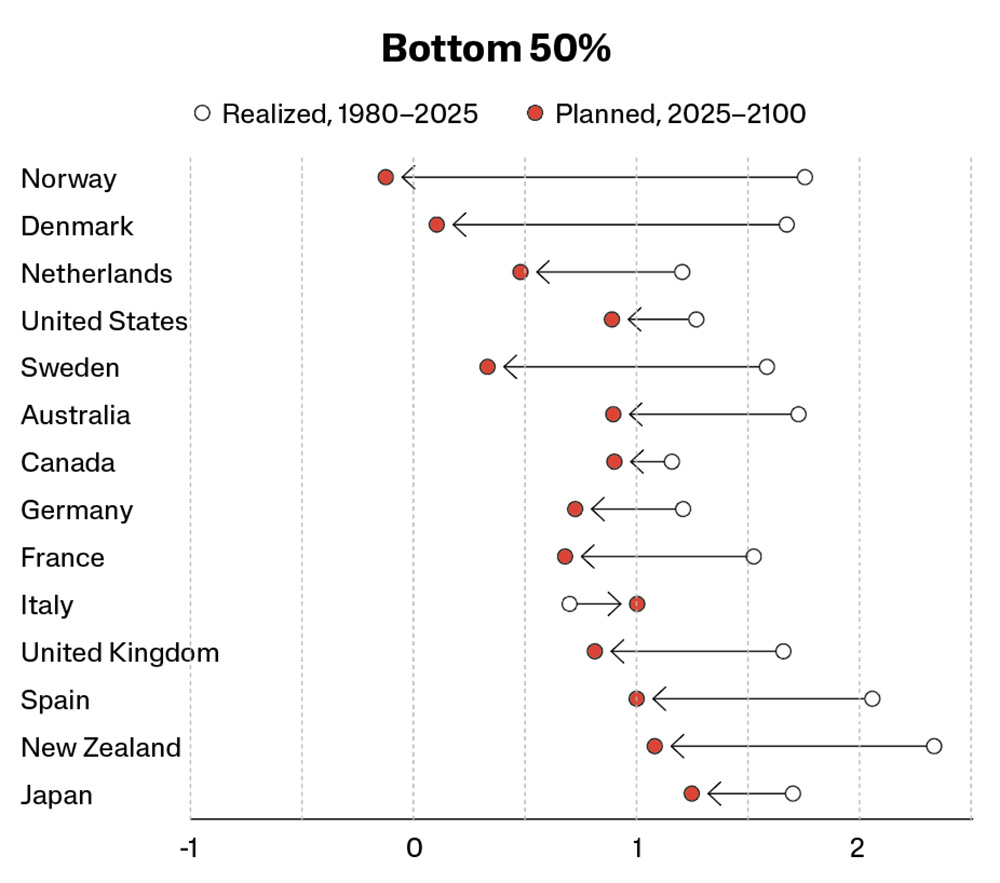
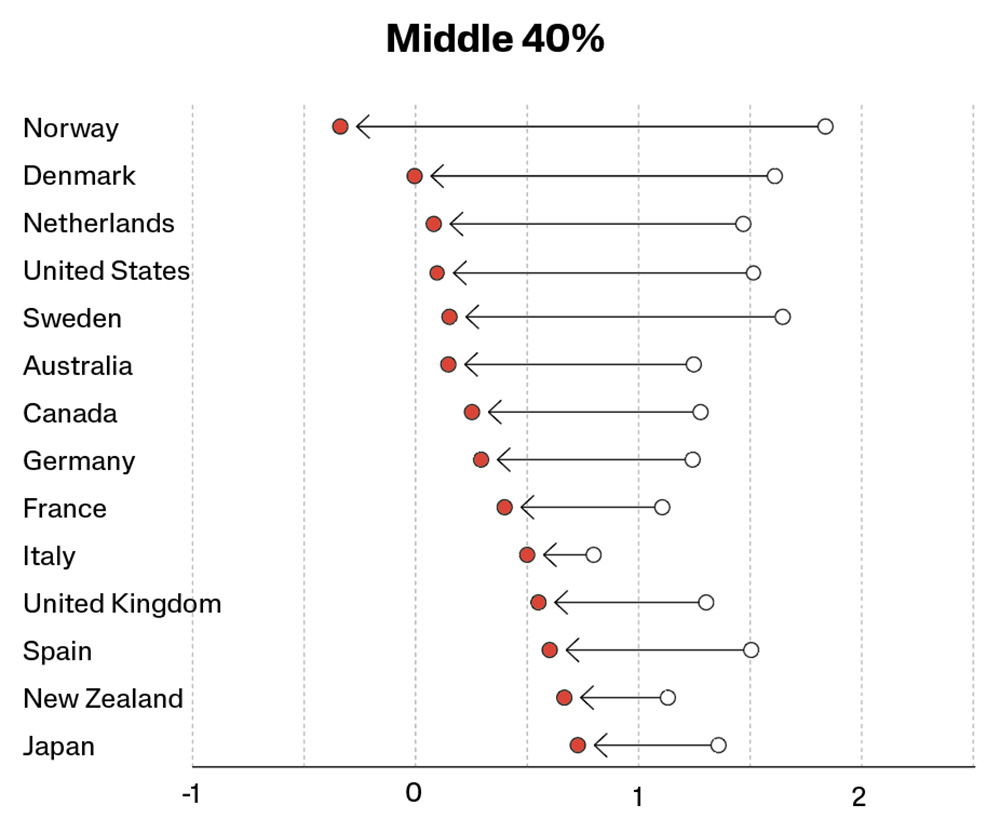
As stated above, the report’s model awards developed countries near-zero yearly growth for the remainder of the century. Aware of the damaging political implications that might flow from this, the report engages in what can only be described as an intellectually dishonest sleight of hand by positing that, when factoring in the compression of incomes, most of the inhabitants of the Global North (specifically, the bottom four-fifths of the income distribution) would nonetheless experience a doubling of their monetary incomes between now and 2100. In fact, this represents a ceiling on income growth that most Northern workers wouldn’t come close to experiencing, although the bottom 20 percent could experience something slightly above it. The implicit claim seems to be that because this does not constitute a net reduction in incomes, the political allegiance of most of the North’s population would not be seriously jeopardized.
But as the World Inequality Lab’s economists surely know, the reality of modern growth is such that sustained income losses — outside of economic depressions — are a rare experience. The question is, rather, how fast incomes grow. And a doubling of incomes in seventy-five years represents an annual growth rate of less than 1 percent, which, incidentally, has been the rate of growth of median household incomes during the neoliberal period. In other words, in the report’s ideal scenario, the workers of the developed world would be subjected to the near-austerity conditions of the last thirty years until at least the end of the century, if not beyond.
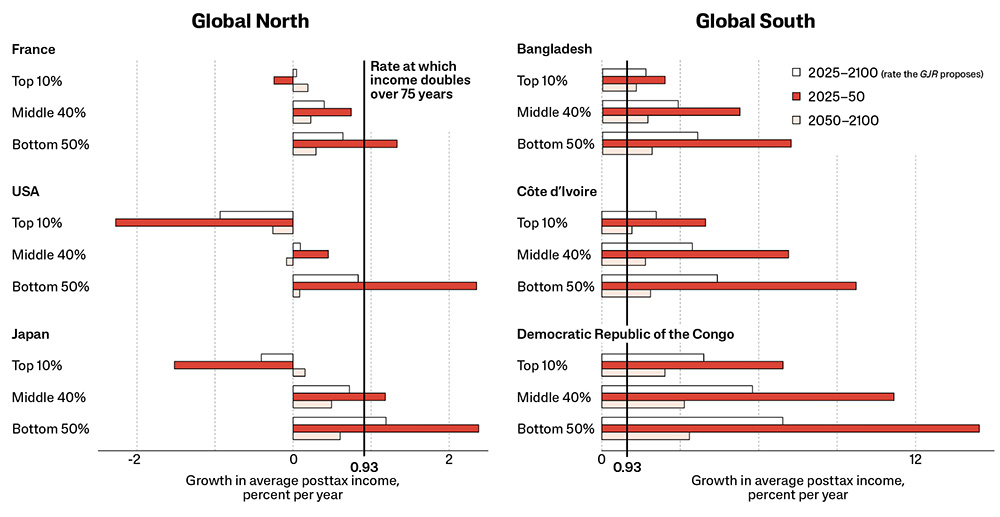
This objection does not rest on any chauvinistic preference for the welfare of Northern workers, although it should raise some alarm bells that a growing coterie of progressive thinkers now seem to think it’s acceptable to deny up to one-fifth of the world’s population most of the benefits of economic growth. It is instead a sober-minded exercise in strategic thinking. Regardless of one’s judgment on the moral worthiness of these workers, the inescapable reality is that securing their participation in a cross-country redistributive scheme is not at all optional. Due to Northern workers’ structural position within the most productive economies of the planet, in addition to their ability to exercise the political rights they have won through centuries of struggle, they and they alone hold the leverage to inflict the sort of penalties on Northern capital that would be necessary to inaugurate a fairer global dispensation.
Yet what the GJR proposes is that workers in the advanced capitalist world shoulder the Herculean task of reversing decades of tax cuts for the rich, only to hand over most of the resulting gains to a distant tax authority that has already determined in advance that they have had enough. If there is a central political lesson to be taken from the rise of the far right in the last decade, it is that the more a political fight is framed as — or resembles — a zero-sum game between workers, the more they will turn aside from universalistic appeals in favor of exclusionary ones. This response flows directly from the insecurity inherent to the proletarian condition. In this sense, the GJR represents an unintentional ideological gift to the nationalist right, even as it purports to endorse a class-based appeal in its concluding sections.
Of course, the report’s authors would regard all this as beside the point, since their selective embrace of degrowth is, according to their input-output model, the only path consistent with limiting warming to two degrees. Their actual tone, however, is considerably more caustic. In a revealing reply to a Financial Times columnist, they argue that the view that “current generations [in the North] should not be [held] responsible for their ancestors’ actions. . . . rests on shaky ground.” So much for that class-based appeal.
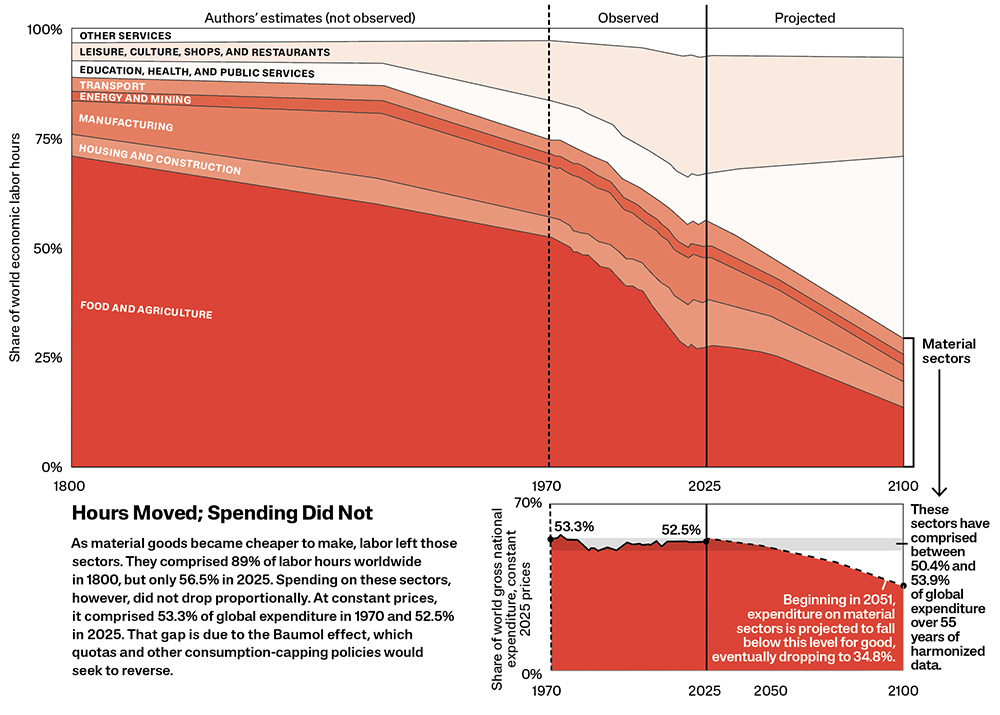
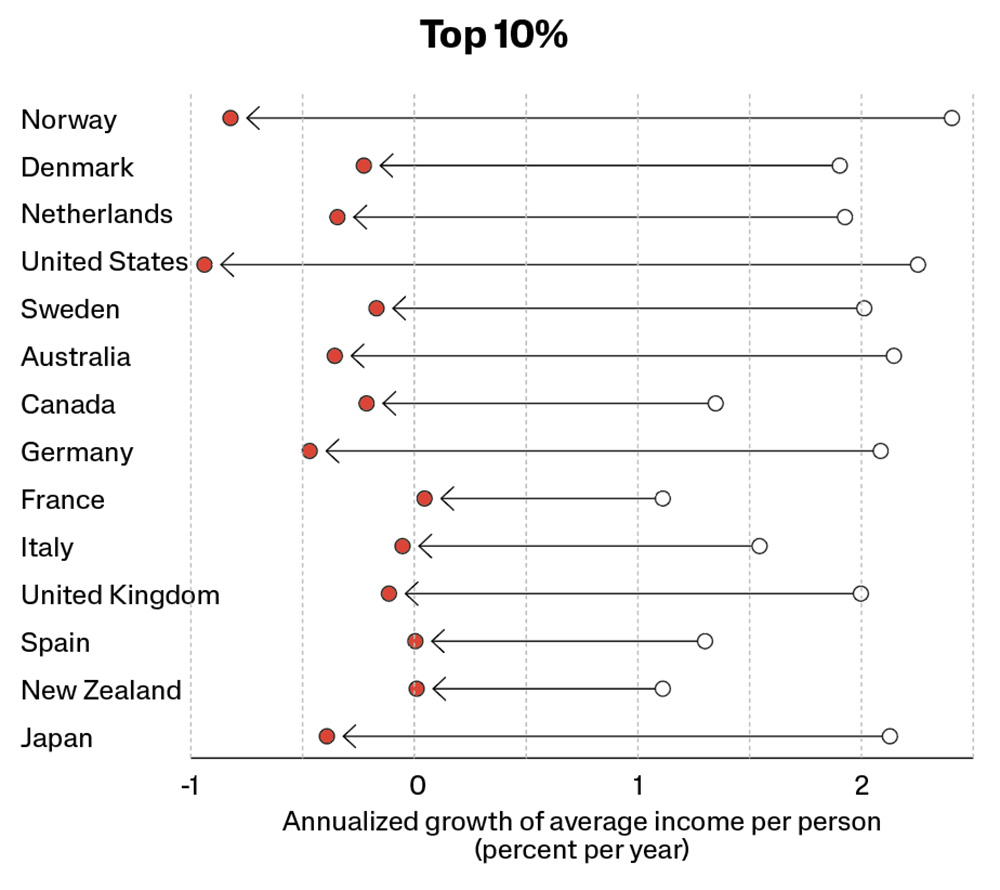
It may come as a surprise, then, that one searches in vain for any serious engagement in the report or its working papers with the burgeoning climate economics literature on the decoupling of growth from material throughput, including but by no means limited to greenhouse gas emissions. The report treats the decoupling phenomenon as settled science instead of a live debate, quickly disposing of it through selective citation of its most bad-faith critics. Ironically, it is precisely the environmentalist movement’s partial but genuine successes in the Global North that have already placed a growing number of countries on a decoupling trajectory for more than two decades, even after accounting for the material footprint of imports. While decoupling is not yet occurring at the pace required to avoid the worst of the climate crisis, a plausible alternative to degrowth has nonetheless been taking shape before our eyes. That fact makes the report’s insistence on an exceedingly pessimistic extrapolation of current trends all the more perplexing, including the use in its input-output model of assumptions seemingly lifted from the worst-case RCP8.5 scenario that was recently retired by the Intergovernmental Panel on Climate Change.
More could be said about the report’s proclivity toward excessive centralization. This is most visible in the unwieldy structure of the GJF, which in its governance comes uncomfortably close to the Right’s much-ballyhooed nightmare of a globalist technocracy — one that intrusively delimits how ordinary people far removed from its halls can shape their own future. Once again, the experience of the European Union, which has been roiled by one crisis of legitimacy after another, is instructive here. However, in the end, the GJR will almost certainly disappear without a trace into the capacious graveyard of well-intentioned policy briefs for one very simple reason: its inability to mobilize majoritarian political constituencies where it matters most.
This should not be cause for smarmy celebration but rather painful disappointment. Aside from their many invaluable contributions to the study of economic inequality, the intellectual trajectory of Piketty and the World Inequality Lab since the publication of Capital in the Twenty-First Century has been one of the most encouraging developments in contemporary academia. Starting off as relatively conventional social democratic researchers, their analysis came to resemble the socialist left’s class-struggle perspective, centered on the need to rebuild the working-class institutions with proven track records of wresting wealth, power, and influence away from elites. A quick comparison of the role of trade unions in the explanatory apparatus of Capital in the Twenty-First Century with that presented in Piketty’s 2019 follow-up, Capital and Ideology, makes this shift unmistakable.
Considering the vast amount of time and resources spent by the World Inequality Lab on putting together the GJR, however, it seems clear that much of that progress has been undone. More than a decade ago, Jacobin held a symposium on Piketty’s work that (fairly) accused him of putting forward policy platforms so devoid of a realistic assessment of the balance of class forces as to make him “a general without an army.” Sadly, the same charge is even more appropriate for this latest venture. ′
Read the full story at the source →
Source: Jacobin