
World · Jacobin · · 3h
The Uprising We Got vs. the One We Need
English (original) · Read in Deutsch ⇄
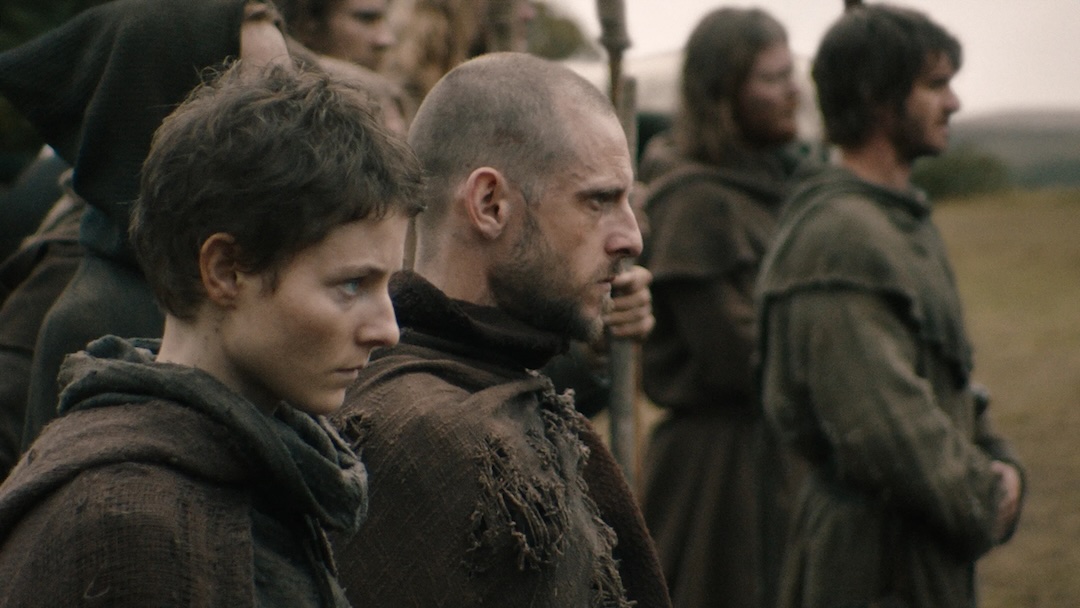
How do you make a boring film about a peasant revolt? Writer-director Paul Greengrass (The Bourne Supremacy, Captain Phillips, United 93) has found a way. His new film, The Uprising, is about the English Peasants’ Revolt of 1381, and it’s such a glum plod I should’ve forgotten it immediately after seeing it. But somehow it haunts me.
Maybe it’s the dismal blue-lit cinematography, so typical of our spiritless era. And on top of that, Greengrass’s tendency to favor in intense scenes his wobbling, uncertain handheld-camera work that has so little impact, you want to yell at the screen, “Pick a shot, man! You’re the director!”
But mostly, it’s the way the film disapproves of peasant revolts, which you might say is surely impossible. If there’s a peasant revolt, you side with the peasants, obviously — even old Hollywood flicks made by rank conservative movie moguls got that part right. But The Uprising earnestly insists on an “its complicated” stance toward the events of 1381. There’s all that distasteful violence and looting by enraged and starving peasants, for example. And the protagonist, a leader of the massive rebellion, tut-tuts and shakes his head and gets depressed over that in a way that says plainly, “The peasants are revolting in more ways than one.”
This view reflects Greengrass’s fundamental take on revolutionary history worldwide throughout recorded time. Once a documentary filmmaker who worked in apartheid South Africa and Northern Ireland, Greengrass maintains his very limited, Cambridge-educated-Brit notion of the breadth of historical events, saying smugly, “Revolutions always eat themselves.” In other words: Why bother? “They start off with people’s intense hopes and dreams, but once you pull authority down, the result is chaos.”
Greengrass follows the same logic of Christopher Nolan’s The Dark Knight Rises and many other contemptible movies about the folly of mass revolt, showing that suffering proles driven to the edge by a corrupt ruling class are sympathetic only up until the moment when they rebel and fight back. From then on, unless they repent, they’re the baddies — mindless, bloodthirsty, brutal mobs. They can only become fully sympathetic again in abject defeat — if then.
Ploughman, the Worst Superhero Ever
The film is not helped along by having our hero played by the stupefyingly dull Andrew Garfield. As the fictional farmer called simply “Ploughman,” he’s in perpetual mourning over his family that died in the Black Plague. Pushed to his limit by the royal taxes that are beggaring his community, Ploughman assaults the tax-collecting hirelings of King Richard II, thus kicking off the revolt.
Ploughman explains that his name refers to the fact that he and his work are regarded as one entity, but hearing it said over and over gets very distracting. What’s with that name anyway? Ploughman. Is he the worst superhero ever? Is his superpower growing potatoes?
I should add that Garfield is in no way believable as a fourteenth-century farmer. He has the soft-boy look of some random coffeehouse laptop jockey, yet we’re supposed to accept that he’s a formidable figure, lean and sinewy from a lifetime of hard labor. Wielding his favorite weapon, the sickle — don’t get your hopes up, communists! — he’s such a deadly fighter, he readily defeats the knights who are guarding the king, one after another, in an absolutely delusional action sequence that arrives late in the movie. Honor labor, Greengrass, by acknowledging that a farmer might be very handy with his sickle and still not be able to defeat, on his own, several highly trained knights whose lifelong calling is combat.
Unsurprisingly, this lame attempt at an action-oriented historical epic is bombing badly at the box office. It’s the second of two failed films in a row for Garfield after The Magic Faraway Tree, which is the real title of a real movie that opened a few weeks ago and was immediately consigned to oblivion by a disgusted public.
Making Ploughman the superhuman Everyman at the center of The Uprising pushes into secondary roles the more interesting historical figures who actually led the revolt, played by more exciting actors — Cosmo Jarvis as renegade soldier Wat Tyler and Jamie Bell as seditious priest John Ball. There was a certain poetry and logic to soldier and priest, sword and scripture, joining forces to lead the most massive peasant revolt in English history. But here, it gets thrown out of whack by shoving a sad-sack farmer into the foreground.
Greengrass wants to make sure that women get some screentime too, which is fair enough, so there’s a fictional character named Alyce (Thomasin McKenzie), an ex-nun who was raped by a priest and had her newborn child torn away from her, who’s now a head-shaven toughie ready to fight. And the worried mother of troubled boy king Richard II, Joan of Kent (Katherine Waterston), prays that he’ll find the strength to rule independent of his corrupt and self-serving counselors who include the archbishop of Canterbury, Simon Sudbury (Stephen Dillane), Sir Robert Hales, the grand prior of the Knights Hospitaller (Tom Hollander), and nobleman politician William Walworth (Jonny Lee Miller).
Woody Norman as fourteen-year-old Richard II, tormented by nightmares and conniving advisers and presentiments of doom, does a nice job of making the boy king both pitiable and disturbing. He appears to be a weak reed on which to build any confidence, yet the peasants still believe intensely in kings divinely ordained by God and are convinced he’ll cast off his evil counselors once the people petition him with their grievances. When the boy king finally does find the strength to lead, well — I probably don’t have to say “SPOILER ALERT!” when I tell you that this doesn’t go well for the peasants. Or for peasant leaders.
Robin Hood and His Morose Men
Just to give you one example of what ultimately happened — though it’s not handled this way in the film, which chickens out at every turn — the priest John Ball was executed by being hanged, drawn, and quartered. If you look it up, you’ll find that’s a gruesome multiple-step form of medieval capital punishment that certainly wasn’t the origin of the word “overkill,” but that term comes to mind nevertheless.
But that’s a bummer, right? So Paul Greengrass decided to find a way to tack a happier ending onto The Uprising. And this really is a SPOILER: Greengrass has Ploughman escape and then turn up again in an idiotic denouement when the heavily guarded royal coach bearing King Richard II and the Queen Mother is lumbering through the woods and gets surrounded by a bunch of masked figures all wearing dull green who drop down out of the trees.
“It’s Robin Hood and his Merry Men,” you think with a sinking sense of despair, and it is, only this bunch is anything but merry. It’s Robin Hood and his Morose Men, starring Ploughman as the beloved masked outlaw of Sherwood Forest, not in the least cheered up by finding this liberating form of ongoing rebellion and guerilla-style warfare. Ex-nun Alyce is now one of the low-spirited gang. Any hopes Greengrass might have cherished that The Uprising would kick off a rebooted Robin Hood series die a well-deserved death right here.
Where’s Errol Flynn when you need him? When somebody in The Adventures of Robin Hood (1938) says in shocked tones to Flynn’s Robin Hood, “You speak treason!” he answers with heartening élan, “Fluently.” So goddamn proud of himself and his fellow rebels, I mean. Those were the days. But here, we have the worst of both worlds: gritty “realism” and absurd Hollywood convention.
Here Ploughman/Robin Hood has a chance to kill Richard II, this little royal sumb-tch who betrayed Wat Tyler and John Ball and slaughtered thousands of trusting peasants who believed in him. But you can’t count on these dreary depressive half-hearted rebels who never really commit to their own revolution. Ploughman/Robin Hood merely drags the king out of his carriage into the dirt and says scornful words at him. He promises that, after this schoolyard-style humiliation, the boy king will be harassed by a fresh set of nightmares till the end of his days. Yeah, that’s real punishment. An already nightmare-plagued teenage king, safe in his castle, has more nightmares. That’ll show him.
How media-makers have embraced utter toothlessness even in fictionalized narratives of historical rebellions is sickening to contemplate. Movies like this are just one more way of reminding ourselves that for decades we’ve been macerating in weak equivocation and class-traitor spinelessness.
So there’s yet another promising cinematic premise gone down the chutes — with a bomb this size, nobody will be able to make another 1381 English Peasant Revolt movie for who knows how long. And I’d like to see a unsparingly realistic version of that film that includes some of John Ball’s famous incendiary speeches, such as the one with the mocking kick-ss line, “When Adam delved and Eve span, who then was the gentleman?”
Then it should show Ball’s hanged-drawn-and-quartered execution after Richard II reneges on every promise to his too-trusting subjects in order to get them to disband and then hunts down their rebel leaders.
Let’s look at this historical uprising squarely. It has, shall we say, enduring relevance.
Read the full story at the source
Source: Jacobin