
Politics · Jacobin · · 2h
The Rise of Germany’s Far Right Reflects a Systemic Crisis
English (original) · Read in Deutsch ⇄
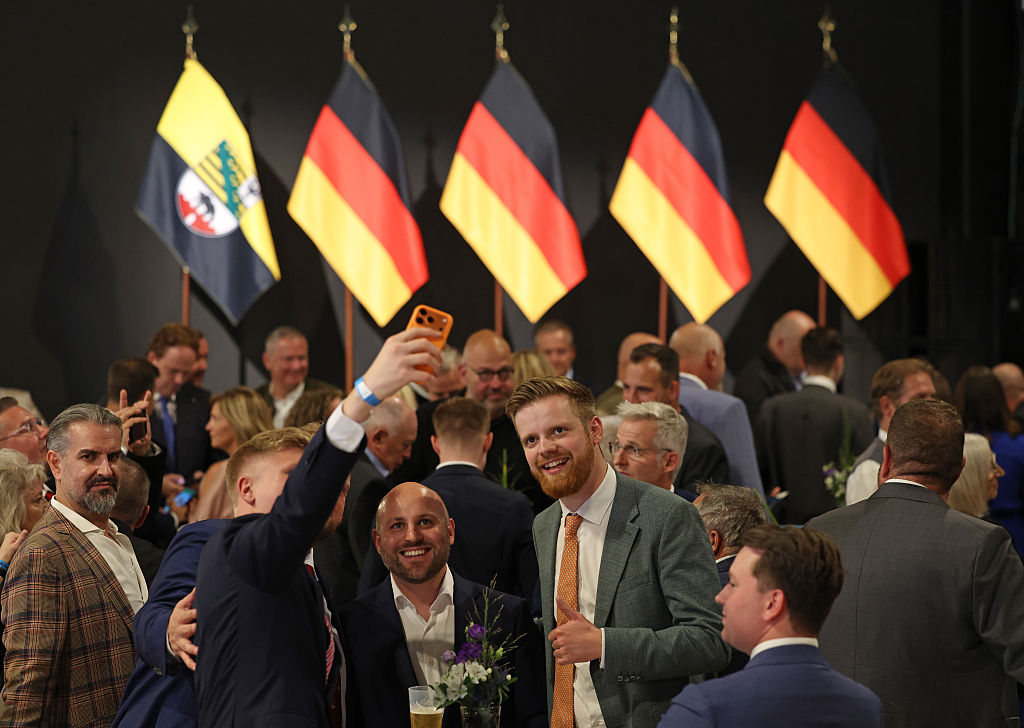
After the Alternative für Deutschland (AfD) scored 44 percent of the vote in the September 6 state election in Saxony-Anhalt, many analysts sought some single, clearly identifiable reason. The interest in the AfD’s success is well justified: what happens in Germany shapes Europe and even world politics, and most mainstream accounts seek tools with which the center can disarm the far right. In this vein, the AfD’s success is said to owe to a sluggish bureaucracy, the peculiar political culture of the former East Germany, or more simply to immigration.
Yet the reliance on a single explanatory factor yields single-variable strategies in response, and such strategies are bound to fail. The rise of the far right is a symptom of a systemic crisis that has merely become more visible in eastern Germany than elsewhere.
Institutions, National Character, and Subcultures
One rather unconvincing group of explanations focuses on the peculiarities of national institutions. In the German case, conservative commentators often bewail a slow and frustrating bureaucracy — and it is indeed notoriously sluggish. The morning after the Saxony-Anhalt election, one of Germany’s largest news portals blamed the “sprawling bureaucratic state” for the growth of political dissatisfaction, and prescribed trimming it as the remedy.
Yet such explanations share a typical flaw: they look for nationally specific factors, even though the phenomenon in question — the rise of the far right — is much more general. In each country concerned, some local particularity is blamed for such forces’ breakthroughs, whether that means the US electoral college, Britain’s first-past-the-post system, or France’s two-round presidential elections.
If the causes were such unique institutional quirks, it would be hard to explain the far right’s global presence. Yet by last year, radical-right parties together formed Europe’s most popular party family, with support above the levels reached in the 1930s. In summer polling, France’s Rassemblement National stood at around 35 percent, and Britain’s Reform UK at 26. Beyond the West, Narendra Modi has governed India since 2014, and Recep Tayyip Erdoğan has ruled Turkey since 2003; the former in a federal parliamentary system, the latter in a system he converted to a presidential structure. Neither institutional design has stood in their way.
Simplistic cultural readings — the various decodings of the national psyche — are not much more convincing either. In Germany, this is a genre known as “Ossi-bashing”: East Germans (“Ossis”) supposedly inherited an inferior, illiberal political culture. The thesis has several eastern European variants, all of which explain the rise of illiberalism in terms of a supposedly servile national character: the homo sovieticus, the serf mentality, or civilizational incompetence. Still, in more recent years the fall of illiberal governments in Poland and Hungary has turned these same countries into international laboratories of democratic resistance. So much for the dysfunctional national psyche.
As I shall explain, while eastern German particularities may explain the intensity of the AfD vote, they don’t explain the mechanism of change itself.
Backlash?
The cultural explanation also has a seemingly more scientific version, by now the most thoroughly refuted theory of populism, which nonetheless still organizes public debate: the cultural backlash of aging, uneducated men against unstoppable progress toward cosmopolitanism.
However, the basic facts contradict this theory. The AfD was founded in 2013 by highly educated neoliberal economists led by Bernd Lucke; in the office of Bernd Baumann, the parliamentary group’s chief whip, a portrait of Friedrich Hayek hangs on the wall. The party is popular among the young: in Saxony-Anhalt, 41 percent of first-time voters ages eighteen to twenty-four voted for it. It also won 59 percent of workers, but the density of craft and small industrial businesses best predicts its strongest districts. Its financiers are frustrated big entrepreneurs: in the 2025 campaign the AfD received the largest individual donations of any party, including €1.5 million from Winfried Stöcker, founder of the diagnostics company Euroimmun. Its largest known donor is Henning Conle, a real estate billionaire who lives in Zürich and London and owns a Liechtenstein holding company.
The AfD, and by extension much of today’s far right, is an exclusionary-nationalist rebranding of neoliberalism. Viktor Orbán’s Fidesz party, the US Republicans, and Reform UK have traveled the same path. The far right is the party of a double revolt, of national capital and a devalued middle class. For want of anything better, a large share of workers vote for it as the only alternative to the ruling elites, even though that alternative turns out to be fake most of the time.
Behind these explanations lies a common narrative: the far right is a passing disturbance in an otherwise functioning system. Chancellor Friedrich Merz, for instance, contritely “admitted” that the government does not communicate its measures well enough. If only someone could finally explain to those foolish voters how well the government is actually doing. In reality, the AfD has been growing for thirteen years, while trust in the political elite keeps falling: only 17 percent of Germans now believe the state can carry out its basic tasks. Across Western democracies, the share of people who think democracy is not important is rising. This is no longer a passing disturbance but a chronic, life-threatening illness of democracy.
Firewall, Copy, Govern
Misdiagnoses produce dead-end strategies. If the AfD’s rise just reflected a minoritarian subculture, then a “firewall” blocking its path might be enough to stop it. Those who imagine the AfD’s success owes to its particular policies may choose to copy them. Those who see a passing disturbance call for it to be allowed to govern, hoping it fails and ends up exposed. Yet all of these are illusory.
The firewall strengthens what it is meant to wall off through three mechanisms. First, it splits the political space in two: it suggests there are five legitimate democratic parties on one side and the AfD on the other. Second, the only common denominator among the five parties is defending the establishment, so the theme of change belongs to the far right. In Germany, this is a chronic condition: as early as 1980, Chancellor Helmut Schmidt told anyone with visions to see a doctor, and this has remained the philosophy of the German center ever since, a world of small technical steps and muddling through. Third, firewall coalitions are paralyzed from birth: given the ideological contradictions between parties like the socialist Die Linke and the conservative Christian Democrats, decisive governance is impossible. Against this dithering, the plainspoken drive of the far right impresses more and more people.
Co-opting the far right’s themes is another dead end. In January 2025, Friedrich Merz relied on AfD votes to pass a migration resolution in the Bundestag; at the federal election four weeks later, the AfD doubled its 2021 scores. The Danish Social Democrats invented the anti-immigration left in 2019 by adopting the far right’s migration program, yet in spring 2026 they collapsed to their worst result since 1903. The research shows the same thing: on the terrain of exclusionary nationalism, the far right is unbeatable, because voters prefer the original to the copy.
The center parties increasingly resign themselves to the third option: let them govern. The idea that right-wing populism succeeds in opposition and fails in government came from the entry of the Austrian Freedom Party (FPÖ) into government in 2000: it fell from 27 percent to 10 percent in 2002. Yet in 2024 it was stronger than ever, finishing first with 29 percent. After Viktor Orbán’s sixteen years in power in Hungary, it hardly needs explaining how dangerous the belief is that the far right either fails or mellows in office.
The misdiagnosis follows from how knowledge is produced. Populism research focuses ever finer methods on ever smaller variables, while the logic of clicks pushes the media toward moral panics and the personal dramas of celebrity and influencer politicians. Much of the think tank world in between the two specializes in greasing the revolving doors of power and avoids confronting elites. The systemic crisis is thus broken down into its components, even though the whole is more than the sum of its parts.
Exit From Stalemate
Politics is a stage, with ever more dramatic, personal, and kitschy spectacle. Yet ultimately, the fate of what’s going on in the party-political theater is decided by deeper processes. It is not particular institutions, subcultures, or groups that have fallen into crisis, but the postwar compromise that reconciled the market’s polarizing effect with democracy’s demand for equality.
Two twentieth-century thinkers worked out theoretical frameworks that integrate these questions into a single system. Both wrote about the rise of fascism, but their framework fits today’s illiberalism as well. Karl Polanyi saw fascism as an exit from a stalemate. Between the two world wars, the forces of market expansion and society’s self-defense paralyzed each other; the democratic market economy became ungovernable, and in the end the elites opted to back fascism. According to Antonio Gramsci, the crisis of authority in the liberal order sets in when an economic model is exhausted, along with the institutions that temporarily reconciled capital’s need for growth with the interests of working people. Gramsci’s infamous “morbid symptoms” emerging from such an impasse are again on full display, and not only in Germany. Contemporary political economists willing to look past the firewall know this well, from Wolfgang Streeck to Nancy Fraser, but their voice is conspicuously missing from the mainstream discussion of populism.
Behind the far right’s rise today also stands the exhaustion of an economic model. Fordism, the system of industrial mass production and mass consumption, rested on a class compromise (wages tied to productivity, a welfare state, strong trade unions), and this compromise sustained the liberal democratic institutions we now take for granted. What now looks like “the crisis of the German economy” is in fact the protracted crisis of this model. First, financialization and globalization shifted profits from production toward financial returns, and wages decoupled from productivity. The platform economy then intensified this, reshaping the public sphere and how economic and cultural value is distributed.
German real wages have stagnated since the early 1990s, and low-skilled wages have fallen. Full-time wages in the East were 17 percent below Western levels in 2024. As Isabella Weber highlighted, 89 percent of AfD voters in Saxony-Anhalt fear they will be unable to pay their bills; food prices have risen 34.7 percent since 2021, while wages have risen only 14.8 percent. Germany is not alone. The real income of the middle of Hungary’s income distribution regained its 1980s level only in the late 2010s, and the real value of the average American wage has roughly stagnated since the 1980s. Both countries saw far-right parties take power.
Wherever the industrial crisis is concentrated, the far right is consistently stronger. The crises of the eastern German states, northeastern Hungary, the American Midwest, or northern England are symptoms of one protracted crisis of the model. Yet in West Germany, too, the historic industrial powerhouse in the Ruhr region shows the same pattern: in Gelsenkirchen, held by the Social Democrats (SPD) without interruption since 1949, the AfD became the strongest party last year, and it records its highest results in the state’s old mining and steel towns.
An economic shock is never merely economic. Saxony-Anhalt has lost a quarter of its population since reunification, and of 2.9 million people, 1.8 million will remain by 2040; the post-socialist transition in eastern Europe brought more than seven million excess deaths, and the American rust belt gave us the concept of deaths of despair. Long-term population decline is one of the strongest predictors of the AfD vote, just as Donald Trump is overrepresented in the counties with above-average mortality. Those who stay feel, with some justification, that they have been consigned to the scrap heap of history.
Great economic transformations also intensify cultural tensions. Whoever loses their job also loses one of the foundations of their self-respect; along with industrial work, forms of knowledge, subcultures, and whole lifeworlds are devalued. In the competition for shrinking jobs and decaying public services, the immigrant is the easiest scapegoat: our own research shows that even perceived competition for health care increases hostility to immigration. In eastern Germany, too, anti-immigrant sentiment is a political product: the fewer the immigrants, the better it works. Across the “new federal states” in the former East Germany, the share of foreigners and the AfD vote are inversely related.
Those whose economic and cultural capital this transformation devalued cannot make their voices heard in politics either. East Germans hold 12 percent of national leadership positions, one seat on the boards of the forty companies listed on the DAX stock exchange, and none among army generals. Among AfD voters, 83 percent believe that East Germans are second-class citizens, and two-thirds of Christian-Democrat and SPD voters think so too.
Polanyi identified two systemic answers to the paralysis of democratic market economies. Besides the deadly embrace of fascism, the list also contained a second item, social democracy, which saved Scandinavia and the America of the New Deal from fascism. To the present systemic crisis, history has so far written only one answer, and Saxony-Anhalt shows what it looks like. As long as we read the crisis one variable at a time, nobody will offer the second answer.
Read the full story at the source
Source: Jacobin