
World · Jacobin · · 1h
The New Canada-EU Deal Is More of the Devil We Know
English (original) · Read in Deutsch ⇄
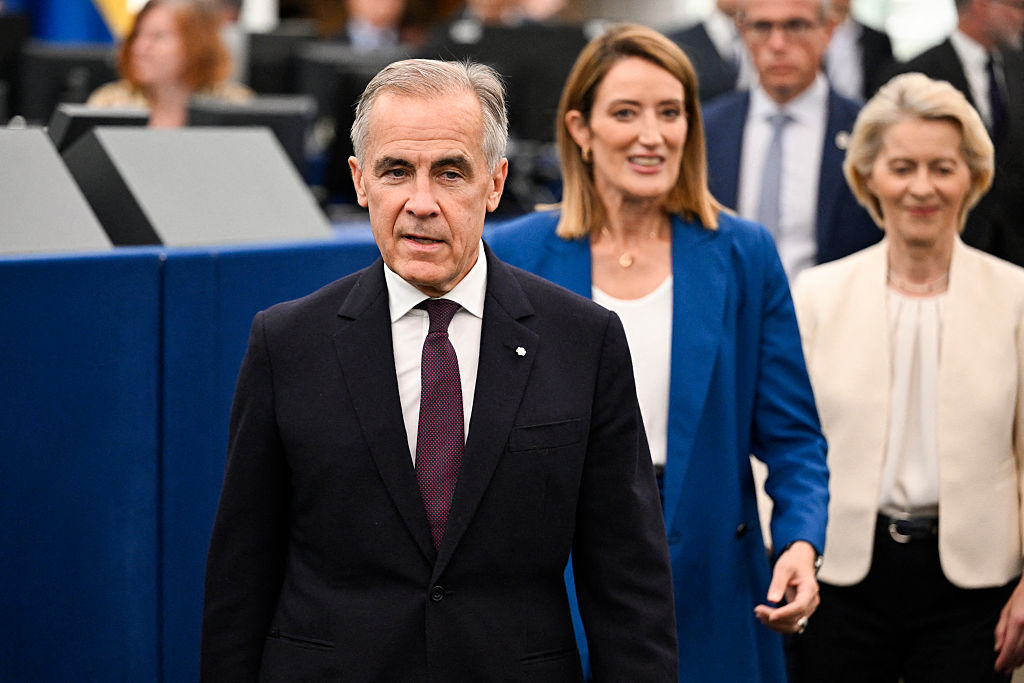
European Commission President Ursula von der Leyen wants Canada to become the first “associate member” of the European Union. For Canadian Prime Minister Mark Carney, it is a deal that he can present to his country as reducing its economic dependence on the United States. For the EU, it will help show, by building bridges with a like-minded democracy, that the bloc will remain a major player in a world order of declining American power.
Creating a category of associate membership presents its own set of challenges, given the notorious difficulty of reforming the EU.
However one slices it, the devil will be in the details. As things stand, there is good reason to believe the deal will mostly be about fossil fuels and the arms industry. If this is the case, it will merely cement the direction that Canada-EU relations were already headed in. Canada has become increasingly integrated into Europe’s defense industry since Carney took office. Canada will also be hosting a first-of-its-kind global defense bank that is primarily European-backed.
Not only does this contribute to the world’s rising tide of militarism, but as a strategy for job creation and economic development, it is weaker than nonmilitary alternatives.
As for the matter of fossil fuels, this past May, Canada secured its first liquefied natural gas (LNG) deal with Europe. This reflects Canada’s belief that it can be a major player in the LNG market. But LNG is no climate solution, even as a “bridging fuel,” and EU demand for natural gas is actually expected to decline. Why is EU demand for natural gas likely to decline? In part, the answer is obvious: climate change is producing milder winters. For Canada, this is a bad economic strategy.
Myopic Trade Strategy
The American war on Iran is making Canadian fossil fuels attractive for the short term, leading Canadian policymakers to believe the country needs to build extensive and expensive infrastructure — new pipelines and LNG terminals — over the next several years to capture that spike in demand. But by then, the world will have continued to transition away from fossil fuels, making these investments highly risky.
There are also the obvious omissions. The fight against climate change only gets a passing mention, with no detailed plan. Nor is there is talk of AI safety and regulation. Canada and the EU could be major players in nudging the rest of the world toward robust regulation on both fronts but appear to have abandoned the field. So far on the Canadian side, the responsible cabinet minister has offered the not-very-reassuring message that he is aware of the risks while continuing to embrace the technology. One has to wonder if this reflects, in part, a desire not to antagonize the Trump administration, which is very protective of the American tech industry.
Then there is the possible China-EU trade war. Should one materialize, Canada has little to gain from definitively tilting toward either side.
There are many reasons that Canada should be wary of moving closer to the EU. One clear example is the bloc’s drift to the right, as the recent state election in Saxony-Anhalt shows. A Marine Le Pen presidency in France is a very real possibility next year. While Canada’s immigration consensus has faltered, linking up with an EU struggling with Fortress Europe sentiment may further inflame the issue domestically.
Canada has other promising opportunities for pursuing inclusive development and rejecting militarism elsewhere in the world.
For example, South Africa’s high commissioner to Canada recently gave an interview in which he noted that Canada risks falling behind because it has not pursued closer trade and other partnerships with African countries, especially now that the African Continental Free Trade Area is in effect. Obviously Africa does not offer the immediate trade potential that the EU does, but sub-Saharan Africa’s demographics are favorable for economic growth, creating real long-term opportunities for mutually beneficial trade.
Solar, Not Arms
Canada has increased its ties to Mexico in the face of Donald Trump’s trade threats, but the relationship could be even closer. And given that Trump’s National Defense Strategy calls for American dominance of the western hemisphere, Canada should be coordinating much more closely with Latin America and the Caribbean. Trump’s plans threaten the entire hemisphere, but Carney’s response to this is to try to jump over the ocean to the other one. It is a dereliction of duty to neighbors on Canada’s side of the globe.
The demand for critical minerals also offers Canada a new way to conduct foreign policy. As a major producer, Canada should work with other major exporters — such as Brazil, Indonesia, and South Africa — to push for trade deals that allow countries that mine critical minerals to process them domestically as well. This would align Canada with labor demands abroad and at home for mineral-producing countries to capture more value through domestic processing and manufacturing. It could also develop research networks to promote more sustainable and carbon-friendly mining practices that respect the local communities affected by mining. This would be an actual alliance of middle powers that Carney argued for in his famous Davos speech — one that, so far, he has not followed through on.
The most constructive thing Canada and the EU could do together — something that would benefit their own societies as well as the rest of the planet — would be to commit tens of billions of dollars to solar deployment. By installing panels at home while financing solar infrastructure and training in lower-income nations, they could make a meaningful contribution to reducing emissions. But North Atlantic elites lack the political will to treat clean energy as a global public good rather than another arena of geopolitical competition.
Ultimately, this Canada-EU deal is an example of what both parties have come to do best in recent years — promise something big and underdeliver. It does not do enough to address the biggest threats facing our planet and may in fact exacerbate them by mistaking militarism for a sustainable and just model of development.
The catch to all this is that polling in Canada suggests that aligning closer to Europe is very popular. It is up to the Left to offer alternatives that expand Canada’s opportunities without falling into narrow nationalism.
Read the full story at the source
Source: Jacobin