
World · Jacobin · · 1h
The Last Revolutionary Filmmaker
English (original) · Read in Deutsch ⇄
When the French-Swiss film director Jean-Luc Godard died in 2022 at the age of ninety-one, obituaries celebrated both his boundless cinematic inventiveness and the radical politics that shaped his work. To some, his death marked the end of an era of politically committed filmmaking. But in Japan, another artist as equally radical is still, at age eighty-seven, hard at work.
In the last four years alone, Masao Adachi has released two movies, both dealing with political militants — including Shinzo Abe’s assassin — and has also worked with other artists, like French filmmakers Éric Baudelaire and Philippe Grandrieux in the early 2010s. His most recent collaboration is with Palestinian filmmaker Kamal Aljafari, whose new short film, Masao Adachi Takes a Passport Photo — chronicling Adachi’s latest attempt to apply for a passport — screened at the Toronto International Film Festival and will play at the New York Film Festival this autumn.
As Adachi told the The New York Times in 2012, he is pleased that these new endeavors do more than just burnish his reputation as an elder statesman of the Japanese New Wave. “Through this way,” he said, “I’ll continue to revolt.”
In his 1970 manifesto “What Is to Be Done?” Godard argued for the need not to make political films but to make films politically, since the former is idealistic and bourgeois, while the latter is militant and “belongs to the Marxist and dialectical conception of the world.” In 1971, Adachi responded to Godard’s text with his own tract that asserted undō (movement, activism) over seiji (politics), arguing that drawing binary distinctions between political films and political filmmaking was counterproductive when a collaborative and dynamic undō-centered modality of cine-politics could encapsulate both concepts and more.
It has long been a cliché to discuss Adachi’s work as standing at the intersection of politics and art, but what is particularly compelling in this regard is how the trajectory of his own life has embodied this intersection. In the 1970s, Adachi became directly involved in the Palestinian struggle and eventually relocated to the Middle East, where he was active as a member of the Japanese Red Army, a group that carried out hijackings and embassy attacks and claimed responsibility for the 1972 attack on Lod Airport in Israel that left nearly a hundred people dead or injured. Adachi, though, has always maintained that he was never involved in any attack on civilians. The Japanese Red Army leader, Fusako Shigenobu, who was released in 2022 after more than twenty years behind bars in Japan, became a close friend during his time with the group.
This undeniable association with the Japanese Red Army has made Adachi a favorite of certain online radicals: the director who put down his camera and reached for the gun. This is not quite true; Adachi’s primary motivation for relocating was to continue his revolutionary filmmaking, but he soon found himself unable to return to Japan without risk of arrest. After living in Lebanon for more than two decades, he was picked up by authorities for passport violations in 1997, jailed for three years, and then extradited back to his homeland, where he is now effectively barred from leaving. Today there is a stark disparity between Adachi’s repute abroad as a legendary provocateur who made politically engaged sexploitation, experimental underground films, and conceptually bold propaganda, and his status in Japan as a rather obscure and neglected filmmaker and former member of a terrorist organization.
Over the course of writing a biography of Adachi, Pink Auteur, Red Outlaw, I found that to better understand his contribution to cinema and revolutionary politics, we need to contextualize his work within postwar Japan and what is known as the country’s “Long ’60s.”
Japan’s Wild, Radical, and Terrifying 1960s
Multilingual scholarship in the past twenty years has dislodged the stereotype of Japan as an inherently conservative and peaceful society without any protest culture. But the legacy of the Long ’60s remains bitterly contested due to the violence — directed not only at the state but inward, at rival New Left factions. For most of the Japanese public at large, the period tends to exist as a blur of helmeted students clashing with riot police for causes vaguely related to the Vietnam War.
But the famous unrest of the late 1960s had a precedent. A decade earlier, Japan passed through a comparable period of political and social turbulence over the American military bases on its soil and the security treaty that bound the country firmly to the Western bloc. Adachi belongs to the generation that came of age around the renewal of the treaty in 1960 and that remained haunted by its failure to stop it — a failure that made them appear, to the young activists at the end of the decade, outdated and politically compromised. This goes some way toward explaining Adachi’s detached, often satirical portrayal of student radicals during his peak years from around 1967 to 1972. In the films he directed or wrote for Wakamatsu Kōji in this period, such as Schoolgirl Guerrillas (1969) and Ecstasy of the Angels (1972), the leftists are no better than the authority figures they oppose and tend to collapse into glorified LARPing or, worse still, self-destructive violence.
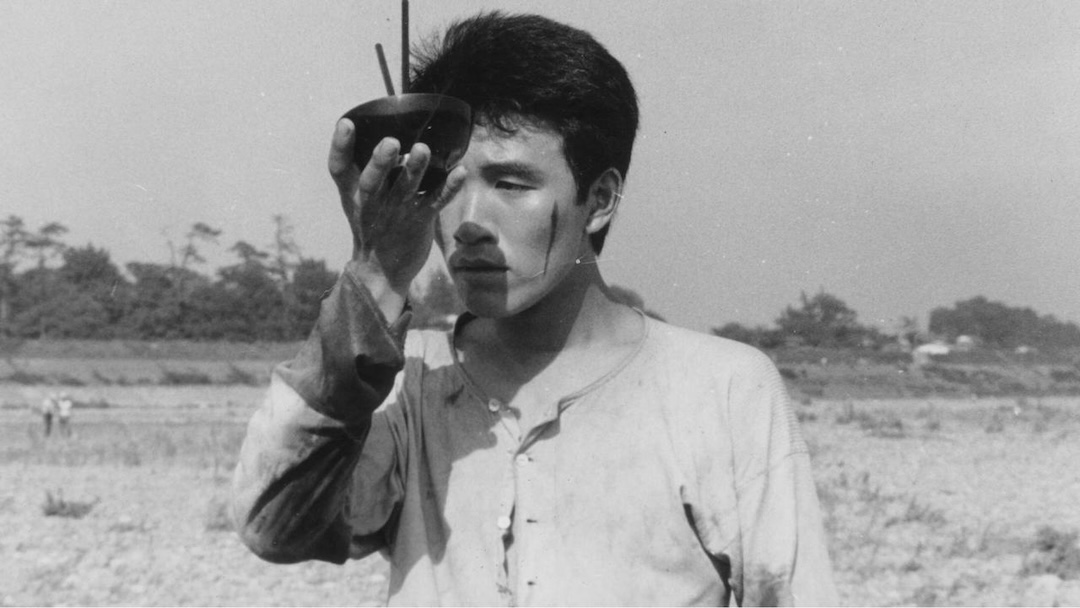
Alongside this societal strife, postwar Japanese culture witnessed an explosion in the avant-garde that redefined attitudes toward the body and artistic mediums. Visual artists like Kazuo Shiraga turned painting into a physical record that captured the traces of the practitioner’s body, and dance styles like butoh fractured the aesthetic of the body into something grotesque and fragile. There was a shift to more allegorical modalities of political art, to which aspects of Adachi’s output also adhere, such as his early films Bowl (1961) and Closed Vagina (1963), which express the disillusionment of the 1960 security treaty protests through oblique metaphors like the titular female genitalia instead of more didactic messages. One of the many reasons a film like Galaxy (1967) is so engrossing and rewarding to rewatch is that you can read it as both an allegory of mid-’60s disenchantment and a surreal psychodrama about a bourgeois man’s mental breakdown.
Far Weirder Than Just Agitprop
Adachi’s more allegorical and ambiguous films may reward a closer look in ways the better-known ones — those in which the oppositional politics of the day are writ large — do not. Compared both to the militant documentaries of Shinsuke Ogawa, which chronicled the struggle of farmers opposed to the construction of Narita Airport in the 1960s and ’70s, and to the overtly political (and almost instructive) films of Jean-Luc Godard from around 1968 to 1976, much of Adachi’s work is far more opaque, even abstruse at times, despite the agitprop reputation of his output.
Nominally a film about a notorious spree killer, A.K.A. Serial Killer is a highly conceptual exploration of state power residually haunting the postwar landscape of Japan, rendered through hypnotic visuals. Completed in 1969 but not shown publicly until 1975, it focuses on the everyday urban and rural spaces that shaped the perpetrator of sensational crimes and is regarded as a seminal work in landscape theory (fūkeiron). The Red Army/PFLP: Declaration of World War (1971), codirected with Wakamatsu, was filmed while Adachi was embedded among Palestinian guerrillas and was initially dismissed as merely recruitment propaganda for impressionable Japanese leftists, yet it is actually a pensive meditation on the nature of living on a daily basis as part of a revolutionary struggle, engaging in a dialectical inquiry with the viewer by posing questions and positions.
Like. A.K.A. Serial Killer, Adachi’s recent films Revolution+1 (2022) and Escape (2025) have dealt with sensational figures — former Prime Minister Shinzo Abe’s assassin and the fugitive bomber Satoshi Kirishima, a marginal member of a group that carried out a series of bombings of corporations in the 1970s — albeit in a somewhat more conventional biopic style. Upon release, they prompted febrile responses in Japan (especially the Abe film), but the headlines overshadowed the fact these films were avowedly not celebrating their subjects. Neither condemning nor condoning, Revolution+1 portrays how Abe’s assassin was pulled almost inevitably toward his act by domestic and socioeconomic circumstances, while Escape focuses on the mental strain of living an ascetic life on the lam as a way of both atoning and continuing the struggle. In these times of endless culture wars and social divisions, such approaches to political art (and violence) are arguably more fertile than the didactic or provocative.
An Artist’s Late Style
Adachi has expressed admiration for Franz Kafka and Lu Xun, drawing on their writing for his film Artist of Fasting (2016), a typically bawdy tale of a man who arbitrarily takes up residence one day in a quiet neighborhood and becomes a spectacle attracting a broad range of people in society, all looking to exploit him for their agendas. Static, disjointed, and packed with literary references, the film seems very distant from Adachi’s 1960s and ’70s output’s cast of student activists and wannabe revolutionaries and its more frenetic pacing. And yet Artist of Fasting ultimately suggests a through line between both periods by functioning as an ironic portrait of an individual’s attempts to resist power.
While the overtly politicized filmographies of others may date, Adachi’s oeuvre has the potential to outlive his and our lifetimes and offer lessons for future viewers. “Creating is, above of all, firstly about hoping,” Adachi wrote in 1970. Though his work lacks the formal elegance and stylistic consistency of Japanese filmmakers like Nagisa Ōshima (Merry Christmas, Mr. Lawrence and In the Realm of the Senses) and Yoshishige Yoshida (Eros + Massacre), it is precisely this anarchic range and rejection of cinematic convention that gives his cinema the capacity to retain political currency. And this should indeed give us hope.
Read the full story at the source
Source: Jacobin