
World · Jacobin · · 57m
The Jewish Socialists Who Fought the Tsar and Zionism
English (original) · Read in Deutsch ⇄
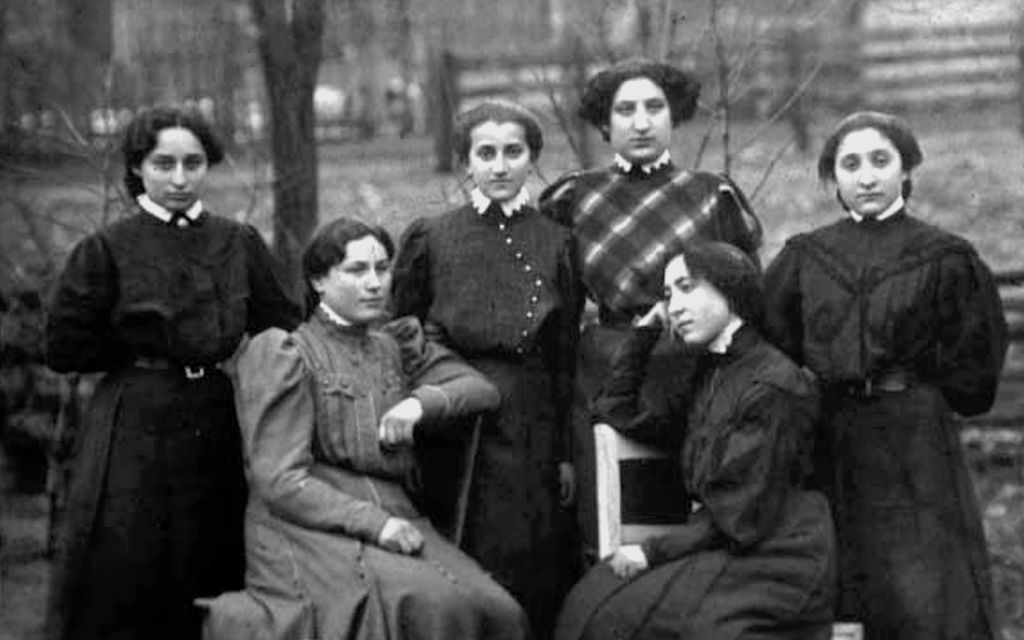
Jewish socialist intellectuals founded the Bund in the Russian Empire in 1897, and it soon became a mass organization of the Jewish working class — a working class confined by law to the Pale of Settlement. From its inception, the Bund and the socialist politics it represented struggled against capitalists and autocrats alongside non-Jewish socialist comrades. It also competed bitterly with its Jewish rivals: Orthodox traditionalists, Zionists, and Bolsheviks.
Amid repression and revolution, the story of the Jews of the western Russian Empire diverges. Huge numbers emigrated to the Americas, and more than anywhere to New York City, where they built a Yiddish-speaking socialist world whose inheritors are in many ways today’s anti-Zionist socialist Jews.
Most of the many Bundists who remained in Europe were annihilated in the Holocaust, murdered on an industrial scale while the United States and other Western countries shut the door to refugees. Bundists remained steadfastly opposed to Zionism to the end. But many Jewish Holocaust survivors, their lives and life worlds shattered, emigrated to Palestine under the auspices of British colonialism to become settlers, and then perpetrators of the Nakba.
For Jacobin Radio’s podcast The Dig, host Daniel Denvir sat down with Molly Crabapple to discuss her recent New York Times bestseller Here Where We Live Is Our Country: The Story of the Jewish Bund and a half-century-long sequence of revolution and reaction that carries lessons for all of us today. You can listen to the first part of this two-part interview here and the second part here.
Daniel Denvir
Before we get to the Bund, let’s begin by discussing the movement’s territory, its homeland: the Pale of Settlement, the territories of the Russian Empire in Poland and thereabouts to which Jewish residence was confined. What was the Pale? How did it come about with the 1772 Prussian, Russian, and Austrian dismemberment and annexation of the Polish-Lithuanian Commonwealth? And what was that world like — the world from which the Bund would emerge at the end of the nineteenth century?
Molly Crabapple
The Pale of Settlement refers to the swath of western provinces in the Russian Empire to which the vast majority of the empire’s Jews were legally confined.
It came about after the partition of the Polish-Lithuanian Commonwealth when Russia, Prussia, and the Habsburg Empire sliced Poland up and each gave themselves chunks of land. Poland, or the Polish-Lithuanian Commonwealth at this time, was home to a massive Jewish population that had come there after Jews were expelled from Germany during the Crusades, after Jews were expelled and kicked out from this duchy and that duchy all over Europe.
They were invited by King Casimir III the Great to settle in Poland, where they played a very typical middleman role, working as tavern owners, small tradesmen, and tax collectors for the estates of Polish lords, and where Jews constructed these small towns called shtetls.
The Russian Empire was an autocracy. It was also an empire that drew a lot of its legitimacy from the powerful Russian Orthodox Church. And as soon as it acquired these territories and their massive Jewish population, it worried, “What are we going to do about these people? What are we going to do about these non-Christian people, people who are working in trades, who might compete with our tradesmen, who have these quasi-self-sustaining communities?”
The tsarist empire developed entire bodies of laws to restrain the new Jewish subjects that they had acquired. The most important one was defining these western provinces as the zone that Jews were allowed to live in.
This didn’t refer to all Jews in the tsarist empire, because there were other, Bukharan Jews in Uzbekistan. There were Jewish communities in Georgia that were called the Mountain Jews. This really was about Eastern European Jews, who were millions of people. So the empire defines this swath of territories that goes from Dvinsk — Daugavpils now — in the north to Odessa in the south. Like, this is where you are stuck.
It makes further restrictions: Jews can’t live in the countryside; they have to live in towns. It makes restrictions on what sorts of jobs they could do. Later there are restrictions on how many Jews could go to gymnasiums, gymnasiums being the Russian Empire version of high schools, and also how many Jews could go to university.
They at one point have a term of military conscription for Jews that is twenty-five years long and starts at age twelve — as opposed to five years long and starting at roughly age eighteen for Christian subjects. The explicit reason for this huge term of military service was to force Jews to convert.
These Jewish communities, these shtetls, were also places that had their own internal hierarchies, and one of the internal means of self-organization was called the kehillah. This was a council of rabbis and pious notables that would adjudicate communal matters while also dealing with the Russian authorities. So it was the kehillah, for instance, that would come up with the quota of young Jewish boys that were going to do military service. It was also the kehillah that, if [the community] heard rumors of a pogrom, would try to raise money for a fat bribe to keep that pogrom from happening.
In these Jewish communities, most Jewish people were quite poor. They worked as small tradesmen or in cottage industries. Working in home-tailoring sweatshops was pretty typical. Brush-making, leather tanning — that was what my great-grandfather did.
Also, there were market days in these towns where peasants would come from the surrounding countryside to sell their crops and then to buy finished goods from Jews and to get really drunk at Jewish-owned taverns. These market days were often an occasion both for relationships and for problems. Because whenever people are arguing about money, that always makes a moment for other sorts of more passionate disputes to break out.
These Jewish communities were also extremely religious. There wasn’t necessarily the idea of a secular identity in the Russian Empire in 1850. A Jewish woman like my great-great-grandmother, Chaya Rochel, could be expected to marry at age fourteen to devote her life to running a kosher Jewish house, having children, and also working. Because the ideal version of Jewish life was one where men would get to study the Torah and Talmud and women like my great-great-grandmother would run a small flour mill and support them. It was almost like a patriarchal grad school.
They were also places that were not cut off from the larger non-Jewish world. Volkovysk, the small town where my great-grandfather was from, was about half-Christian, a quarter Polish, a quarter Belarusian; it had some Muslims in it. These were tight-knit Jewish communities, but it was not something where they never dealt with non-Jewish people.
They were also communities where education was really valued. Boys typically would be expected to be literate, which would not be the case for a poor Russian or Polish boy. The traditional means of education was something called a cheder, which is a religious school where you learn to read Hebrew and then you study the Torah, the Talmud, and the Gemara, and a lot of it was done through rote memorization. Your teacher would beat your ass if you weren’t paying attention.
It was a traditional life that was confined both by the larger Russian government and your own communal authorities.
Two Sources of Hatred
Daniel Denvir
What was the structure of antisemitism in the Russian Empire? What were its origins? What was its logic and function within both the tsarist political order and within Polish and Russian society?
Molly Crabapple
There were two sources for the antisemitism at play in the tsarist empire. The first one is just the classical Christian thing that Jews killed Jesus, and then they didn’t even have the decency to believe in him afterward. That’s old-school stuff that we’re familiar with from Catholicism, and it was no less important in Eastern Orthodoxy.
Another thing is that in the Polish-Lithuanian Commonwealth, Jews — not all Jews, but a lot of Jews — were middlemen. The Polish lord would own the land, but he might employ a Jewish supervisor to go and collect taxes from the peasants who worked that land, who might be Ukrainian, for instance. The Khmelnytsky Uprising in the seventeenth century, an uprising completely foundational to Ukrainian national identity, was also the mass slaughter not just of Polish lords but of Jewish tax collectors, tavern owners, and Jewish people writ large.
The Khmelnytsky Uprising is one of the great mass murders of Jewish history, but it was framed very much in the way that Jews were collaborators of the Poles, which then fed into all of the classic antisemitic stuff about being blood-sucking middlemen. The truth was that the power did not actually lie with these Jewish middlemen. The power lay with the Polish lords.
It was similar with the role of Jews as tavern owners. As an example, in the old-school Polish-Lithuanian Commonwealth, and later to some extent in the Russian Empire, the lords would have the exclusive right to make alcohol on their land, and they would be the ones who profited from it. But they would not be the ones who were cleaning bars and filling glasses at a tavern. A lord doesn’t do that; they get someone else to do that. So, in the Polish-Lithuanian Commonwealth, Jews traditionally worked as tavern owners. But the monopoly and the real profit from liquor was something that the Polish lords had and derived.
This led to anger, in the same way that — it was very classic when I was growing up in the 1980s and ’90s — there were a lot of conflicts between immigrants who ran small convenience stores and poor people in the neighborhoods who would buy from these stores, even though the immigrants were also dirt poor themselves.
This is just a classic way that capitalism, but also early modern, late feudalism, draws divides between people and pits the working class against what you could call a petty bourgeoisie that is also quite impoverished itself. Jews in particular served a really important scapegoat function, because the anger of the peasantry could be diverted onto the Jewish tax collector or the Jewish tavern owner and away from the Polish lord, who was actually the person deriving all of the profits — or away from the Russian lord, for that matter.
The Study Circles Created Hipsters
Daniel Denvir
How did the Bund emerge when and where it did out of the various radical currents you trace circulating across Russia and across Europe during this era? More specifically, how did it emerge from within the society of the Pale — a Jewish community where the maskilim, followers of the Jewish Enlightenment, or Haskalah, were contesting traditionalist Orthodox shtetl Jews for influence and power?
Molly Crabapple
Russia is a hereditary autocracy, and it’s also a country that is shaped by the institution of serfdom, which is not the same as chattel slavery, but it’s certainly a cousin to it. It’s the idea that there are groups of people called serfs who are bound to the land, and when you buy land, you buy the people, and they work on that land, and they do not have the right to leave it and start new lives elsewhere.
They are your workers, whom you more or less own. Serfdom is abolished by Tsar Alexander II in 1861, which is around the time slavery is abolished in the United States. For this, Alexander II is heralded throughout the country as the Tsar Liberator, the Great Reformer.
At the same time as he is ending serfdom — which, by the way, he’s quite inadequate here: serfs literally have to toil to pay the price of their freedom. But nonetheless, he does end serfdom. At the same time as he’s doing that, he is also easing the restrictions against Russian Jews.
By this time, there are a bloc of middle- and upper-class Russian Jews who are followers of a movement called the Haskalah, or the Jewish Enlightenment, which is a movement to put Jews in the same sort of European modernity as their fellow Frenchmen or Germans might have been. It’s the idea that you could be both a modern citizen of your country and a believing Jew. There’s a line by a famous maskil that says, “Be a Jew at home and a man on the street.” Which I always thought, when I heard it — are Jews not men? It makes a dichotomy of being a Jew and being a human.
Anyway, there’s this idea that you can assimilate in a lot of ways into your society while still being a proud Jew, and this is something that you see with Moses Mendelssohn and Rahel Varnhagen in Germany. This idea that you learn to speak your beautiful French or German, shave your face, wear your suit, stop speaking Yiddish, get a respectable job. Don’t be some grubby pushcart trader like your grandfather, and prove that you’re civilized enough to deserve civil rights.
In Tsar Alexander II, Russia’s maskilim really think that they’ve found their champion, that this is going to be the guy who will remove the boot from their face and will let them transcend the confinement of the Pale of Settlement and become equal Russian, Alexander Pushkin–quoting citizens.
But at the same time, the inadequacy of Tsar Alexander II’s reforms is starting to breed massive frustrations, and new radical youth movements are emerging. The most famous of them to history is the Narodniks, a group of agrarian populist socialists who believed that the answers to creating utopia were to be found in an indigenously socialist Russian peasant society.
They’re complete romantics about the Russian peasantry, and by the late 1870s, they do a movement where they decide that they will go to the countryside and try to preach to the Russian peasantry about why they need to do a big-ass revolution and overthrow the tsar. This goes about as well as you might imagine, and the Russian peasantry immediately turns them into the police.
The disappointment of the failure of going to the countryside will lead these young Narodniks in more radical directions. These become the first people I know of in history who refer to themselves, and not just their enemies, as terrorists. In 1881, a group of Narodnik-inspired young people who call themselves the People’s Will assassinate Tsar Alexander II with a series of bombs. One of these young people, the young woman who runs the safe house for these assassins, is a Jewish seamstress from Kyiv named Hesya Helfman.
The assassination of a tsar is a massive shock to Russia. Tsar Alexander III, the ultraconservative heir to the assassinated Tsar Liberator, Alexander II, will draw several lessons from his father’s murder, and those are: crush dissent without mercy; never do reforms — they make you seem weak; and do not trust the Jews.
In May 1882, he brings back all of the old antisemitic laws that his dad has overturned. Not just the pogroms but also the futurelessness imposed by these laws will set off the first great wave of mass Jewish migration out of the tsarist empire. By the time that World War I starts, one-third of all the Jews in the tsarist empire have left, and the majority of them have come to New York City.
The Bund did not emerge from a peasant populist milieu. They emerged from a different tendency, and that was the tendency of Russian Marxism. The young people who would create the Bund were deeply shaped by the ideas of Karl Marx, of Karl Kautsky, and by the first Russian Marxist, Georgy Plekhanov, who had been presiding over courts of worshipful students in his Swiss exile, and many of these students had been smuggling pamphlets back across the border.
The type of young Jews who created the Bund were middle-class kids. They spoke Russian rather than Yiddish, which was the language of working-class Jews. They first came to revolutionary organizing with all of the arrogance and cluelessness that we know so well from a Party for Socialism and Liberation (PSL) chapter trying to set up a book club in Brooklyn.
The theory of how revolutionary organizing was supposed to work in Russia, and the theory that these young Jewish Marxists subscribed to, was that Russian workers were incredibly stupid. They were uneducated. They were backward. There was no way that these dumbasses could possibly make a revolution.
So, what you needed to do is you need to set up study circles, and these study circles would educate workers — make them conscious, in the revolutionary parlance of the day — and then these conscious, educated workers would recruit more workers for your study circles, and then they would recruit more workers, and eventually, when you had enough workers who had attended your study circles, revolution.
It reminds me of the underwear gnomes in South Park. Step one, collect underwear. Step two, . . . Step three, profit. They were like: Step one, study circle. Step two, . . . Step three, revolution.
This crew of young Jewish Marxists called the Vilna Group — people like Pati Kremer, Arkady Kremer, John Mill, Luba Levinson — they get their start by holding study circles for workers. These study circles have an additional aspect in that, because Jewish workers spoke Yiddish, not Russian, the study circles also focused on teaching these Jewish workers to be able to read and write and speak Russian, because Russian was the language that you needed if you were going to read theoretical Marxist texts.
This seems like it would be a massively unpopular idea, but because the culture of these working-class Jewish communities in the Pale of Settlement was a culture that so worshipped books and so worshiped education, and because education was something that Jews were highly restricted from — especially, God forbid, if you were poor, if you were working class, if you were a woman — these study circles became massively popular.
For years, Pati Kremer and Arkady Kremer were just instructing groups of young Jews about Charles Darwin and Marx and life in China. But after a half-decade of these study circles, they realized that they were no closer to revolution than before, that the workers they instructed were not organizing a proletariat to overthrow the tsar.
Instead, they were carrying around large books that they could half-read to seem impressive. They were posturing like very fancy intellectuals, and they were trying to take their college-entrance exams so that they could be intellectuals just like these young Marxist teachers of theirs. Basically, the study circles were meant to create revolutionaries; instead, they created hipsters.
The young Marxists decided that they would have to try a different tactic. Now, this may be shocking, but it turns out that workers do not need Marxists to tell them that their wages are too low and that their hours are too long. It turns out workers can figure that shit out for themselves.
At the same time as Arkady and Paddy are creating their coterie of nerds in a variety of attics around Vilna, there are the rudiments of a trade union movement being established by Jewish workers, including young Jewish women. These workers are organizing mutual aid funds where they will pool their meager earnings so that they can have enough money to sustain them through a strike. They’re organizing strikes. They are organizing detachments of burly guys to defend their picket lines.
So the real breakthrough of our young Jewish Marxist heroes is that they turn their eyes away from the study circle and toward the actual working class. They think, “Maybe what we need to do, instead of telling the working class how to be smart, is learn from them, and maybe we need to use our skills to help them do what they want. Maybe we need to use the fact that we’re literate, the fact that we can read the meager corpuses of employment law, the fact that we know people in other cities, other countries. . . . We can print pamphlets. We have all of these skills. Why don’t we use that to help workers organize themselves?”
This move from huffing theory to doing practice is the breakthrough that will make the Vilna group explode and will set the stage for them becoming the Bund.
Oppressed as a Race and as a Class
Daniel Denvir
Nineteenth-century European radicalism facilitated the emergence of a huge variety of socialist ideologies and modes of organization. What sort of socialism did the Bund articulate? What made it particularly Jewish, and what made it not particularly Jewish at all, in that it was emphatically a universalist project for human emancipation? How did their vision emphasize multiethnic working-class unity, rejecting both assimilationism and nationalism?
Molly Crabapple
The Bund emerged in this milieu where Jewish workers basically had three boots smashing on their face. First, they lived in the tsarist empire, an autocracy run by inbred idiots who squandered the country’s money on little diamond eggs that opened to little diamond birds.
They lived in a place with no free press, with no parliament that meant anything. They lived in a place where protests were put down by mounted cavalry called Cossacks, a place where having a reading group could get you sent to Siberia. Everyone in the tsarist empire was oppressed, full stop.
But they also lived in a place where Jews were a racialized minority, where they had a whole body of laws that restricted their lives, and where because they were targeted by the government, they were also targeted by popular hatred and violence, including by pogroms. Sometimes people have this vision of what a pogrom is — I guess it’s from Fiddler on the Roof — where they think it’s just slashing open a duvet and feathers going everywhere. No, these are acts of world-shattering violence that sometimes will lead to hundreds and hundreds of people being slaughtered over the course of several days. These are acts of popular terror that were not organized by the state but where the state certainly looked the other way.
So this position, where Jewish workers in the Russian Empire are oppressed by the autocracy and oppressed as all workers are under capitalism but also oppressed as Jews specifically, leads the Bundists to this insight that Jews are oppressed as both a race and a class.
I’m going to read from an amazing speech by Yuliy Martov, who was a member of the Vilna group before he would go on to be the leader of the Mensheviks. In the speech that Martov gave on May Day 1894 in Vilna, he says that Jewish workers are oppressed both as workers and as Jews, as a race and as a class, and he says, “They cannot rely solely on the Russian or Polish proletariat,” which might sell them out for profit. Instead, they must, “fight as an organized Jewish group alongside other groups for economic, civic, and political liberty.”
What do you have there? You have, first, the notion that Jews as an oppressed and racialized minority have to organize themselves but not as a segregationist or separatist project. They have to organize themselves to fight for their specific rights while fighting alongside other people who are different from them for socialism, for the end of the autocracy, and for the better and more beautiful world.
That is going to be the defining ethos of the Bund. The idea that you can fight for your liberation as a Jewish person, for your freedom from racist laws, for your culture, for your right to speak your own language, while also fighting in solidarity and alongside all of the other people in Eastern Europe for a better tomorrow.
It was a way of balancing the universalist aspirations of Marxism with the reality of who they were as an oppressed and racialized group that had its own language and its own culture. When the Bund is officially founded in 1897 in a Vilna safe house, the founder, Arkady Kremer, says that they need an autonomous organization of the Jewish proletariat.
He says, “That is because Jewish workers suffer not only as workers, but also as Jews, and we dare not and cannot remain indifferent at such a time.” Some months after the Bund was founded, they would join the Russian Social Democratic Labor Party (RSDLP), the first Marxist party in the Russian Empire. They will join it as an autonomous organization of the Jewish proletariat; they will join it as equals.
Daniel Denvir
The story of the Bund ends, in many senses, truly horrifically, with the Holocaust. Nazi ideology, as we’ll also discuss later on, was fundamentally organized around anti-communism and antisemitism, two things that were truly and fundamentally intertwined for the Nazis.
How, in the late nineteenth century already, did European ruling classes and reactionaries begin to associate and conflate socialism and revolutionary democratic politics with Jews? In Russia, I take it that the assassination of Tsar Alexander II was a pivotal moment, but this is a much broader phenomenon that becomes central to reactionary politics across the region.
Molly Crabapple
Absolutely. The majority of Jews in the Russian Empire were not revolutionaries. The majority of any group of people just want to live their lives and don’t usually have any great political view at all. But a very disproportionate number of Russian revolutionaries of all stripes were Jewish, and this is not just the case for the Bund.
This is the case if you’re talking about the Socialist Revolutionaries, who are the populist heirs to the Narodniks. This is the case if you’re talking about the Russian Social Democratic Labor Party writ more broadly, the party that would spawn both the Mensheviks and the Bolsheviks and eventually, through a variety of twists and turns, would become the Communist Party of the Soviet Union. This is the case if you’re talking about anarchists.
Why were so many Jews in the Russian Empire revolutionary? I think it’s pretty obvious. They were revolutionary because they were being victimized by the state, and when you are specifically victimized by a state, when a state specifically has the boot on your neck, you want the boot off of your neck.
The prevalence of Jews in revolutionary movements becomes a way that the tsarist empire will try to discredit those same movements. The Protocols of the Elders of Zion, which was printed on tsarist secret police printing presses and distributed by undercover agents, is one of the many ways that it tried to associate revolutionary and Jew, to make them synonymous.
But it’s also true that many young Jewish people wanted out of the hemophiliac autocracy. They wanted revolution. They wanted modernity. They wanted to create the better and more beautiful world, and they were willing to fight for that. For me, as a Jewish person who grew up in a leftist home, that’s a heritage to be proud of.
A Faith in Solidarity That Was Not Naive
Daniel Denvir
How did the Bund make sense of the place of Jews in an extraordinarily hostile Russian Empire? More specifically, how did it articulate this promise of solidarity with non-Jewish workers who were also so often their persecutors?
Molly Crabapple
The Bund blamed reactionary governments for antisemitism. They thought that antisemitism and racism more broadly were tools used by the ruling class to divide workers and keep them at each other’s throats rather than fighting for their real interests.
The Bund wasn’t alone in that. I think that’s how most socialist groups understood antisemitism at the time. They didn’t think it was something that was just born into non-Jewish people. They didn’t think that people who aren’t Jewish had some switch in their brains that [caused them to hate] Jews. They thought that this was something they were taught by capitalists, by reactionary politicians, by a reactionary church, in order to keep power in power.
When the Bund was looking at the Jewish working class in the Pale of Settlement, they weren’t just seeing people who were victims of antisemitism. They were also seeing people who were victimized by the fact that they were forced to work in industries that were in many ways more powerless industries.
If you are a worker who is working on the railway or the telegraphs, you can grind an empire to a halt in one day by withholding your labor, whereas if you’re working making brushes or tailoring dresses, your power is much more limited. The Bund saw Jews as people who were stuck in poverty because they weren’t allowed to leave the Pale of Settlement, and so they couldn’t go to find better employment opportunities the way that other people could.
But it was also highly critical of the Jewish bourgeoisie. It was highly critical of religious leaders. Sometimes the Bund could be d-ckishly anti-religious; there’s no other way to describe it in the early days.
These are people who would swagger around on Yom Kippur smoking a cigarette with their girlfriend. These are people who would slap up a poster on the wall of a synagogue on Friday night because they knew no one could take it down until Saturday night. These were people who would take over the synagogue at gunpoint to stage debates.
That is the level of challenge, of real youth rebellion, that was embedded in how the Bund operated. They would flaunt eating pork. They were jerks. It came from a specific context; they were also people who, when they were kids, got their asses beat by their teachers in religious school.
These Bundists also saw an immense amount of beauty and richness in Jewish life, in the songs, in the customs, in the language — Yiddish. Yiddish is the ultimate diasporic language. It comes from medieval German. It has Hebrew letters; it has a bunch of Hebrew vocabulary. But it also takes vocabulary from every single place that its speakers pass through.
There’s a line by the Bundist Max Weinreich that a dialect is just a language without a navy, and that is a line about Yiddish — meaning that the difference between a dialect and a language is the ability to inflict state violence at a distance. So even while they were highly critical of traditional Jewish life and traditional Jewish authorities, even as they were incredibly cognizant of the restriction and violence of the empire, they also saw so much beauty and strength in the Jewish working class of Eastern Europe.
And they saw people. In terms of their faith in solidarity, this was not a naive faith. They were not people who said, “We can just hug it out. We can just show what nice people we are, and the Christian workers will love us.” They were not like that. They lived in the real world. In fact, one of their most important institutions in the early years in the Russian Empire was the self-defense groups they made — armed groups, armed with guns and knives, that were formed to beat back pogroms.
But at the end of the day, when I see how the Bund wrote about pogroms — I was reading Di Geshikhte fun Bund, the deadly dull official history that describes in granular detail every single pogrom the Bund fought against between 1900 and 1905 — when I read how this writer, a Bundist writing after the war in New York, talks about these pogroms, they always talk about them as being stirred up by undercover police agents or by the state. They always really emphasize how the state would spread lies about Jews in order to start these pogroms — even spreading lies that Jews were going to burn down churches, or that Jews wanted to replace the tsar with a Jewish tsar. They were utterly committed to defending themselves while at the same time having a larger analysis, and one of the things that they really tried to do was to work with other revolutionary movements that were led by non-Jews, and that’s one of the reasons why they were part of the Russian Social Democratic Labor Party.
In addition to that, they would print pamphlets in Russian, and they would go out and speak to peasants and non-Jewish workers and try to organize, just as straight-up Marxists, based on their mutual interests as working-class people. They really thought that there was a great value in working-class union organizing. They thought that organizing and winning material victories together was something that could overcome racism.
They also believed that one of the ways that Jews would overcome not just the degradation imposed on them by the tsarist regime but also the self-hatred that’s imposed on you when you are so oppressed was by militantly standing up for their rights and fighting for them. They saw their self-defense almost as a way to remake who they were and to assert their dignity.
Blowing Open the Doors to the Universe
Daniel Denvir
The Bund really entailed a social revolution within the Pale. It entailed a social revolution in terms of the pride and confidence and remaking of collective identity that comes with organized self-defense. It was in particular a social revolution for women, whose role and position in society the Bund articulated an extraordinarily different vision of from the traditional Orthodox shtetl leadership.
What did that conflict look like? How did it play out, and how was it experienced by ordinary Jews in the Pale?
Molly Crabapple
When you read these memoirs of young Bundists, you hear constant stories about these conflicts within families. For instance, a young Jewish person from a traditional family sneaking out to the woods on the Sabbath. A young girl from a traditional family making friends with men, dating — dating, oh my God! Forgoing early marriage to eat nonkosher food — just the mere fact of eating nonkosher food.
There was a strictness to the type of Orthodox Jewish life that was lived in the shtetl that I think would be very unfamiliar to most people in America who didn’t come from a Hasidic family. For instance, you weren’t supposed to carry anything on Saturday. If you went around on Saturday carrying a stick, you are a heretic, bad. So all of these things, right down to the most minor detail, like walking around on Saturday with a walking stick, involved a major defiance of familial authority.
Also, one of the things about women in the late nineteenth and early twentieth century in the Pale of Settlement is that they always worked. There was not this idea that girls would be protected at home until they got married and then became homemakers. These women in the Pale of Settlement, these girls, were working in factories to raise enough money for their dowry.
Married women were running shops. They were running stalls. These are sharp-elbowed, tough, confident women interfacing with the world. So it wasn’t the sort of thing that we sometimes imagine in America, where just the act of going off to work would be a huge rebellion.
It wasn’t that. The rebellion was that you were not obeying your father’s authority. You were waiting to get married, not having an arranged marriage. You were violating Shabbos. You were sneaking off to do God knows what, God knows where.
Even reading secular books — and I don’t mean Marxist radical texts. I mean books of math, or like Jules Verne or something. Even that, for a traditional, not maskilim family, but a traditional, pious, normal family, even that was a huge challenge to the established order. I would read stories about Jewish kids from these very pious families sneaking out to go to secular school.
For a young woman, especially a young working-class woman joining the Bund, you were entering into the most exciting subculture in the world. You were radically expanding your possibilities in life. It was like you were blowing open the doors to the universe, intellectually, socially, romantically, everything.
The Yiddish Socialist World of New York
Daniel Denvir
As you mentioned earlier, in the late nineteenth and early twentieth century, a huge number of Jews from across the Russian Empire — about a third — left. Most sailed to the Americas, and they were fleeing economic conditions but also these renewed antisemitic laws and pogroms after the assassination of Tsar Alexander II. Parts of my wife Thea’s family traveled to Argentina. Other parts went to New York City, which is where your great-grandfather, a Bundist, arrived in 1904.
In New York, first on the Lower East Side, then in Brooklyn and across the boroughs, Jewish immigrants from the Pale of Settlement built a powerful Yiddish-speaking socialist politics, really an entire immigrant Yiddish socialist world, with newspapers, labor unions, social clubs of all sorts, and political organizations. What did Jewish socialism look like when it took root and blossomed in New York?
Molly Crabapple
For anyone who’s interested in this, there is an amazing book by Tony Michels called A Fire in Their Hearts that’s kind of the Bible on this. The world of Yiddish socialism really emerges before the Bund. It comes out of this encounter between young Russian Jewish radicals — particularly and most importantly, a guy named Abraham Cahan — who are fleeing the repressions in the aftermath of Tsar Alexander II’s murder. . . . They roll up in New York City, and for the first time, they are forced to labor alongside a Jewish proletariat that they had read about in pamphlets and of course thought was an agent of history but really preferred to deal with from afar.
At first, Abe Cahan and his friends mostly devoted themselves to giving pompous speeches about overthrowing the tsar and bemoaning the fact that they had to work at sweatshops in this new city, alongside these Yiddish-speaking hicks, basically. Yiddish-speaking workers — not politicized people, just working Joes. But the thing that shifts how they think is that at the same time, there are all of these German socialists in New York who have been kicked out by Otto von Bismarck and his anti-socialist repression. All these socialists are meeting and mingling at café tables and lecture halls.
New York has always been a capital for the radical diaspora writ large: everyone from Chinese radicals to Armenian radicals to Puerto Rican radicals are in New York getting their fundraising on, arguing, and building their strength to bring about the utopia in their respective countries. These Jewish socialists, like Abe Cahan, meet the German socialists, and the Germans are like, “My man, why are you just giving speeches about overthrowing the tsar? That doesn’t really seem like it’s doing much. You are working alongside a massive Jewish proletariat.”
So Abe Cahan and his comrades start [organizing them]. Working in Yiddish, they create Forverts, called The Forward in English, which at the time is a massive publication, and it is the publication of Yiddish socialism. Other Jewish socialists, they start organizing garment unions. They start organizing debate societies, lecture societies. There’s a secular socialist mutual aid society called the Workmen’s Circle that does everything from provide death benefits and health insurance to take Jewish workers on tours of the Museum of Modern Art to expose them to Rembrandt.
They build an entire Yiddish socialist world. In large part, they’re able to do that in America because in America, unlike Russia, Jews have an unprecedented amount of political freedom. They’re not living in an autocracy anymore. They’re living in a democracy. They can organize unions. They can write freely in Yiddish. They can contest for political power and run for office.
Jews in New York will play a huge role in the Socialist Party in America. The Jewish socialist Meyer London will become the second socialist congressman ever in American history — and incidentally, he was running in the same district that Brad Lander, Zohran Mamdani’s ally, is running in right now. History, it rhymes.
This is a world that is capable of leveraging massive strikes; it’s also a world that benefits from the economies of scale. New York City was and is the largest Jewish city in the world. It is and was a massive, rich, cosmopolitan metropolis where even a broke-ass worker probably makes a lot more than they would doing their broke-ass work at home and so can send some money back to fund a revolution elsewhere, which happens then and now.
It was a place where organizing was possible. A lot of this benefited from the fact that while Jews were the official underclass and scapegoat of Tsarist Russia, that was not the case in America. America is built on the genocide of indigenous people and on the enslavement of black people. In a lot of ways, every other bigotry that America holds, and it’s held a million violent bigotries, is really much more subject to geopolitics and economics and is easily shrugged off when things change. That was certainly the case for Jews. When Jews landed in the late nineteenth century, there was a lot of antisemitism, a lot of crap with other immigrant groups. There were quotas in universities or whatever.
But it was nothing like the Pale. One of the strange things that I found when I was doing this newspaper research is that the same newspapers that would indifferently shrug off the lynchings of black people would be writing these stories about the pogroms in Russia, and just being like, “Wow, these poor Jews. Look at the savage Russians.” It was almost like they couldn’t see that the exact same behaviors were being carried out by Americans, just against a different group.
Daniel Denvir
Which Jewish New Yorkers did understand, and which the Jewish press certainly covered.
Molly Crabapple
Yes, the Jewish press covered lynchings, which they called pogroms — the violent white riots that were tearing through the South. It’s so funny: sometimes establishment Jewish places now get so grabby about certain words in Jewish history, like “pogroms.” They’re like, “It’s my toy.” But if you ever read the Yiddish press, you would know that they constantly referred to stuff like Tulsa as pogroms. It’s utterly ahistorical.
The Yiddish press — which, again, was free, it was verbose, it was radical — this Yiddish press was getting smuggled back into the Pale of Settlement, and it was inspiring the Yiddish press there.
At the same time as you have young Jewish Marxists like Pati Kremer running their impotent little lecture groups in the Pale of Settlement, the Jews in the New York garment unions are bringing their entire industry to a halt. That gives you an idea of the difference in power. And also in terms of money.
Jews on the Lower East Side were poor. These are poor, exploited people working in sweatshops, living a dozen people to a room. But even with all of that poverty, they still made enough money that they could send it back home to fund guns for a self-defense group.
1903: How the Bolsheviks Got Their Name
Daniel Denvir
I want to talk about the role the Bund played compared to and alongside other revolutionary forces across the empire, particularly how they fit into the Russian Social Democratic Labor Party. Interestingly, it was the same 1903 Congress of the RSDLP that occasioned the historic Bolshevik and Menshevik split. It was at that same party Congress where Leon Trotsky and Yuliy Martov, two prominent Jewish socialists, denounced what they saw as Jewish exceptionalism in the Bund’s proposal for an autonomously organized Jewish section of the party for Jewish comrades.
It seems like you’re telling a story here that connects these different debates of a very complex party congress, as a moment that privileges cadre over mass, and party over class. What do you make of this moment in the history of international socialism, and of the simultaneous divides that emerged over autonomous Jewish organization and over the role of mass organization and mass trade-union politics in the socialist movement?
Molly Crabapple
I have to give a little caveat about how I approach writing about movement history, which is unconventional and perhaps heretical for a historian. Having been in leftist movements my whole life and having a father who’s a Marxist and who has also been in leftist movements, I believe that there is a huge difference between the text that is read out in the resolution, or the justification that is given in the party newspaper, and the actual reasons things happen.
There are many things that are promoted as matters of high ideals that actually come down to personal beef. I believe that often, you will have someone who f-cked someone else’s girlfriend, and the guy who was cheated on will denounce that guy — not for breaking up his relationship but for being an imperialist. The way I told the story about what went down at the 1903 Russian Social Democratic Labor Party conference is very influenced by my belief that personal beefs are a major force of history.
Let me give some context. In 1903, the Bund was the largest revolutionary party in the entire tsarist empire. They had 30,000 members. They were a mass party. They were also a part of the RSDLP, which had five thousand members, even though it represented everyone in the entire Russian Empire, and the Bund represented a group that made up 2 percent of the empire, tops.
But the disputes between the Bund and the larger Russian Social Democratic Labor Party, and the disputes between the Bund and Lenin and Trotsky, don’t come out of the Russian Empire. They come out of debates in a place that I call “Exile Land.” Exile Land is the term I use to refer to this sort of network of Western European cities where exiled Russian revolutionaries live, fight, spar, have sexual liaisons, print pamphlets, and plot for their glorious return to the homeland.
The people who inhabit Exile Land are intellectuals. They are not foul-smelling young factory workers like my great-grandfather. These are fancy boys and girls — usually boys — who write pamphlets. They are also people who spend all of their time in an incredibly incestuous world arguing with each other and debating.
This is the world they come from. The Bundists, the Russian Social Democratic Labor Party, the Socialist Revolutionaries, the Zionist Polish Socialist Party — doesn’t matter. These are people who have spent so much time in little rooms yelling at each other over theory that they have developed true and deep hatreds of each other, of the type that only people of the most incestuous scenes know.
Now, the Bund starts [articulating] its demand for an autonomous Jewish organization. What they want for Jews is just the removal of racist laws and freedom from racist violence. That’s what they want. But as the nineteenth century turns into the twentieth, Bundists like John Mill, who is very influenced by the Polish Socialist Party, start thinking a little bit differently.
They start saying, “Why do we look down so much on our own language and culture? Look at the Poles. Polish education is banned by the Russian Empire, and look at the pride with which they fight for their repressed language and culture. Why are we so different? Why do we spit on our language and culture like it’s nothing and think it’s better to speak in Russian, the language of empire?”
He starts developing the idea that there should be a positive program for the promotion of Eastern European Jewish culture. This is not a separatist thing; it’s not like we all want to move out to Bialystok and build a wall around it. The idea is that as people living in an ultradiverse, ultramulticultural society, everyone in that society should have the right to speak their own language, to educate their kids in their own culture, to have cultural institutions like newspapers and theaters, to vote in their language, to represent themselves in court in their language — that all of the languages of this vast empire should be treated with equal dignity, and Yiddish should be one of those languages.
They call this principle national cultural autonomy, but in a lot of ways it would be very similar to the sort of multiculturalism that we would recognize in New York, where in my neighborhood I can file a ballot in Yiddish, I can buy a Yiddish magazine; if I wanted to, I could send my kid to a school that was teaching in Spanish or in Haitian Creole. I can buy newspapers from a dazzling variety of languages.
This is an idea that is so common in our daily lives as Americans in diverse cities that it almost doesn’t seem revolutionary, but it really was. Because the other answer for what you should do with the fact that there are all these diverse groups in these big empires is that you should have a whole bunch of bloody border wars where you mutually ethnically cleanse each other until you each have a homeland.
The Bund thought this was f-cking dumb, and they were like, “Nope. Multiculturalism; mutual respect; everyone stays in their homes. They should get state support for the promotion of their own culture, especially if it’s a subaltern, oppressed one, and we fight together for a better and more beautiful world.” That’s the Bundist idea.
At the same time, Russia was also going through some pretty horrific pogroms, including one in 1903 in a city called Kishinev, which becomes a massive international black mark on Russia. Kishinev is a city that’s close to the border, and foreign press is able to come in, and they’re able to photograph the corpses and the desecrated Torah scrolls, and it becomes more than an act of mass murder. It becomes a symbol of everything that is evil and rotten and blood-soaked about the tsarist empire.
This very raw, painful, visceral horror at the violence against Jews is really alive in these young Bundists in Exile Land. So, in various Bundist party congresses leading up to the Russian Social Democratic Labor Party Congress of 1903, they create the demand that the Bund will be considered the sole representative of the Jewish proletariat.
In some ways, this is based on their theories about national culture. In some ways, this is based on their belief that they need to be strong enough to defend Jewish people. But there’s something else, and this has to do with my personal views on how history is shaped.
At the same time as the Bund is arguing about nationalism and arguing about Yiddish language rights, a world-historical figure who is not yet world-historical has made his appearance in exile land, and that man is Vladimir Ilyich Ulyanov, aka Vladimir Lenin. He immediately becomes Plekhanov’s number-one disciple.
He’s so forceful. He is so iron-willed. He is such a f-cking d-ck to everyone who disagrees with him. He is the dictator of the book club. When you read memoirs about what Lenin is like in 1901, 1902, you’re like, “My God, I know that man.” He is the person screaming that you’re an imperialist running dog because you made a different schedule for who washes the dishes afterward. He is someone where it’s his way or the highway.
He and Yuliy Martov, who was a member of the Vilna group but has since gone in a completely different direction, create this newspaper called Iskra. And Iskra devotes a lot of its time to attacking other socialists who they don’t view as being true representatives of what socialism should be. They spend so much time attacking socialists who disagree with them, and the Bund is one of the groups that they are constantly attacking.
The Bundists hate Vladimir Lenin. They hate him on a personal level. You read Bundist memoirs, and they describe him as like a crafty Russian grain merchant with a sly smile as if he doesn’t believe a word he’s saying. They peg him as a tyrant in waiting. They think that he’s a liar, that he is constantly, Machiavellian-ly scheming.
In my opinion, a lot of the reason the Bund is so concerned with being the sole representative of the Jewish proletariat is not actually about the theoretical reasons it claims to be so concerned with. It’s because it views this as a way to shore up its own autonomous power against Lenin and his buddies. Especially when you think about the position of strength it’s in: they have six times as many members as the rest of the RSDLP. It has all the best printing presses. It has a lot more money than the rest of the RSDLP has, because it has all these New York sweatshop workers giving them money. It runs all the smuggling routes.
The Bundists want to consolidate and protect their turf. They’re like, “Why should we fucking subjugate ourselves to these rinky-dink, disagreeable boys run by the most disagreeable boy in the world? No.” So they make up a theoretical excuse. This is my opinion.
So, the second Congress of the Russian Social Democratic Party, which begins in Belgium and, after some terse meetings with the Belgian police, moves to London, is the scene of some momentous splits. Everything about the congress from the first day proves why the Bund hates dealing with Lenin. He has done all sorts of little parliamentary moves to make sure that all of his supporters are stacking all of the committees. He’s made sure that the Bund has way fewer representatives than it ought to have. He has worked with Plekhanov to make sure that the Bund’s status is the first thing on the menu, so everyone is bright and fresh to really argue about it.
So, the Bundists come in. Everything is stacked against them. The first thing that’s brought up is how they should not be the sole representatives of the Jewish proletariat. After six weeks of arguing that is both so dull to read and so mendacious that I get panic attacks from it — I had to suffer through the minutes of the Russian Social Democratic Labor Party. I don’t recommend it. I don’t believe in trigger warnings, but this is like: trigger warning — worst DSA [Democratic Socialists of America] meeting ever.
But eventually, Trotsky and Martov, who are both allied with Lenin at this time, lead the charge for the Bund status as the sole representative of the Jewish proletariat to be put up for a vote. Everyone votes against the Bund except the Bund, and the Bund storms off and leaves.
Now, its storming off and leaving for me represents a fatal weakness in the Bund that it will repeat over and over again. When the Bundists are in moments where they’re dealing with people they loathe, but they’re in a space where they have power, and that power is limited — the power is contested, things are fraught, but nonetheless, they still have some power — they have a real tendency to just flounce out of the room instead and to abdicate their power.
This will become much more significant later, during the Russian Revolution of 1917. But after the Bund leaves, taking its three votes with them, the next issue comes up, which is whether the party should be a mass party like Yuliy Martov supports, or whether the party should be a party of highly disciplined cadre that answer to leadership, aka Lenin.
Without the Bund’s three votes, Lenin’s proposal wins, and this is what allows Lenin to take on the term “Majorityite” for his faction. And in Russian, Majorityite translates to Bolshevik.
Daniel Denvir
It’s fairly clear where your sympathies lie in these debates, but you also have a complex assessment: even though you favor the Menshevik line here, you very much fault the Bund for lacking the practical ruthlessness to stay and fight for its position.
Molly Crabapple
Absolutely. When I think about what leftists can learn from the Bund, there are all sorts of positive things they can learn, but one of them is this: you have got to stay in that room and fight ruthlessly for your position, because if you leave that room, if you flounce out in the name of principle, then your enemy takes the power that you’ve ceded.
Believers in Neither God nor Tribe
Daniel Denvir
Many of the most prominent figures in the European socialist movement as we’ve referenced already were Jews. Julius Martov, Rosa Luxemburg — we can go back to Karl Marx, and so on. This is, of course, a fact that antisemitic reactionaries murderously seized on.
But many Jews were Bundists, and many Jewish socialists were not: you write, “Believers in neither God nor tribe, they denied that there was such a thing as a Jewish people.” What accounts, in your view, for these diametrically opposed instincts among different Jews with respect to their own ethnic and religious inheritance and community and their profound commitment to socialism?
Molly Crabapple
In a lot of ways, I think I personally would fall more on the Rosa Luxemburg part of the spectrum, just in terms of how I live my own life and how I organize. Even though obviously I’m in love with the Bund — no one would spend seven years writing a book about people they didn’t love a bit.
There’s a few things. Some of it has to do with your own personal experience of what being Jewish meant. For someone like Leon Trotsky, he did not grow up in a Jewish community; his father was one of the only Jewish farmers in the Russian Empire. He took part in a farming scheme where he moved out to this part of Ukraine where there were barely any other Jewish people, and he was a Jewish kulak. There was only one, and that was Trotsky’s dad.
Trotsky didn’t go to Jewish religious school. He didn’t speak Yiddish. He’s a very assimilated dude. I think that he probably experienced being Jewish mostly in terms of the racism that people levied against him. Throughout his entire life, even though he didn’t give a lick about his own ethnic identity, he was constantly being referred to as “Trotsky-Bronstein” and painted in these disgusting caricatures with Stars of David on him, as a devil eating blood. He was a figure that attracted so much racism while himself being, in my opinion, very uninterested in matters of anyone’s ethnic identity.
The same with Rosa Luxemburg: She moved in this very cosmopolitan, multilingual European milieu. She was living in Germany. She left Poland fairly early in her life. In the worlds they lived in, what being Jewish meant to them was that people were racist against you, and what they thought would be best for Jews would be if people stopped being racist against them.
They didn’t see it as a positive cultural identity. They saw it more as a caste: something that you were stuck in by dint of medieval prejudice and racism, and that if they got rid of the laws and if people stopped being such bigots, you would assimilate and be like everyone else. Especially because they weren’t religious.
The Bundists came from a very different milieu. They came from a milieu where, even though a lot of them were pretty assimilated themselves when they were young, the people they were organizing spoke Yiddish. They lived in places, sometimes, that were 60 percent Jewish. They lived in these very close-knit Jewish communities, and the idea of arguing about what a Jew was would have been ridiculous to them. They’re like, “It’s that guy. It’s Shloyme over there speaking Yiddish. That’s who a Jewish person is. It’s the Podil neighborhood of Kyiv. What are you talking about?”
I also think a lot of it had to do with the fact that the Bundists were ground-level organizers in Jewish communities. Trotsky himself was an organizer. He was organizing in Odessa when he was young, across all sorts of lines. He was not going to Pale of Settlement towns. He was not going to Bialystok and trying to organize Jewish workers. So, his experience of organizing, his formation as an activist was very different.
I imagine that the idea that Jews had to just stick with organizing the Jewish proletariat, and that this specifically Jewish organization would represent all proletarian Jews must have seemed so constricting to someone like Trotsky, or to Yuliy Martov, for that matter.
There’s a quote from Martov that I thought really summed up the argument against Jewish-specific organizing. Remember, Yuliy Martov in 1895 is a member of the Vilna group, who is intellectually crystallizing the idea that Jews are oppressed as both a race and a class. He crystallizes it two years before the Bund. He’s the innovator of this concept. So the fact that eight years later he changed his mind is quite significant.
This is what he says: “However perfect the organization of that relatively insignificant section which Jews constitute may be, so long as the organization of the vast majority of the proletariat of heavy industry limps on both legs, the most intensive and dedicated work in its own little corner will not yield even a tenth of the result which it could produce.”
He’s saying, Jews are 2 percent of the empire. They work in industries like brush-making, leather tanning, instead of in steel mills or trains. And so even if you organize the Jewish proletariat in the most perfect way possible, and they are so enlightened, and they are so revolutionary, and these are the crème de la crème of activists on the entire earth, even if you do that, it doesn’t matter because they’re 2 percent of the Russian Empire, and they don’t work in any heavy industries. You can’t actually cause a revolution with it.
It’s a very practical way of looking at things. There’s almost a practicality and a concern for building power that I think a lot of people would find anathema today, but I totally see where he’s coming from. He’s quite correct, actually.
In a lot of ways the Bund had an approach to ethnicity that would be more similar to, let’s say, a union organizer in New York organizing dishwashers who are mostly Latino. The union organizer speaks Spanish, they celebrate Three Kings Day, and all of this — versus an intellectual who’s writing about unionization writ large.
Figures of Impossible Authority and Glamour
Daniel Denvir
Let’s turn to the Russian Revolution of 1905. What role did the Bund play alongside other socialist and popular organizations across the Russian Empire in this historic uprising? Did the Bund glimpse, at various moments, its dream of multiethnic working-class power coming true?
Molly Crabapple
In the western provinces of the Russian Empire, the Bund was one of the most important, most powerful forces in the 1905 revolution, whether it was on the barricades of Łódź, or whether it was at the port of Odessa when the battleship Potemkin pulled in. Bundists were orators; they were fighters; they were pamphlet and weapons smugglers.
They were some of the premier ideologues and also the premier fighters in this amazing moment of violence, of tumult, and of hope. I think about Anna Lipshitz. She was a young Bundist speaker; she was in her early twenties. Her sister, Esther, had been tortured to death by the political police. And there she was at the Odessa port as the star speaker.
The press nicknamed her “the Fury.” She was so famous and so iconic that she even gets her own cameo in Sergei Eisenstein’s Battleship Potemkin. He immortalizes one moment when secret police in the crowd tried to instigate against Anna by using racist slurs against her. But instead of this working the way the police had hoped, Anna incited the crowd against them, and they beat the cops to death.
In Łódź, the young Virgil Cahan, a leader of self-defense groups, was essentially the king of the barricade fighting there. In the small town of Krynki, in Poland, Bundists and Polish socialists worked together to literally take over the city. They kicked out the cops. They took over the municipal liquor warehouses and broke open all the crates so that people couldn’t do the usual thing that derailed revolutionary moments and get extremely drunk. They held power for several days until the military was called in to drive them out.
In the old city of Vilna, the Bundist playwright A. Vayter was the most popular man in the city. He led the self-defense forces. He kicked the cops out of the old town. When I read stories of this moment, you can feel the thrill that people must have felt, from the distance of a century.
People talk about these areas — they’re called birzhes. These were workers’ boulevards where people would hang out to try to get day-labor jobs, but also where revolutionaries would organize. These birzhes became temporary autonomous zones. Bundists were authorities in the Pale of Settlement.
They were mediating disputes that rabbis would mediate, like broken engagements. Bundists were figures of almost impossible authority and glamour during those first months of the revolution. And they weren’t doing it alone. They were fighting alongside other socialists.
They were fighting alongside Ukrainians, alongside Poles, alongside Russians. And one of the things that really struck me when I was reading these histories was how important the Bund thought the education of the Christian working class was. They knew that the tsarist empire kept people deliberately ignorant in order to use racism as a wedge.
So, from the earliest days of the revolution, Bundists were like, “How do we fight against that?” They published pamphlets to educate peasants on the fact that it wasn’t the Jews who were f-cking them over; it was the czarist officials and the landlords. They helped Christians organize labor unions.
In Riga, Maxim, a Bundist orator, organized all of the Christian railway workers, an essential thing to taking over the city. They didn’t just fight alongside preexisting socialist groups that were made of non-Jews. They even helped found new ones, because they knew that the thing that you needed to prevent racist violence was an organized working class.
Then the Pogroms Began
Daniel Denvir
And why was the revolution of 1905 defeated? What sort of shape did the reaction take, and what specifically were the consequences of that defeat for the Bund and more generally for Jews across the empire, as revolution was framed as Jewish conspiracy? You narrate the aftermath of 1905:
The pogroms forced Jewish socialists to face the hostility of much of the Christian working class. Jews and Christians had struck, demonstrated, and died together in 1905. They draped their friends’ coffins in red flags and marched to the cemetery together, where they gave speeches about the international brotherhood of working men.
Then the pogroms began, and the Christian workers vanished or joined in.
Molly Crabapple
In October of 1905, after a general strike brings economic activity in the empire to a halt, the tsarist government is forced to make concessions. After four days of a general strike, the technocratic minister Count Sergei Witte convinced Tsar Nicholas II that he was going to have to offer some sort of concession to the revolution.
He forces the tsar to issue this manifesto that’s called the October Manifesto, and it offers pretty middling and petty “rights.” There’s the right to a parliament called the Duma, but the parliament doesn’t really have any power. There’s the right to a free press, except it can be censored. There’s the right to vote for only a few people in limited circumstances.
But this document is enough to buy off the liberal support of the revolution. The release of the October Manifesto is greeted with ecstasy by everyone at first, though. It’s not that the rights in it are so good. It’s the fact that this autocrat, this motherf-cker who thought that he got his power from God himself, had been forced to give up the smallest fraction of his autocracy, and he had been forced to do it by a movement of the working people.
This was huge. And so when the October Manifesto was announced, crowds of revolutionaries all over the Russian Empire — crowds of ordinary people, workers, poor people — they went onto the street to celebrate. And as if it was coordinated, Cossacks and military police shot up those celebrations all over the empire. It was as if the tsar could not make this concession without at the same time showing that he had the power to mutilate and to kill.
At the same time as these mass shootings and attacks on demonstrators are taking place, a wave of pogroms breaks out across the Russian Empire. Over twelve days, pogroms break out in 690 different places, everywhere from tiny little towns to massive cities like Odessa and Kyiv. These pogroms are not a matter of a few people being murdered. These are acts of spectacular and apocalyptic bloodshed that are meant to put Jews in their place, because the tsar blamed Jews for the revolution.
In Odessa, over the course of a few days, nearly eight hundred Jews are murdered. Thousands upon thousands more are made homeless when their houses are burned. And these pogroms are carried out in large part by organizations that are collectively referred to as the Black Hundreds. These are proto-fascist, genocidally antisemitic, pro-monarchy organizations, and the biggest Black Hundreds organization, called the Union for the Russian People, is an organization that is so buddy-buddy with the government that the tsar wears its pin when he goes to parties.
The pogroms alone were not enough to crush the revolutionary wave, and neither were these initial shootings and repressions of protesters. The revolutionary wave is crushed by a combination of things. There is military defeat: armed revolutionaries in Moscow try to take over the government, and the tsarist army puts them down viciously. Hundreds are murdered. There’s also the fracturing of the coalition, as workers get hungry after so long on strike.
There’s a scene in my book where Raphael Abramovitch, who is a Bundist leader, talks to a coachman about why the coachman no longer supports the revolution, and the coachman basically says, “Comrade, human solidarity is all well and good, but a horse needs oats, and the Soviet has no oats to give him.”
After the revolutionary wave is just kind of crushed with this mixture of fragmentation, brute violence, pogroms, racism, the liberals being bought off by minor reforms, there is another wave of arrests and repression because the remaining revolutionaries are exposed. They’re no longer part of this giant mass movement. Hundreds upon hundreds of people are executed. Huge numbers are sent to Siberia, to internal exile or to prison camps, and countless Bundists flee the empire. You only have to cite numbers to see how devastating the failed 1905 revolution was for the Bund.
In 1903, the Bund had 30,000 members. In 1907, it had 609 members. The violence, the repression, the failure — it convinced a lot of Jews, Bundist or not, that there was no place for them in Russia, and many of the Bund’s top orators, people like Baruch Charny Vladeck, labor organizers like David Dubinsky, these people decided, “To hell with this. There is no chance of liberating Russia. It is time to leave for somewhere better.” These people left for New York City, where they became massive leaders in the burgeoning American socialist labor movement.
Exile Land
Daniel Denvir
You dedicate a lot of attention in the book to Bundist leaders’ places of refuge when they recurrently went into exile. There were places of emigration like New York, but there was also this network of locations that you call Exile Land, where Bundists and every sort of radical current fleeing the severe repression in the Russian Empire went: Paris, Geneva, Berlin, even Istanbul.
Often the center of activity for the movement, at least for these leading participants, wasn’t in the Pale or even in the empire. It was wherever they fled to stay safe, conduct meetings, congresses, produce pamphlets, do the work of the revolution, but outside of the place where the revolution was supposed to happen.
It’s rare to read a study of such a place-based organization and movement that’s so thoroughly international, with all of these various hubs of frantic activity distributed across different states and different empires amid shifting borders. Why did those scenes speak to you so powerfully? What does this many-front picture of the Bund teach us about the centrality of internationalism, migration, and exile in the history of the socialist movement? And what sort of internationalism do you feel like it points toward?
Molly Crabapple
The story of exiled leadership and exiled intellectuals is something that’s common to all revolutionary movements. Everyone from Ho Chi Minh to the Ayatollah Khomeini to Vladimir Lenin himself spent major stints in exile. When you’re trying to overthrow a repressive government, whether that government is the shah or the tsar, a lot of times you have to skip town, or else you end up in prison or dead.
That tension between here and there, between the leadership in exile and the movement at home — the Palestine Liberation Organization in Tunis, the Bund in Geneva — whatever that leadership is, this is always a major part of revolutions. Successful ones, failed ones: There’s always an exiled leadership. There’s always an on-the-ground rank and file. The relations between them are sometimes frayed, sometimes tight. Sometimes the exiled leadership swoops in to take over — one might argue steal — a popular revolution. Another common recurring theme of history.
One of the milieus that I talk about a lot in the book is Exile Land, which is this network of Russian radical colonies all over Western Europe. Exile Land is not just a place that the Bund retreats to. This is the stomping ground of all the revolutionaries who will shape the future Soviet Union.
Kamenev is from Exile Land. Grigory Zinoviev, Trotsky, Lenin — utter Exile Land. Nikolai Bukharin, Karl Radek . . . In the context of the Russian Empire, the machinations of thinkers and leadership who were abroad were as important as the on-the-ground organizing inside the empire, sometimes more important.
The Bundists were no exception. Inside the empire, they’re creating labor unions; they are doing self-defense against pogroms. They’re educating shtetls. They’re setting up mutual aid. They’re doing these very practical things. But outside the empire, that’s where they are developing theory. It’s where they are writing these formative texts that will then get smuggled into the empire. It’s where they’re raising money to buy weapons.
Sometimes when Jewish groups are talked about, Bundist or Zionist or whatever, there’s this idea that these groups existed in isolation — that there was a Jewish history separate from a Russian history, separate from a European history. But in actuality, these Jewish groups were part of this diasporic, exiled, multiracial, multiethnic, multireligious revolutionary scene, and they were all interwoven.
They all slept with each other. They all owed each other money. They all had interminable beefs with each other. They all influenced each other, whether positively or negatively. And the dynamics of these incestuous communities in Western Europe fundamentally shaped how the Russian Revolution would shake out.
The Bund’s Jewish Rivals
Daniel Denvir
The Bund was a powerful pole of Jewish politics, sometimes an extraordinarily powerful pole at certain moments in its history. But it wasn’t the only political and social force engaged in the struggle for political power in the Pale. There were, of course, more Orthodox religious Jews, against whom the Bund was rebelling in many ways. And after 1897, there were Zionists.
What was the balance of power between the Bund and these other forces? What did the struggle for political power look like inside the Pale among Jews? And how did the Bund view its Jewish rivals and enemies through the lens of its own socialist ideology?
Molly Crabapple
Jewish politics — I’m going to say something shocking — has always been pretty disputatious and diverse. In the Pale of Settlement, there were a number of different political actors.
There are bourgeois assimilationist Jews who just want to be fancy Russians at the end of the day. There are Jewish Bolsheviks and Mensheviks. There are Jewish Socialist Revolutionaries. There are Jewish anarchists — Bialystok was a major center for Jewish anarchism.
There are pious Orthodox Jews who have their own disagreements with each other. Not to go on a tangent, but in addition to the Hasidic Jews, there was another very pious Orthodox sect called the Misnagdim, who were founded to say Hasidic Jews were doing sh-t wrong, and that you shouldn’t be doing ecstatic prayer. You should be doing study. There was a lot of dispute.
And there were Zionists. People sometimes imagine that the Zionist movement was a single thing because it was able to act in a cohesive and unified way in the creation of Israel and the Nakba. But the Zionist movement was a divided movement.
You had fancy-pants bourgeois Zionists like Theodor Herzl. You also had a movement that was called Labor Zionism, and Labor Zionism is a very interesting and wacky movement that people like to bring up now when they’re trying to make apologia for Zionism, because they’re like, “The Labor Zionists were socialist.” But I want to talk a little bit about what Labor Zionism was.
Labor Zionism was led by a guy named Ber Borochov, who was in the same milieu as the Bund. The idea was that Jews were not able to develop into economically normal people, because of their position as a minority in Europe. And what did he mean by “economically normal”? He meant that Jews were not doing big-d-ck, manly man, hammer-swinging jobs,
Read the full story at the source
Source: Jacobin