
Politics · Jacobin · · 2h
The Foundations of Turkey’s Peace With the Kurds Are Shaky
English (original) · Read in Deutsch ⇄
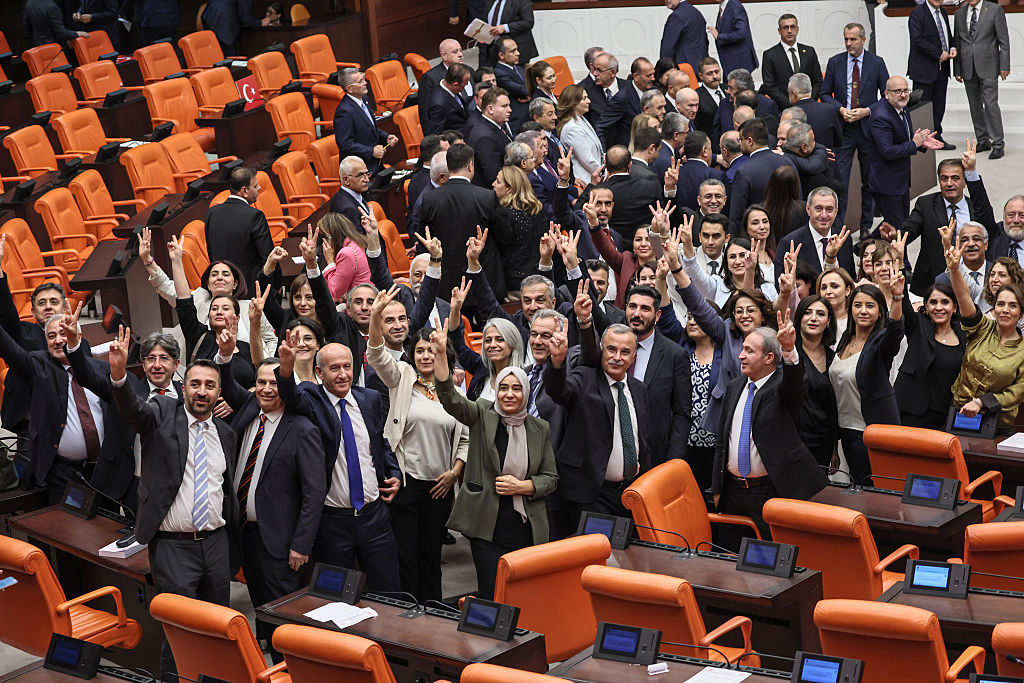
Turkey’s political scene is moving. The recently passed Framework Law redirects the Kurdish question — the principal fault line in the country’s imagined national unity — from armed confrontation to regulated pacification. This has political consequences far beyond its narrow legal scope. More than bringing one period of the Kurdish conflict to a close, it opens a new phase in Turkey’s class struggles by reshaping the balance between the state, the Kurdish movement, and the political opposition.
The August 10 Framework Law — officially the Law on Strengthening National Solidarity and Social Cohesion — is a genuine rupture in Turkey’s handling of the Kurdish conflict. More than an administratively dressed-up executive concession, it crowns a parliamentary process initiated by an all-party commission, excluding only the ultranationalist Good Party (İyi Parti). This commission was mandated to recommend measures to end the armed conflict, including talks with the guerrilla Kurdistan Workers’ Party (PKK) and its imprisoned leader, Abdullah Öcalan.
The law passed with an exceptionally broad parliamentary majority: 467 votes in favor, eighty-seven against, and seven abstentions. Alongside the governing Justice and Development Party (AKP) and Devlet Bahçeli’s Nationalist Action Party (MHP), the coalition behind the text included the Kurdish-based Peoples’ Democracy and Equality Party (DEM Party), the newly formed Yeni Parti, the Workers’ Party of Turkey (TİP), the Labor Party (EMEP), several independents, and a small minority of Republican People’s Party (CHP) deputies. Despite radically different narratives on the Kurdish question, these parties converged on the legal framework regulating the consequences of the PKK disarming.
That breadth of support matters because it prevents President Recep Tayyip Erdoğan (AKP) from claiming exclusive political credit for ending the armed conflict. However, despite Yeni Parti leader Özgür Özel’s deft efforts to stop Erdoğan from monopolizing the peace process, the political initiative currently rests with the Erdoğan–Bahçeli coalition and Öcalan — not with the main opposition Yeni Parti. This latter emerged from the split in the historic CHP, after most of its parliamentary group and grassroots supporters defected in protest at former Chairman Kemal Kılıçdaroğlu’s attempt to regain the party leadership through what they saw as a court ruling shaped by Erdoğan’s influence over the judiciary.
If implemented in full, the law will release imprisoned PKK-affiliated political activists or suspend pending prosecutions. Release is conditional upon a three-to-five-year probationary period. Any new criminal offense committed during that period will reactivate the remainder of the original sentence in addition to any new penalty. Those convicted of offenses committed before 2005 and those serving aggravated life imprisonment remain excluded.
Room for Maneuver
By securing parliamentary backing for the disarmament process, the Erdoğan–Bahçeli alliance has accomplished what once appeared politically impossible. Despite steadily declining approval ratings since the 2024 local elections, the ruling coalition has partially detached the Kurdish question from the traditional government-versus-opposition cleavage and gained unprecedented room to maneuver politically.
Until now, the parliamentary arithmetic had been relatively stable. The ruling bloc depended on Turkish conservative-nationalist mobilization; DEM on organized Kurdish democratic-patriotic support; the CHP — now largely succeeded by the Yeni Parti — relied mainly on urban secularist votes. Across the last four national and local elections, Kurdish voters and their political leadership consistently backed the CHP as the only viable national alternative capable of producing a new interlocutor for a negotiated settlement.
Beginning with the secret talks with Öcalan, continuing through his unilateral call to dissolve the PKK and culminating in the Framework Law, the ruling coalition has cut diagonally across Turkey’s political alignments. Unlike during the 2013–15 peace process, Ankara’s implicit message is now clear: the state can negotiate directly with Öcalan and the Kurdish movement without first democratizing Turkey’s political order.
This has given Cumhur İttifakı (the ruling People’s Alliance) a major competitive advantage. Under the banner of Terörsüz Türkiye (“Terrorless Turkey”), it can pursue a strategy that combines regulated pacification of the organized Kurdish movement with continued authoritarian competition against the main opposition. From the government’s perspective, the two tracks are complementary rather than contradictory.
The second track has continued uninterrupted since 2025. Beginning with the arrest of Istanbul Metropolitan Mayor Ekrem İmamoğlu in March last year, there have been police raids on at least thirty-nine municipalities that the opposition CHP captured in the 2024 local elections. Dozens of mayors have been detained or imprisoned on corruption charges based largely on forced or highly contested confessions.
The same governing technique was first perfected against Kurdish municipalities. Between 2015 and 2025, Kurdish mayors were removed in successive waves under terrorism-related charges; CHP municipalities are now targeted through corruption, bribery, and embezzlement cases built on similarly politicized judicial practices.
Leverage for DEM and Öcalan
For the Kurdish movement, the Framework Law, despite the state’s instrumentalization of it for pacification, is far more than symbolic. According to the statement released by the DEM Party after its visit to İmralı, Öcalan said:
A trek of a thousand kilometers commences with a single step. With this law, we are setting out to resolve a historical problem. We are at the beginning of a democratization process that will be at least as important as the founding of the Republic.
The “process,” since its public announcement by Öcalan on February 27, 2025, has progressed through irreversible steps demanded by the government — disarmament, dissolution, and withdrawal of armed units from Turkish territory — whereas the state’s own commitments remained political pledges rather than legally binding. Öcalan’s optimism is clearly nurtured by the fact that some of those assurances have now been written into law and thereby transformed into legal obligations, thus marking a threshold.
As a result, Öcalan emerges politically stronger after two years of negotiating. His February 2025 call, the PKK’s dissolution congress, the symbolic disarmament, the formation of the parliamentary commission, negotiations over a legal framework, and the Framework Law comprise an unbroken chain of concessions and Öcalan’s recognition by all negotiating parties as the indispensable interlocutor of the process.
However, this success comes at a price. The more effectively Öcalan delivers PKK disarmament, the more Erdoğan becomes confident that he can separate the settlement of the armed conflict from Turkey’s progress toward the rule of law, human rights, and democracy.
Thus, the framework law remains both historic and deliberately confined in the face of colossal historic demands. It regulates pacification, prosecution, and reintegration but leaves full Kurdish demands unresolved. It offers no promise or call for Kurdish rights, no local democracy, no return of the mayors replaced by government-appointed trustees, no amnesty for prisoners of conscience, and no hint of Öcalan’s future status.
This is the political world into which former PKK guerrillas will return after their release.
Yeni Parti Momentum
The political force that defeated the ruling alliance in the 2024 local elections with decisive Kurdish support was subsequently dismantled by judicial intervention. Following the court-imposed return of former CHP Chairman Kemal Kılıçdaroğlu, the majority of the parliamentary group, local leadership, and grassroots organization regrouped as the newly founded Yeni Parti, under Özgür Özel, while maintaining its commitment to a negotiated solution of the Kurdish question and supporting the Framework Law.
Yet the parliamentary vote exposed a profound contradiction. A majority of Yeni Parti deputies voted against legislation that could release imprisoned PKK members and suspend pending prosecutions. Whatever the party’s broader democratic credentials, many Kurdish voters interpreted that vote as opposition to the immediate release of their imprisoned relatives.
The Yeni Parti is not as powerful as before the vote — a move that weakened its standing within the Kurdish electorate, albeit not irreversibly. There remains room for Özel and his leadership to reconstruct a democratic alternative that links the end of armed conflict to wider democratization. Whether they succeed may become one of the decisive political questions of the next phase.
Kurdish Opinion
The majority of Kurds support the “process.” Yet this should not be confused with trust in Erdoğan. They are carefully observing how the law will be implemented. It is moving beyond rhetoric into legislation; there is reason to hope for an end to the armed conflict, the release of prisoners, and the normalization of political life.
Yet there still remains the memory of the collapse of the previous peace process of 2013–15, and the ongoing reality of trustee-controlled municipalities, mass prosecutions, and the weaponization of the judiciary against those calling for Kurdish rights. Therefore, if Kurds are turning their faces toward peace, this by no means implies that they are opening their minds to Erdoğan’s autocracy. They have learned a bitter lesson: if they don’t empower themselves, they will remain powerless.
The continuing repression of Yeni Parti municipalities creates an intense dilemma within the Kurdish constituency. A Kurdish voter may simultaneously believe that Öcalan is right to pursue negotiations, that ending the armed conflict is historically necessary, and that the government’s treatment of the Yeni Parti is fundamentally undemocratic.
The methods now used against the Yeni Parti — criminal investigations, removal of elected officials, prolonged detention, and politicized prosecutions — closely resemble those long directed against Kurdish municipalities. Rather than drawing Kurdish politics toward Erdoğan, this may reinforce a different conclusion: negotiations can end the war, but democratic guarantees must become universal.
The government’s current perspectives and actual governance give no hint of democratic transformation. They are best understood as a set of selective nonaggression pacts under a wider authoritarianism. The state is relaxing one historic axis of coercion while intensifying another.
Armed conflict has long vanished from the former war zone between Turkey and the PKK. The decisive question is no longer whether there will be armed conflict or whether the PKK leaves the mountains. The issue, now, is whether the political room opened by the call to lay arms becomes a democratic space for all or merely space newly monopolized by Erdoğan’s state and his military-industrial complex.
Read the full story at the source
Source: Jacobin