
Labour Jacobin
The Food Industry Is Rife With Worker Abuse
Food systems employ more workers than any other sector of the global economy — roughly 1.4 billion people. And few industries are more rife with worker abuse.
English (original) ·Read in Deutsch ⇄
Two things in life are certain: everybody eats, and nothing explains capitalism better than food. A new report from the International Panel of Experts on Sustainable Food Systems (IPES-Food) presents a comprehensive analysis of the exploitation inherent in the global food system, and what needs to be done to change it.
More people work in food than any other sector of the global economy, yet the food system can only function through systemic exploitation. Addressing these contradictions gives us a blueprint for not only tackling the worst aspects of food production but a model for taking on the worst of capitalism in general.
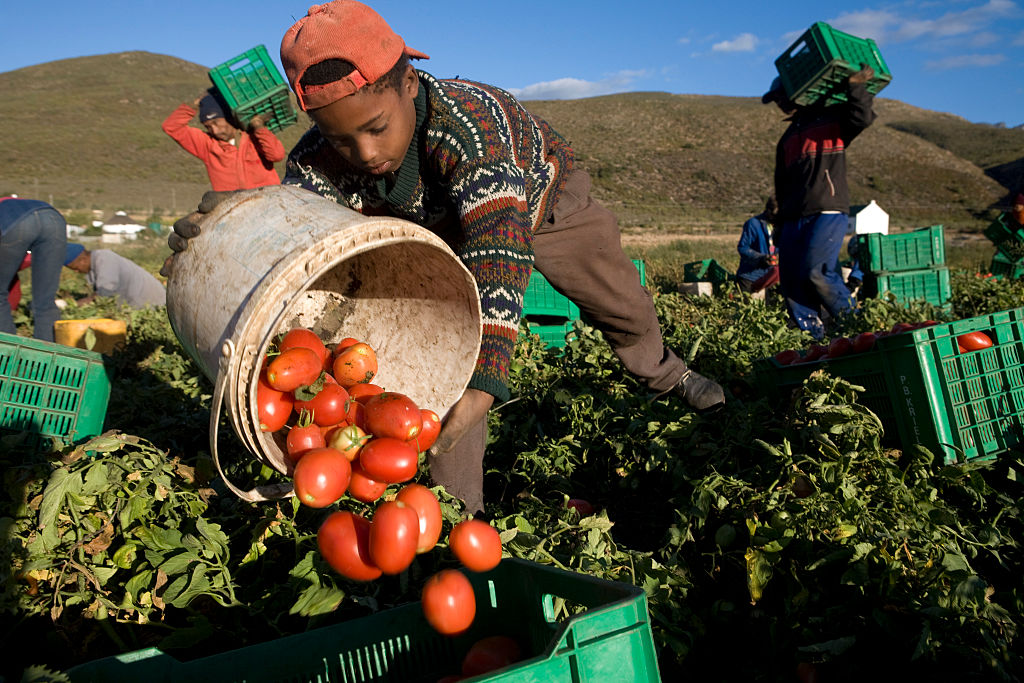
Food systems employ more workers than any sector of the global economy. Roughly 1.4 billion people work in food systems — that’s two out of every five working people. Food workers face low pay, wage theft, forced and child labor, human trafficking, insecure work, discrimination, sexual violence, occupational health and safety risks, and exclusion from social protections. Nearly four hundred million food system workers earn below a living wage. Minimum wage protections are often weak or absent for food system workers, with farmworkers consistently ranked among workers most likely to live in poverty.
Food work has the highest rates of informality of any part of the global economy, excluding workers from basic protections and collective bargaining and leaving them highly vulnerable to exploitation and poverty. Ninety percent of farm work, 80 percent of domestic work, 60 percent of accommodation and food service activities, and 60 percent of wholesale and retail workers are informal. Agriculture consistently ranks as one of the most dangerous sectors to work in worldwide, due to exposure to extreme weather conditions, long shifts without breaks, contact with harmful pesticides and chemicals, and an elevated risk of injury and death.
Food and agriculture are also considered among the highest risk sectors for modern slavery, with impoverished, informal, and migrant workers the most susceptible. There are an estimated 2.1 million forced laborers working in agriculture. Agriculture is also the sector responsible for the highest amount of child labor worldwide. More than 83 million children work in agriculture, accounting for 61 percent percent of global child labor.
Migrant workers are essential to today’s food systems yet face some of the highest levels of exploitation. Restrictive immigration policies make workers more vulnerable to abuse and drive down standards for everyone. Migrants are three times more likely to be trapped in forced labor compared to nonmigrant workers globally and are 70 percent more likely to die on the job. They also lose an estimated $31 billion in wage underpayment by employers annually. Women in food work also face systemic inequalities: wage gaps, harassment and violence, a disproportionate burden of care work, and exclusion from decision-making.
None of this is an accident. Today’s food systems are built on keeping labor cheap and profits high. Weak labor protections, poor enforcement, and unequal power leave millions of workers exposed to exploitation. Governments directly enable exploitation through selective regulations that exempt food and farm employers from basic standards on wages, safety, and collective bargaining. Informal, contract, seasonal, self-employed, and family workers are routinely excluded from workers’ rights.
Food Work’s Accelerating Race to the Bottom
The food system is evolving in ways that deepen exploitation. Rising heat, extreme weather, wildfire smoke, and growing pesticide use are making food work increasingly dangerous. US farmworkers are thirty-five times more likely to die from heat stress than other workers. In Africa, 93 percent of workers are exposed to dangerous heat; most work in food systems.
Corporate concentration is driving a race to the bottom, suppressing wages, weakening unions, outsourcing responsibility, and prioritizing shareholder returns over decent work. Industry consolidation directly undermines bargaining rights; larger food firms show significantly higher rates of illegal union interference, including wrongful terminations, refusals to hire, coercion, and retaliation for union activity.
In 2019, nine of the largest US poultry processors settled for over $398 million in a lawsuit alleging a twenty-year conspiracy to depress wages and target vulnerable populations, including migrants and refugees, to keep pay at or below the poverty line. Similar cases have emerged across pork and beef sectors.
Walmart illustrates the full weight of this dynamic. With 90 percent of the US population living within ten miles of a store, the company captures one in every four grocery dollars — more than the next five supermarket chains combined. This has reduced employment exit options and suppressed wages and benefits. Within ten years of a Walmart Supercenter opening in a community, average household income can fall by 6 percent. Walmart employees use $6.2 billion in public assistance to survive, and the company is the largest redeemer of consumer SNAP and WIC dollars.
Digital technologies are also creating new forms of exploitation. Gig-based platform work, automation, algorithmic management, and digital surveillance are isolating workers, intensifying productivity pressures, increasing injuries, and weakening protections for workers. Digital surveillance and algorithmic management also function as tools for wage suppression, pushing into outright wage theft. Digital productivity tracking intensifies workplace pressure and drives injury rates upward. Employees must work harder simply to maintain incomes that remain both inadequate and unpredictable.
The Path to a Different Food System
Despite these entrenched structural pressures, food workers and advocates are organizing. The efforts are scattered, not always coherent, and take different tacks, from deeply pragmatic and reformist to visionary. But a vastly different food system is possible through five strategies.
Worker power must be the priority, and that means strengthening unions, expanding collective bargaining, and building solidarity across movements. Guaranteeing decent work includes enshrining workers’ rights in law, setting enforceable floors for decent work, and investing in labor inspection and enforcement. Reining in corporate power means holding firms accountable for labor abuses throughout food supply chains. Demanding equal rights for migrant workers includes ending legal exclusions for migrant workers and the criminalization of migrants. Valuing food work means recognizing, protecting, and rewarding the skills, knowledge, and care of the people who feed us. These are the formulas that social movements are applying throughout the world.
In India, street vendors are organized under the National Hawkers Federation, an association of over 1,650 unions across twenty-eight states. In the United States, farmworker-led models initiated by the Coalition of Immokalee Workers are utilizing legally binding agreements to ensure suppliers respect workers’ rights and provide higher wages. Workers set their own labor standards and oversee independent investigation and enforcement systems funded by the companies themselves.
Public sector supply chains in Brazil and the United States are enacting purchasing requirements that protect supply chain workers and ensure more sustainable and diversified growers and producers. Growing interest in public grocery stores across Bulgaria, Canada, and places like New York City reflect an implicit understanding that workers have the right to organize, will be paid union-level wages, and food affordability will be prioritized. And for over forty years, The Landless Workers’ Movement in Brazil has actively built cross-movement solidarity by connecting rural peasants, urban workers, and international grassroots campaigns through cooperative food distribution, political education, and joint organizing.
One critical question as food prices rise is not whether workers should be paid better, but who captures value along the supply chain. Fairer food systems are about changing who holds power, who profits, and who bears the costs. This requires raising incomes, lowering the cost of living, and shifting the objective of food systems from private profit to public good, ensuring that all people can access healthy, nutritious food without depending on the exploitation of those who produce it.
The food system isn’t broken. It is working as it was designed: to use food production as a means to concentrate wealth by squeezing every penny of profit, every last drop of blood out of everyone and everything along the supply chain. Food system workers and allies can change that.
This article originally appeared in Jacobin, a democratic socialist magazine publishing long-form essays and analysis on politics, economics, and culture. Subscribe to the print edition for $20 a year.