
World · Jacobin · · 3h
The Death of Honor
English (original) · Read in Deutsch ⇄
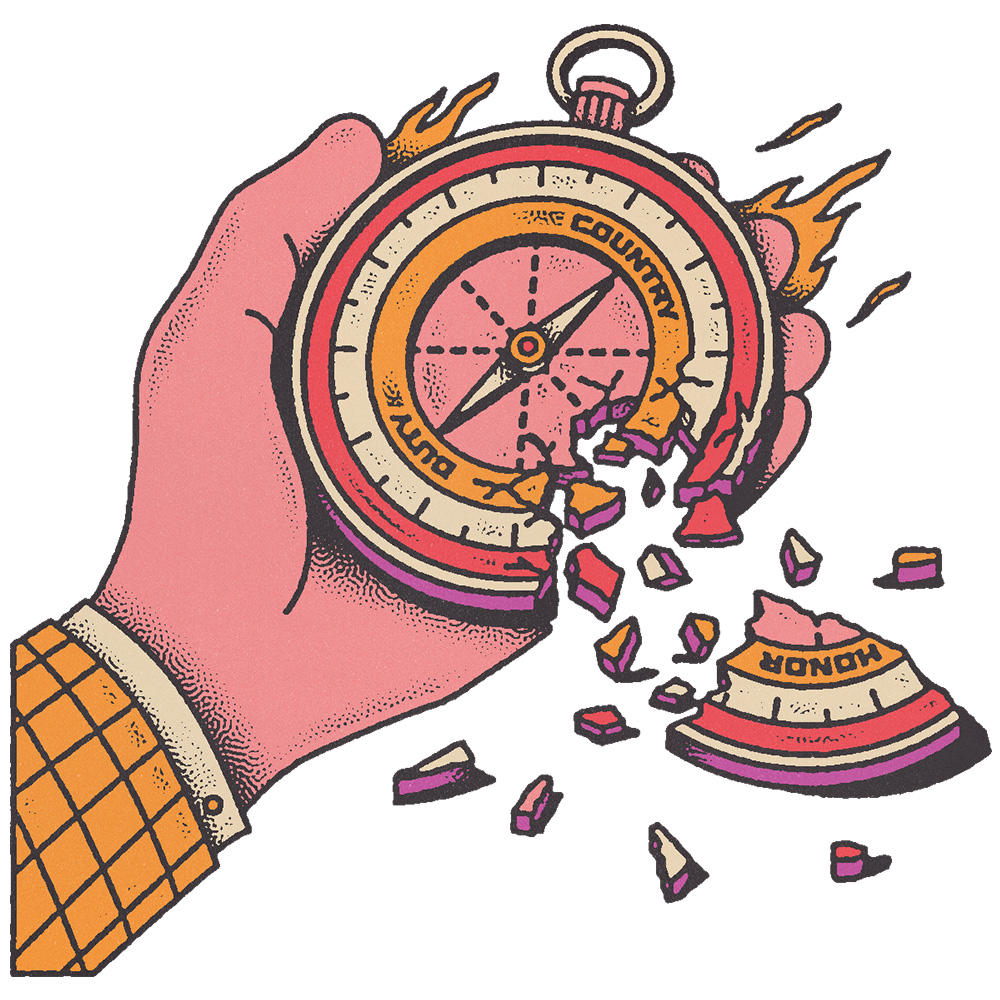
On May 12, 1962, General Douglas MacArthur strode into the West Point mess hall and delivered a stirring farewell address before an audience of more than two thousand cadets. It had been just over a year since another famed former general, President Dwight D. Eisenhower, had famously delivered his own closing warning about industry’s capture of the Pentagon. Now MacArthur seemed worried about the corruption of the American soldier’s soul — the death of honor itself.
Honor was everything to MacArthur. Between 1919 and 1922, as West Point superintendent, he built cadet life around the academy’s hallowed motto, “Duty, Honor, Country.” He further instituted a cadet honor code and attendant honor boards, a quasi-judicial trial system meant to discourage unethical behavior and promote a culture of leadership among fledgling recruits.
While honor is traditionally equated with honesty, integrity, and accountability, it doesn’t require any of these things by definition. Rather, it denotes fidelity to an institution’s core rites and standards, making it a fragile, fungible concept whose strictures shift depending on who is giving the orders.
In the mess hall that day, MacArthur conjured honor in its purest form, urging the sea of cadets before him “to learn to stand up in the storm, but to have compassion on those who fall; to master yourself before you seek to master others; to have a heart that is clean, a goal that is high.” He called upon them “to be modest so that you will remember the simplicity of true greatness, the open mind of true wisdom, the meekness of true strength.”
MacArthur was a fearsome figure, but like any good military mind, he knew the importance of building soldiers with camaraderie, humility, and intelligence. In his stint as West Point superintendent, MacArthur cut down on hazing and expanded academic freedom. He took the education of these warriors in training seriously, even fortifying the humanities as a critical part of their moral development. For the first time, he provided cadets with access to the daily newspapers, a policy that was viciously opposed by a cadre of influential graduates who prized West Point’s insularity. After just three years on the job, that influential cadre, now ensconced in the War Department, transferred Mac-Arthur to the Philippines and reversed his dictate.
MacArthur’s ideal of the honorable, well-read, and well-rounded officer was an inspiring conception of service but one that would soon come under grave threat from West Point’s superintendent, William Westmoreland, who, a year after MacArthur’s speech, departed the school to run a campaign in Vietnam racked by war crimes, cooked books, and countless strategic failures. During a sojourn to MacArthur’s apartment at the Waldorf Astoria just before this appointment, the wizened general told Westmoreland that the war in southeast Asia was “fraught with hazards” and could only be won with a “scorched earth policy.”
Despite Westmoreland’s profound shortcomings and corruption, he, like many other military architects in Vietnam, would retire in good standing, his reputation helpfully revised via a fawning biography written by West Point’s chair of American history.
As the war corroded both honesty and integrity throughout the ranks, heady notions like honor were reduced to meaningless platitudes. President Richard Nixon frequently invoked the vagaries of honor to mask Vietnam’s discredited premise and the degenerate killing that proliferated. When, on January 23, 1973, Nixon announced the end of the war in a short but defiant speech, he used the phrase “peace with honor” five times.
The same year as Nixon’s speech, Captain Michael Rose, a young Air Force Academy graduate studying at New York University Law School, published A Prayer for Relief, a damning 253-page investigation into the dysfunctions of MacArthur’s beloved Cadet Honor Code.
Over months, Rose collected interviews and intelligence from major training grounds for future military brass, among them all five service academies, including West Point and the Air Force Academy, plus the Virginia Military Institute and the Citadel. His inquiry was powerfully cosigned by a contingent of federal lawmakers, who explicitly counseled military schools to accommodate Rose’s requests for access. They did so begrudgingly, especially at West Point, which actively frustrated his efforts. “The military police there were following me,” he said.
West Point also refused to connect Rose to James Pelosi, a cadet then facing a gauntlet of hazing for failing to immediately put down his pencil at the conclusion of a test. Rose ultimately managed to sneak into West Point’s Camp Buckner, a training facility a few miles from the academy on Lake Popolopen, where he went tent to tent one night looking for Pelosi until he found him. “Then he and I went into the latrine, and I tape-recorded him for an hour.” Pelosi’s assessment of military honor was unsparing. “I’m disillusioned with the air of elitism, of perfection, around here,” he said. “People think that just by being here they’re automatically a little bit better than anyone else. But they’re not.”
Rose’s resulting thesis was simple but devastating: the military’s festering morality crisis — evidenced by “pandemic drug addiction, racial tension, sedition, common crime, refusal of combat duty, widespread assaults and murders of officers [and] rapidly increasing desertion and decreasing reenlistments” — could be traced back to the transactional notions of honor perpetrated at places like West Point.
His argument was crafted from a powerful combination of legalistic analysis and hundreds of vivid interviews from sources sketching out scenes that often seemed plucked from a hard-boiled police drama. Rose documented tainted honor board investigations and corrupt cadet interrogators, some of whom turned off their tape recorders to scream threats at defendants, forcibly cut their hair, and deprive them of sleep. One cadet said the pressure became so bad that he vomited. Others compared the experience to the mock prisoner-of-war interrogation training that school officials had instituted a few months earlier.
Honor-code-related punishments were often biased and freighted with personal baggage. The chairman of one honor board stated his hostility toward a cadet on trial. “This guy has been in trouble before,” he said. “And we don’t want that kind around.” Cadets, many of them under twenty-one, who sought to appeal their honor board decisions were often threatened with a more serious military court-martial, which, due to the military justice system’s punishing and capricious nature, could entail imprisonment at Fort Leavenworth.
Prosecution could stem from any number of offenses. Hundreds of regulations dictating cadet life were itemized in a standard-issue manual known as the Blue Book. Infractions were often vague, making them easily exploitable. They included “general inattention,” “carelessness,” and exercising “poor judgment.” Cadets were technically considered in violation of the honor code for asking a fellow cadet how to spell a word for an essay assignment, or for telling a fib. One cadet who told a superior he had done twenty push-ups when, in fact, he had done eighteen had the book thrown at him. Another who lied about shaving was expelled. Admitting one’s failings could also end in expulsion. “The code,” one West Pointer griped, “weeds out some cadets who are honest enough to report themselves for honor violations.”
Even cadets who reported others for wrongdoing were sometimes expelled for “tolerating” bad behavior, imparting what some administrators quietly worried was a warped lesson, namely that “those who said ‘no comment’ or lied fared better than those who told the truth.” One West Point professor argued that these “seemingly purposeless rules breed resentment,” which in turn curdles into a full-blown rejection of morality. The honor code was a stand-in for respectable behavior, and yet cadets found it nearly impossible to stay in the code’s good graces. It could be fairly reasoned from here that the code was simply too rigid and that rule-breaking was the only way to survive. “Cadets,” Rose’s report concluded, “learn by example that deceit and deception are ‘standard operating procedure’ when the image of West Point or the Army is at stake.” His assertion was backed up by scores of cadets and even in-house psychiatrists. “I hear leaders talking about integrity and spirit and intent,” confessed one cadet. “But I see few who live by their preaching.”
MacArthur’s high-minded crusade a generation earlier had led to something far more brutal and duplicitous than the “Athens on the Hudson” he had prescribed. As one commentator argued in Time magazine, the new batch of senior military leaders tasked with teaching ethics had become infamous for “falsifying body counts, concealing the bombing of Cambodia, [and] covering up My Lai.” At this time, West Point offered a single ethics course, an elective that was only available senior year.
By the Vietnam War’s end, few cadets held MacArthurian feelings about honor. Sixty percent of West Point cadets, for instance, asserted in a 1974 survey that “adherence to the spirit of the Honor Code is deteriorating.” This, according to an accompanying study, could be traced back to the military’s “sanctimonious” belief in honor, which obscured the true knottiness of ethics.
This was a generational loss of military integrity, and yet because it largely played out in academic environments, it often took the form of seemingly insignificant cheating rings. A series of major cheating scandals broke out at the service academies during the Cold War: in 1951, in 1967, in 1972, and then, not long after the fall of Saigon, in 1976. Air Force Academy Dean Robert McDermott defensively blamed the 1967 scandal on civilian counterculture, testifying to congressional investigators that dozens of identified cheaters had hailed from a clique “symbolized by kooky music, long hair, and a few other things.” A subsequent report penned by a committee of retired brass and academics disagreed, blaming the behavior on an academic environment concerned with “the symbols of achievement, sometimes at the expense of reality.”
This shift in military culture was impossibly swift, evident in the case of West Point cadet Joseph Zengerle, whose hopes were high when, as a first-year plebe, he marched at John F. Kennedy’s 1961 inauguration. He absorbed, in person, Kennedy’s rousing call to “ask not what your country can do for you — ask what you can do for your country.” Months later, he was there in the mess hall for General MacArthur’s humanistic farewell address.
And yet shortly before his graduation from West Point, Zengerle marched at Kennedy’s funeral. The event presaged a darker politics and the continuation of a poisonous war, things that the man in the casket had tried to curb. Soon after, Zengerle was sent to Vietnam to be Westmoreland’s aide-de-camp.
Rose’s report, meanwhile, was ignored, and the Air Force’s judge advocate general declined to certify him as a military lawyer. By the summer of 1974, brass had coerced him to resign.
The deep issues Rose spotlighted continued bubbling up to the surface, often in the form of schoolyard deceptions. In 1976, more than 150 West Point cadets were charged with cheating, this time within the academy’s most storied and prestigious department: electrical engineering. Some assessments later indicated that as many as six hundred cadets had cheated, but even the smaller statistic qualified the 1976 affair as the worst cheating scandal in military history. One of the many cadets forced to resign was Robert K. Koster, son of Samuel Koster, an Army officer who helped cover up My Lai and previously ran West Point.
After the war, many in the Pentagon fell victim to ego, blinkeredness, and historical revisionism. There was no reckoning with the war’s failures. This avoidance was typified by the POW-MIA movement, which, according to historian Rick Perlstein, was used “to justify the carnage in Vietnam in a way that rendered the United States as its sole victim.” Vietnam, along with the civil rights movement, saw the inflammation of the “Lost Cause” myth around the Civil War, manifested when President Nixon attempted to erect a monument to the Confederacy on West Point’s grounds.
Today the warped lessons of the “Lost Cause” and POW-MIA continue to be nurtured by Defense Secretary Pete Hegseth, who has himself introduced a new fiction for his generation, namely that DEI was the major cause for America’s losses in Iraq and Afghanistan.
Like MacArthur, Hegseth has made his own rhetorical paeans to honor, writing in his 2024 book The War on Warriors that it was a cornerstone commandment of “America’s civil religion.” By his definition, honor is for those with high casualty counts and reactionary politics. He wrote that honor was under threat from leftist causes, among them: “Diversity, Equity, and Inclusion (DEI), Critical Race Theory (CRT), feminism, genderism, safetyism, climate worship, manufactured ‘violent extremism,’ straight-up weirdo shit, and a grab bag of social justice causes.”
Still, in a few fleeting paragraphs, Hegseth offers a cogent analysis of the rot, eloquently fusing MacArthur’s worries about military honesty with Eisenhower’s warnings about military spending. “Once you pin a star on your shoulder, the political pressure mounts,” Hegseth wrote. “Go-along-to-get-along, and get promoted, is the smoothest path. Don’t rock the boat, do what your political masters tell you, never admit mistakes — and get promoted. Then, once you retire, you get to collect a pension and a sweet job from Lockheed Martin.” In these pages, Hegseth proclaims that American generals should be statutorily restricted from comfortably migrating from their “comfy desk jobs in the Pentagon to the boardroom of the military-industrial complex.” It was a veiled swipe, perhaps, at President Joe Biden’s defense secretary, Lloyd Austin, who left a seat on Raytheon’s board to become the first black American to hold the position.
A few months after his book was published, in November 2024, Hegseth was himself unexpectedly nominated to run the Pentagon. During his confirmation hearings, he sketched out how he would construct a hard-charging, unrepentantly violent, and blatantly ahistorical Department of War — departments of mere “defense” were no longer up to the task. In a flash, he dropped any of his past diagnoses about the Pentagon’s true problems, instead hypercharging all the agency’s worst qualities. Hegseth pushed the Pentagon budget past $1 trillion, retaliated against brass simply for their gender or skin color, engaged in war crimes, and prioritized his own future and personal vanity above all else, installing a makeup studio at the Pentagon and having government employees film his workouts and upload them to social media. Hegseth also barred from the Pentagon briefing room photographers who took unflattering photos of him.
At one point during his confirmation hearing, US Senator Elizabeth Warren pressed Hegseth on his shifting stance regarding the dangers of military-industrial influence. “You’re quite sure that every general who serves should not go directly into the defense industry for ten years, but you’re not willing to make that same pledge?” she pressed. Hegseth smirked. “I’m not a general, Senator,” he said.
One of the first things Hegseth did once in office was to crack down on academic freedom at places like West Point, banning books, pushing out professors, and reinterpreting the honor code. In a strange twist, a major ally in his fight is Michael Rose, who, under Biden, became a fierce critic of DEI policies and COVID-19 mandates. In little more than a year, Hegseth has done much damage, though the culture of the US Armed Forces was deeply compromised decades ago. For years, a certain subset of cadets has come to see deception as an ingrained part of military life, represented by a circulating joke about West Point’s motto that goes “Duty, Country, Hon — well, two out of three ain’t bad.” ′
Read the full story at the source →
Source: Jacobin