
Politics · Jacobin · · 2h
The Battle of Cable Street Was an Antifascist Landmark
English (original) · Read in Deutsch ⇄
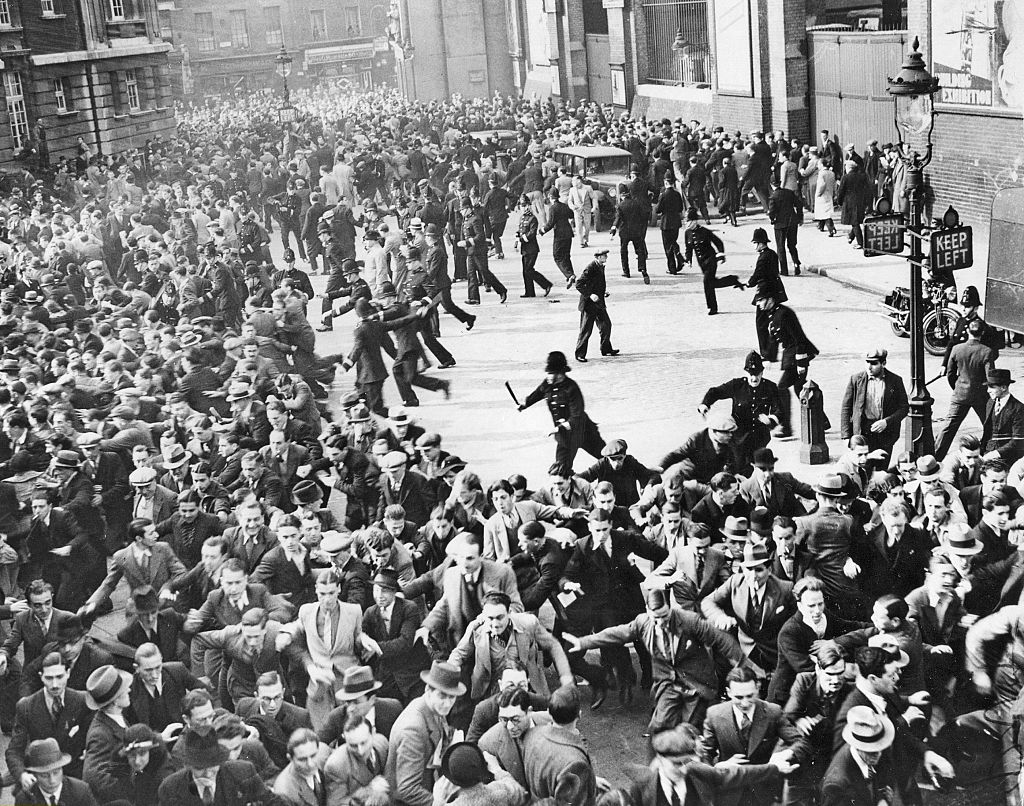
Twenty years ago, I shared a platform with Aubrey Morris, one of the “ordinary” heroes of the Battle of Cable Street on October 4, 1936 — the iconic event in Britain’s prewar antifascist history. Aubrey was sixteen at the time, a Labour League of Youth member, and he still glowed with pride at having been part of the mass defiance that put the slogan “They shall not pass” into spectacular effect. He helped build barricades in Cable Street.
Aubrey denied being a hero: “I did what any young Jewish boy would have done at that time.” Though he did have an additional motive. If Oswald Mosley’s uniformed, jackbooted British Union of Fascists (BUF) had invaded that narrow street to terrorize its largely Jewish residents, they would have reached number 86, where Aubrey’s grandmother ran the family’s bagel bakery! He took this personally.
Eventually, police partially dislodged the first barricade — a tipped-over truck with furniture stacked behind it, blocking the road. They ran through to find a route for the fascists to march but got trapped between that truck and the next barricade. There they faced fierce resistance at ground level and an aerial barrage of objects thrown by women in flats above the shops.
The antifascist mobilization that day in Cable Street and the surrounding area stands out for its extraordinary scale and the powerful psychological blow it dealt to Mosley’s British Union of Fascists at a time when fascist parties were making gains across Europe.
Mosley repeatedly told his followers that they were “invincible.” But a week later, he acknowledged that they had been “humiliated” in East London. This Sunday, October 4, we will be marching again from Tower Hamlets Town Hall to Cable Street to mark the nineteenth anniversary of this landmark.
Routing Mosley
Those defending the Jewish end of Cable Street on the day were reinforced by dockers from the street’s largely Irish Limehouse end. A propaganda battle raged for the allegiances of the Irish locals. Mosley won over a segment of them, gaining recruits who frequently delivered antisemitic tirades on street-corner fascist platforms.
But antifascists were patiently building a class-based unity between Jews and Irish against Mosley that recalled a history of unity and solidarity between tailors and dockers in strikes. The Communist Party prepared special “Speakers Notes” for use in Irish areas, reminding audiences of the unjust discrimination and scapegoating their community suffered over decades. On October 4, 1936, many Irish defended Cable Street alongside Jews.
Joyce Rosenthal was younger than Aubrey, just twelve when she and a friend joined the mass blockade at Gardiner’s Corner, Aldgate, half a mile north of Cable Street. Mosley planned to lead his troops from Royal Mint Street, in the City of London, to Gardiner’s, before marching through the heart of Jewish Whitechapel.
After that, they were to split into four columns, tramping through Jewish-populated streets toward platforms being erected by Mosley’s local fascist branches — in Shoreditch, Bethnal Green, Bow, and Limehouse — for open-air victory meetings. Mosley, “The Leader,” promised to address each one.
However, the blockade at Gardiner’s was so dense that it withstood repeated charges by truncheon-wielding mounted police. The police relayed a message to Mosley, in Royal Mint Street, to say that he would not reach Gardiner’s but would have to enter further south. The antifascists predicted that the police would use Cable Street.
Youngsters like Aubrey were already erecting barricades there. The entrance to Cable Street saw some of the fiercest fighting that day between police and antifascists, and many arrests.
After Mosley was beaten back at Cable Street too, the police eventually instructed him to turn his troops around, head west to Embankment and disperse. Mosley accused the police of surrendering to “red and Jewish terror,” but he complied. He was due in Berlin two days later to marry Diana Mitford, in Adolf Hitler’s presence and at the home of Nazi Minister of Propaganda Joseph Goebbels.
Demonstrators were jubilant as the fascists scurried westward, though the seventy-nine antifascists arrested on the day, many of whom were severely beaten at Leman Street police station, were probably feeling more subdued. Just five fascists were arrested that afternoon.
“Where Were You on October 4?”
The police had mobilized seven thousand officers to facilitate four thousand fascist marchers after the home secretary rejected a petition to ban the march that had collected nearly a hundred thousand signatures. The Jewish People’s Council Against Fascism and Antisemitism (JPC), a radical grassroots Jewish campaign formed in July 1936, drafted the petition. The home secretary justified his decision to allow the march citing “free speech” and “free movement” (for the fascists), prioritizing their freedoms over community fears.
The Jewish community’s West End–based “leaders,” the Board of Deputies and Anglo-Jewish Association, held themselves aloof from the anger brewing in the East End’s working-class Jewish streets. They told Jews to stay indoors and asked rabbis to deliver synagogue sermons driving home that message twenty-four hours before the battle.
The Jewish Chronicle newspaper, a reliable cheerleader for representatives of the Jewish elite, warned Jews to “keep away from the route of the Blackshirt march,” adding that if Jews “become involved in any possible disorders,” they would be “actively helping antisemitism.”
But they were not the ones feeling the heat. As Charlie Goodman, who served three months in prison after Cable Street, told me: “The fascists rant against rich Jews in Park Lane then beat up a Jew in Brick Lane,” the famous East End street.
Charlie recalled the transparent tactic employed by Jewish youth club directors locally, who organized additional football matches that Sunday to divert youngsters from protesting. The youth chose to tackle fascism that day rather than tackle each other on a football pitch.
After the war, Charlie married Joyce Rosenthal. She asked him an important question before agreeing to their first date: “Where were you on October 4?”
By and large, the East End Jews, who experienced daily antisemitic abuse and assaults from fascists through 1936, ignored the advice of their communal establishment. They responded energetically to the JPC’s leaflets, which were distributed hours after the home secretary rejected their petition.
Addressed to “Citizens of London,” the leaflets stated: “This March Must Not Take Place!” If the government wouldn’t ban it, the people would. Estimates of numbers on the streets opposing the fascists on October 4, 1936, range from one hundred thousandto three hundred thousand.
The established political organizations that were already campaigning against fascism in several ways — especially the Communist Party (CP), the Independent Labour Party (ILP) and the Labour League of Youth (LLY) — echoed the JPC’s call. The CP recruited strongly among East End Jews in this period, on issues of poverty, unemployment, and housing as well as antifascism. CP activists were well represented within the broad-based JPC, which was supported by local synagogues, youth and student groups, Jewish trade unions, community associations, and friendly societies.
A Constellation of Protest
When antifascists today look for inspiration on how to effectively oppose and stop Britain’s contemporary far right, they are drawn instinctively toward the blockades and barricades of the most dramatic physical confrontations. Cable Street was by far the largest, but between 1933 and 1938, people also united in numbers seeking to deny the streets to the fascists in many other towns and cities: Aberdeen, Bristol, Hull, Leeds, Liverpool, Manchester, Oxford, Stockton, Tonypandy, and the seaside town of Worthing.
These local antifascist uprisings form a single constellation, and they should all be celebrated. The skills that activists honed in building and organizing mass mobilizations, decades before they could share pinned locations on social media, remain astonishing.
Today, when the Left is riven with sectarianism and its own destructive versions of cancel culture, we should seek to emulate the inclusivity of 1930s antifascist protests. These were based on unity in action without demanding uniformity of thought, though there were, of course, theorists analyzing the growth of fascism around Europe, who it was attracting, and how that process could be interrupted.
It is vital, though, to recognize that these local antifascist battles were reactive. The fascists had seized the agenda by threatening to invade specific areas. By doing so, they sought to intimidate those they perceived as their enemies, but also to recruit members (including the unemployed) who might be impressed by their propaganda and their militaristic style, which conveyed a sense of unity and power.
The JPC believed that antifascists needed to assert their own broader strategy, patiently building antifascist majorities in local areas across the divisions the fascists sought to impose. They embodied this approach in their public meetings, which always had both Jewish and non-Jewish speakers on the platform.
The global economic crash of 1929 created the crisis that opened the doors to fascism. Many countries suffered high unemployment rates through that decade, fostering a growing sense of hopelessness. In Britain, there was a widespread belief that the “tired old gang” of politicians — as Mosley dubbed Conservative, Liberal, and Labour leaders in Britain — had created dire economic problems that they could not resolve.
Mosley was in his mid-thirties when he launched the British Union of Fascists (BUF). He described his movement as a “party of action based on youth that would mobilize energy, vitality and manhood to save and rebuild the nation.” His opportunistic use of generational politics and his emphasis on “the nation” obscured his own superwealthy economic position and the class interests he represented and sought to defend.
This deceptive approach helped him win cross-class political support. Young people — and many of their parents too — were drawn to Mosley’s antiwar rhetoric. He claimed that his party alone offered young people opportunities to serve the nation in peacetime, not just as war fodder. Dig deeper, and you will find the youth he was really interested in: BUF-supporting student societies in twenty elite public schools, grooming the next generation of fascist ideologues.
Far-right parties and movements in today’s Britain naturally exploit the cost-of-living crisis. But when younger left-wing activists shift the blame to “boomers,” I weep. I think of working-class communities, especially in northern England and Wales, where so many people’s lives were devastated in the 1980s as Margaret Thatcher waged war on trade unions and industries closed down. Yes, a section of people got rich in that decade, but most working-class “boomers” were left impoverished and leading precarious lives. They still do.
Understanding Fascism
From autumn 1934, the BUF promoted a virulent form of antisemitism that attempted to explain every social, political, and economic problem as resulting from “alien Yiddish finance.” Mosley found support for antisemitism in every social class. Antisemitic stereotypes of Jews as alien, cunning, evil, and manipulative were commonplace in the 1920s, molded into conspiracy theories that posited a worldwide threat from “Judeo-Bolshevism.”
This kind of antisemitism slipped effortlessly from the tongues of Tory politicians and right-wing newspaper publishers, filtering downward. This is worth reflecting on when we consider how the normalization of Islamophobia within mainstream society over the last twenty-five years has boosted Britain’s current far-right forces, who try to blame every problem on migrants and refugees.
Whenever Mosley announced that the BUF would march in a particular area, people at the grassroots came together to discuss how to respond, with local trade unions and left-wing parties — especially the CP and ILP — in the forefront. While successful resistance was not guaranteed, fascist plans were often disrupted at the very least. In some cases, the fascists were literally chased out of town. In others, both sides later claimed victory.
If we are going to draw important lessons from the 1930s for activists today, we also have to examine the breadth of the work they undertook during that decade in the period between mobilizations. We also need to analyze the different elements that comprised the fascist threat, how the fascists were able to recruit in different localities, and what made people vulnerable to being recruited by fascism. This is the kind of analysis that makes it possible to draw some people away from the far right and even to bring them into a collective struggle for better lives for all.
The activist-theorists of the 1930s distinguished between two aspects of the problem they were facing. On the one hand, there was fascism as a sophisticated, totalizing ideology, adhered to by a growing core of educated far-right actors in Britain and across Europe. On the other hand, there was a larger number of individuals drawn toward the fascist flag by a sense that their circumstances were rapidly deteriorating and that no one was on their side. Mosley’s party offered them a chance to be part of something new that could restore their pride as well as providing them with someone to blame for their problems.
The activists did not simply write off people who reacted positively to what Mosley said (still less disparage them as “scum”). They viewed them as people who could be persuaded by a different set of ideas, a vision of a better future, especially if it simultaneously showed them where and how they could play a part themselves in bringing about change.
In 2026, we need to think more creatively about how to stem the growth of the far right and the normalization of their ideology — including crude and violent racism today — beyond a fixation with outnumbering them at every protest opportunity, however small. We need to be more strategic and not use the same tactics for every situation.
After Cable Street
A few days after the Battle of Cable Street, Mosley went looking for revenge. The fascists mobilized a counterprotest against a victory march from Bethnal Green to Tower Hill that was organized by antifascist ex-servicemen. The marchers faced horrific antisemitic abuse at close quarters, not to mention physical attacks with razor blades and other weapons. However, this was a decoy maneuver.
While police focused on containing that counterprotest, another group of fascists, 150-strong, mainly teenagers, ran riot a mile away, between Stepney Green and Mile End. They set fire to cars and attacked Jewish-owned shops, beating shopkeepers who fought back with wooden planks. A hair salon owner and a young child were thrown through a plate glass window. The fascists also launched an assault on the residents of a predominantly Jewish housing block.
Immediately after Cable Street, Mosley’s party recruited hundreds of youngsters seeking the excitement of physical action, but they got bored quickly. More serious fights raged within Mosley’s inner circle, where formerly devoted admirers now became hypercritical. Some resigned; some even defected over the coming months to the antifascists — and were rightly welcomed.
Mosley saw the spring 1937 local elections as an opportunity to revive the party’s agitational work. They stood candidates in their three strongest East End areas, Bethnal Green, Shoreditch, and Limehouse, promising local supporters they would win. Their highest vote was 23 percent in Bethnal Green, whereas Labour candidates in those seats won with more than 60 percent of the vote.
Predictably, Mosley blamed Jews for voting Labour as a bloc, though each of these seats was on the margins of the local Jewish enclave and there were in fact few Jewish voters. But many Jewish activists, especially those mobilized by the JPC, went there to leaflet, canvass, and urge people not to vote for fascists. Non-Jewish antifascists did so too. Effectively it was the non-Jewish voters who defeated Mosley, having been convinced by antifascist arguments. This victory, which was as important as Cable Street, was achieved in a very different manner.
Unity in Action
In summer 1937, another antifascist opportunity presented itself. It involved a grassroots campaign that mushroomed in 1938–39, bringing the very communities that the fascists had sought to divide into close cooperative contact and delivering real gains for ordinary people, while making the area much less hospitable for fascists. Phil Piratin, a Jewish communist, was prominent in this campaign.
Piratin had been born into a Ukrainian Jewish family in Whitechapel. The CP recruited him as a member in 1934 through the antifascist struggle, when he was twenty-seven years old. He was very worried about the growth of the fascists locally and across Europe and grappled with the question of why the poorest people locally were drawn to the aristocrat Mosley and his party.
As a Jew, Piratin was sensitive about antisemitism, but he didn’t think that was the principal driver. In his view, unemployment, poor wages, and appalling housing conditions were more significant in pulling struggling people toward a dynamic political alternative. He urged the CP to work energetically on these issues, convinced that this would enhance their direct campaigning against fascists.
The party began working among tenants on local estates in the East End’s Stepney area, out of which the Stepney Tenants Defence League (STDL) was formed. In June 1937, Piratin learned that two families in rent arrears in Paragon Mansions, Stepney Green faced imminent eviction. One family had five children, the other six.
They were reluctant to accept help from the League, which they associated with communists. Both families were BUF members. But Piratin knew he should persist. One family soon came on board; the other did so later and more reluctantly. A campaign that involved barricading the estate and beating off bailiffs was successful.
Piratin asked the families what the BUF had done for them to help. They couldn’t answer. The tenants stayed, settled their arrears, and tore up their BUF membership cards. The League produced a leaflet, widely circulated, that showed what tenants could do when they united across the dividing lines the fascists encouraged.
Learning the Right Lessons
This was the spur to a broader ongoing campaign that saw more than twenty successful local rent strikes between August 1938 and the summer of 1939. These strikes won concrete gains for renters and brought together people from different communities, especially Irish and Jewish tenants. Women from both communities did much of the day-to-day organizational work. Tenants paid a small weekly subscription to join the STDL.
At the time of the Battle of Cable Street, the most organized radical left-wing force locally, the Communists, had around a thousand members in Stepney, including the party’s youth section. By the middle of 1939, the STDL, instigated by communists but reaching much more widely, had around eleven thousand members. This movement cemented the victory at Cable Street and made longer-term gains for working-class communities.
In our work today, organizing in our localities against the far right and to unite communities, we should be seeking similar opportunities to establish grassroots campaigns that can meet our collective needs, and enhance our common anti-racist, antifascist goals. The past is not a blueprint, but it does contain important lessons we can apply today.
This article originally appeared in Jacobin, a democratic socialist magazine publishing long-form essays and analysis on politics, economics, and culture. Subscribe to the print edition for $20 a year.
Read the full story at the source
Source: Jacobin