
War & Militarism Jacobin
The 1973 Athens Polytechnic Uprising Still Matters Today
In November 1973, Greek students occupying the Athens Polytechnic painted “USA Out” and “NATO Out” on its gate, protesting decades of US interference in Greece. Today US bases there still tie the coun
English (original) ·Read in Deutsch ⇄
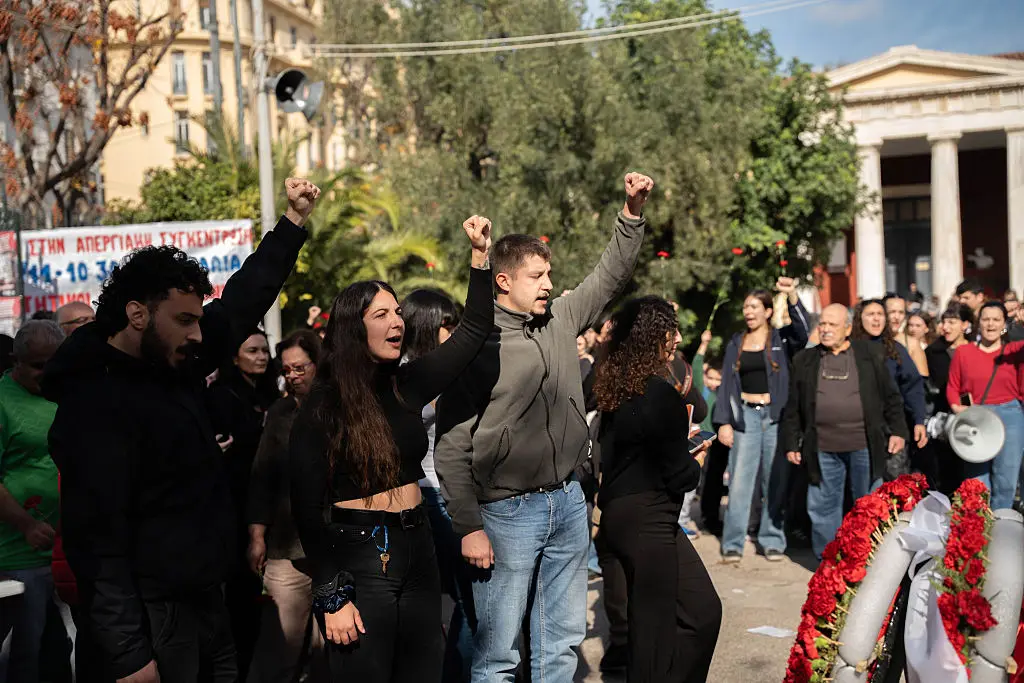
A military dictatorship had ruled Greece for more than six years when, in November 1973, hundreds of student occupied the Athens Polytechnic, transforming their university into a center of resistance. Thousands of workers, school students, and ordinary citizens soon joined them.
On the pillars of the Polytechnic’s central gate, a student painted two messages in large letters: “USA OUT” and “NATO OUT.” Within days, on November 17, a military tank would smash through that same gate. Why were young Greeks risking their lives to overthrow the military dictatorship also demanding the withdrawal of the United States and the North Atlantic Treaty Organization (NATO)?
The answer lies in the three decades preceding the uprising. During those years, Greece experienced Nazi occupation, British military intervention, civil war, and the consolidation of an anti-communist political order that American assistance sustained. The Greek ruling class was all too happy to allow US interference to consolidate its own rule.
The Resistance That Britain Opposed
During World War II, Greece developed one of Europe’s largest resistance movements. The communist-led National Liberation Front (EAM) and its armed wing, the Greek People’s Liberation Army (ELAS), mobilized hundreds of thousands of people and came to control much of the Greek countryside.
EAM was far more than a guerrilla organization. In the territories it liberated from Nazi occupation, EAM established institutions of popular administration, organized schools, and introduced new forms of political participation. In 1944, women were able to vote and stand as candidates in elections the resistance organized, years before they gained equal voting rights in national Greek elections.
By the time German troops withdrew in October 1944, the resistance had become one of the most powerful social and political forces in the country. But Winston Churchill’s government was determined to prevent the communist-led movement from dominating postwar Greece.
The confrontation centered on the future of the armed forces. Under British supervision, the Greek government demanded the disarmament of ELAS while retaining military formations associated with the government in exile. EAM rejected an arrangement that would leave its supporters disarmed in the face of potentially hostile forces.
In practice, the leadership of EAM and of the Communist Party of Greece had an ambivalent stance toward the British army and British agents operating on Greek soil. They had cooperated with the British against the Nazi occupation. But they were deeply skeptical of British intervention in liberated Greece. Events after the German withdrawal from Athens confirmed their suspicions: the forces of liberation (EAM/ELAS and their allies) would have to fight a new battle.
On December 3, 1944, an enormous, initially peaceful demonstration gathered in central Athens. Police opened fire, killing demonstrators and wounding many others.
The Athens police chief, Angelos Evert, later acknowledged ordering the shooting. He had remained in charge of the police during the Nazi occupation, maintaining relations with the occupying authorities as well as contacts with British intelligence. The massacre marked the beginning of the December clashes, which Greeks call the Dekemvriana.
British troops clashed with ELAS in the streets of Athens, using tanks, artillery, and aircraft. Their Greek allies included formations containing former members of the Security Battalions, which had collaborated with the Nazi occupiers in the struggle against the resistance. Militants who had fought the Nazis now faced the British army — and, fighting alongside it, former collaborators of the occupation.
Churchill himself arrived in Athens on Christmas Day to intervene in the political negotiations. The British military campaign eventually defeated ELAS in the capital. The Varkiza Agreement, which the government and EAM signed in February 1945, then required the resistance to surrender its weapons.
The Left had suffered a military defeat and now had to accept a political settlement from a position of profound weakness. Its supporters would soon discover how little protection that settlement provided.
White Terror and the American Takeover
Widespread persecution of the Left, which Greeks remember as the White Terror, followed the disarmament of ELAS. Armed right-wing groups, often operating with the tolerance or cooperation of state authorities, targeted people associated with EAM. They murdered and tortured former resistance fighters or drove them from their homes. State authorities imprisoned many more.
Contemporary figures that EAM compiled recorded 1,289 murders, 31,632 cases of torture and physical abuse, 84,931 arrests, and 265 rapes between February 1945 and March 1946. United Nations documentation later cited these figures, but they originated with the persecuted movement rather than an independent nationwide investigation.
The political climate was hardly conducive to a free electoral contest. The government scheduled elections for March 1946, while thousands of leftists faced imprisonment, displacement, intimidation, and restrictions on political activity. The communist-led left boycotted the vote, arguing that the conditions made meaningful democratic participation impossible.
The Right emerged victorious. A referendum later that year restored King George II to the throne, consolidating the monarchy’s influence in the postwar political order. Greece descended into full-scale civil war.
By 1947, however, Britain could no longer afford to sustain its intervention. The United States took its place.
President Harry Truman requested $400 million in assistance for Greece and Turkey, declaring that Washington would help free peoples resist communist domination. In Greece, this meant massive military assistance to the government fighting the communist-led Democratic Army of Greece (DSE).
American weapons, money, and military advisers helped determine the outcome of the war. During its final stages in 1949, Greek government aircraft dropped American-supplied napalm on Greek territory, targeting communist positions in the mountains of northern Greece. The United States had used napalm during World War II, but its deployment in Greece preceded Washington’s much better-known use of the weapon in Vietnam.
Government forces defeated the DSE in 1949. For their supporters, however, the end of the war did not bring freedom.
The state sent thousands of leftists to prisons and remote island camps. The camp on the island of Makronisos became particularly notorious for its system of torture, beatings, forced declarations of repentance, and ideological reeducation. The contrast with the treatment of Nazi collaborators was striking, with far higher numbers of executions.
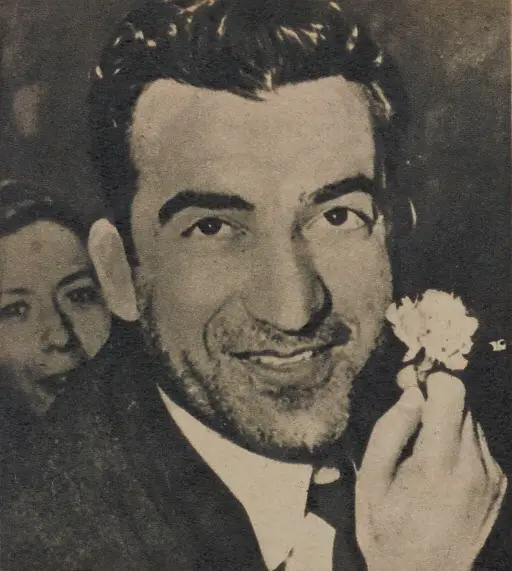
One execution became a symbol of that political order. Nikos Beloyannis had been a communist resistance fighter during the Nazi occupation. The authorities arrested him after the civil war, and a military court sentenced him to death. A photograph of him smiling with a red carnation during his trial became famous internationally, while an international campaign demanded that the Greek government spare his life.
Nevertheless, on March 30, 1952, a firing squad executed Beloyannis and three other communists.
Their deaths reflected the determination of the postwar Greek state to eliminate what it regarded as the communist threat, despite the formal restoration of parliamentary institutions. That same year, Greece joined NATO.
Much of Greece’s political elite had fled the country during the Nazi occupation, while significant sections of its economic elite had collaborated with the occupying forces. After liberation, the former returned to power, while much of the latter retained its economic influence. The restored ruling establishment built new mechanisms of repression and presided over a new era for Greek capitalism, keeping wages low and suppressing trade unions. US imperialism, which had taken the reins from its British counterpart, underpinned this new configuration of forces. In the postwar years, US interference would take many forms; at the same time, the Greek left would prove much more resilient than anyone could have predicted.
When the American Ambassador Intervened in Greek Elections
American influence went beyond supplying weapons. Declassified US diplomatic documents reveal direct American intervention in Greece’s electoral arrangements.
In March 1952, US ambassador John Peurifoy informed Washington that the American embassy’s political intervention and a public statement had blocked the introduction of proportional representation. The American ambassador was candidly discussing his government’s efforts to influence the electoral system of a formally sovereign democracy. The elections four years later vividly illustrated the political consequences of Greece’s unusual electoral arrangements.
In the 1956 parliamentary elections, the opposition Democratic Union won 48.15 percent of the popular vote, compared with 47.38 percent for Konstantinos Karamanlis’s conservative National Radical Union.
Yet Karamanlis secured 165 parliamentary seats, while the opposition received only 132. The party that won fewer votes formed the new government.
The opposition alliance was not a communist electoral front. It brought together centrist and left-wing forces against the conservative government. Even this broad parliamentary challenge failed to dislodge the Right.
Two years later, the United Democratic Left (EDA) became Greece’s second-largest parliamentary party, demonstrating the continuing electoral strength of the Left despite years of persecution. The result alarmed the conservative establishment and reinforced its fears about the political consequences of a more open democratic system.
The Monarchy, the Para-State, and the Road to Dictatorship
The Greek monarchy was far from a ceremonial institution. The palace intervened repeatedly in political affairs, exercised substantial influence over the armed forces, and helped shape the composition and survival of governments. Alongside the formal state existed an extensive anti-communist security apparatus and networks of right-wing organizations, some of which maintained close relations with elements of the police, military, and intelligence services.
Greek and American security agencies also cooperated during the Cold War in covert structures, including a clandestine stay-behind network called “Red Sheepskin.” These networks formed part of the country’s anti-communist security architecture, although their existence alone does not establish responsibility for every episode of political violence.
In 1965, King Constantine II’s confrontation with the centrist Prime Minister Georgios Papandreou over control of the military precipitated a government crisis. Papandreou had won a substantial parliamentary majority in 1964, yet his government collapsed amid royal intervention and defections from his own party. Greeks call these defections the Apostasia.
The conflict was particularly revealing because Papandreou was no communist revolutionary. He was a moderate centrist politician operating within the parliamentary system. Nevertheless, his attempt to exercise authority over the military collided with the monarchy and the security establishment.
By April 1967, Greece was approaching another national election. The army intervened before voters could go to the polls.
The Colonels and Their American Allies
On April 21, 1967, a group of military officers seized power. They suspended the constitution, banned political parties, imposed censorship, and arrested thousands of political opponents.
The dictatorship established a system of exile and torture that particularly targeted communists, trade unionists, students, and other opponents. Its leaders justified their seizure of power as necessary to prevent a communist takeover.
The precise extent of American foreknowledge of the coup, and of individual US officials’ involvement in it, remains contested. But the documentary record of Washington’s subsequent military cooperation with the dictatorship is extensive and undisputed.
The Johnson administration suspended deliveries of certain major weapons systems. The suspension, however, was only partial, and restrictions on military deliveries were gradually eased. An October 1969 memorandum for President Richard Nixon acknowledged that the United States had delivered approximately $100 million in military equipment to Greece as grant assistance between April 1967 and June 1969. During the same period, the dictatorship held political prisoners in camps and prisons, and torture and repression continued unabated.
American officials had a clear understanding of the nature of the dictatorship. They also regarded Greece’s position in NATO, its military installations, and its strategic location in the eastern Mediterranean as important to American interests.
The contradiction was evident. Washington publicly called for constitutional government while maintaining significant military ties with a dictatorship that had abolished it.
Greece was not an isolated example. In Spain, the United States had signed military agreements with Francisco Franco’s dictatorship in 1953, securing access to bases in exchange for financial and military assistance. The protection of Western strategic interests could coexist with the survival of authoritarian governments.
The Tank at the Athens Polytechnic Uprising
By November 1973, the Greek dictatorship was facing growing opposition. On November 14, students occupied the Athens Polytechnic and established a makeshift radio station. Their broadcasts called on the population to join the struggle for freedom. The most famous slogan of the uprising was “Bread, Education, Freedom.”
But the messages painted on the pillars of the university gate revealed another dimension of the revolt. They read “USA OUT” and “NATO OUT.”
For the protesters, these demands were inseparable from their struggle against the dictatorship. They had grown up in a country where American military assistance had helped defeat the communist left and where political prisoners had endured years of persecution. US diplomats had intervened in its domestic politics, and Greece’s military dictatorship maintained close relations with Washington. Thousands gathered around the Polytechnic.
In the early hours of November 17, the dictatorship sent tanks against the occupied university. One crashed through the main gate. Police and soldiers violently suppressed the uprising. Historian Leonidas Kallivretakis has documented twenty-four confirmed deaths associated with the events, many of them in the streets surrounding the Polytechnic.
In Greek popular memory, the uprising became the decisive event that brought down the dictatorship. Strictly speaking, however, the dictatorship survived for another eight months.
On November 25, hard-line military officer Dimitrios Ioannidis overthrew dictator Georgios Papadopoulos and established an even more repressive military government. But Greek society had watched police and soldiers kill young people who had demanded freedom. The apparent restoration of military control could not erase the political consequences of the uprising.
American officials continued to maintain diplomatic and military relations with the new junta, despite their awareness of its repressive character.
US diplomatic reporting from 1974 acknowledged the resentment directed at Washington and the widespread Greek belief that American support had contributed to the dictatorship’s survival. The new rulers also maintained their interest in relations with the United States while seeking international support for their rule.
The junta finally collapsed in July 1974, after it organized a coup against Cyprus’s president, Archbishop Makarios III, triggering the crisis that culminated in Turkey’s invasion of the island.
Democracy returned. But the legacy of the Polytechnic uprising extended far beyond the overthrow of the colonels.
The Bases That Never Left
The anger against foreign intervention remained a powerful force in Greek politics after the restoration of democracy. In August 1974, even conservative Prime Minister Karamanlis withdrew Greece from NATO’s integrated military command structure in protest over the alliance’s response to Turkey’s invasion of Cyprus.
The decision reflected both the government’s security concerns and the extraordinary public anger surrounding the Cyprus crisis.
Greece returned to NATO’s military command in 1980.
In October 1981, Andreas Papandreou, the son of Georgios Papandreou, led the Panhellenic Socialist Movement (PASOK) to victory. PASOK won 48.07 percent of the vote, the highest share in the party’s electoral history. Its program had promised a fundamental change in Greece’s relationship with the United States, including the removal of American bases and withdrawal from NATO, but neither happened.
In 1983, Papandreou’s government signed a new agreement regulating the American military presence. The country remained in NATO, and American facilities continued operating.
More than fifty years later, Greece remains an important part of American military strategy. Successive governments have expanded defense cooperation with Washington, including agreements granting American forces access to facilities across the country. Among the most significant is Souda Bay, on the island of Crete, a major logistical and operational hub for the US Navy and Air Force in the eastern Mediterranean.
The implications became particularly visible during the American attacks on Iranian nuclear facilities in June 2025.
Greek news outlets reported that American KC-135 aerial refueling aircraft operating from Souda Bay supported the mission involving US B-2 bombers. According to these reports, aircraft departing from the base participated in refueling operations over the Mediterranean.
In March 2026, the United States, Israel, and Iran were once again locked in military confrontation. Greece’s defense minister, Nikos Dendias, publicly discussed the possibility of attacks on military facilities and the measures the government had taken to protect Souda Bay and other critical infrastructure.
The Greek government has stated that Greece is not participating in operations against Iran. But the strategic importance of American military facilities on Greek territory has made questions about their use, security, and accountability increasingly consequential.
The Polytechnic Uprising Lives On
Every November 17, tens of thousands of Greeks take to the streets to commemorate the Polytechnic uprising. The annual march traditionally ends outside the American embassy. Even the statue of Harry S. Truman in Athens became a target of protest. Over the decades, demonstrators repeatedly attacked it and attempted to bring it down, sometimes succeeding.
The monument to the president whose doctrine had initiated America’s postwar intervention in Greece became a recurring symbol of opposition to that intervention.
The dictatorship fell in 1974. Parliamentary democracy returned, and governments of different political orientations have held power since then. Yet the country continues to host military facilities that form part of Washington’s wider strategic presence in the Mediterranean and the Middle East.
For generations of Greeks, the Polytechnic has represented not only the struggle against military dictatorship but also the demand that the country’s future should be decided by its own people.
Fifty-three years after the uprising, the words students painted on the pillars of its gate remain part of an unresolved historical debate. A tank smashed the gate. The demands written on its pillars survived.
This article originally appeared in Jacobin, a democratic socialist magazine publishing long-form essays and analysis on politics, economics, and culture. Subscribe to the print edition for $20 a year.