
World · Jacobin · · 54m
Texas Wasn’t Always a Right-Wing Evangelical Powerhouse
English (original) · Read in Deutsch ⇄
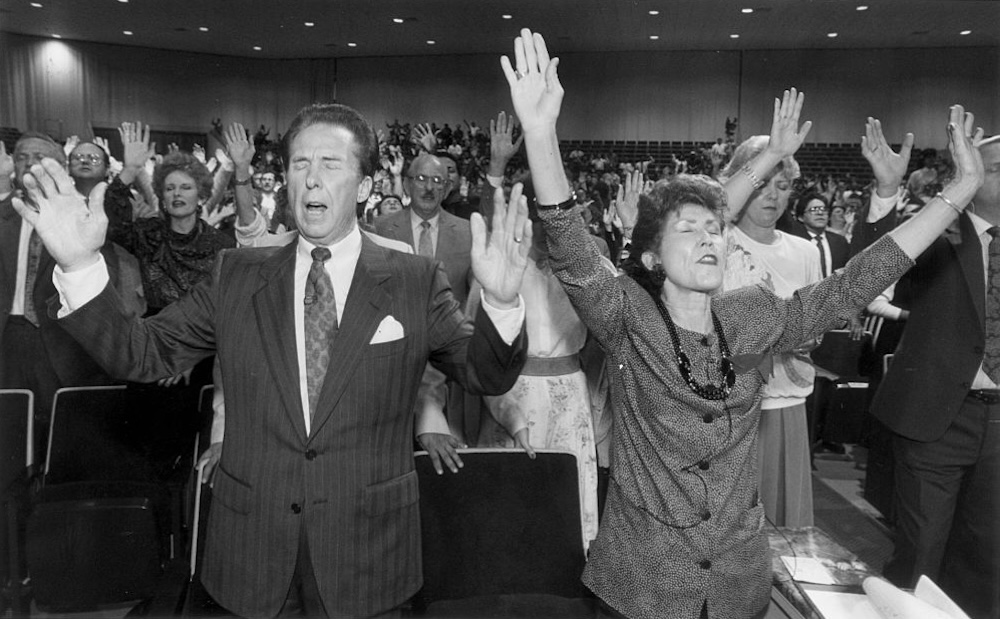
There’s a common view of religious history that holds that the further back you go, the stronger the smell of brimstone and the more conservative the beliefs. It isn’t true, and it obscures how much the human hand makes the world, including our ideas of the sacred. Joseph L. Locke’s new book One State Under God: A History of Religion in Texas is an important reminder that the conservative evangelical Christianity that dominates Texas, and through it has consolidated its influence over the country, was not a natural outgrowth of Christianity itself, but a product of historical developments.
Texas today is at the forefront of the campaign to tear down the wall between church and state. The Bible has been reintroduced in Texas classrooms, along with a new law requiring classrooms to display the protestant version of the Ten Commandments. Texas gave the country the prosperity gospel preached by televangelists, including the megachurch pastor and multimillionaire Joel Osteen. The state has been the proving ground for a fiery marriage between evangelicalism and conservatism. Religion has been woven through Texas history, and in turn Texas has woven a particular form of religion into American life.
But in One State Under God, Locke shows that the marriage of Texas conservatism and evangelicalism was never preordained. Indeed, Texas was once considered a “godless” land.
Christianity did not come easily to Texas. The first imperial attempt to impose it failed. Spain saw Texas as a bulwark against French expansion but never conquered it, physically or religiously. The missions of San Antonio, ancient by American standards, were sparsely populated. When Mexico declared independence from Spain, only two priests remained in Texas — and neither, observed the Tejano revolutionary Juan Seguín, was particularly religious. A Spanish official lamented the failure to make Texas a Catholic land, writing that it remained “under the domination of the barbarian.”
Locke takes us through Mexican and revolutionary Texas, where religious expansion ran into similar obstacles. For most of this period, the governance of Texas was an afterthought — the territory was administered as part of Coahuila y Tejas, literally tacked onto a neighboring Mexican state. And religion was an afterthought, too.
There was scant religious infrastructure in early Texas. Most of the Anglo migrants were protestants of the frontier variety, whose faith ran on circuit riders and camp meetings rather than settled clergy and church buildings, and Mexico had little interest in supplying Texas with priests. Much of life was secular: children went unbaptized, marriages went unrecognized, and burials were conducted in secular graveyards. Texans today may be taken for a religious bunch, but in those years they were seen as living at the edge of civilization, godless and rough.
As a Presbyterian minister wrote at the time, these Texans “generally appear in their personal depravity to have forgot if ever they did know or pretend to believe, that there was a God, or a devil,” and behaved as though “as soon as they had crossed the Sabine line, they considered also that they had passed over the line of spiritual accountability.” When conservative politicians call on Texas to embrace its Christian roots, then, it’s not entirely clear what roots they’re talking about.
The Bible Belt Gets Its Buckle
Anyone who has spent time in the South today can see the sway that Christianity holds over our politics. It wasn’t always so. According to Locke, a term like “Bible Belt” would have drawn puzzled looks in the early twentieth century. Nationally, “the South was not yet seen as an especially religious region, and religion did not seem particularly active in public life there.” Most religious Texans considered this a good thing. Separation of church and state was taken seriously by Texas politicians and Texas Baptists alike, who believed that it kept religion “pure and left the rest of the world to its hellish ways.”
What, then, brought Texas evangelicals into politics? One State Under God supplies the answer: prohibition, the jingoism of World War I, and the Ku Klux Klan. The fight over alcohol was the opening salvo. Governor Oscar Colquitt defeated his prohibitionist challengers in 1910 by stoking the state’s long-standing opposition to religious rule, saying, “The place of a preacher is in the pulpit and not in politics.” But his victory was short-lived, as the forces that had amassed to outlaw drinking on religious grounds found they rather enjoyed politics as a means of social purification.
By the early 1920s, the prohibitionists had won, the war had made loyalty a religious test, and the Klan had put a hundred thousand Texans in white robes. The preacher who best understood what all of that made possible was J. Frank Norris, who can be thought of as the nation’s first megachurch leader. Norris preached a fiery, reactionary Christianity, condemning communists, liberals, modernists, Catholics, and Jews. He turned on Baylor University, his own alma mater and the world’s largest Baptist college, hounding a professor out of his job for teaching evolution. He made common cause with the Klan. And he had a violent streak: Norris was tried for arson in 1912, and in 1926 he shot an unarmed man dead in his church office. He was acquitted both times.
Starting with a congregation of little more than a dozen, Norris built a church of thousands, and his radio show and newspaper reached many more. He founded a second church in Detroit and spent the 1930s flying back and forth between the two, in the early days of aviation.
Norris had influence, and he used it. When the Democrats nominated Al Smith for president in 1928, Norris raged against the Catholic from New York, prophesying that if a Catholic won power, “they would behead every Protestant preacher and disembowel every Protestant mother. They would burn to ashes every Protestant Church and dynamite every Protestant school.” Conspiratorial and paranoid religiosity had been let loose in Texas politics, and it would stay.
God and Landlords
The rise of conservative evangelical Christianity happened against the backdrop of two major mobilizations of working-class Texans. The first was the populist uprising, which united laborers and farmers, white and black, in a People’s Party that vied for power with the ruling Democrats. That movement was put down violently, and the defeat was followed by severe restrictions on the vote — not only for black Texans but for poor whites as well. Then the Socialist Party of Texas competed with the Democrats for the support of tenant farmers across the state. When James Edward “Pa” Ferguson won the governor’s mansion, he did it largely on a platform of tenant-farmer reforms lifted from the Socialist Party. Both movements leaned heavily on religion.
Locke notes that Christianity shaped the populists, and that the movement borrowed organizational methods from the Methodists, like sending out traveling lecturers. As I observed in my own book on Texas’s populist past, Thomas Lewis Nugent, one of the movement’s major leaders and its candidate for governor, called the life of Jesus Christ the “beginning of Christian socialism.” Black populist leaders like John B. Rayner preached to rural Texans as well.
But Locke argues that despite these more radical strains, “Texas’s new wealth infected the Baptists and the Methodists and the Presbyterians,” especially once the oil boom erupted. His account of the two Christianities that divided Texas through slavery and Reconstruction is the book at its strongest: one belonging to the slaveholders, which preached a paternalistic apologetics for chattel slavery, and one belonging to black Texans, which held out liberation for the enslaved and judgment for the wicked in the next life. It is a distinction he largely stops drawing once emancipation arrives — a shame, because the decades that follow are full of it.
Take the example of John B. Rayner. After the defeat of the populist uprising, he began taking money from the same landlords and bosses he had once opposed and wound up in the employ of the lumber baron John Henry Kirby, no longer speaking of liberation or the cooperative commonwealth but of personal responsibility and the self-help programs of Booker T. Washington. Kirby at the time was trying to break the Brotherhood of Timber Workers, one of the first interracial unions in the South. What Rayner was hired to do, preachers were hired to do across the cotton fields of Texas and the South: attack the “sinful ways” of the poor and keep their attention off the men robbing them. This was a Christianity bankrolled by the wealthy to keep working people in line.
Locke does not ignore the alliance between the evangelical movement and the rich; he shows in detail how religion in Texas was cultivated for political ends. What he leaves out is this particular use of it, as a weapon against the agrarian revolts of the populists and then the socialists, who had made religion a common language for uniting tenant farmers across the state. Texas is a big place with a long history, and any book about it has to make cuts.
In the decades that followed, the familiar alliance between evangelical Christianity and free-market conservatism came into the open. As Locke notes, the change was captured in Ronald Reagan’s line to a gathering of evangelical leaders in Dallas in 1980: “I know that you can’t endorse me, but I want you to know that I endorse you.” That rally was organized by the Texas televangelist James Robison, and men like him had by then steamrolled what was left of the prohibitions on religion in politics. The long campaign to remake religion in the image of the Right was complete.
Today Texans live in the evangelical right’s world: abortion is banned, the Ten Commandments hang in classrooms, and the Texas GOP has its eyes on ending no-fault divorce. But the great service of One State Under God is to show that this world was deliberately made — and that what was made can be unmade.
Read the full story at the source
Source: Jacobin