
World · Jacobin · · 4h
Report: The Working-Class Vote Is Not Lost
English (original) · Read in Deutsch ⇄
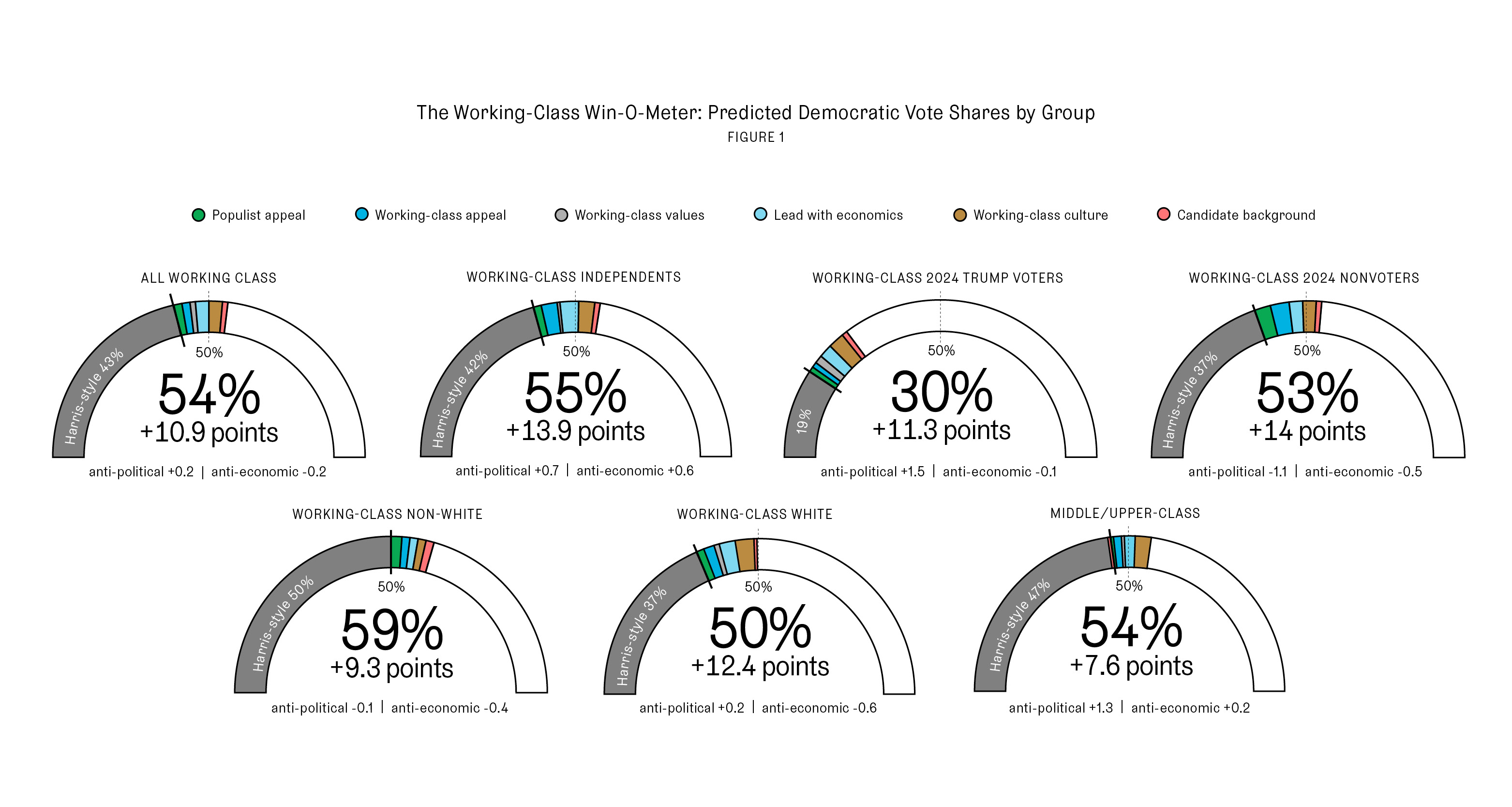
A new survey experiment from the Center for Working-Class Politics and Joan C. Williams finds that a six-part formula can lift Democrats’ working-class vote share by nearly 11 points. It also adds nearly 8 points among the party’s affluent, college-educated base. More than 40,000 respondents evaluated nearly 800,000 hypothetical candidate profiles, making the study one of the largest of its kind. The project was supported by Jacobin and the Rosa Luxemburg Stiftung. The formula boils down to two imperatives: lead with working-class economics and connect with working-class values.
Earlier this summer, Jared Abbott of the Center for Working-Class Politics (CWCP) and Joan C. Williams of the Equality Action Center (EAC) released “The Left’s Coalition Crisis,” a study of working-class and college-educated voters that showed how Democrats could hone their policy messaging to win back working-class voters without losing their college-educated base.
Their second study, produced by Jacobin and fielded between April and June 2026, moves beyond testing messages in isolation and puts voters in a virtual voting booth. Respondents worked through a series of head-to-head matchups and chose which candidate they would vote for, or neither. Because every trait — demographics, class background, rhetoric, issue priorities, and economic and cultural positions — was assigned at random, the researchers can isolate how much each one moves the vote. The design also does something surveys rarely do: every matchup pits a complete Democratic candidate against a complete Republican one. Since party identification decides the large majority of votes, building partisanship into the experiment makes the estimates far more realistic, and more conservative, than those of most studies of this kind.
The result is the Working-Class Win-O-Meter: a data-driven road map for winning back working-class voters, accompanied by a candidate tool kit and an online tool to allow people to better dig into our results.
Some of Our Key Takeaways
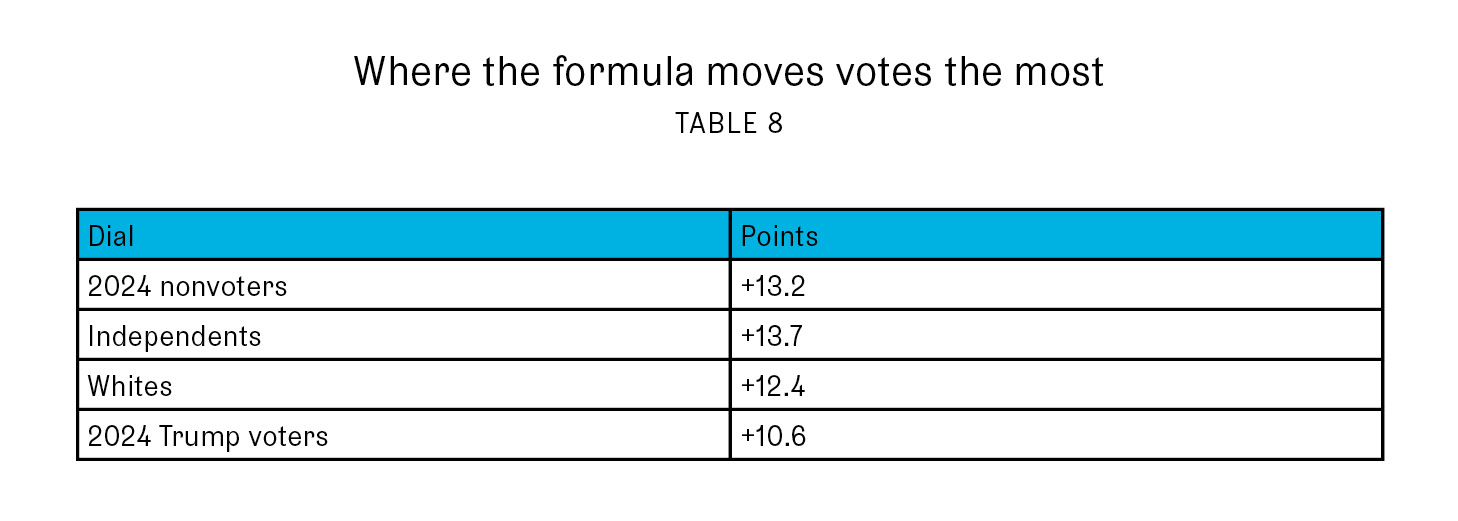
The formula moves the most votes among the voters progressives most need. Turning all six dials adds 10.9 points among working-class voters overall, but the gains are considerably bigger among the groups the party has struggled with: close to 14 points among working-class independents, about 13 points among 2024 nonvoters, and nearly 11 points among 2024 Donald Trump voters. At the district level that works out to a swing of 2 to 3 points in the two-party vote — more than Democrats’ 2024 losing margins in Wisconsin (0.9 points), Michigan (1.4), and Pennsylvania (1.7).
Lead with working-class economics. Making working-class economics the campaign’s top priority, rather than defending democracy or leading with climate or culture-war issues, raises working-class support by 2.8 points. The payoff is largest with the swing voters the party needs back — 4 points among working-class independents and 3.3 among working-class 2024 Trump voters — and it also adds 2.3 points among the college-educated base. An earlier CWCP–EAC study found that ten of the twelve top working-class priorities are economic. One caution: whereas the college-educated base is fixated on prices, working-class voters (like black college graduates) care just as much about higher wages and economic opportunity.
Progressives can (mostly) go bold on economics without paying a price. Where the study tested an ambitious version of an economic policy against a cautious one, on jobs, wages, unions, skills training, and industrial policy, the ambitious version matched or beat the cautious one. A $17 minimum wage, the highest tested, was also the most popular, outperforming $15 by 2 points and $12 by 3 points. Funding 500,000 skilled-trades apprenticeships a year performed as well as a modest employer tax break; a million public jobs rebuilding roads, bridges, and public buildings tied with simply funding job training; and $150 billion a year in manufacturing and infrastructure investment tied with a small tax credit. What working-class voters decline to reward are new tax-and-transfer programs with no connection to work, abstract market rules such as antitrust, and higher business tax rates. Form, not ambition, is what determines how a policy lands.
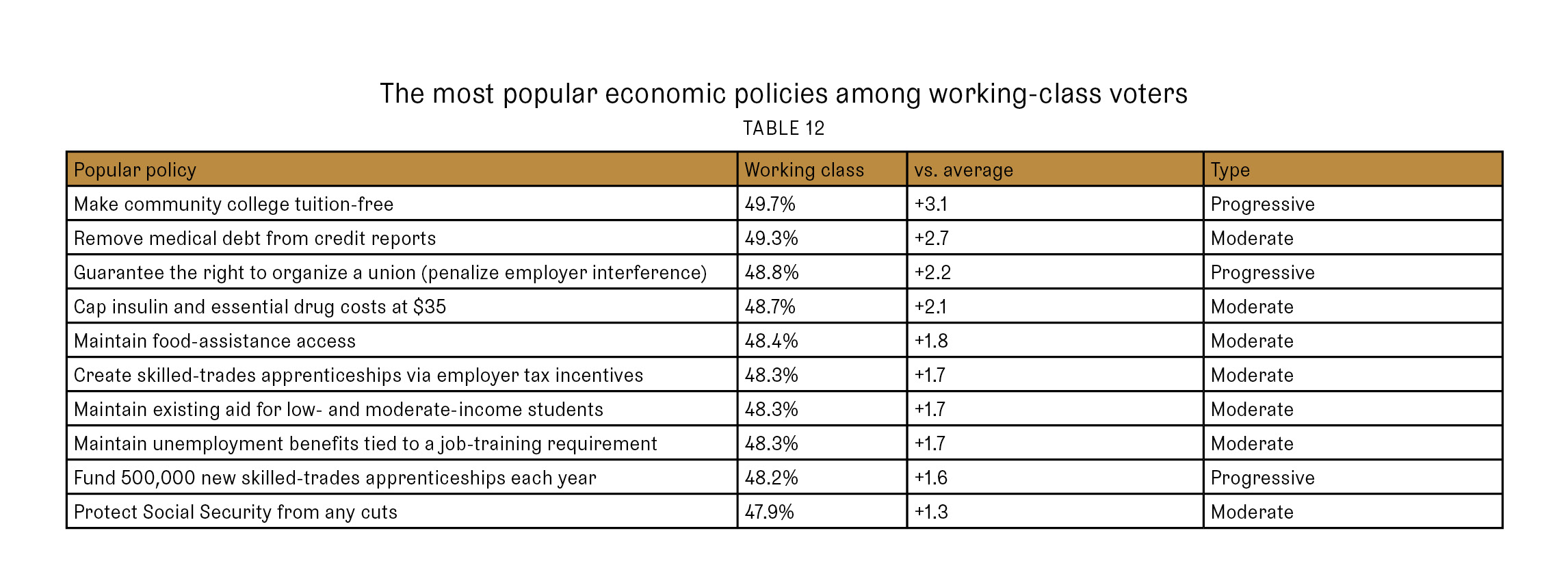
The most popular policies defend what people already rely on and reward hard work. Of the forty-five Democratic economic policies tested, the most popular is one that has rarely topped the party’s affordability agenda: tuition-free community college. Protecting existing programs — the Supplemental Nutrition Assistance Program (SNAP), current student aid, Social Security benefits — generally outpolls sweeping new ones such as free four-year college. Among new programs, working-class voters favor those that make hard work pay off in good jobs, including apprenticeship programs and a guaranteed right to organize. This tracks a long-documented pattern: Americans are wary of redistribution in the abstract, until a program passes and becomes untouchable.
It’s not only the economy: connecting with working-class values is worth up to 8 more points. The second headline cuts against James Carville’s old maxim. The study identifies five ways to do it, described in the takeaways that follow.
Adopt culture and climate positions that resonate with working-class values. This is the most powerful of the five, adding 2.9 points overall and 3.3 among working-class Republicans. A validated scale identifies the values in question: loyalty to community and country, pride in hard work, respect for traditional institutions and for playing by the rules, personal security, and anti-elitism. Resonance does not mean surrendering the causes the college-educated base cares about; it means tying those causes to working-class values. “Abolish ICE,” as described below, is not popular in the abstract, yet 70 percent of working-class respondents back a path to citizenship for immigrants who have held jobs, paid taxes, and “stayed out of trouble.”
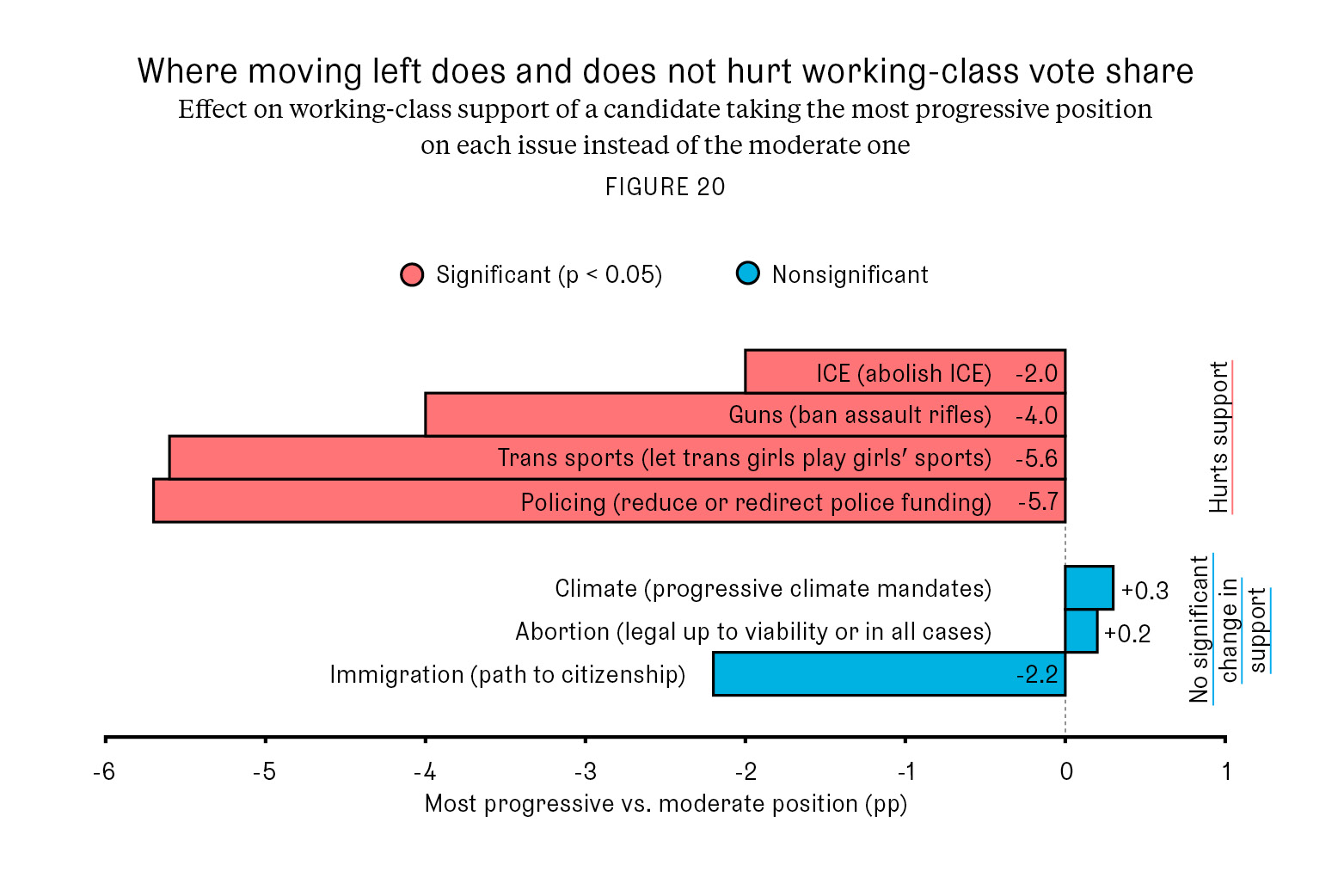
“Moving to the center” carries no consistent advantage. Consistent with recent work by David Broockman and Joshua Kalla, the study finds no reliable payoff from moderating across the board. What costs votes is not progressive policy in general but a handful of positions like defunding the police and banning assault rifles. Reducing or redirecting police funding runs 5.7 points behind pairing body cameras with de-escalation training; banning assault rifles costs 4 points relative to universal background checks; and abolishing Immigration and Customs Enforcement costs 2 points relative to reforming it. Progressive social positions framed in working-class values, by contrast, perform about as well as moderate ones. Leading on economics also marginally softens the penalty for progressive social stances — the “Mamdani effect” — trimming it from about 2.9 points to about 1.7.
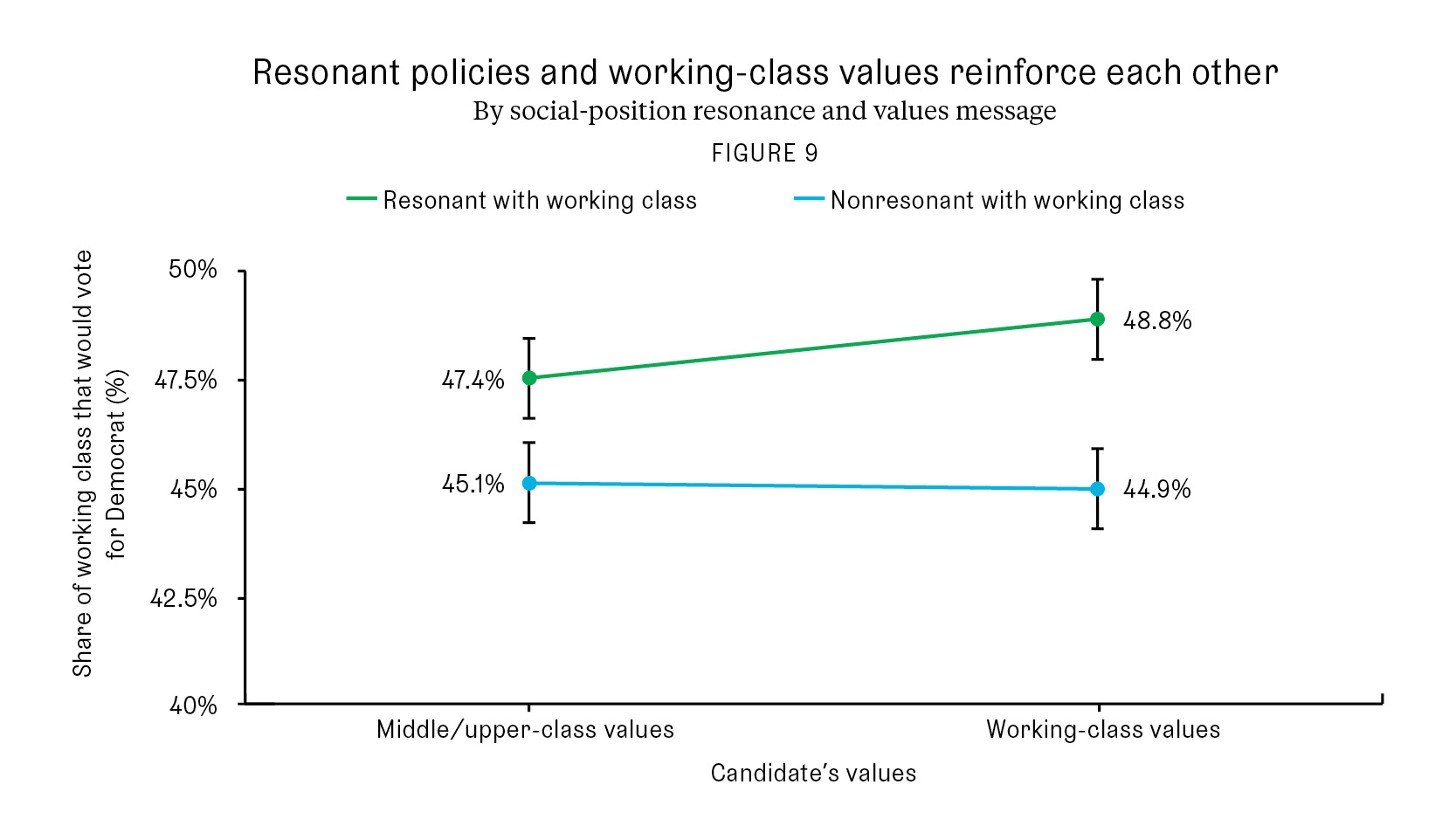
Pair those positions with an explicit statement of working-class values. Combining a resonant culture or climate policy with a direct appeal to working-class values adds another 1.6 points, and nearly 5 points among 2024 Trump voters. A candidate might, for instance, invoke loyalty to community and country by saying the country should look after its own communities first.
Say you will listen to working-class people. Candidates who promise to listen more to working-class people, or to people from all walks of life, gain about 1.9 points, and a full 4 points among 2024 nonvoters. That beats centering the middle class, which is what Kamala Harris did in 2024 and what many other Democrats have done for decades.
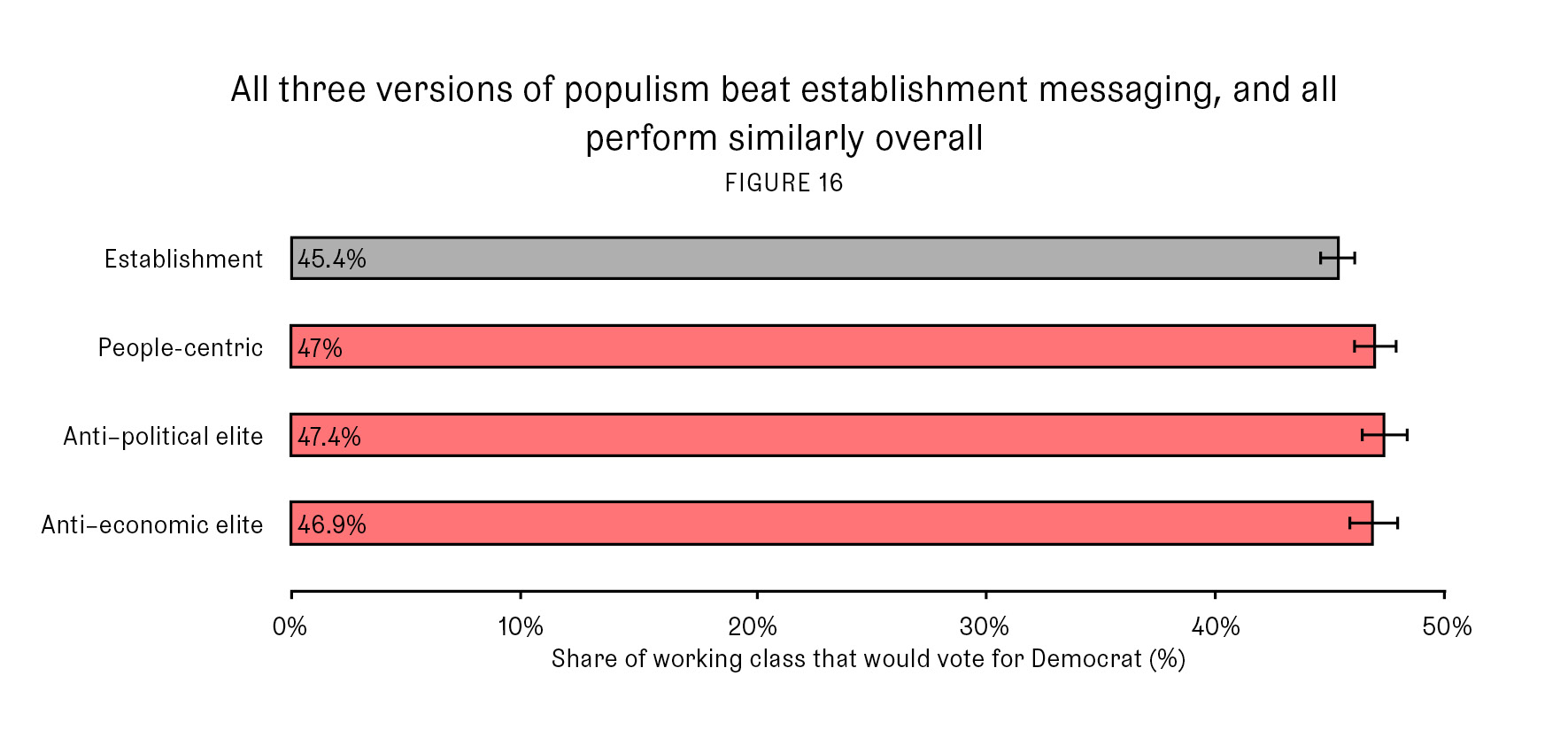
Use populist rhetoric and choose the right villain. Populist rhetoric adds 1.7 points, and most Democrats already use some version of it. The trap is the reflex to lean on expertise: candidates should praise the common sense of ordinary people rather than demand deference to experts. The target matters too. Attacking economic elites appears to lift support among the base, though only marginally significantly, and does little with working-class voters, whereas attacking political elites reaches a different group Democrats need, lifting support among middle- and upper-class moderates by 3.7 points.
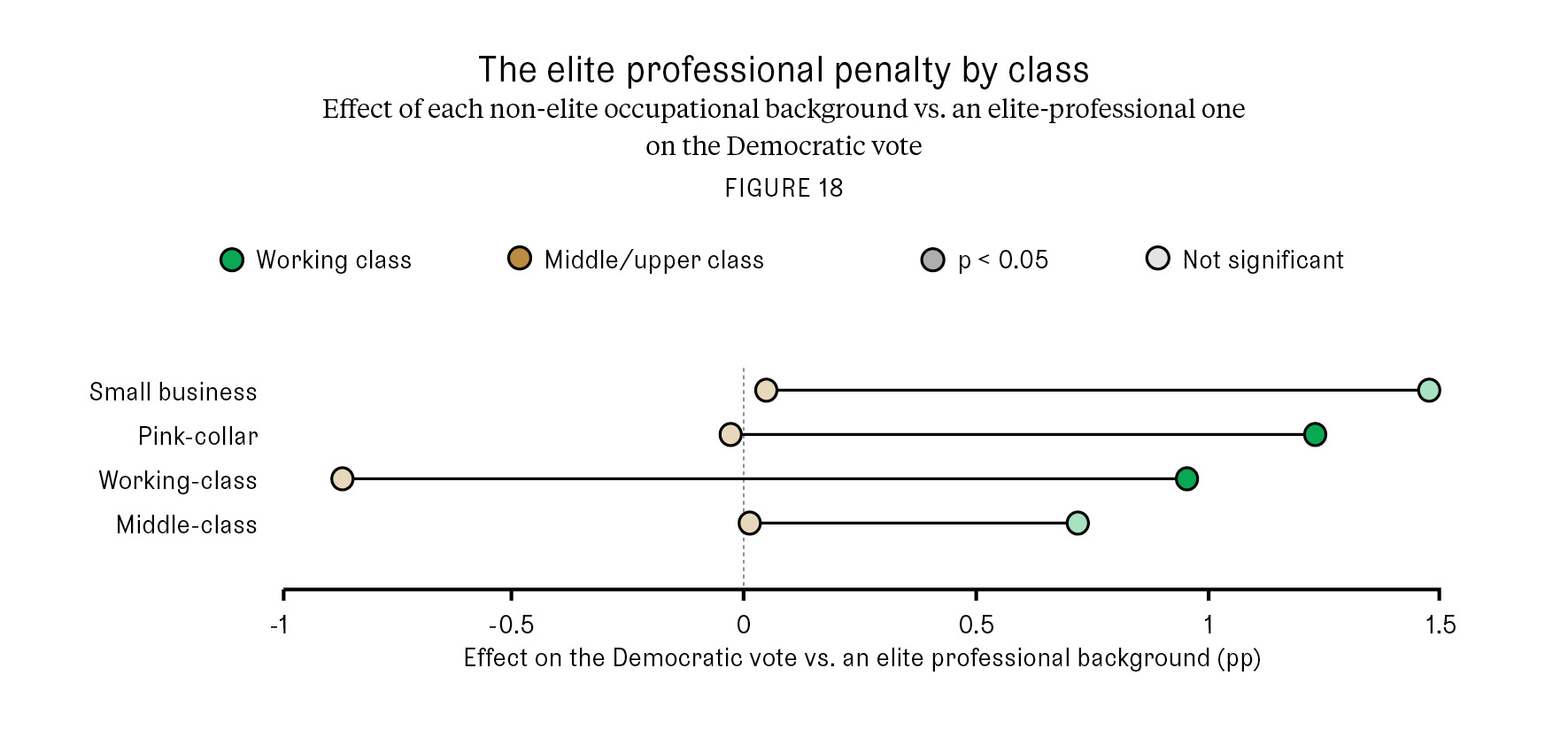
Candidate class background matters. An elite professional résumé is the background working-class voters penalize most, and any non-elite background helps. But the blue-collar archetype is not required. Small business owners, pink-collar workers such as nurses and teachers, and service workers such as servers and retail clerks do just as well with working-class voters as blue-collar candidates. The dividing line is between elite professionals and everyone else, not between one kind of non-elite background and another. For the many Democrats who do come from elite backgrounds, this dial is worth about 1 point — a gap the other five can more than close.
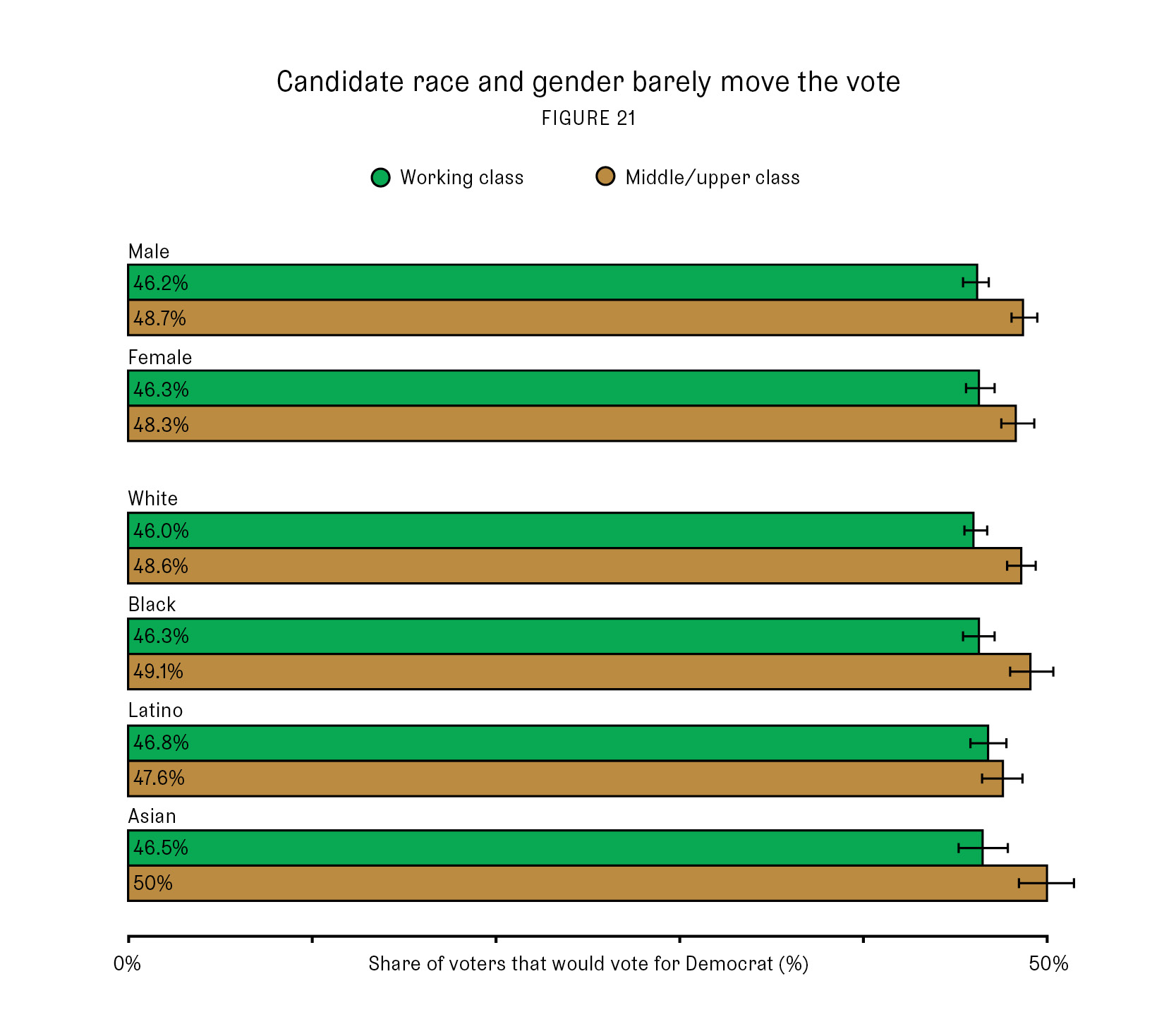
Candidates’ race and gender don’t matter to most working-class voters. The study independently randomized each candidate’s race (white, black, Latino, Asian) and gender. Neither had a significant effect on its own. The one exception is co-ethnic affinity: a black Democrat gains 3.3 points among black voters and a Latino Democrat gains 2.2 points among Hispanic voters, while white voters impose no penalty on a candidate of another race.
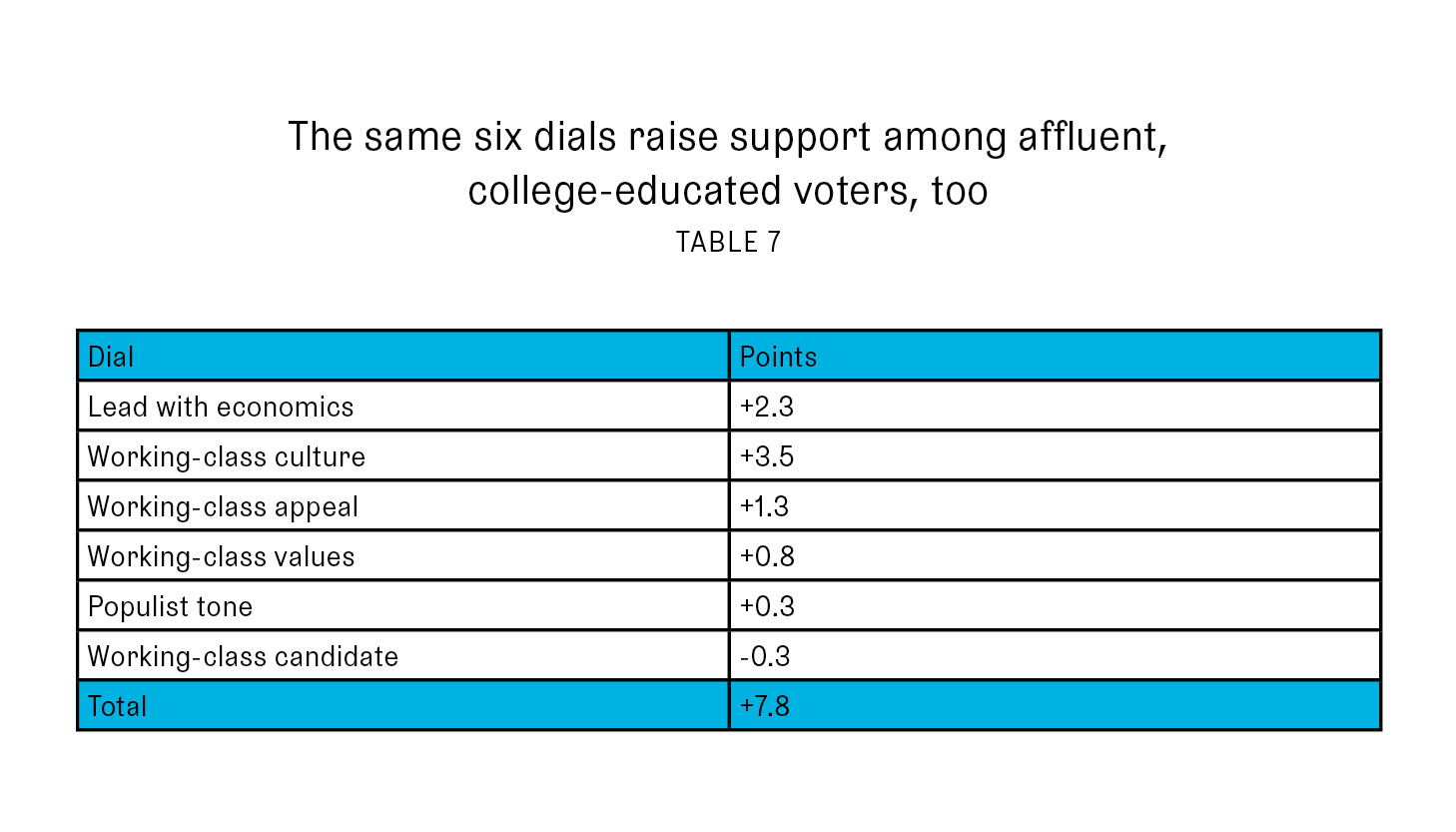
There is no trade-off with the college-educated base. None of the six dials provokes a significant backlash among higher-income, college-educated Democrats, and the formula as a whole raises their support by about 7.8 points.
The Harris Test Case
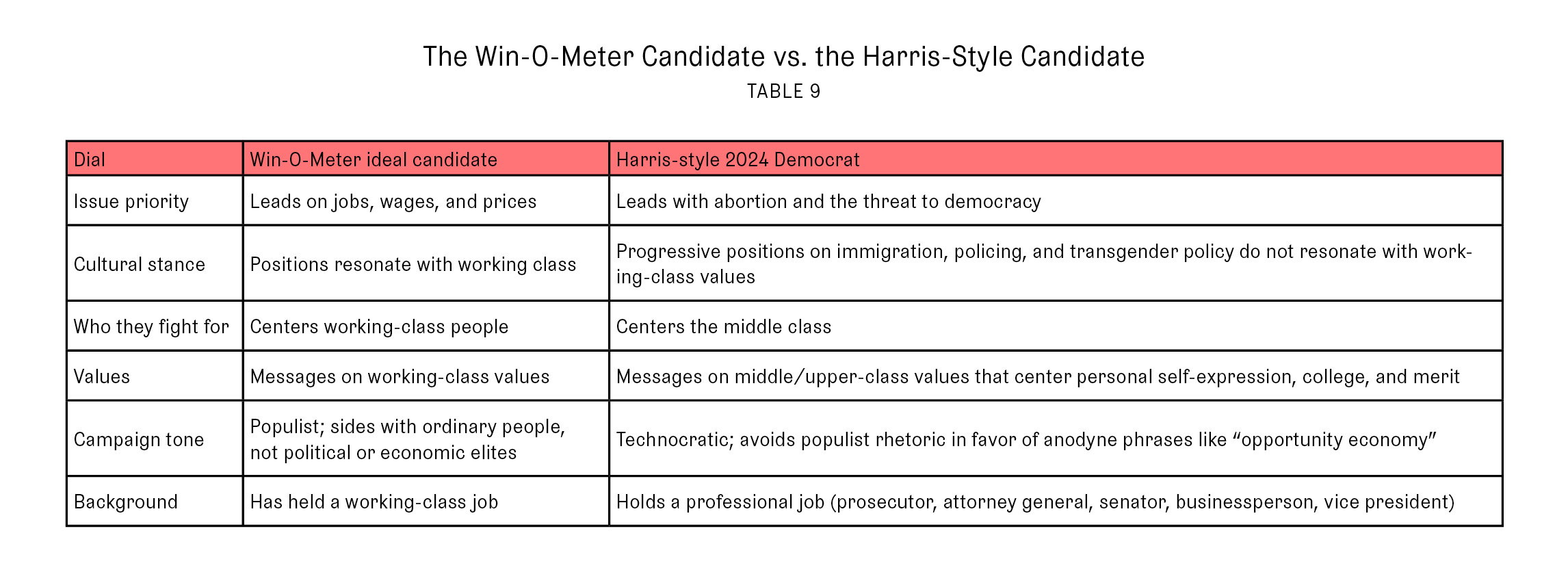
The formula’s gains are measured against a Harris 2024–style Democrat, and the comparison is not a straw man: every element of that profile scored poorly in the experiment. Harris foregrounded abortion rights and the threat to democracy over a wages-and-prices message. She struck a technocratic “opportunity economy” tone, leaning on expertise and credentials rather than the populist tone that scored far higher. She led with her professional résumé — prosecutor, attorney general, senator, vice president — the background working-class voters penalize most. And she repeatedly appealed to “the middle class” rather than “the working class,” a choice that ran about 2 points behind. As the authors put it, the Harris-style profile is assembled from the lower-scoring option on every dial.
In the end the Win-O-Meter confirms what any skilled politician understands: voters back candidates who seem like them and who seem to like them. The prescription is simple — lead with working-class economics and connect with working-class values — and it points toward a big-tent coalition that does not require demonizing anyone.
Read the full report here.
Contact:
Authors: jared@workingclasspolitics.org
Press: publicity@workingclasspolitics.org
Read the full story at the source
Source: Jacobin