
World · Jacobin · · 3h
Reasons of Empire
English (original) · Read in Deutsch ⇄
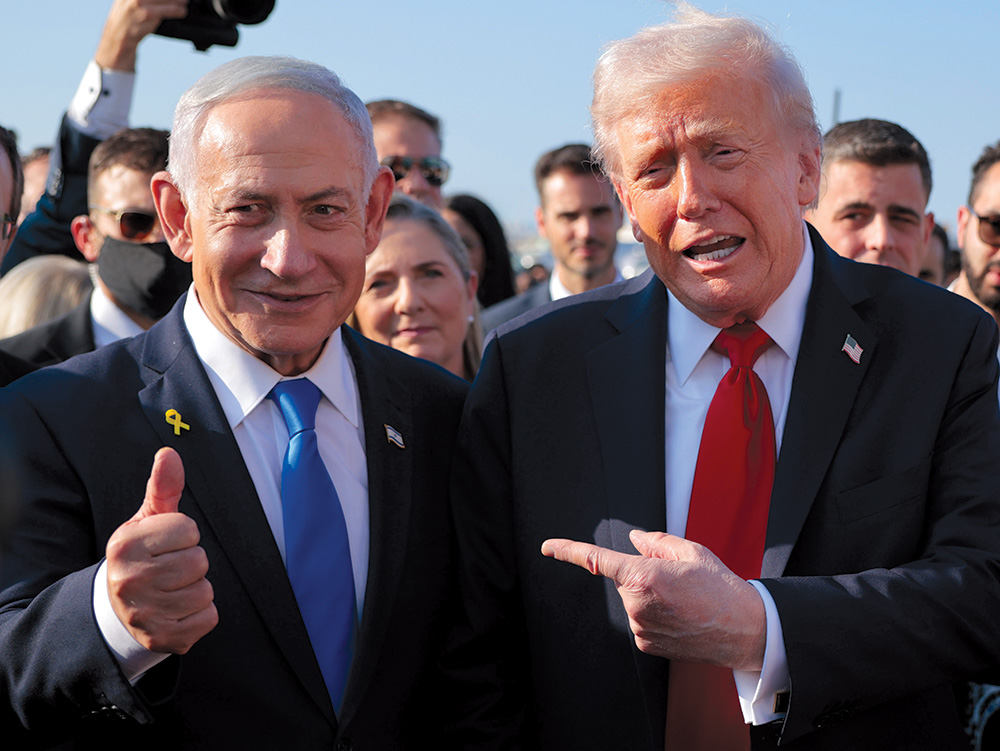
It happens every time now. The United States jumps headfirst into a Middle Eastern quagmire, and, like clockwork, voices start rising, blaming it all on Israel. The two most salient cases of this exercise unfolded around the 2003 invasion of Iraq, led by the George W. Bush administration, and the joint US-Israeli onslaught on Iran that began on February 28, 2026, led by the second Trump administration.
The best-known “blame it on Israel” controversy remains the one touched off by John Mearsheimer and Stephen Walt. It began with an article of theirs published in the London Review of Books in 2006 before being developed the year after into a hefty book of close to five hundred pages, The Israel Lobby and U.S. Foreign Policy. The two authors began this work at a time when the Bush administration’s fiasco in Iraq had become so blatant that the US Congress had to intervene and appoint a bipartisan commission — the Iraq Study Group, also known as the Baker–Hamilton Commission — tasked with designing a way out of what had evolved into a damaging morass.
This fact alone raises a question: Why hadn’t the two authors reacted in the same way to the previous devastating war waged on Iraq by the United States, the original 1991 onslaught led by the George H. W. Bush administration? After all, Israel’s interest in destroying both Iraq’s armed forces and the country’s infrastructure back then was certainly greater than any interest it might have had in seeing American troops occupy the country in 2003, especially as they brought with them from exile the Iraqi allies of Israel’s regional archenemy, Iran, and included them in the postinvasion Coalition Provisional Authority.
Prior to the 1991 onslaught, Saddam Hussein’s Iraq had come out of its eight-year war against Iran with a swollen army and a huge debt. It invaded the oil-rich Emirate of Kuwait in August 1990 in an attempt to solve its economic problem and fund the preservation and development of its armed forces. Israel obviously had a huge interest in the destruction of that Iraqi state, and it would have been easy to build a compelling argument showing how both the Israeli government and the Israel lobby had intensively and decisively intervened on the side of the pro-war section of the US establishment.
It’s no great mystery why Mearsheimer and Walt omitted this history: they both supported that war, which they likely saw as serving the United States’ national interest — a concept that refers to a state’s interest in a traditional “realist” manner, with no regard to the specific social interests this state represents. The two academics’ conservative brand of realism thus construes the world as divided among powers whose legitimate interests stem from their geopolitical position and their drive toward achieving regional or global hegemony.
As realists, Mearsheimer and Walt were very much in tune with the senior Bush administration’s own realism, which converged with the view of Washington’s Arab allies that, in the absence of a credible alternative suiting American hegemony, the overthrow of Saddam Hussein’s regime was to be avoided. This is why the 1991 onslaught stopped short of marching on Baghdad, a position that led to bitter recrimination from some neocons and their Iraqi allies, who saw in it a betrayal of their aspiration for regime change. Trump would later heap scorn on the regime change ambition once it had failed, fully endorsing the so-called realist approach.
The contrast between the 1991 war and the 2003 invasion was blatant — not only because the neocon-stuffed Bush administration pursued regime change, much to the annoyance of the Arab oil monarchies, which rightly feared that the real beneficiary would be their nemesis Iran, but also in the war’s rationale from the standpoint of the US national interest as Mearsheimer and Walt perceived it.
They found the decision to overthrow Saddam Hussein “difficult to fathom.” Hussein was, they granted, “a brutal tyrant with worrisome ambitions — including a desire to obtain WMD — but his own incompetence had put these dangerous objectives out of reach. His army had been routed in the 1991 Gulf War and further weakened by a decade of UN sanctions,” leaving Iraq’s military power “never impressive except on paper” and “a pushover by 2003” without weapons of mass destruction.
Yet in the aftermath of 9/11, when one would have expected the United States to be focusing laser-like on al Qaeda, the Bush administration chose to invade a deteriorating country that had nothing to do with the attacks on the World Trade Center and the Pentagon and was already effectively contained.
For Mearsheimer and Walt, it was “a deeply puzzling decision.”
The worst possible key to this “puzzle” is indeed Israel, for the obvious reason that the above factors determined the Zionist state’s own priorities even more than those of the United States. Why on earth would the Israeli government be keen on inciting the United States to invade Iraq when this country had already been crippled by the devastating destruction of its military power, along with its civilian infrastructure, in 1991, followed by a dozen years of US-inflicted strangulation? Would anyone believe that Israel was less worried than the Gulf’s Arab oil monarchies about Iran potentially seizing control of Iraq? And yet such obvious considerations did not prevent Mearsheimer and Walt from laying the blame on the Israel lobby, while carelessly lumping together specifically pro-Israel US institutions — the most notorious of them being the American Israel Public Affairs Committee (AIPAC) — and the neocons, in particular those who lobbied for the invasion of Iraq as members of the Project for the New American Century (PNAC).
The two academics did a good job of exposing the nefarious influence of the Israel lobby on US Middle East policy in general. For this, they were unfairly accused of antisemitism, a charge that Israel and its supporters deploy against most critics. But they also provided ammunition to the “blame it on Israel” stratagem, to which they fully adhered.
Their argumentation mobilized numerous quotes from Israeli sources — politicians and media — in order to demonstrate that Israel had intensively lobbied for the 2003 invasion of Iraq, which was done against the US “national interest.” There is no doubt, of course, that many Israeli politicians supported the George W. Bush administration’s drive to occupy Iraq. The most enthusiastic among them was Benjamin Netanyahu, except that — during the crucial period of discussion in the United States, in which he took part by testifying under oath as a private individual before a committee of the House of Representatives — he was at the same time busy maneuvering against his rival Ariel Sharon, who was then Israel’s prime minister and leader of the Likud party.
The case regarding Sharon’s lobbying for the 2003 invasion of Iraq is much more tenuous. Of course, the Israeli PM could hardly openly state his reservations (and those of the Israeli intelligence community) about the pet project of a US administration backed by many of Israel’s friends within the American establishment. But by the time Mears-heimer and Walt’s thesis had become a topic of heated discussion, significant evidence pointing to those reservations, and their expres-sion through discreet channels, had emerged. A prom-inent testimony in this regard is that of Lawrence Wilkerson, chief of staff to Secretary of State Colin Powell, who said in a 2007 interview that Israel had warned the United States not to invade Iraq.
The debate boils down to this: Was the invasion of Iraq undertaken following pressure from Israel and its supporters against the US national interest, or was it undertaken in pursuance of that national interest, as understood by the George W. Bush administration?
Consider the difference between AIPAC and PNAC — one that’s visible in their respective names. It is indisputable that PNAC played an incomparably greater role in the administration’s decision to invade Iraq than whatever specific component of the Israel lobby did. The three most influential members of the administration — Dick Cheney, Donald Rumsfeld, and Paul Wolfowitz, who also happen to be the three most involved in the Iraq adventure — were among PNAC’s twenty-five founders, as was Zalmay Khalilzad, Bush’s ambassador to Iraq.
Unlike AIPAC, however, PNAC’s rationale was not support for Israel but the drive for a “new American century,” as its name indicated: in other words, the furtherance and consolidation of US imperial hegemony over the rest of the world. In the January 1998 PNAC letter to Bill Clinton urging him to invade Iraq, the eighteen signatories mentioned Israel only once and on a par with America’s Arab allies: “The safety of American troops in the region, of our friends and allies like Israel and the moderate Arab states, and a significant portion of the world’s supply of oil will all be put at hazard.”
The letter expresses the most widely shared view of what US national interest consisted of within elite circles. Instead of focusing on the discussion of that view, Mearsheimer and Walt — two members of the US foreign policy establishment themselves — chose to lay the blame on the Israel lobby, a stratagem that allowed them to explain the Iraq fiasco without a frank and open (and more difficult) discussion of US imperialist interests, aka national interest.
This is not wisdom in hindsight. Many critics of US imperialism have explained why the belief that Israel was dictating US policy in the Middle East was, in fact, a case of the tail wagging the dog. The point requires a historical perspective. By the early 1960s, a radicalizing Arab nationalism had forced Washington to give up its direct military foothold in the region — it abandoned the Dhahran air base, in the heart of Saudi Arabia’s oil fields, just as the interests that base was meant to protect came under threat. Unable to intervene openly without inflaming Arab hostility further, the United States found in Israel a priceless strategic asset. As I wrote in 2003, “On the one hand Israel played a military role as watchdog of imperialist interests in the region. On the other hand, Washington derived political benefits in Arab countries’ eyes by showing that it had a grip on the watchdog’s leash.”
Seen from this perspective, the sums the United States spends on Israel represent one of the most profitable investments it has ever made in building up its hegemony. Compare the more than $300 billion (adjusted for inflation) in total economic and military assistance that Washington provided Israel between 1946 and 2024 with the $1.5 trillion that the Trump administration is requesting for the Pentagon for the next fiscal year alone. It is obvious that what economists call the “marginal utility per dollar spent” on Israel is far greater than that of the same dollar added to the gigantic US military budget.
This perspective allows for a much closer understanding of what was at stake in the 2003 invasion project and what was revealed, the year after it took place, about the debates it had led to, not only within the Bush administration but also between Washington and its Arab allies (and, behind the scenes, Israel). I commented on these debates in May 2004, long before the Mearsheimer–Walt controversy, in an article entitled “Bush’s Cakewalk Into the Iraq Quagmire.”
Mearsheimer and Walt cannot bring themselves to see that the guiding rationale of US policy in the Middle East is the strategic importance of the Gulf to US imperial interests — common knowledge since 1945. Nor will they admit that this same importance is the main rationale for the US-Israeli alliance itself. So they join in the refusal to concede what Alan Greenspan, Federal Reserve chair from 1987 to 2006, acknowledged in his 2007 memoir: that “the Iraq war is largely about oil.” Greenspan, no radical, called Middle East instability the eight-hundred-pound gorilla capable of halting world economic growth — a factor, he noted, that sober energy forecasting cannot pretend away.
Today US control of the Gulf’s oil flow matters less for the United States’ own supply than as leverage over others: over import-dependent China, its only real peer competitor, and over its own import-dependent allies in Europe and East Asia. And the prize is not just oil but oil money — the petrodollars Greenspan left out. The sovereign wealth funds of the six Gulf Cooperation Council (GCC) monarchies together manage nearly $6 trillion, more than 40 percent of the global total. Those same states are crucial customers of the US military-industrial complex: according to the Stockholm International Peace Research Institute, three of them — Saudi Arabia, Kuwait, and Qatar — ranked among the world’s top ten arms importers in 2020–24, with the United States supplying 74 percent of Saudi imports, 63 percent of Kuwait’s, and 48 percent of Qatar’s.
Add the well-known business interests that the Trump, Kushner, and Witkoff families hold in and with the GCC states as well as the increasingly decisive stakes of the tech oligarchy, and the sheer range of US interests in the Middle East comes into view. These weighed more heavily than any other factor, Netanyahu’s incitement included, on Trump’s decision to join Israel’s strikes on Iran in June 2025 and then, on February 28, to wage a joint war alongside it. To imagine that Trump launched a military expedition of this scale mainly to please Netanyahu misreads the “America First” president as badly as the notion, popular before his second inauguration and for months afterward, that he was an antiwar man of peace.
The only argument that could make the case that striking Iran’s nuclear program served no US national interest was made, almost preemptively, by Mearsheimer and Walt in their original 2006 article. Iran’s nuclear ambitions, they granted, gave Washington its own reasons for concern — but, they went on, those ambi-tions posed no direct threat: “If Washington could live with a nuclear Soviet Union, a nu-clear China or even a nuclear North Korea, it can live with a nuclear Iran.”
This is but another blatant underestimation of the strategic importance of the Gulf region for US imperial interests. The United States could do nothing but adapt its nuclear strategy to the growth of China and the USSR’s arsenals. The nuclear armament of North Korea, a country adjacent to China and under its wing, was of limited strategic significance for Washington: it did not substantially change the balance of forces in East Asia. The same goes for the nuclear armament of India and Pakistan and their mutual deterrence. A nuclear Iran, however, would be a very different story indeed. It would jeopardize US hegemony in the Gulf region by demonstrating a major failure of its pledge to provide protection to its vassal states. It would also trigger a nuclear race in the region, greatly compromising the security of this highly strategic part of the world, way beyond Iran’s already significant role in compromising it through its regional proxies and allies.
It is thus highly credible that, behind the Saudis’ official line of appeasing Iran, Riyadh actually joined Israel in encouraging Trump to go to war, as reported on day one by the Washington Post. In any event, Trump would not have gone to war before consulting his local friends, foremost among them the Saudis and the Emiratis. It is most unlikely that he would have gone to war had he encountered real pushback from these two key regional allies. The only plausible and meaningful reservation against the war was likely expressed by the emirate of Qatar, which has always hedged against risks by befriending everyone, from hosting the key US regional military base and command center to cozying up to Tehran and its allies — and which stood to be heavily affected by the war, as indeed happened. But Qatar’s influence on Trump is much weaker than that of the Saudi kingdom and the UAE, despite its attempt to enhance its influence by gifting Trump a luxurious Boeing plane taken from its own princely fleet.
All of the above does not alter the fact that Trump and his administration have launched what I called “the most botched up of all US imperial wars.” And it didn’t take long for everyone to notice that, compared to the imperialist expedition against Venezuela, Washington faces a much tougher nut to crack, with the risk of having to choose eventually between escalating the war with no exit strategy and exiting it without achieving its proclaimed goals. That is precisely when voices started rising from every corner — from the far right, à la Tucker Carlson, to figures of the mainstream MAGA crowd, to even some on the Left who believe that anti-Zionism requires the espousal of the Israel lobby thesis.
Aside from those who fantasize about an all-powerful Israel, thus belittling the United States’ own huge imperialist interests, most of those who resorted to the “blame it on Israel” stratagem, consciously or by knee-jerk reaction, deflected attention away from those very imperialist interests, which they strongly endorse as clearly corresponding to the so-called US national interest.
That Netanyahu and his far-right government as well as the entire Israeli power elite were wholeheartedly in favor of the war on Iran is beyond question. That they are the ones to blame for Trump and his team’s highly blundered engagement in this war and conduct of it just does not hold up. One can in fact make the opposite case: that Netanyahu is Trump’s poodle, as was said of Tony Blair at the time of the invasion of Iraq, judging by how the US president is treating the Israeli prime minister. Netanyahu now stands accused by the Israeli opposition of being a “puppet” and turning Israel into a “vassal state.” The inescapable truth is that, whatever advice Netanyahu might have given Trump, the crucial responsibility for the ongoing war lies with the American president, along with those members of his administration who share his delusions of grandeur.
Read the full story at the source →
Source: Jacobin