
World · Jacobin · · 4h
Raphäel Glucksmann, a Hawk in Progressive Clothing
English (original) · Read in Deutsch ⇄
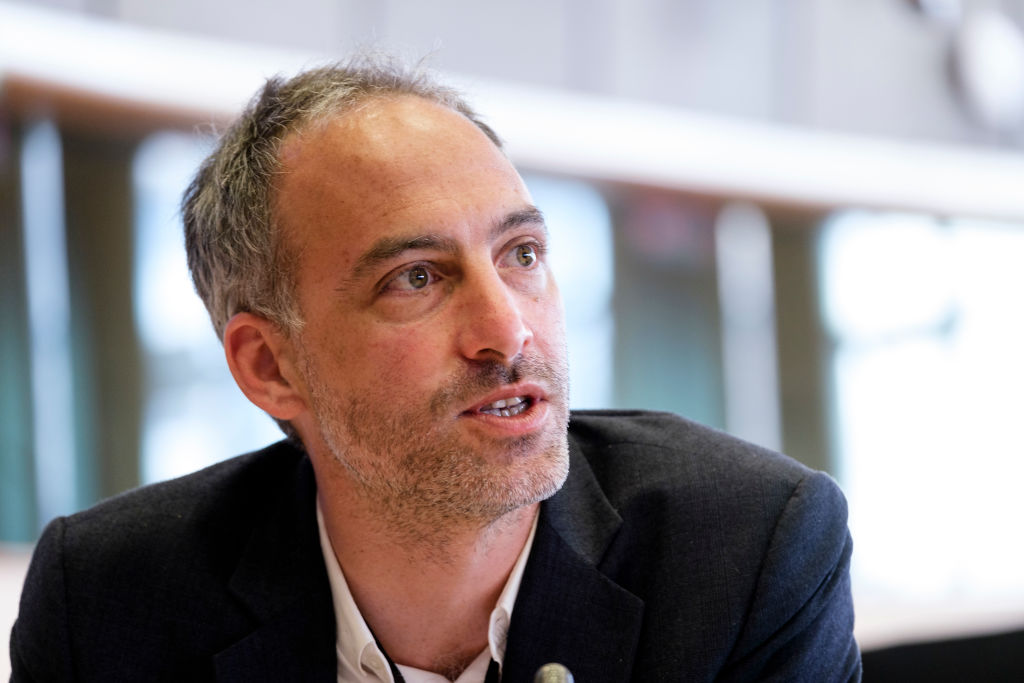
On August 23, Raphaël Glucksmann, the French essayist and member of the European Parliament (MEP), officially announced what had long been an open secret: his candidacy for the 2027 presidential election as a standard-bearer of the French center left.
To my eyes, his candidacy is a disaster in the making and, in fact, a story I’ve already seen unfold from close range. I first encountered him not in Paris elite circles but in the wreckage of Georgian hubris, back in 2013, when I visited that country as part of the delegation of the European Parliament’s foreign affairs committee.
Glucksmann, then in his early thirties, was suave, articulate, and utterly convinced of his own righteousness. He was then serving as a foreign adviser to Mikheil Saakashvili, the mercurial Georgian president whose adventurism, encouraged by the George W. Bush administration, had culminated in the 2008 war with Russia and Russian forces advancing deep into Georgia.
Glucksmann spoke of Western integration with the fervor of a true believer. He did not speak of the limits of Georgian power and the precariousness of the country’s geopolitical position, or the cost of Saakashvili’s recklessness in ignoring it.
Years later, long after he had swapped Tbilisi for Brussels, and once it had become impossible to ignore the extent of democratic degradation under Saakashvili, Glucksmann’s loyalty to his former patron remained undiminished. Not only had he continued to defend his record, but he also actively lobbied his own political group in the EU Parliament, the center-left Progressive Alliance, to sever all ties with the ruling Georgian Dream party, which had just defeated Saakashvili’s United National Movement at the ballot box.
The irony was lost on no one who’d been paying attention. Glucksmann, the self-professed progressive, aligned himself with the right-wing European People’s Party (EPP), which had made Saakashvili’s defense and alliance with his nationalist party their top priority in relations with Georgia. For the EPP, this was an exercise in political tribalism thinly disguised under rhetoric about “democracy.”
Glucksmann’s joining of the EPP on Georgia was not a corrective, a response to the Georgian Dream’s alleged retreat from democratic principles. On the contrary, his maneuvers took place long before the controversial foreign agents law was adopted in Georgia in 2022, in a move that eventually became a rallying cry for Western critics of Georgian Dream.
But it is worth asking how much Glucksmann’s own misguided activism contributed to the very outcome — Georgia’s stalled EU bid — that he now decries. The foreign agents law, when it came, was in part a product of the polarization that Glucksmann had done much to deepen.
A Hawk in Progressive Clothing
My first encounter with Glucksmann in Tbilisi might have been a distant memory, had I not found myself, years later, working in the same institution where he’d made his political home. In 2019, he had been elected as a MEP for his center-left outfit Place Publique and joined the Progressive Alliance in the European Parliament.
At the time, I was serving as a foreign policy staffer for this same group. Back in the mid-2000s, I’d been drawn to it by the belief that internationalism, human rights, and European cooperation could coexist with strategic restraint and skepticism toward military power. The disappointment of that belief would eventually drive me away from it.
This was not the result of any sudden conversion to the right, but the growing decay of the European center-left (“socialist”) tradition itself: foreign policy had become an empty vessel for self-congratulatory virtue signaling. I found myself increasingly closer to the old-fashioned realists — and, on questions of individual liberty, to libertarians — than to the progressives with whom I had once worked.
Glucksmann was, to me, an embodiment of that decay. He had shed his Georgian skin and donned the mantle of progressive savior, but the underlying instinct was unchanged: a hawk preaching liberal values at home while clamoring for confrontation abroad.
One memorable episode came in 2022, when the football World Cup was to be held in Qatar. The Progressive Alliance descended on it like a ton of bricks — not only over its labor rights record, which was a legitimate concern in its own right, but over gay rights and, heaven forbid, restricting alcohol consumption at stadiums.
At a group meeting in Strasbourg, before the vote on the resolution condemning Qatar in November 2022, an experienced MEP, then chair of the parliament’s human rights subcommittee, objected that denouncing countries was not always the best way to promote reform. Otherwise, she argued, “as an example, we’ll have to also remove the GSP [Generalised Scheme of Preferences]+ trade arrangement with Pakistan for its human rights shortcomings. Is that what we want?”
Glucksmann’s eyes lit up. “Yes,” he said. If consistency demanded sanctioning more countries over their human rights record, then so be it, he argued.
I sat dumbfounded. If it were up to him, I thought, the EU would soon be at war with the entire world, except, perhaps, Canada and Norway. It was not only in committee rooms that I witnessed this instinct. On more than one occasion, his assistant called my office, demanding to know why the progressives were not supporting ultra-hawkish amendments on Russia (appended to already strongly worded motions) tabled by the hard-right European Conservatives and Reformists.
The man presenting himself as the future of the French center left was pressuring progressives to vote alongside parties like Poland’s Law and Justice or the Sweden Democrats, whose nationalist and socially conservative politics otherwise put them at odds with everything Glucksmann claims to represent. On Russia, however, they were allies of convenience. Anyone who hesitated risked being treated as a mere “Putin appeaser.”
Blind Spots
For all his fervor on Russia and China, where he is among the most vocal hawks in the European Parliament, Glucksmann’s moral compass has a curious blind spot.
A January 2026 resolution on Iran provided one example. Glucksmann broke with his own group by abstaining on an amendment reaffirming Iranian sovereignty in determining its own political system and leadership, while voting against criticisms of Israel and calls for de-escalation.
A politician who lectured countries such as Pakistan and Qatar on human rights and social mores and demanded a Europe-wide confrontation with Moscow and Beijing was reluctant to apply the same political pressure to Israel.
To be fair, the picture is not entirely one-sided. In November 2024, Glucksmann coauthored a Le Monde op-ed with Daniel Cohn-Bendit that condemned Israel’s government’s war in Gaza and Lebanon in strong terms. They described the Israeli conduct as a violation of the laws of war and argued that the International Criminal Court’s arrest warrant was not antisemitic.
Yet the framing of his critique of Israel was telling. By assigning primary causal and moral agency to Hamas, Hezbollah, and Iran, Glucksmann treats Israeli policies — occupation, settlements, apartheid — as aggravating factors rather than foundational drivers of the conflict. The occupation and settlements are mentioned but appear as contextual grievances (“the permanent extension of settlements is unbearable”) rather than as the structural engine that perpetuates violence.
The same selectivity appears in his response to the US-Israeli strikes on Iran in February 2026. Following the attacks, Glucksmann expressed solidarity with Iranians fighting the Islamic Republic, warned of regional escalation, invoked the Iraq war and questioned whether Donald Trump and Benjamin Netanyahu could be trusted to relieve the suffering of the Iranian people.
But he conspicuously stopped short of explicitly condemning the strikes themselves as unlawful. The question is no longer whether an action is legal or prudent but whether it furthers his goal of regime change in Iran.
This pattern of selective indignation extends to other areas of his performance. In the European Parliament, Glucksmann secured for himself the position of the chair of the newly established Special Committee on Foreign Interference. From that perch, he set his sights, predictably, on a handful of familiar adversaries: Russia and China foremost among them. While his views on Russia were well known, he also targeted China by notably cultivating ties with Taiwan and seeking the recognition of China’s treatment of Uighurs as genocide.
Yet this narrow framing conveniently overlooked a glaring reality closer to home. In a recent interview, François Fillon, a Gaullist conservative and prime minister in 2007–2012, put it bluntly: “The most significant foreign interference” that Europe faces is “first and foremost, that of the Americans,” adding that “the Americans are constantly interfering in the organization of European countries.”
Fillon elaborated further on “a particularly insidious mechanism that allows them to sanction Western companies. That is how, for example, [French bank] BNP was ordered to pay several billion in fines to America. That is how America can sanction a Western company like Airbus, for instance, to give an advantage to Boeing.”
Fillon referred to specifically was a record $9 billion fine BNP Paribas had to pay in 2014 for allegedly breaking US sanctions against trade with Iran and Cuba.
We all knew it, but it’s quite remarkable for someone of Fillon’s stature to say it out loud. The contrast with Glucksmann’s narrow focus is instructive. For a politician who has made a career of denouncing foreign influence, the one form of interference that is most pervasive — American economic and legal coercion, the weaponization of the dollar, the extraterritorial reach of US sanctions — is curiously absent from his crusade.
To be sure, Glucksmann does occasionally condemn US interference — but only insofar as it emanates from the Trump administration and MAGA-aligned far-right networks that he already opposes on ideological grounds. This is the interference he is comfortable naming, because it fits his preexisting political narrative.
What he consistently fails to acknowledge is the normalized interference that long predates Trumpism: the structural, systemic, bipartisan exercise of American power that Fillon described. It’s precisely this kind of interference that Glucksmann refuses to confront.
The French Neocon Ascendancy
No isolated phenomenon, Glucksmann’s recent prominence illustrates a broader, troubling shift in French foreign policy: the rise of a new French neoconservatism.
This neoconservatism à la française is not simply a US transplant. It does not derive from the Cold War anti-communism of Irving Kristol or Commentary’s crusade for American global hegemony. Rather, it has its own genealogy and its own distinctly French intellectual texture.
Its roots go back to the nouveaux philosophes: a group including Raphaël’s father, André Glucksmann, as well as Bernard-Henri Lévy and Pascal Bruckner, among others. These former leftists broke with Marxism after Alexander Solzhenitsyn’s revelations about the gulag and embraced an increasingly militant “anti-totalitarianism.” They retained a culturally liberal sensibility — opposition to clericalism, defense of secularism, suspicion of traditional authority — while abandoning much of the Old Left’s skepticism toward military power.
Where the US and French variants of neoconservatism converge is in the worldview in which Western power is not merely permitted to confront tyranny but morally obliged to do so. The distinction between opposing an authoritarian regime and launching a war against it began to disappear.
The pattern became unmistakable in the Balkans. The nouveaux philosophes were among the most enthusiastic French supporters of NATO’s 1999 bombing of Yugoslavia. Then came the 2003 war in Iraq, in which Paris did not participate.
André Glucksmann and Pascal Bruckner were among the leading French intellectuals who openly supported the US invasion that toppled Saddam Hussein and unleashed a yearslong civil war.
This is where the contrast with traditional French Gaullist tradition becomes decisive.
Jacques Chirac and his foreign minister, Dominique de Villepin, had no interest in defending Saddam Hussein. They simply understood something the moral crusaders did not: removing a dictator is not the same thing as building a stable political order, and military power is no substitute for a strategy for what comes next. De Villepin’s February 2003 speech at the United Nations became the defining expression of that judgment.
History was considerably kinder to the Gaullists’ judgment than to the neoconservatives’. Iraq produced precisely the kind of strategic disaster Chirac and de Villepin had warned about: the destruction of the Iraqi state, sectarian conflict, regional destabilization, and conditions in which jihadist movements could flourish. Yet such Gaullist restraint was not to last.
From Sarkozy to Macron
In 2007, André Glucksmann publicly endorsed right-winger Nicolas Sarkozy for president. His endorsement symbolized a broader realignment: French anti-totalitarian interventionists were finding a home around a politician determined to break with essential elements of the Gaullist tradition in favor of a more Atlanticist orientation, such as reintegrating France into NATO’s military command. Sarkozy went on to win the presidential election that year.
The appointment of Bernard Kouchner as foreign minister, reportedly at the suggestion of André Glucksmann, brought the nouveaux philosophes’ humanitarian interventionism directly into the heart of French foreign policy: Kouchner, cofounder of Médecins Sans Frontières, embodied the “right to interfere” (droit d’ingérence) doctrine, namely the belief that humanitarian concern could and should override state sovereignty. This framing was a major break with earlier Gaullist tradition.
The irony is that Kouchner’s subsequent career reveals the darker side of humanitarianism. In the years after leaving office, Kouchner became a prominent supporter of the Mujahedin-e-Khalq (MEK), a bizarre, cultish organization with a history of violence, including assassinations of US citizens and Iranian officials. Yet former humanitarian icons could embrace it because it has come to be seen as a useful instrument against the Iranian regime.
Added to this was the disaster in Libya. In 2011, Bernard-Henri Lévy became one of the most visible advocates of intervention against Muammar Gaddafi. He did not single-handedly persuade Sarkozy to launch the war, but he helped accelerate recognition of the Libyan rebels and create the political narrative for intervention, and he became an influential intermediary between the insurgency and the Élysée Palace.
The result was another regime change war. Under the US-British-French no-fly zone, accompanied by air strikes by these same countries, Gaddafi was toppled, and Libya collapsed into years of civil war, militia rule, arms proliferation, and regional instability. The country has still not recovered from the ensuing catastrophe.
The interventionist turn did not end with Sarkozy. Under his Socialist successor, François Hollande, France pursued a notably hawkish line on Syria, backing regime change in that country. On Iran too, Paris was often more hard-line than Washington during the nuclear negotiations, with Foreign Minister Laurent Fabius demanding tougher restrictions before France ultimately signed the 2015 nuclear deal.
Emmanuel Macron, who succeeded Hollande as president in 2017, occasionally mused about France’s, and Europe’s, strategic autonomy but ultimately adhered broadly to the interventionist worldview that had become a mainstay of French foreign policy, notably on Ukraine and in the Middle East.
After Unipolarism
Raphaël Glucksmann is the latest expression of this French interventionist tradition. His particular innovation is to turn that tradition into a defining political identity of the contemporary center left: wrapping confrontation in the language of progress and making hawkishness a test of moral seriousness.
But the world he wants France to confront is no longer the unipolar world in which Western power could imagine that political will was enough to remake distant societies. It is a more fragmented, competitive, and increasingly multipolar world, in which Western coercion has limits.
Glucksmann and his fellow European hawks, by contrast, are pushing for rapid EU militarization in the name of a Manichaean crusade against autocracies — casting every geopolitical rival as an existential threat. But that binary worldview is a poor compass for navigating today’s complex reality.
The choice before France is therefore larger than the candidacy of one man. It is whether moralism will continue to substitute for strategy. The future belongs not to those who are most certain of their righteousness but to those capable of understanding the limits of their power.
Read the full story at the source →
Source: Jacobin