
World · Jacobin · · 3h
No, Digger Is Not a Misunderstood Masterpiece
English (original) · Read in Deutsch ⇄
You may have heard already that Digger, the new film cowritten and directed by Alejandro González Iñárritu (The Revenant, Birdman) and starring Tom Cruise, is an expensive box-office bomb that got many annihilating reviews. One of the better ones sums it up perfectly: “It’s like being trapped inside a tuba for two hours.” Bad news travels fast.
And I’m going to further speed it along by providing an all-spoiler review, so consider yourself warned. This is in order to convince you that you’d be better off staying home watching Dr. Strangelove, Stanley Kubrick’s scathingly funny and incisive 1964 protest against world-ending insanity, which set the template for satirical black comedy for generations to come.
Cue the predictable guardians of art and high culture emerging to defend Digger from us lowbrow proles who can’t appreciate cinematic brilliance and originality when they see it. See bits of it in previews, that is. They’re not crazy enough to actually go see the whole gruelingly unfunny and uninvolving movie. Very few people are, besides all the embittered film critics obligated to see Digger, sitting there alone in vast dark theaters trying to come up with new adjectives to describe their own jaded disaffection.
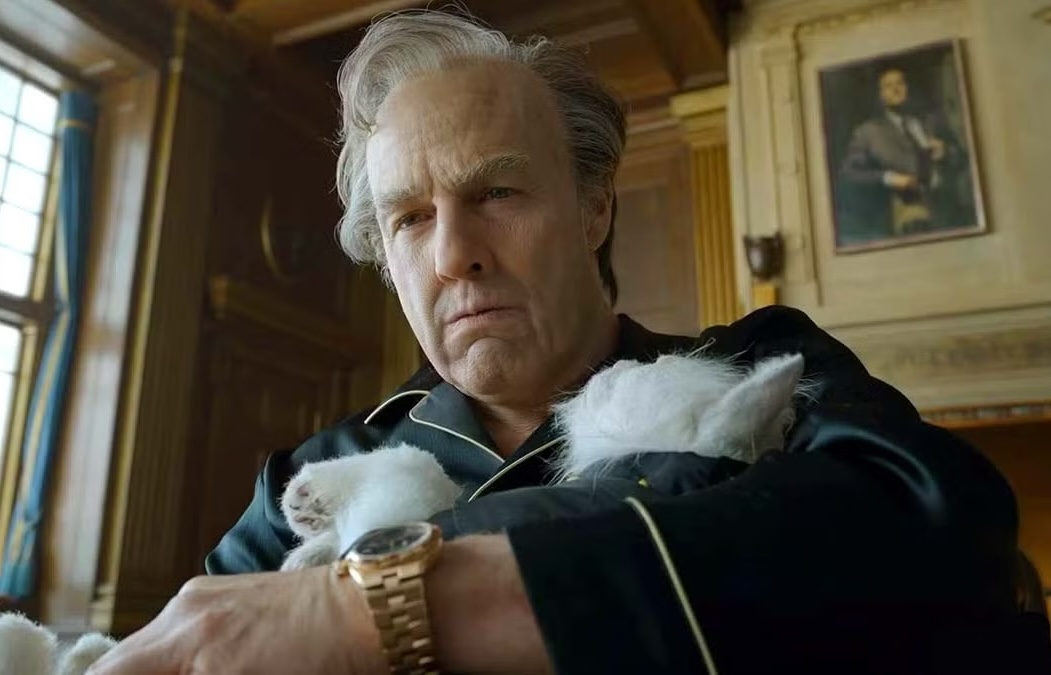
As happens much more frequently than is generally acknowledged when it comes to films, the lowbrow proles are right. Digger is dead on arrival. All that big-budget prestige-picture money, all that great acting talent (John Goodman, Riz Ahmed, Sandra Hüller, Michael Stuhlbarg, Jesse Plemons), all that lushly beautiful cinematography (Emmanuel Lubezki) and production design (Dennis Gassner and Richard L. Johnson), all that topical relevance, and for what? So you can watch Tom Cruise, nearly unrecognizable in gray hair, old-age makeup and prosthetics, and a fake potbelly, stomping around braying his lines as the title character Digger Rockwell, a crazily overconfident Texas oil tycoon tasked with preventing the ultimate world-destroying climate catastrophe that his own massive oil-drilling company created.
The Big Meta “Twist” Falls Flat
Signing big star Tom Cruise presumably got Iñárritu that extravagant reported budget of $125 million to make what amounts to a ponderous art film. You know the kind of art film I mean, the one that reveals partway through that all the characters shouting and crying and vomiting and making faces all over the place are in fact actors performing roles in a play — which is the big twist in Digger. At a certain point, Tom Cruise even stops hollering in an overripe, hog-calling Texas accent and speaks in his own voice in order to complain to the play’s director that he finds the Digger character “cartoonish” and feels “disconnected” from him and the whole experience.
If this film weren’t so enervating, that would be the moment to yell at the screen, “You and me both, Tommy boy!” But no one’s got that kind of energy, not when the camera is heading backstage to show us that this is all actually a production of a theatrical cult hit called Fossil Fools. It seems the survivors of horrific climate catastrophes that occurred in the real world and wiped out much of the human population find it cathartic to watch those disasters replayed onstage, along with the downfall of Digger.
It’s not that everyone involved in the production — the Digger production, I mean, not the Fossil Fools production — isn’t trying hard to sell the material. Part of the misery of watching it is seeing all the actors struggling to put their undeveloped characters across in wearying scenes full of rotten dialogue. Tom Cruise is generally effortful and a bit exhausting anyway — it’s part of his star persona — but as Digger he wears you out a quarter of the way into the film.
Then there are the fabulous actors in supporting roles giving their all. John Goodman plays President Compson, another loud idiot, who’s grappling with the world-ending scenario created by Digger while suffering from “a-s cancer.” It’s a deadly affliction which will turn out to be convenient because he’ll be safely under the knife at Walter Reed Hospital when someone has to answer for the recent massive catastrophe. The subservient vice president, called “Eddie” throughout and played by Michael Stuhlbarg (A Serious Man), is deputized to face the enraged governing body.
Meanwhile, Dr Nirav Ganesh (Riz Ahmed of Four Lions and Nightcrawler), the earnest scientist who heads Digger’s environmental safety team, tries in vain to get any of the blowhards in charge to listen to him before it’s too late.
An Astonishing Waste of Talent
Other phenomenal actors are entirely wasted in nothing roles. Sandra Hüller, who came to international prominence in Anatomy of a Fall and The Zone of Interest, plays a few scenes as Emma, Digger’s much younger, cluelessly self-centered half-sister and business partner who’s allowed to run a company dedicated to clean energy that Digger treats as a joke. Jesse Plemons roams into scenes in the framing narrative about putting on the play, because he’s portraying Kenny Rockwell, Digger’s nephew, who owns the rights to the play Fossil Fools and encourages the cast to carry on mocking his ridiculous destroyer-of-worlds family because it’s cathartic for the play’s audiences. Burn Gorman, an excellent English character actor whom you’ll recognize if you’re a BritBox subscriber, literally has no lines and only one bit of business — an absurdly overdone patriotic salute when President Compson launches nuclear weapons at the massive ice shelf that broke off from Greenland and is about to crash into the western coast of the European continent, causing massive damage and loss of life. Nuking things, always the recommendation of military brass, only creates more problems, however.
Featured in many more scenes and frankly performed with greater care is an animatronic white cat named Maggie, the only creature that Digger loves. She’s thirty years old and dying of several fatal conditions, a pitiable creature cruelly kept alive by the moronically doting Digger. That’s all played for laughs, by the way, just to give you a sense of Iñárritu’s comic stylings.
It’s depressing to read about the ten-year development of this film involving writer-director Iñárritu and star-producer Tom Cruise. Iñárritu says the “spine” of the project was always Digger’s long monologue delivered to the European Parliament midway through the film, in which Digger admits to all charges against him about enriching himself through endless oil drilling and environmental despoliation, and covering up studies that would’ve provided proof for scientists trying to awaken the public to the dangers of fossil fuel reliance. Digger then proceeds to blame all the ordinary people in the world for this. He keeps the oil pumping because we all selfishly want to heat and cool our homes and drive cars and have cell phones.
According to Iñárritu, he gave Digger ultimate persuasive power in this central scene because, as he puts it, “I’m not interested in pointing fingers or reducing the film to a political commentary or a right or left thing.” For Iñárritu, “we are all part of this madness.”
It’s with a weary sense of inevitability that we watch this scene, which shifts blame to the struggling masses just trying to get by in a world run by vicious self-serving plutocrats. It doesn’t even make sense in terms of the rest of the film, which is dedicated to mocking the monstrous venality and cluelessness of billionaires and the politicians who serve them.
Nevertheless, Iñárritu still wants to know if all of us relatively powerless people are now ready to dig deep and sacrifice any creature comforts we might have in order to save the world. For him, it’s all in our power to do it somehow. At the end of the film, the audiences shown flocking to see Fossil Fools to gloat over Digger’s demise are all wrong, failing to learn the proper lesson from the ongoing apocalypse — that “there are no good or bad people” and we all have to work together, kumbaya.
This is a message that might have been convincing in the early 2010s. In 2026, with plenty of genuinely very bad people at the top of both our government and our economy — people who seem to even embrace their villainous powers — it falls very, very flat.
This article originally appeared in Jacobin, a democratic socialist magazine publishing long-form essays and analysis on politics, economics, and culture. Subscribe to the print edition for $20 a year.
Read the full story at the source
Source: Jacobin