
World Jacobin
Minneapolis Refused to Take Trump’s Bait. It Paid Off.
The Trump administration was dealt its first major defeat in Minneapolis. But this wasn’t foreordained — it happened because the city’s anti-ICE movement was disciplined in response and refused to pla
English (original) ·Read in Deutsch ⇄
All signs point toward a resounding rebuke of Donald Trump in Tuesday’s midterm elections. Democrats have opened up a commanding lead in national polls, Trump’s popularity has sunk to historic lows, and even many of his former supporters are turning against him.
There are plenty of reasons for this collapse, from rising prices to Trump’s disastrous war with Iran. But we shouldn’t forget what was arguably the single most important turning point of his presidency: the defeat of his militarized assault on Minneapolis.
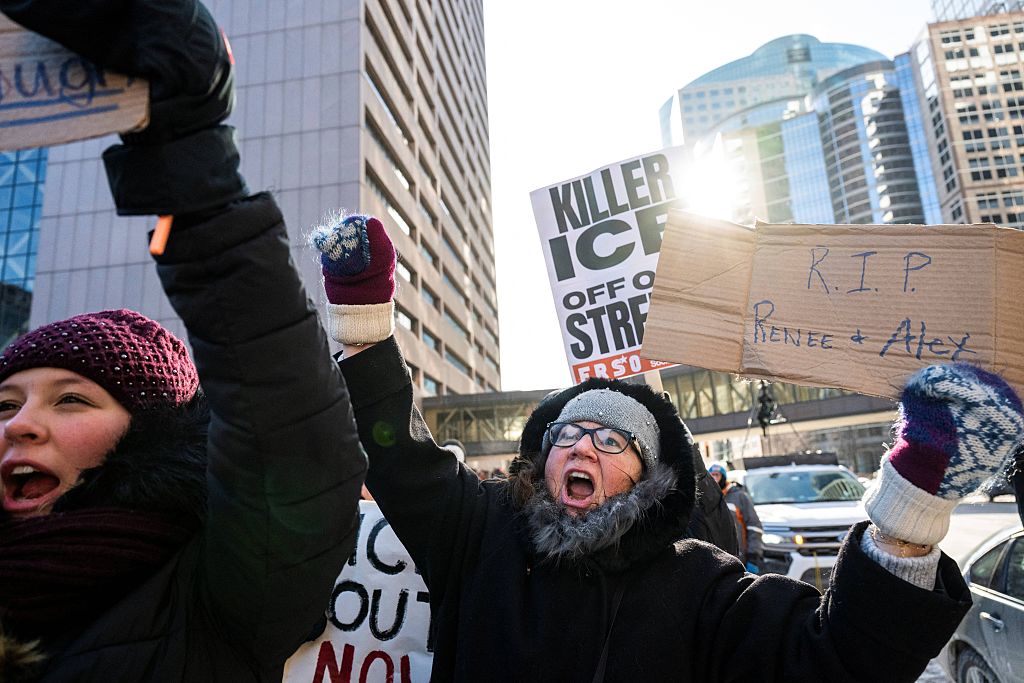
In January, Trump’s administration set out to terrorize immigrants, crush resistance, and establish the precedent that federal forces could occupy American cities against the wishes of their residents and elected officials. Instead, it encountered a mass movement whose courage and discipline forced Washington into a humiliating retreat.
The political fallout was immediate. By late January, a Reuters poll found Trump’s overall approval had fallen to 38 percent, matching its lowest point of his second term to date. His approval on immigration, previously his strongest political asset, had sunk to 39 percent. Minneapolis had helped turn Trump’s signature political strength into a liability.
In retrospect, this outcome can seem inevitable. Surely Trump’s attacks were so excessive, his agents so brutal, and the killings of Renée Good and Alex Pretti so shocking that a national backlash was bound to follow?
But nothing was predetermined. Indeed, there’s compelling evidence that Trump and his advisers had a plan with a real chance of working: provoke Minnesota into a social explosion, whose grassroots violence and property destruction would serve as a pretext for polarizing the country and escalating Trump’s crackdown on dissent and democracy nationwide.
Similar strategies have worked for authoritarian governments in other times and places. In Minneapolis, the trap failed because of the movement’s exceptionally high level of organization and nonviolent discipline.
The Provocation
It’s clear that ICE, under administration orders, was consciously provoking the people of Minneapolis this past winter. Thousands of heavily armed, poorly trained federal agents flooded the Twin Cities. Masked officers conducted aggressive raids, detained residents, confronted legal observers, and deployed chemical weapons against protesters. On January 7, an Immigration and Customs Enforcement (ICE) agent shot and killed Renée Good, a thirty-seven-year-old mother. And rather than de-escalate, Washington doubled down.
On January 13, Trump warned Minnesota that a “DAY OF RECKONING & RETRIBUTION” was coming. Two days later, he threatened to invoke the Insurrection Act unless Minnesota officials stopped the supposed “professional agitators and insurrectionists” confronting ICE.
Homeland Security Secretary Kristi Noem confirmed that military intervention had been discussed. And by January 18, the Pentagon had placed roughly 1,500 active-duty soldiers on prepare-to-deploy orders. The administration was preparing the ground for deploying the military.
Nor do we have to guess how some White House officials hoped events would unfold. On January 17, Zeteo reported that two administration officials acknowledged that figures inside the White House would welcome significant violence by Minneapolis protesters. One senior official said they “would not mind it” if such violence provided a pretext for invoking the Insurrection Act.
In other words, widespread disorder wouldn’t have been a setback for Trump’s strategy. It could have provided exactly the excuse he needed.
The logic was straightforward: Provoke confrontations through extraordinary federal aggression. Wait for enraged protesters and community members to retaliate with widespread violence or property destruction. Then portray the movement as an anarchic threat to public safety, rally Americans around the need for order, and justify an unprecedented expansion of federal military power.
Recent revelations make the administration’s methods even more disturbing. As Wired reported this week, federal investigators infiltrated activist organizations and communications networks on an extraordinary scale. Attorney Kevin Riach, representing one of fifteen Minnesota activists facing federal charges, has argued in court that undercover agents participated in organizing groups while seeking to entice participants into criminal activity.
The strategy was hardly irrational. Research shows that property destruction, even on a limited scale, can sharply undermine public support for protests. It would not have taken much for Trump to transform a confrontation about federal repression into a national argument about supposedly violent leftists and blue-city disorder.
Imagine the aftermath of Good’s killing had Minneapolis descended into sustained rioting, widespread vandalism, and attacks on ICE or local police. How long before the national conversation shifted away from the shooting itself toward whether Trump should restore order and whether movements should oppose property destruction and violence?
Why Minneapolis Didn’t Take the Bait
Trump’s central miscalculation wasn’t underestimating the anger his agents would generate. It was choosing to stage this provocation in one of the most deeply organized progressive metropolitan areas in the United States.
Minnesota has a rich, decades-long tradition of labor, immigrant-rights, and religious organizing. Groups including Unidos MN, ISAIAH, Service Employees International Union (SEIU) Local 26, and the Twin Cities teachers’ unions had spent years developing relationships, training leaders, winning reforms, and building the capacity to act together. As SEIU Local 26 President Greg Nammacher explained, their January resistance would not have succeeded without years of preparation: “We would not have met it if we had not built a capacity beforehand.”
These organizations saw clearly that a violent confrontation on Trump’s terms was one the movement was likely to lose. As JaNaé Bates Imari, co–executive director of the faith-based organization ISAIAH, explained in an interview on The Dig:
Part of what is happening in Minnesota is a needling by the federal government to try to get us to respond in a particular way. And Minnesotans across the spectrum have said we will not take the bait . . . . No one [is] confused about who the peacekeepers are in the midst of what’s taking place.
Crucially, organizers went beyond merely preaching restraint by building the organizational capacity to turn restraint into a collective practice.
Unidos developed mass trainings for legal observation of ICE operations, ultimately training approximately thirty thousand people. ISAIAH trained hundreds of clergy, while allied groups trained thousands in nonviolent civil disobedience. Neighborhood Signal chats sprang up. Residents organized to document immigration raids, distribute whistles, support families sheltering at home, and mobilize neighbors.
There were genuine pressures toward escalation. Some protesters threw objects at officers, and instances of vandalism occurred. After witnessing federal violence, not everyone agreed about the limits of confrontation.
But breaking with unstrategic leftist norms about a “diversity of tactics,” the movement’s leading organizations had developed the relationships and legitimacy needed to establish collective norms about disciplined nonviolent mass action. The Minnesota Star Tribune reported that protesters confronted a suspicious flag-burner and that participants in organizing chats rebuked and expelled people proposing violence.
By cultivating shared expectations, training participants, challenging provocations, and giving people effective alternatives, the Minneapolis movement provided opponents of ICE with something more powerful to do than express their fury.
On January 23, an estimated 75,000 or more people marched through downtown Minneapolis in subzero weather during the Day of Truth and Freedom strike action. According to organizers, roughly a thousand businesses, overwhelmingly small businesses, participated in the work stoppage.
The movement’s militant resistance and discipline helped keep the attention on federal agents’ terrorization of Minneapolis’s undocumented community, as well as the heroism of two innocent Americans who decided to stand up for their neighbors.
Renée Good and Alex Pretti were ordinary people who resisted injustice and paid with their lives. But their deaths alone would not necessarily have been enough to defeat the administration’s offensive. Because without an organized movement committed to preventing mass violence and property destruction, their killings could have become entangled in a debate over which side was responsible for the disorder. Instead, Trump lost control of events and the narrative.
The Warning From France
We don’t have to rely entirely on hypothetical scenarios to see what might have happened otherwise.
France’s growing protests this fall against the cost of living and the government have recently provided a troubling counterexample. What began with high school students protesting deteriorating educational conditions in September grew into a broader movement drawing in unions, Yellow Vests, and other groups demanding economic and political change.
But on October 17, huge demonstrations across the country were accompanied by extensive violence and destruction. Shops were looted in Paris, public buildings attacked, and Marseille’s city hall vandalized.
Remarkably, Le Monde reported that the government had deployed only about sixty thousand police nationwide — tens of thousands fewer than normal — even though intelligence services had warned of a high risk of violence and looting.
Before October 17, much of the national discussion had focused on police repression and the legitimacy of the protesters’ grievances. Afterward the government seized the opportunity to recast the confrontation as a battle against disorder. Prime Minister Sébastien Lecornu attacked the radical-left La France Insoumise, while politicians on the Right demanded harsher policing.
The events on October 17 were a gift to the right. Far-right leader Marine Le Pen received the most positive assessments of any major political figure’s response. And an Ipsos survey found that 55 percent of French respondents believed the leftist party La France Insoumise had contributed to the tensions and violence.
As historian Luca Provenzano has argued, allowing disorder to spread can itself be a highly effective state strategy. During France’s May 1968 upheaval, for example, authorities shifted from highly visible repression toward a more restrained police posture that created space for student escalation. A subsequent Interior Ministry assessment concluded that protesters’ excesses had helped restore support for order. The Right went on to win a sweeping electoral victory.
Whether the French government deliberately allowed the October 2026 violence to unfold is not yet established. But the danger doesn’t depend on proving a grand conspiracy. A state can benefit from disorder whether it consciously encourages it or simply takes advantage when it erupts. That’s precisely the trap Minneapolis avoided.
The Fight Ahead
Of course, Trumpism is far from defeated. We don’t know exactly how badly MAGA will lose on Tuesday, and even a decisive electoral rebuke won’t automatically stop his political prosecutions, authoritarian ambitions, or continued mass deportations.
Trump could still try to manipulate or reject unfavorable election results, whether next week or in 2028. He could again seek to provoke widespread disorder and use the ensuing fear to justify repression.
To defeat Trumpism nationwide and to transform our country, we’ll need big, durable, welcoming organizations, new recruits beyond the ranks of existing college-educated activists, trusted leaders, and the ability to launch rapid, disciplined nonviolent action when necessary.
The best way to honor Renée Good and Alex Pretti — and to thank the people of Minneapolis for their courage and sacrifice — is to learn from what they achieved. Mass nonviolent resistance doesn’t happen automatically. It has to be organized. And when it is, even the most powerful government on earth can be forced to retreat.
This article originally appeared in Jacobin, a democratic socialist magazine publishing long-form essays and analysis on politics, economics, and culture. Subscribe to the print edition for $20 a year.