
World · Jacobin · · 1h
Karl Marx Was for the Children
English (original) · Read in Deutsch ⇄
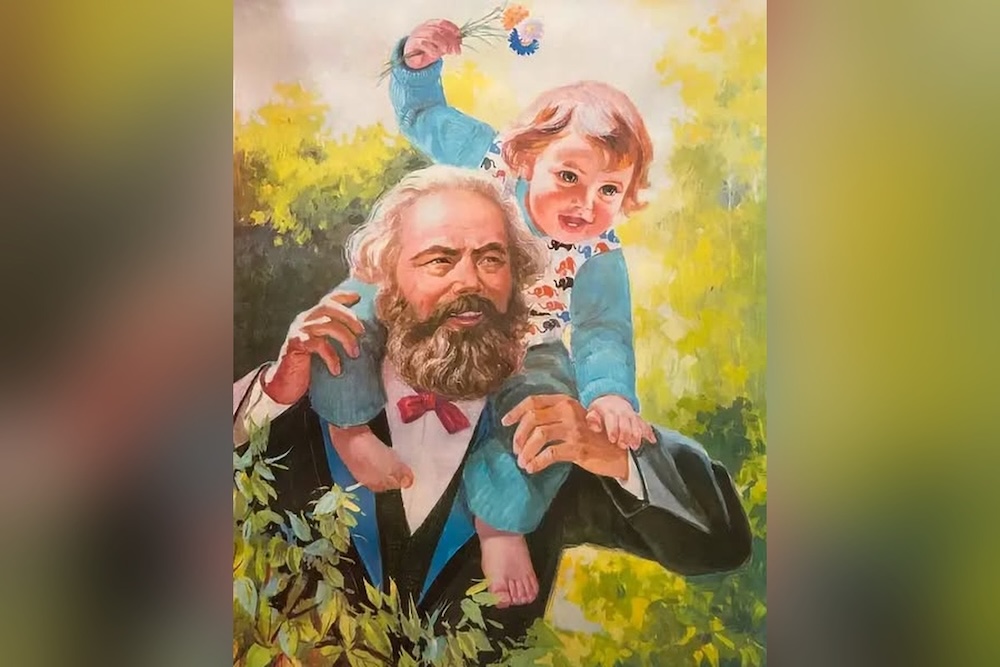
In the late 1870s, a visitor to Karl Marx’s North London house might have found the author of Capital on his hands and knees in the garden, with his grandson Johnny on his back shouting, “Go on! Plus vite! Hurrah!” Marx was past sixty, and he would keep at it until he was covered in sweat.
This is not the Marx most people picture. He is commonly known as a curmudgeon — a “salty” fellow with harsh words, not exactly the warm and fuzzy type. Saul Padover begins his introduction to Karl Marx on Education, Women and Children with just such a characterization: “In speech and writing, his attacks on those he deemed to be personal or ideological — or merely unintelligent — opponents were unsparing.” A familiar image comes to mind: Marx, unshaven, with thick hair in all directions, a towering figure in a three-piece suit smoking cheap cigars, ranting and raving with pride and contempt. But there is no contradiction between his tenderness with children and his polemical politics: he wrote some of his most passionate prose about what capitalism does to children.
Marx found time for his own children and grandchildren. On Sundays, he would march out of his smoke-filled office to Hampstead Heath, where he would picnic and frolic with his family. There, onlookers could find him on all fours pretending to be a horse while the children joyfully rode him. As Padover writes, “Marx’s extraordinary love for children, his own and others, is the most luminous feature of his character. He was, a friend who knew him intimately said of him, ‘a child among children.’” Padover also paints a picture of Marx during his weekly outings: “When out walking on Hampstead Heath he would stop and play with children, who responded easily to the bushy-bearded kindly stranger. . . . Although a materialist with an antipathy for all religions, including Christianity, Marx used to say that what he liked most about Christ was His great love for children.”
Marx’s personal attitude toward children offers an intimate reflection of his broader political commitments, especially his conviction that human beings should have the opportunity to develop their capacities free from oppressive social and economic conditions. Seeing the joy and energy of children, as well as the suffering of children under capitalism, strengthened Marx’s principles and motivated him to continue his fight to abolish class society. A significant portion of his life’s work and personal correspondence was devoted to challenging the brutal exploitation of children, lamenting his own family tragedies, and expressing ongoing anxiety about the state of his kin.
Marx and his wife, Jenny, had seven children together, only three of whom survived into adulthood: Jennychen, Laura, and Eleanor. The other four died in childhood or infancy: Edgar, Henry Edward Guy, Franziska, and an unnamed infant son. He expressed a deep attachment to all of his children, and the loss of Edgar was particularly devastating for him; he never fully recovered. Marx gave each of his children a special nickname, and Edgar’s was “Musch.” He was the only son of Marx and Jenny to survive infancy, and he died at the age of eight in his father’s arms, most likely from tuberculosis. Wilhelm Liebknecht, who attended Edgar’s funeral, described the crushing grief of Marx, whom family and friends called “Mohr” (the Moor): “Marx sat in the carriage, dumb, holding his head in his hands. I stroked his forehead: ‘Mohr, you still have your wife, your girls and us — and we love you so well.’ ‘You cannot give me back my boy!’ he groaned. . . . At the graveside Marx was so excited that I stepped to his side, fearing he might jump after the coffin.” In a letter to Friedrich Engels on April 12, 1855, Marx wrote:
Only now do I know what real unhappiness is. I feel broken down. Since the funeral I have been fortunate enough to have such splitting headaches that I can neither think nor hear nor see. Amid all the fearful torments I have recently had to endure, the thought of you and your friendship has always sustained me, as has the hope that there is still something sensible for us to do together in the world.
Accounts of Marx as a parent paint him as an affectionate, doting, anxious figure who was deeply concerned for and protective of his family. He was adamant that his three daughters would grow up with a bourgeois education, and he exposed them to a range of literature and politics early in life: he read his children works by Homer, the Nibelungenlied, Don Quixote, and A Thousand and One Nights. Eleanor remarked that “Shakespeare was our house bible; at the age of six I knew whole scenes from Shakespeare by memory.” The girls were enrolled in music and art lessons and studied several languages. Marx and Jenny were poor during this time, and occasionally the family went hungry in order to pay the children’s school tuition. Jenny proudly remarked that “They are completely at home in English, and they know French well. In Italian they understand Dante, they also read some Spanish; only in German is there a hitch . . . ”
For his part, Marx believed that all children deserved a high-quality education not only within the four walls of the schoolhouse, but also at home with their parents. In fact, in line with many progressive approaches to education today, he said, “Children should educate their parents.”
Such a view of education as a comprehensive and lifelong endeavor enriched his relationship with his three girls, which was cemented by mutual respect and love.
As indisputable as Marx’s love for his daughters was, it was also plagued by deep prejudice. While his worldview demanded equality and dignity for all, Marx himself harbored patriarchal and racist views in his personal life that stand in tension with his socialist politics. In his letters to the revolutionary Paul Lafargue, who was courting Laura, Marx sometimes adopts the view that his daughter could not take care of herself and needs to be guarded by others. These letters also include racist remarks, such as “When you invoke your Creole temperament, then I consider it my duty to step in between your temperament and my daughter with my healthy common sense. If you are unable to show your love for her in the form consonant with the London latitude, then it is advisable that you love her from a distance.”
Other moments of sexism come through in Marx’s letters, from describing to Engels how his wife spent her weekly allowance — “Women obviously always need a guardian!” — to his description of his youngest daughter, Eleanor, who was pained by her love for Prosper-Olivier Lissagaray, whom Marx did not approve of: “Tussy [Eleanor] feels much better; her appetite grows in geometric proportion, but this is peculiar to these feminine sicknesses where the hysterical plays a role; one has to act as if one does not notice that she again lives on terrestrial nourishment. But this too will disappear as soon as there is complete recovery. . . . ” Here Marx makes light of Eleanor’s eating troubles and her health, attributing her struggles to hysteria and a supposedly feminine emotional condition. On the one hand, Marx’s politics sought the abolition of domination and exploitation; on the other hand, he espoused prejudices that stood in tension with those same emancipatory commitments.
Marx’s thought and, in particular, his analysis of the family in Capital pushes beyond his own interpersonal limits. In his magnum opus, he investigates the impact of industry on the traditional family unit. With the advent of modern machinery and the factory system, older economic relations are destroyed, and society reaches the point where “the rights of the children had to be proclaimed” against their exploitation. But even more radically, Marx claims that industrialization, despite its brutal form under capitalism, creates the conditions for “a higher form of the family and of the relations between the sexes.” It breaks down the division of labor that confined women and children to fixed roles in the household.
The Stolen Children of Capital
While Marx fought for the best educational circumstances available to his own children, he was all too aware that thousands upon thousands of working-class children were deprived of those chances and forced to labor under harrowing conditions. Much of Marx’s writing in Capital explored the terrible exploitation of children in factories, workshops, and mines. Such abuse and terror of the young drove him to be unapologetic and adamant in his push for socialism.
It was easy to see where these commitments came from. Marx documented the reality of the dangerous and horrific work throughout England in Capital. Some of the worst workshops were tiny cottages where workers gathered for lace-making, straw-plaiting, and straw-hat-making, many of them working from six in the morning until ten o’clock at night and beyond. Children as young as two-and-a-half years old worked alongside over a dozen people, with only 24.5 cubic feet per head, about the size of a large refrigerator.
Long stretches of the first volume are devoted to the fate of children in conditions like these, and Marx’s writing on their exploitation and neglect is among his most devastating and moving; it was a driving force of his revolutionary rage and determination to hold the ruling class accountable for its disregard for human life.
Drawing on British parliamentary investigations, factory inspectors’ reports, and medical testimony, Marx examined the exploitation of children in factories, mines, workshops, and domestic industries that were dangerously overcrowded and poorly ventilated. Children suffered chronic exhaustion, deformities, stunted growth, disease, and constant injuries, while their education and opportunities for intellectual development were sacrificed to production. For Marx, these conditions were not just a collection of abuses committed by cruel employers; they followed from the logic of capital itself: “Hence Capital is reckless of the health or length of life of the labourer, unless under compulsion from society,” he wrote. Confronted with “physical and mental degradation, premature death, [and] the torture of over-work,” capital effectively answers: “Ought these to trouble us since they increase our profits?”
In 1853, Marx published “Prosperity — The Labor Question” in the New-York Daily Tribune, where he reported statistics on workers age nine to twenty-two and their weekly hours. He wrote: “Boys of nine and ten working sixty hours consecutively, with the exception of three hours’ rest! Let the masters say nothing about neglecting education now. One of the above, Ann. B., a little girl only nine years of age, fell on the floor, asleep with exhaustion, during the sixty hours; she was roused and cried, but was forced to resume work!!” In chapter ten of Capital, “The Working Day,” Marx cites reports of boys in glassworks whose minimal periods of rest also had to include traveling, washing, dressing, and eating, leaving “none for fresh air and play, unless at the expense of the sleep necessary for young boys.” Not only did children work exceptionally long hours, but capital absorbed the precious time that should have belonged to childhood itself.
In “Important British Documents” (1858), Marx returned to the reports of the British factory inspectors and the limitations of the Factory Acts, which attempted to restrain some of the worst abuses of industrial capitalism. Even under these laws, children as young as eight could legally work in tiny, dirty, and oppressive rooms for extraordinarily long periods of time, while a boy “having attained the age of 13 may, and is often, lawfully employed day and night for any number of hours, without any restriction whatever.” These laws provided minor limitations on exploitation without abolishing it, and capital continually resisted even those limitations. Marx later wrote in Capital that the shortening of children’s working hours by the state was necessary “to prevent the coining of children’s blood into capital.”
The Factory Acts’ provisions for education encountered similar problems. Marx highlighted the ways in which children’s working conditions produced irregular school attendance. For example, children employed in printworks were required to “complete” a mandatory number of school days and hours over six-month periods. The result, however, was incredibly sporadic attendance, with children showing up at school for the chunks of time required by law and then disappearing for weeks at a time. The widespread inconsistency of schooling was organized once again around the needs of employers rather than the healthy development of the child. A factory inspector quoted by Marx captured the absurdity of this system in a single line: “Thus the child is as it were buffeted from school to work, and from work to school, until the tale of one hundred and fifty hours was told.”
A government inspector, John Kincaid, visited two schools from which children were required to obtain attendance certificates. At the first school, the teacher, Ann Killin, could not spell her own name, unsure whether it began with a K or a C. At the second school, seventy-five children were packed shoulder to shoulder into a fifteen-by-ten-foot room. The schoolmaster was unable to identify these children, let alone tell Kincaid which of them were his students. Marx commented on these observations: “The educational clauses of the Factory Laws, while they require children to have certificates of school attendance, do not require that they shall have learned anything. . . . ”
Under the Factory Acts of 1833 and 1844, younger children were bound by a “half-time system” under which they were to divide their day between factory labor and schooling. Parents of poor working-class boys and girls were eager to find ways for their children to earn full-time wages to assist the family. They were therefore anxious to pull them out of school, and off half-time wages, so they could earn more. Meanwhile, the mill owners were only concerned with getting full-time workers who had strength in their hands to perform the work. Advertisements even sought young people “not younger than what can pass for 13 years.” Employers opposed enforcing school attendance for half-time children, maintaining that it was cheaper and less of a hassle to employ one set of children rather than two sets alternating six-hour work sessions.
Marx rejected the explanation of child labor as merely a result of irresponsible parenting: “It was not, however, the misuse of parental authority that created the capitalistic exploitation, whether direct or indirect, of children’s labor; but, on the contrary, it was the capitalistic mode of exploitation which, by sweeping away the economic basis of parental authority, made its exercise degenerate into a mischievous misuse of power.” Marx argued that the exploitation of children under capitalism had weakened the economic basis of parental authority and altered family relations through material necessity. As Marx explained in Capital, “Now the capitalist buys children and young persons under age. Previously, the workman sold his own labour-power, which he disposed of nominally as a free agent. Now he sells wife and child.”
Machinery drastically changed who could be paid for their work, which exacerbated the transformation of the family. “In so far as machinery dispenses with muscular power,” Marx writes, “it becomes a means of employing labourers of slight muscular strength, and those whose bodily development is incomplete, but whose limbs are all the more supple.” Consequently, “The labour of women and children was, therefore, the first thing sought for by capitalists who used machinery.” The machine, which had the potential to reduce the many hardships and suffering that accompany labor, instead became a method of enrolling “every member of the workman’s family, without distinction of age or sex” under the direct dominion of capital. “Compulsory work for the capitalist usurped the place, not only of the children’s play,” Marx concluded, “but also of free labour at home within moderate limits for the support of the family.” For Marx, Mammon worship becomes Moloch worship, where unchecked capital’s pursuit of profit demands the sacrifice of children. So too does the health of the family suffer, as time at home is subordinated to capitalist greed.
Work was, of course, common for the young before industrial capitalism, but Marx highlighted the printing industry as an example of how machinery particularly stunted children’s development. Under an older apprenticeship system, young workers progressively advanced from simpler tasks to more complex forms of printing and were expected to develop literacy as part of their profession. However, the introduction of printing machinery eliminated this process of education and skill development altogether. Instead, factories divided labor between skilled adult workers and young boys whose only responsibilities were repetitive tasks, such as placing paper into machines or removing finished sheets, that offered no chance to develop skills.
Marx understood factory legislation as more than charitable relief for the workers and their families. The struggle over the working day revealed that “free” contracts between workers and their bosses could not protect workers from intolerable abuse and misery. When the worker goes to the market to sell their labor power, it seems as if they are doing this of their own free will, but inside the factory, that freedom is exposed as an illusion. Workers, according to Marx, had to “put their heads together, and, as a class,” compel the construction of ��an all-powerful social barrier” that would protect “themselves and their families” from “slavery and death.” For Marx, a legally limited working day was the “modest Magna Charta” of the working class, one that finally established some — albeit small — limits to capital.
Hardware manufacturing in Birmingham, which included very heavy and physically demanding labor, was a common area of child exploitation, with some thirty thousand children and young persons employed. This included brass foundries, button factories, enameling, galvanizing, and lacquering works. Citing the Children’s Employment Commission, Marx reported that “owing to the excessive labor of their workpeople, both adult and nonadult, certain London houses where newspapers and books are printed have got the ill-omened name of ‘slaughterhouses.’” Young women and children were engaged in what seemed like constant labor in bookbinding; children worked in exhausting circumstances in ropewalks and on night shifts in salt mines, candle manufactories, and chemical works; meanwhile, in silk weaving, children were worked to death turning the looms in place of machinery. But perhaps one of the most unsanitary and disgraceful lines of work for women and young girls was the sorting of rags. Great Britain was the hub of the global rag trade, with rags coming in from all over the world, chiefly Germany, France, Russia, Italy, Egypt, Turkey, Belgium, and Holland. The rags were used for “manure, for making bed-flocks, for shoddy, and they serve as the raw material of paper.” The rag sorters would frequently contract smallpox and other infectious diseases and then spread them to others.
Another example of brutal work that was completely unsuitable for young children was tile- and brickmaking, where the newly invented machinery was used sparingly owing to the cheapness of labor. Here, children — both boys and girls — as young as four, were employed, and often worked longer hours than the adults. The summer heat contributed to the treacherous conditions: “In a certain tile field at Mosley, e.g., a young woman 24 years of age was in the habit of making 2,000 tiles a day, with the assistance of two little girls, who carried the clay for her, and stacked the tiles. These girls carried daily 10 tons up the slippery sides of the clay pits, from a depth of 30 feet, and then for a distance of 210 feet.”
The harms of child labor, it was clear, extended far beyond the physical dangers of industrial work. The emergence of capitalist production had deprived children not only of their health but also of their moral, intellectual, and emotional development by forcing them to mature in overcrowded environments marked by exhaustion and neglect. By highlighting these conditions in his analysis, Marx demonstrates that capitalism’s exploitation of children permeated every aspect of their lives, reinforcing his belief that a just society must protect children’s dignity and capacity for true freedom. When all of this is stripped from young children, what is left? Marx wrote: “That excessive insobriety is prevalent from childhood upwards among the whole of this class, is only natural.”
Similar exploitation and oppression befell women and child lace workers in domestic industry. The making of lace itself was done by machinery, but the finishing and mending took place outside factories, in “mistresses’ houses” kept by poor women. These women took orders from manufacturers and employed as many women, girls, and young children as could fit in their tiny rooms: sometimes ten to twenty, and at other times twenty to forty. The average age at which children started this work was six, and in many cases, it was below five. Twelve-hour shifts were the norm, with a mere hour and a half for meals, which were taken at irregular intervals and often in filthy workrooms. When business was booming, the workday could stretch to fifteen hours or more. In order to keep the lace clean, the children were compelled, even in winter, to take off their shoes. To observers, the children seemed to have become machines: “Even the very youngest children work with a strained attention and a rapidity that is astonishing, hardly ever giving their fingers rest or slowing their motion. If a question be asked them, they never raise their eyes from their work for fear of losing a single moment.” The Children’s Employment Commission stated that “their work is like slavery.”
The preconditions for manufacturing did not only coincide for Marx with a new period of colonialism and New World slavery; the birth of large-scale industry also came about through a “vast, Herod-like slaughter of the innocents.” The young workers in the factories were recruited by means of a press-gang. Marx is clear that capitalism was born through “child-stealing and child-slavery for the transformation of manufacturing production into factory production and the establishment of the true relation between capital and labor-power.” Manufacturing required the ransacking of cottages and workhouses for poor children who were taken away, forced to work at night, and robbed of their rest. It was the “small and nimble fingers of little children” that were most in demand to operate the new machinery in the large factories. Parish workhouses were emptied of their children, and “many, many thousands of these little, hapless creatures were sent down into the north, being from the age of 7 to the age of 13 or 14 years old.”
The new capitalist masters were for Marx “child-stealers,” and they appointed overseers whose interest was to “work the children to the utmost, because their pay was in proportion to the quantity of work that they could exact.” The consequences were cruel to the extreme. The manufacturer and reformer John Fielden recounted that “cruelties the most heart-rending were practiced upon the unoffending and friendless creatures who were thus consigned to the charge of the master-manufacturers”; the children “were harassed to the brink of death by excess of labour,” “flogged, fettered and tortured,” and “in many cases starved to the bone while flogged to their work.” Some “were driven to commit suicide.”
These horrors were secluded from public view in what became “dismal solitudes of torture and of many a murder.” But the exploitation and murder of these children of the early factory system need to be studied carefully, not for antiquarian reasons, or merely sentimental ones. They should be studied because they remind us of what capital is capable of when its drive for profit goes unchallenged. As Marx shows, so long as capitalism exists, so too does the monstrous tendency to turn the blood of children into profit. All the evil creatures of Grimms’ Fairy Tales have nothing on the child-eating monsters of Capital.
Children in the Realm of Freedom
But aren’t we citizens of a new and enlightened age? Aren’t these childhood horrors of the nineteenth century things that belong only in Charles Dickens novels? According to 2024 figures from UNICEF and the International Labour Organization, about 138 million children are still engaged in child labor; 54 million of these children perform hazardous labor.
Of course, the industries Marx described in Capital have evolved since the nineteenth century, but the persistence of child labor in agriculture, mining, manufacturing, and brick production demonstrates that Marx’s critique of the exploitation of children remains relevant. Across the world, millions of children continue to sacrifice their education, health, and future opportunities to meet the demands of economic production and a society organized around profit.
If capitalism steals the future from children, how can that future be restored? All of the atrocities outlined above, coupled with Marx’s compassion for children, raise the question of what a healthier society would mean for young people. Critics of Marx argued that he wanted communism to function as a giant factory or workshop, where everyone would be leading a drone-like existence in a collective hive. But this is a caricature. Inspired by utopian socialists who preceded him, such as Robert Owen, Marx called for the all-sided development of human beings and the overcoming of the divide between physical and mental labor. And when it came to children, Marx was not entirely against the idea that they should in some capacity participate in organized labor.
This was not an atypical position in the socialist movement. Indeed, in the instructions he drafted for delegates to the First International’s 1866 Geneva Congress, we find the following vision for childhood development combined with industrial education:
We consider the tendency of modern industry to make children and juvenile persons of both sexes cooperate in the great work of social production as a progressive, sound, and legitimate tendency, although under capital it was distorted into an abomination. In a rational state of society every child whatever, from the age of 9 years, ought to become a productive laborer in the same way that no able-bodied adult person ought to be exempted from the general law of nature, viz.: to work in order to be able to eat, and work not only with the brain but with the hands too.
Marx continued by proposing three different classes of children to fulfill this plan: both sexes from the ages of nine to twelve; those from thirteen to fifteen; and those aged sixteen and seventeen. Marx suggested that the first group’s employment in any workshop or housework be legally limited to two hours; the second class, to four hours; and the third class, to six hours. The third class should also be given a break of at least one hour for relaxation or meals.
Marx acknowledged that children could benefit from beginning their education before the age of nine, but his primary concern was addressing how capitalism forced working-class families into impossible choices. As he argued before, workers are reduced to mere instruments of production, and parents are compelled to send their own children into labor. Marx thus insisted that society has a collective responsibility to protect the rights of workers of all ages and ensure that children especially are not sacrificed to the demands of capital. For Marx, defending and safeguarding children was not simply a matter of improving education or working conditions; it was a deep moral obligation, rooted in the belief that every child deserves the opportunity to develop free from exploitation.
According to Marx, the methods of schools should be based on independent science and kept free from the influence of the state or the church. Protecting children, Marx argued, required “general laws, enforced by the power of the state”: “In enforcing such laws, the working class do not fortify governmental power. On the contrary, they transform that power, now used against them, into their own agency. They effect by a general act what they would vainly attempt by a multitude of isolated individual efforts.” Marx did argue in favor of free education for all children in public schools. But by public schools, he did not mean what is commonly thought of as “state schools”:
Defining by a general law the expenditure of the elementary schools, the qualifications of the teaching staff, the branches of instruction, etc. and, as done in the United States, supervising the fulfillment of these legal specifications by state inspectors, is a very different thing from appointing the state as the educator of the people. Government and church should rather be equally excluded from any influence on the schools.
For Marx, neither parents nor employers should be permitted to send children into the workforce unless their labor is combined with a real education. Education extends far beyond classroom instruction, and Marx included three core areas for what constitutes a meaningful education: intellectual development, physical education that promotes health and strength, and technological training that introduces children to the fundamental principles of production while providing practical experience with a variety of tools and trades. By integrating mental, physical, and practical learning, Marx envisioned an education that would cultivate well-rounded individuals rather than preparing children for a lifetime of restricted and repetitive labor.
In the “Critique of the Gotha Program,” Marx wrote:
A general prohibition of child labor is incompatible with the existence of large-scale industry and hence an empty, pious wish. Its realization — if it were possible — would be reactionary, since, with a strict regulation of the working time according to the different age groups and other safety measures for the protection of children, an early combination of productive labor with education is one of the most potent means for the transformation of present-day society.
The above statement reflects a potentially controversial aspect of Marx’s thinking, since it is clear he rejected a blanket prohibition of child labor. However, this is not at all because he endorsed the exploitation of children but because he maintained that such a prohibition ignored the material realities of industrial society. Instead of advocating for a complete separation of children from productive activity, Marx argued that the problem lies in the capitalist organization of labor, where children are exploited for profit instead of being educated and developed. In his view, productive labor, when strictly regulated, age appropriate, and integrated with intellectual and physical education, could become a powerful means of developing versatile human beings with the ability to participate consciously in the betterment of society.
At the heart of the matter lies a distinction between labor and exploitation. Marx did not altogether condemn work; instead he denounced the capitalist system that turned child labor into a source of profit while depriving children of education, health, and opportunities for development. By combining highly regulated productive labor with comprehensive education, Marx believed that children could cultivate a wide range of practical skills, intellectual growth, and physical well-being simultaneously. This reflects his broader revolutionary commitment to creating a society in which work serves human development rather than reducing human beings to instruments of capital.
Today we may very well challenge his notion that children should be participating in any form of organized labor as young as nine, or balancing formal work with their schooling. Modern progressive education places heavy emphasis on unstructured time for play and outdoor exploration. But one could argue that we should keep the three foci that Marx emphasized — intellectual, physical, and technological training — all of which benefit children’s development. What counts as “technological training” will change with time and new inventions. Could it be beneficial if, between the ages of nine and seventeen, children devoted two to five hours a week to something besides schooling? Farming, taking care of household duties, gardening, engineering, or learning to code can all be part of a meaningful education. Certainly, most people would advocate for a healthy balance of learning inside school and outside of it; and in our contemporary capitalist society, where we are bombarded at every turn with screens and AI, perhaps some limited skill-based work could be a healthy choice for most children.
Even though the conditions facing children today differ from those Marx encountered in the nineteenth century, the fundamental contradiction he identified remains unresolved. Exploitation is prevalent in both obvious and more obscure ways. Most modern children may no longer be confined to a factory floor in the same way as the children Marx described, but many are still shaped by systems that value profit over humanity and prepare them to participate in an unequal economic order. The persistence of these conditions reveals that the problem Marx confronted was not merely the heartless cruelty of particular employers or the excesses of nineteenth-century industry but the broader structure of a capitalist society that places accumulation and profit above human flourishing.
This much has not changed. If children are to be truly liberated, Marx’s analysis suggests that the solution cannot be found simply through reforming the existing system; rather, it requires a fundamental transformation toward a socialist society organized around collective responsibility, equality, and the free development of every individual. Here, socialism is not only a political alternative but the logical extension of Marx’s critique: namely, that human beings, especially children, should never be reduced to instruments of production. What Marx called the realm of freedom is only worthy of that name if children are no longer denied their own human nature.
This article originally appeared in Jacobin, a democratic socialist magazine publishing long-form essays and analysis on politics, economics, and culture. Subscribe to the print edition for $20 a year.
Read the full story at the source
Source: Jacobin