
World Jacobin
Inside Colombia’s FARC, as Victory Gave Way to Survival
Tanja Nijmeijer’s memoir tells of how Colombia’s FARC was forced into a long and painful retreat. Her account of its political setbacks suggests that power doesn’t always flow from the barrel of a gun
English (original) ·Read in Deutsch ⇄
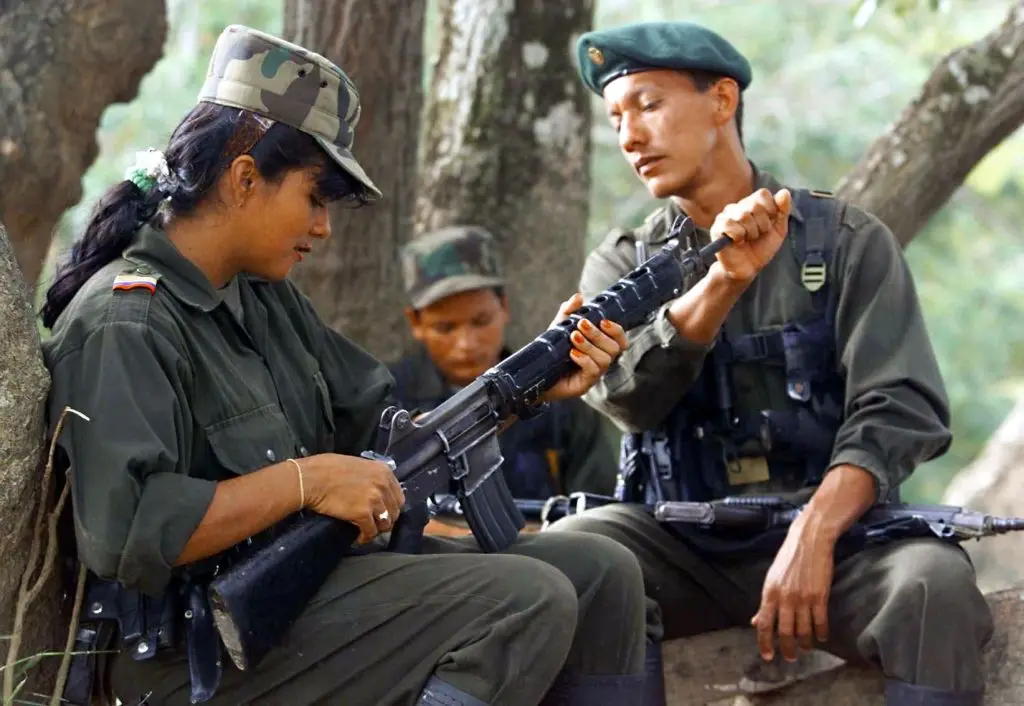
In the early hours of September 23, 2010, Tanja Nijmeijer was awakened by a bomb in a FARC guerrilla camp in the Colombian jungle. The strike landed on her commander’s bunker, followed by screams from her comrades. Moments later, dozens of aircraft roared above and launched another wave of bombs. Nijmeijer grabbed her rifle and dived into her foxhole. As the ground shook around her, she closed her eyes, tensed her body and thought: Aquí fue — this is it.
Seven years earlier, when the Dutch internationalist had first entered the jungle to join the Fuerzas Armadas Revolucionarias de Colombia (FARC), the war looked very different. She remembers it as “the calm before the storm,” with abundant supplies, comparatively large and settled camps, and a degree of security.
Nijmeijer’s autobiography, Into the Jungle, recently published by Pluto Press, traces her trajectory from guerrilla warfare to the negotiations that produced the 2016 peace agreement and the troubled transition that followed. Yet what makes the memoir especially politically revealing is that Nijmeijer joined the FARC at almost exactly the moment when the war started to change so decisively against it.
Stark Disparities
Initially traveling to Colombia in order to teach English to the children of the rich, Nijmeijer quickly encountered the extreme inequalities dividing Colombia. She witnessed gated communities, stark disparities separating the northern part of capital Bogotá from the south, and the concentration of wealth and power among an elite while poorer neighborhoods suffered neglect and repression.
Nijmeijer came into contact with FARC militants through her work and began to question the dominant image of the guerrillas as little more than “narco-terrorists.” Instead she encountered people prepared to sacrifice their lives in pursuit of a revolutionary project. Gradually developing a socialist outlook, she began to recognize that the ruling class was blocking any prospects of meaningful, peaceful change. She increasingly regarded armed struggle as not only legitimate but necessary and was convinced that the guerrillas could “take power and plant the seed for a new world.”
Although it was not apparent then, when Nijmeijer went into the jungle, the FARC’s decline was already underway. Right-winger Álvaro Uribe won the presidential election in 2002 on the back of mounting hostility to the FARC following the collapse of the 1999–2002 peace process. Harnessing hegemonic narratives that portrayed the FARC as having acted in bad faith and merely exploited the peace process as an opportunity to expand, Uribe promised a “military solution,” relying on massive US support through Plan Colombia to modernize the armed forces.
By late 2003, seven months after Nijeimer went into the jungle, the counterinsurgency offensive organized through Plan Patriota had reached Sumapaz, where military operations targeted guerrilla fronts in a region central to the FARC’s strategic plan for surrounding Bogotá. Areas over which the FARC had historically enjoyed complete control were now being contested.
The guerrillas later discovered evidence of around sixty helicopter landing sites, army surveillance of guerrilla roads and infrastructure, and reconnaissance teams operating inside jungle territories that the insurgents had assumed were impenetrable.
The state’s expanding war chest enabled significant increases in military personnel, specialized mountain battalions, and airpower. This was supported by satellite imagery and geospatial intelligence, communications interception, and other technologies challenging the guerrillas’ traditional reliance on rugged terrain as a form of defensive protection.
The military’s expanding reach is already evident earlier in Nijmeijer’s account, when she describes the penetration of her units by infiltrators who pulled various stunts as part of a tactic to undermine morale — unlocking weapons, defecating in huts, and cutting up the guerrillas’ rubber boots. The result was that “nobody trusted anybody else.”
Whereas in the past, counterinsurgency campaigns were temporary, with troops eventually withdrawing due to budget cuts and other constraints, now the Colombian army established a permanent offensive presence and pursued the guerrillas into rearguard zones and jungles, closing in on commanders once thought invulnerable.
The shifting conditions led the FARC’s leading military commander, Mono Jojoy, to declare before a crowd of five hundred guerrillas, “Thanks to President Álvaro Uribe Vélez, we are going to learn how to live as guerrilla fighters again! We must go back to basics.”
Improvements in airpower gave the state forces a decisive advantage. Vehicles disappeared, supplies and comforts were reduced, marches replaced a comparatively settled life, and concentration gave way to greater mobility and dispersion. “Our days of easy living,” as Nijmeijer puts it, “were over.”
For the FARC, going back to basics meant adopting an increasingly defensive posture: land mines, often described as a “weapon of the weak,” became an especially useful tool for slowing the encroachments of army patrols. However, they also caused civilian casualties and left the FARC exposed to criticism for disregarding human rights.
To reduce the risk of interception when communicating with urban militants, the guerrillas began sending encrypted messages via satellite internet. But this wasn’t a comprehensive solution. Air surveillance, increased extensively under Plan Colombia, could still intercept such communications. They had to switch off the equipment whenever an approaching plane was suspected, but the introduction of small, largely undetectable drones enabling real-time surveillance in 2006 made it harder to know when they were being watched.
The transition to a more defensive mode of operating affected daily life. Camps were built with deep foxholes; smoking and flashlights were prohibited after dark; vines were strung along paths so fighters could navigate without light; fireflies were used as improvised illumination. The nightly hour of cultural activities, essential for political education and boosting morale, became a thing of the past in Nijmeijer’s units. Meanwhile, massed forces of guerrillas were restricted — a setback from the FARC’s war of movement strategy at the end of the 1990s, in which large concentrations of troops overwhelmed military bases.
Isolation
True, this was a form of adaptation. Yet adaptation increasingly meant preserving the guerrilla organization under adverse conditions rather than recreating the offensive possibilities of the previous decade. Nijmeijer recounts, “The war changed, and it changed in the army’s favor.”
The psychological impact is described in a way that military histories and government documents rarely capture. Nijmeijer recalls the “pure terror” as bombs drop around her, with nowhere to run for safety, and no visible opponent to shoot at, only the hope that the jungle canopy might offer some protection.
Having to be constantly on the move, often in treacherous terrain, had its physical costs. Long marches left the guerrillas hungry and low on calories, and illness and fatigue, inevitable in such conditions, spread and grew more difficult to overcome. The army had repeatedly blocked Mono Jojoy’s attempts to meet up with Manuel Marulanda, the FARC’s founder and long-standing leader. Nijmeijer describes the resulting two-month march through particularly arduous territory on inadequate rations, which left her body aching so badly that she could barely manage to endure the night watch.
The psychological and physical impact had broader organizational repercussions. Demoralization deepened, and desertion rates increased, which the counterinsurgents exploited to the full. One guerrilla defector recorded the coordinates of Raúl Reyes’s location while sitting on the FARC leader’s bed. Iván Ríos, then the youngest member of the FARC’s secretariat, who had decided to remain with a guerrilla front to tackle problems of indiscipline and disorganization, turned up dead alongside his girlfriend — killed by his own head of security, who hoped to collect a lucrative bounty. Even people imagined to be staunchly politically committed ended up deserting and providing crucial intelligence.
As my own interviews with various former FARC leaders confirm, from around 2007, the counterinsurgents took the FARC by surprise, systematically hiding tiny GPS trackers in items that the guerrillas relied upon to survive. They identified stores in guerrilla areas and forced merchants to cooperate and even pressured family members and the children of guerrillas, as revealed in an interview with a retired strategic intelligence analyst in the Colombian navy. The trackers guided precision strikes on guerrilla camps, such as in the case of Mono Jojoy, whose boot concealed a GPS tracker.
Nijmeijer reflects that “if I had to pinpoint a moment when I began to see we wouldn’t take power by military means, it would be some time before Mono’s death in 2010.”
Yet her growing recognition that the FARC could no longer take power militarily was also linked to the organization’s broader political isolation.
As many former FARC commanders have admitted, kidnapping and extortion, justified by the organization as “revolutionary taxation,” inflicted enormous political costs and enabled the ruling classes to paint it as a group of terrorists and bandits, especially in urban areas where most people were based.
The FARC’s communications strategy — deemed a complete failure by Nijmeijer — also left it politically vulnerable. The state had dedicated task forces whose entire purpose was to undermine the FARC’s claim to political legitimacy. According to Nijmeijer, FARC leader Manuel Marulanda had decided “there was no good reason to respond to falsehoods the state made up.”
Given that the FARC was overwhelmingly rooted in the countryside, and the country was increasingly organized around the big cities, political communication was fundamental. Yet Nijmeijer recounts how long the FARC ignored this issue.
Nijmeijer concludes that while the conflict had no straightforward military victor, the FARC “certainly lost the ideological battle.”
Negotiations
The FARC’s strategy had always theoretically left open the possibility of negotiations alongside the more ambitious goal of taking power through a popular insurrection.
But as the FARC faced military blows and narrowing strategic possibilities, the idea of a negotiated settlement gained prominence.
In November 2011, the FARC’s supreme leader — Alfonso Cano — was assassinated by the counterinsurgents, the first time this had occurred in the organization’s half-century history, a moment Nijmeijer remembers as a “heavy blow” that left even the more radical commanders Iván Márquez and Jesús Santrich sitting in stunned silence, repeating, “We have to go on, anyhow.”
While the FARC was capable of sustaining the war over many more years, its influence had been significantly weakened. Key figures, including Nijmeijer, no longer realistically envisaged taking power through a popular insurrection and the point of war, they saw, was to win it, not simply endure it.
Unable to foresee victory or a realistic possibility of retaking the strategic initiative nationally, the FARC turned to negotiations from a position of relative weakness. The state only agreed to talks on the condition that changes to its fundamental economic model were off the cards — thus leaving intact the exploitative social relations that sustained the conflict.
Ultimately, from the perspective of a former guerrilla fighter who experienced firsthand the FARC’s military reversal, the book reveals that political power does not necessarily grow from the barrel of a gun. To be sure, the FARC became one of Latin America’s most powerful communist organizations, with many thousands of guerrillas, control over territory, and access to an enormous war chest. And yet, this capacity to sustain an insurgency did not translate into nationwide appeal or a credible strategy for taking power.
This article originally appeared in Jacobin, a democratic socialist magazine publishing long-form essays and analysis on politics, economics, and culture. Subscribe to the print edition for $20 a year.