
World · Jacobin · · 2h
In Italy’s Financial Capital, Socialism Is Back in the Air
English (original) · Read in Deutsch ⇄
One in twelve people living in Milan is a millionaire. A report by the consultancy Henley & Partners ranks Italy’s second-largest city and financial capital as the world leader for millionaires per resident, well ahead of New York City, where the figure is one in twenty-two. A growing number come from abroad, drawn not just by the vibrancy of Italy’s fashion hub but also generous tax breaks for wealthy newcomers.
For everyone else, Milan tells a very different story. The cost of living is soaring, and with rents and house prices spiraling out of control, working people are being pushed to the suburbs. Add to that the fact that the public health system is in crisis, with private health care giants opening clinics across the city.
All of this has unfolded under center-left administrations that have governed Milan without interruption since 2011. These trends predate that year, of course. But in the last fifteen years the city’s center left has not merely witnessed the transformation but helped it to thrive.
In spring 2027, Milan will elect a successor to Giuseppe Sala, the current mayor, who is barred from running for a third term. The right-wing coalition that leads the national government is staking everything on the claim that the city has become dangerously unsafe — even though police figures show violent crime falling. These parties still haven’t agreed on who should carry that message: Matteo Salvini’s Lega and Forza Italia, founded by the late Milanese tycoon Silvio Berlusconi, have each put forward their own name, leaving the final call to the coalition’s leaders in Rome.
The center left hasn’t picked its candidate either. Everything points to a primary, likely early next year. This is where things get interesting. The contest hasn’t even been confirmed yet, but one insurgent contender has been campaigning for months already.
Milan’s Revolution
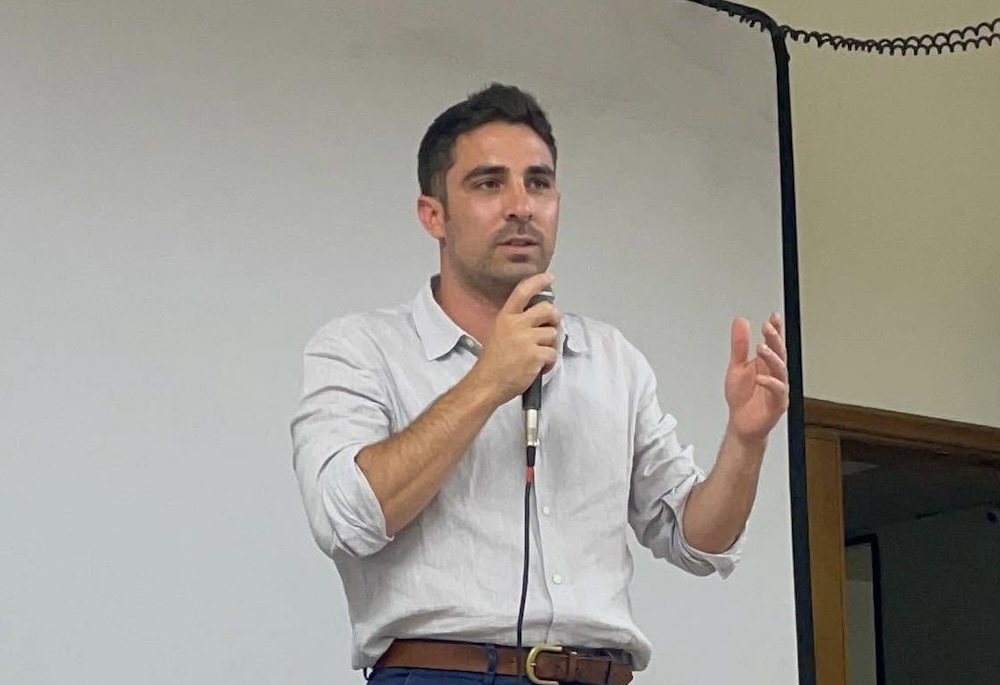
His name is Lorenzo Pacini. Thirty years old and a law graduate, Pacini serves on the local executive of the district covering Milan’s historic center. He belongs to the Partito Democratico (PD), the largest party in Italy’s center-left coalition, but his politics lie well to the left of the PD mainstream.
His campaign is called “La Rivoluzione di Milano” (Milan’s Revolution). Its logo reworks the biscione, the serpent devouring a child that has been a symbol of the city since the Middle Ages, when the ruling Visconti family adopted it as its emblem. Centuries later, Berlusconi borrowed it for his business empire. In Pacini’s version, however, the serpent is swallowing a portly billionaire in a top hat. The goal of his campaign? What he calls “municipal socialism.”
Pacini’s language is plain, direct, and concrete, far from the highbrow register that has come to mark parts of the contemporary Left, in Italy as elsewhere. Yet it is densely political. He talks about “socialism,” “the working class,” and “class struggle” — all terms that Italy’s mainstream left largely abandoned decades ago, and he uses them everywhere: in Milan’s streets, on social media, and on right-leaning TV and radio talk shows, sparring with hosts and other guests. He has more than a hundred thousand followers on Instagram, and several of his videos praising workers or talking about work have passed a million views. He also found himself at the center of a national controversy after appearing on a popular right-wing radio show, La Zanzara, where, in a heated exchange, he said that, if need be, fascists should be fought “with rifles,” as the partisans once did. His point was that branding the entire Right as fascist makes no sense, and that the Italian Republic was officially founded on the armed antifascist resistance. But the governing right, apparently recognizing itself in the label, kicked up a storm. Prime Minister Giorgia Meloni weighed in personally, and PD leaders duly distanced the party from his words.
This past summer, as a prolonged heat wave hit Italy and much of Europe, Pacini took his campaign into the neighborhoods with what he calls anguriate, meaning watermelon parties. These are open-air gatherings where he presents his ideas, listens to residents’ complaints, collects proposals, and hands out slices of fresh watermelon. The gatherings were initially modest in size, but they grew over the summer, and the themes he keeps returning to — housing costs, public services, taxing the rich — have begun to filter into the city’s political debate. He has also launched MiDecido, an online platform where Milanese can submit and vote on policy proposals: a way, in the campaign’s words, to “build municipal socialism together.”
Pacini describes his family background as rich in cultural capital but short on money and says he worked his way through university as a dishwasher and a fruit seller, among other jobs. Asked who inspires him, he often names three figures. The first is Emilio Caldara, Milan’s first Socialist (PSI) mayor, elected in 1914, who, as Pacini told Vanity Fair, “taxed the rich and built the public services we still enjoy today,” including the city’s public transport company. The second is his grandmother, a member of the Partito Comunista Italiano (PCI) who taught in the party’s evening schools for workers. The third is Ho Chi Minh, whom he described as “a great revolutionary, a great patriot, a man who managed to free his country first from the French and then from the Americans, with an enviable political and strategic skill that should serve as an example.” There is a Milanese thread to this unusual last choice: the Vietnamese leader appears to have lived in the city in the 1930s, incognito under Benito Mussolini’s regime, working as a cook — a chapter of his life about which little is known.
All this sits awkwardly with the PD. Even under the new secretary Elly Schlein, who has pulled it somewhat to the left, it remains a party of Italy’s liberal, moderate establishment, and all the more so in Milan, where it governs, and where the national leadership’s modest leftward shift has made little concrete difference. Pacini, however, doesn’t believe he’s the one who should feel out of place. “It’s those who still push essentially centrist ideas,” he told major Italian weekly L’Espresso, who shouldn’t feel at home in a left party.”
An Uphill Primary
Winning the center-left coalition primary won’t be easy. The favorite of the city’s establishment is Mario Calabresi, a centrist and a leading figure in Italy’s media world, former editor of two of the country’s biggest newspapers, La Stampa and then La Repubblica, who is backed by a sizeable part of the PD itself. On his own flank, Pacini will likely face Pierfrancesco Majorino, the PD’s group leader in the Lombardy regional council and a close ally of party leader Schlein. Other candidates from the coalition’s left have also declared or are weighing a run, further crowding his side of the field.
In a hypothetical primary poll conducted in early August, Pacini stood at just 7 percent. For a candidate with no party machine behind him and a campaign run by young volunteers, that is not nothing, but it makes him a long shot. Still, it is worth recalling that Zohran Mamdani was at 1 percent in the first poll for New York’s Democratic primary in February 2025, and that well into the campaign most observers doubted he would get far.
Given his talk of “municipal socialism,” the Italian press has often compared Pacini to Mamdani. The candidate himself, however, does not encourage the comparison, and has played it down whenever interviewers have raised it. He grants that Mamdani’s story has plenty to teach but insists that every city has its own particularities and that copy-pasting models from abroad rarely works. When I spoke with him and brought up the case of Molfetta, the southern town that recently elected a communist mayor, he joked: “I think there are more people from Molfetta in Milan than New Yorkers — so maybe we should listen to them a bit more.” It was a nod to the generations of southern Italians who built Milan’s working class.
He has a point, in any case. When it comes to municipal socialism, Italy hardly needs to import models. Before fascism, the Socialists governed Milan, Bologna, and hundreds of smaller towns, and the phrase itself was already current in Italian politics: it was the socialists’ name for what they were doing. After 1945, the Communists ran cities across Italy — Bologna above all, for half a century — building a distinctive local socialism of cooperatives, public nurseries, urban planning, and welfare that was, for decades, one of the party’s most persuasive arguments for its fitness to govern.
Pacini, in other words, is reaching back into a tradition that his own party, now far from its roots in the workers’ movement, spent the last thirty years trying to forget. Whether Milan’s voters are ready to embrace it again, after decades in which that tradition was dismissed and demonized, remains to be seen. But deteriorating material conditions are sharpening the appetite for change. In a survey published this month, 95 percent of Milanese said the way the city is run needs to change, and 54 percent said the change should be “radical.”
Pacini wants to prove that left-wing politics is not the pastime of a radical-chic cultural elite, as the Italian right loves to caricature it. If he can convince Milan’s population that municipal socialism is a concrete answer to their problems, rooted in the best of Italy’s own history, he may stand a chance.
Read the full story at the source
Source: Jacobin