
Politics · Jacobin · · 2h
High School Protests Have French Establishment on the Ropes
English (original) · Read in Deutsch ⇄
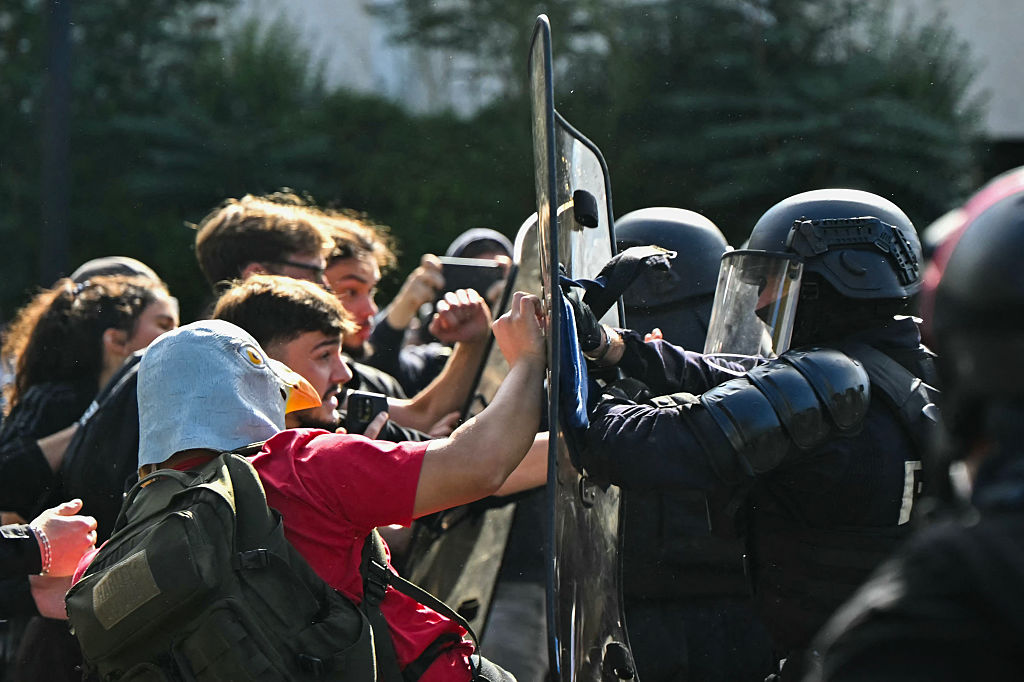
It only took a spark to set France ablaze. Protests broke out as the new school year had barely begun, as lycéens (high schoolers, aged roughly fifteen to eighteen) voiced their anger at what they see as neglect and contempt from the government. This deep-rooted discontent recalls earlier episodes. As the movement tries to spread to universities, the authorities’ only answer is repression, and accusations against La France Insoumise (LFI). The radical-left party wants to ride the wave of youth anger in its campaign for next spring’s presidential election, while its opponents hope the movement fizzles out as quickly as possible.
France faces zero growth, rising unemployment, soaring fuel prices, the abandonment of ecological policies just as climate change accelerates, and a new austerity budget. Until now, the 2027 presidential election had seemed to be channeling that anger. Ultimately, however, the social explosion is coming from a group that votes little or not at all and feels it has nothing to lose: high schoolers in the Paris region, who were quickly imitated by their peers in the rest of the country. And they have plenty of reasons to be angry.
Crumbling Schools and Teacher Shortages
It’s no coincidence that the mobilization began in high schools in the poorer towns of the Île-de-France region around Paris, with the first blockades on September 17 in Créteil. Here the new school year was once again marked by extremely degraded teaching conditions. Buildings are often dilapidated: at Paul-Éluard high school in Saint-Denis and Blaise-Cendrars high school in Sevran, videos filmed by students and teachers show, for instance, collapsing ceilings, rats, water leaks, and a shortage of chairs and tables. At Georges-Politzer middle school in Bagnolet (a collège, for ages eleven to fifteen, in another Seine-Saint-Denis town), murky water containing fecal matter came out of every tap, and the school was informed only four months after the tests had been completed.
Beyond these particularly shocking examples, school buildings are wholly unsuited to extreme weather events. According to a survey by SNES-FSU, which is the leading teachers’ union in secondary education, covering 623 middle and high schools, this May some 78 percent of schools recorded temperatures above 30 degrees Celsius, and above 33 degrees Celsius in one school out of five. The succession of heat waves that hit France between May and September confirmed this diagnosis, with numerous cases of teachers and students feeling faint, the closure of several hundred schools on the hottest days, and the postponement of baccalauréat exams (the national high school exit exam, which also serves as the university entrance qualification).
The académies (the regional branches of the Ministry of National Education) tried to make do and patch things up to deal with the emergency. But at the start of the school year, only 21 percent of schools had planned measures against extreme heat, 61 percent of which consisted of “planned or requested works” — in other words, not yet started. The renovation effort will be gigantic and is already estimated at €40 to €50 billion.
The discontent also concerns staff shortages. True, the Ministry of National Education managed to fill almost all the teaching posts offered in this year’s recruitment exam, compared with 91 to 92 percent in 2025, thanks to a reform lowering entry requirements. But some of the new recruits, who hold only a bac+3 (a three-year university degree), must complete two years of training before standing in front of a class; the effect of the reform will therefore not be felt right away.
These reassuring figures are also tempered by a drop in the number of posts offered, offset by a greater use of contractuels (contract teachers hired on fixed-term contracts rather than as tenured civil servants), whose training is often very basic. More broadly, the teaching profession is going through a genuine crisis and a “low but steady” rise in resignations, according to the Cour des comptes (France’s public audit body). In the latest Organisation for Economic Co-operation and Development (OECD) survey, only 4 percent of French teachers feel that their profession is valued by society, the lowest level of any country studied. Low pay, below the OECD average, is the leading cause; three-quarters of teachers consider their salary too low.
The result is difficulty in delivering all the scheduled classes. At the start of this new school year, half of schools were missing at least one teacher. For the 2023–24 school year, the Cour des comptes estimated that around 9 percent of teaching hours had been lost in middle schools, rising to 11 percent on average in zones d’éducation prioritaire (disadvantaged areas that receive extra resources). This teaching shortfall inevitably weighs on these young people’s level of knowledge and on their professional futures.
Despite substantial hiring in recent years, France is also desperately short of AESH (classroom aides for students with disabilities), with nearly 50,000 students, or one in seven, waiting for one at the start of the 2025 school year. The picture is similar for school nurses, with only 7,700 positions for twelve million students in 2023. Despite pay raises for both professions in recent years, salaries remain unattractive.
Ever-Deepening Inequalities
Beyond these overall figures, the situation varies enormously from one school to another. The académies of Créteil and Versailles, which cover the départements surrounding Paris, have long struggled to attract teachers. Within each académie, the gaps between schools in affluent neighborhoods and those in working-class suburbs (banlieues populaires) can also be wide. Early-career teachers are often sent to these disadvantaged areas while they accumulate points to apply for a transfer. Students in these middle and high schools thus face high turnover among less experienced teachers, which worsens their learning conditions.
Ministry of National Education data confirm this diagnosis: the “social position index” assigned to each school according to the occupations of its students’ parents reveals major imbalances and strong social reproduction. The correlation between social background and academic achievement among French students is one of the strongest in the OECD.
While gaps exist among public schools, they are even wider between public and private education. In 2022, the privately run sector operating under state contract had 40 percent of students from very advantaged backgrounds, against 20 percent in the public sector. Conversely, 18 percent of middle schoolers in these contract private schools came from disadvantaged social classes, against 42 percent of their public sector counterparts. These gaps, which have only widened since the late 1980s, stem from the selectivity practiced by many private schools, based on grades and on the tuition fees charged to parents. Yet these contract private schools are overwhelmingly funded with public money: in 2024, a parliamentary report noted that the state grants €8.5 billion a year to this sector, plus another €1.5 billion from local authorities. The result of a compromise in the long “school war” between the state and the Catholic Church (the great majority of private schools in France are Catholic), the 1959 Debré Law provides that the state covers teachers’ salaries and the running costs of contract schools, amounting to 75 percent of their spending, in exchange for implementing the official curriculum.
There are also private schools without a state contract (hors contrat), freer in how they operate and receiving no public money, but they educate fewer than 1 percent of French students. On top of these mandatory expenses, some local authorities grant additional subsidies to private schools: between 2016 and 2023, the regions distributed more than €1.2 billion to schools that were already well funded.
Although this budgetary lever could allow the state to pressure private schools into promoting greater social diversity, successive ministers have always carefully avoided making such demands. The reason is fairly simple: most of them went through the most prestigious schools (the grandes écoles, France’s highly selective elite institutions) and send their own children to private schools.
In 2024, the short-lived National Education Minister Amélie Oudéa-Castéra caused a scandal when she justified placing her children in an extremely upper-class private school — Stanislas high school, in Paris’s 6th arrondissement — by citing teacher absenteeism in the public sector. Her predecessor Gabriel Attal (who went on to become prime minister and is now running for president) himself attended the very bourgeois École alsacienne, in the same neighborhood. These ministers’ school careers are thus emblematic of a form of social separatism.
Having grown up in a bourgeois bubble, Macron’s ministers know next to nothing about the social reality of public schools, which often leads them to adopt reforms that hurt the sector even further. At the start of the decade, France had the most overcrowded classes in Europe. For the 2026 school year, a teacher faces an average of twenty-one students in primary school, 25.3 in middle school and 30.5 in high school. With such numbers, it is hard to support each student properly; inevitably, some are more disruptive and fall behind. The falling birth rate could, however, allow the number of students per teacher to be reduced: by 2035, France will have 1.7 million fewer students, a drop of 14.2 percent. Teachers’ unions, parents and many politicians see an opportunity: by keeping the number of teachers stable, the ratio can fall naturally over the years.
But the government has a different priority: saving money. In 2026, 3,256 teaching positions were cut. The same austerity imperative also led to €40 million being cut from a program of school renovations designed to face climate change, two-thirds of the budget, in the middle of a scorching summer.
Phone Bans and Sorting Algorithms
Other recent reforms are also fueling the anger, in particular those decided by Gabriel Attal during his time at the Ministry of National Education (July 2023 to January 2024). One is the choc des savoirs (“knowledge shock”), which introduced groupes de niveau (ability-based groups for core subjects), widely denounced by teachers, students, and parents as a form of “social sorting” and whose efficiency has always been disputed. This flagship Attal reform was finally repealed in early 2026.
The second measure, adopted in the name of laïcité (France’s strict principle of secularism, which governs the place of religion in public institutions, schools included), is the ban on wearing the abaya (a long, loose-fitting robe worn by some Muslim women), regarded as a religious garment signaling Muslim faith. But this decree, designed to appeal to conservative and far-right voters, proved a headache to enforce: How do you tell an abaya from a dress? Besides the fact that the French Council of the Muslim Faith (a body that represents Muslims in dealings with the state) points out that the abaya has never been a religious garment or prescription, the inconsistent enforcement among girls wearing similar dresses — some having to change, others not — and the fact that only Muslim girls were targeted sparked numerous controversies.
Above all, while the goal of secularism is fundamental in national education, one may question if sending young Muslim girls home over a garment rather than letting them attend public school really is the right way to fight Islamic fundamentalism.
The ban on mobile phones in high schools since the start of the 2026 school year — already enforced in primary and middle schools — may also have helped stoke the high schoolers’ anger. While the measure clearly has positive effects on students’ focus and public health and helps reduce cheating, the mobile phone remains an often indispensable tool for many school activities. Teachers sometimes ask students to use their phones in class; grades, schedules, and homework are generally conveyed through the Pronote software (the online school-management platform used in most French schools); and the phone also serves as a canteen card. The measure has therefore been applied unevenly, with each school responsible for incorporating it into its internal rules, which inevitably fuels comparisons between students at different schools.
Finally, one reform from the early Macron era has never been digested: Parcoursup. This selection algorithm for admission to higher education already sparked fierce anger when it was created in 2018, since it effectively ends the right to access higher education simply by obtaining the baccalauréat. The algorithm’s opacity has not helped. High schoolers send out volleys of applications for the coming university year without being sure what they will end up with.
For some, the answer never comes: in July 2026, 100,000 students had no placement for the start of their university studies. Although this figure falls later as places open up, the stress for these young people and their parents is enormous: they end up applying to all kinds of programs, sometimes far from what they want and from where they live, and face great difficulty preparing for the new academic year. Dejected, some wait until the following year to apply again.
A History of Student Struggle
The combination of these many factors and an especially anxiety-inducing atmosphere — wars, climate change, the rise of the far right, an economy in poor shape — has resulted in extremely poor mental health among young people. For example, 20 percent of high schoolers had suicidal thoughts during the year, according to Santé publique France (the national public health agency). While adolescence has always been a difficult period of human life, such levels are unprecedented and particularly alarming.
It therefore did not take much to push high schoolers to launch a social movement, which also gives some of them a reason for hope in the future and a collective fervor they had been deprived of by the reign of screens.
Like any youth movement, the current wave of school blockades is chaotic, its demands are sometimes muddled, and its methods do not always command consensus. There are also young people who do not wish to take part in the blockades and are more concerned with passing their exams. The Ministry of National Education is in fact planning video-conference classes for the four hundred to five hundred blockaded high schools in the coming days.
A sign of the times, technological tools are now central, both to weaken the movement and to feed it, with Snapchat videos and Instagram posts. But apart from this novelty and the fear of people fainting in suffocating temperatures, the 2026 high school movement has much in common with other historical episodes.
Over the past four decades, there has been a major youth movement roughly every ten years, always raising the question of the resources devoted to education. In 2018, a high school and student movement — admittedly smaller than today’s — was launched against Parcoursup and to demand more spots in universities.
In 2005, it was the Fillon reform of the baccalauréat, as well as budget cuts, that put high schoolers on the streets. While the government of the day did not back down, it was forced to do so the following year in the face of anger over the CPE (“first employment contract,” which let companies fire young workers without justification during their first two years, adopted with the aim of decreasing youth unemployment).
Further back, other mobilizations resemble those of 2026. In October 1998, high schoolers were already protesting for more teachers and smaller classes and against a general feeling that the future was closed to them. The movement peaked on October 15 with 500,000 protesters across France and won 4 billion francs (roughly €1 billion in today’s value).
In 1990, the movement also began in the Paris suburbs, following the rape of a young girl at a high school in Saint-Ouen. In addition to the fight for safer schools, young people demanded more teachers and the renovation of their run-down schools. The movement led to a package of 4.5 billion francs (roughly €1.2 billion) and to the creation of conseils de la vie lycéenne, which allow elected student representatives to take part in certain decisions at their schools.
Will the Blockades Spread to Universities?
Can the 2026 wave of school blockades repeat these victories? While it is still too early to say, the answer will depend on its ability to broaden its alliance. After high schools, the next step could be the universities, some of which have already begun to be blockaded. University students indeed share common grievances with high schoolers, such as dilapidated buildings and a lack of space that prevents them from studying in decent conditions. Average spending per student has been falling steadily since 2010, and every French university ran a deficit budget this year.
The same logic of inequality and privatization also affects higher education. Faced with a lack of spots in public universities, 26 percent of students chose private higher education in 2022, a share that rises every year. Between 2012 and 2022, the number of students in private higher education rose by 63 percent, against only 3 percent in the public sector. Ranging from excellence to the worst scams, private universities at least have one thing in common: often substantial tuition fees.
Student life is getting ever more expensive, and student precarity has risen sharply in recent years, with, for instance, 23 percent of students having already skipped a meal for financial reasons.
The 2027 budget is unlikely to improve matters, as it plans to freeze the APL (aide personnalisée au logement, a means-tested housing benefit that helps pay rent). Always looking for further savings, the government also wanted to introduce fees for students not receiving need-based grants (non-boursiers) to attend a BTS (brevet de technicien supérieur, a two-year vocational higher-education course) or classes préparatoires (the highly selective two-year preparatory courses for the grandes écoles). The government recently backed down on that idea in the face of high schoolers’ anger.
Besides students, high schoolers could also be joined by their teachers, a number of whom already went on strike on September 29 to protest a pay freeze that has lasted for years. Since their demands are often shared, this convergence is fairly obvious.
Militant Action and a Hostile Press
Besides unions and youth organizations, another player is calling on high schoolers and students to mobilize en masse: La France Insoumise (LFI).
The radical-left party led by Jean-Luc Mélenchon very quickly became the political voice of the high schoolers’ demands. Some of its most high-profile figures have been particularly well received by young people at the blockades, such as MP Louis Boyard, himself a former high school student union activist.
Many LFI elected officials went to meet the high schoolers from the outset of the movement to encourage them to block their schools, but also to try to defuse tense situations with law enforcement. This presence has drawn heavy criticism on TV talk shows, where LFI has been accused of stirring up chaos and held responsible for damage in several cities. The mayor of Saint-Denis, Bally Bagayoko, was thus accused of setting a trash can on fire when he was in fact trying to put it out.
As with every social movement, the question of violence quickly dominated media coverage. An analysis of France 2’s evening news broadcasts (France 2 is a major public-service TV channel) over four days shows that 75 percent of the airtime devoted to the high school mobilizations focused on violence and 12 percent on accusations against LFI, while only 8 percent was devoted to the movement’s demands. While most of this violence is limited to burning trash cans and setting off fireworks, some scenes have been striking, such as the burning of a high school entrance in Nantes.
As with every social mobilization, the overwhelming majority of participants are of course peaceful, and the unions and political organizations supporting the movement have all called for restraint.
But on TV talk shows, LFI is very quickly singled out as responsible for violence and unrest. Prime Minister Sébastien Lecornu even accused “LFI and its far-left proxies” of being behind the movement, relying on an intelligence service memo that was immediately sent to the media.
La France Insoumise has dismissed this thesis as a “conspiracy” that “infantilizes” high schoolers and sees it as part of a “strategy of letting things rot and of provocation.” The government’s strategy seems to be partly working: 55 percent of French people surveyed in a recent poll believe the movement is being manipulated by LFI. But another poll indicates that 62 percent of French people consider the high school movement justified.
Facing a public that largely backs the young on the one hand, and confronting budgetary restrictions on the other, the government has decided to bet on repression.
With the exception of farmers, Emmanuel Macron always applies the same technique to every social movement: crack down on protesters in order to terrorize participants, and exploit the violence to make the movement unpopular.
More than five thousand high schoolers were detained in a single week, an unprecedented level. Police violence has also been significant, for example with a grenade fired almost point-blank into the face of a fourteen-year-old in the Val-d’Oise (a département north of Paris). This strategy is risky: in the event of a tragedy — for example the death of a teenager following a police operation — the anger could turn against the police and the government. That is what happened in 1986 with the Malik Oussekine affair, named after a twenty-two-year-old student killed by police during protests against the Devaquet reform, which planned selection for entry to university. Two days after his death, the reform was withdrawn.
La France Insoumise and Rassemblement National Confront a Social Movement
The high schoolers’ mobilization has in any case surprised the entire political class and brought young people’s malaise back to the forefront of a presidential campaign that had said very little about it until now.
With no real answer to offer, the Rassemblement National (RN, the far-right party led by Marine Le Pen), the traditional right, and the Macronist bloc are betting on the movement running out of steam, hoping to quickly move on to another topic. Marine Le Pen also took the opportunity to criticize the excessive resources supposedly allocated to the banlieues — and therefore to the people with immigration background who live there — compared with “the forgotten France” of rural areas.
The figures, however, disprove this claim, showing average underinvestment of 30 percent per student in Seine-Saint-Denis compared with the rest of the country, even though rural France is also being abandoned by the state.
For LFI, the emergence of this social movement is an opportunity to showcase certain points of its program, such as the repeal of Parcoursup and increased resources for national education.
If the movement spreads and wins concessions, Jean-Luc Mélenchon will be able to turn it into a campaign argument, claiming that the all-out mobilization strategy he advocates delivers results. The presidential candidate also hopes that this support will persuade young people to vote for him. Particularly popular among the youth, he pays the price for this age group’s low turnout.
Conversely, if the movement degenerates and is dominated by violence, LFI risks being held responsible.
This social movement, possibly soon joined by a call to revive the gilets jaunes on October 17 to protest rising prices, is in any case a measure of the general atmosphere in France on the eve of a decisive election. Tension is everywhere, and Macronism in its twilight is increasingly overtaken by events and rejected by citizens.
Very strong polarization is taking hold between a left-wing camp dominated by La France Insoumise, which intends to build on social struggles, and a radical-right bloc dominated by the Rassemblement National, which is multiplying martial proposals to bring “order” back to the country, without offering any real answers to the social roots of the anger.
This article originally appeared in Jacobin, a democratic socialist magazine publishing long-form essays and analysis on politics, economics, and culture. Subscribe to the print edition for $20 a year.
Read the full story at the source
Source: Jacobin