
World · Jacobin · 41m
Germany’s Far Right Is Close to Power. Appeals to “Defend Democracy” Won’t Stop It.
English (original) · Read in Deutsch ⇄
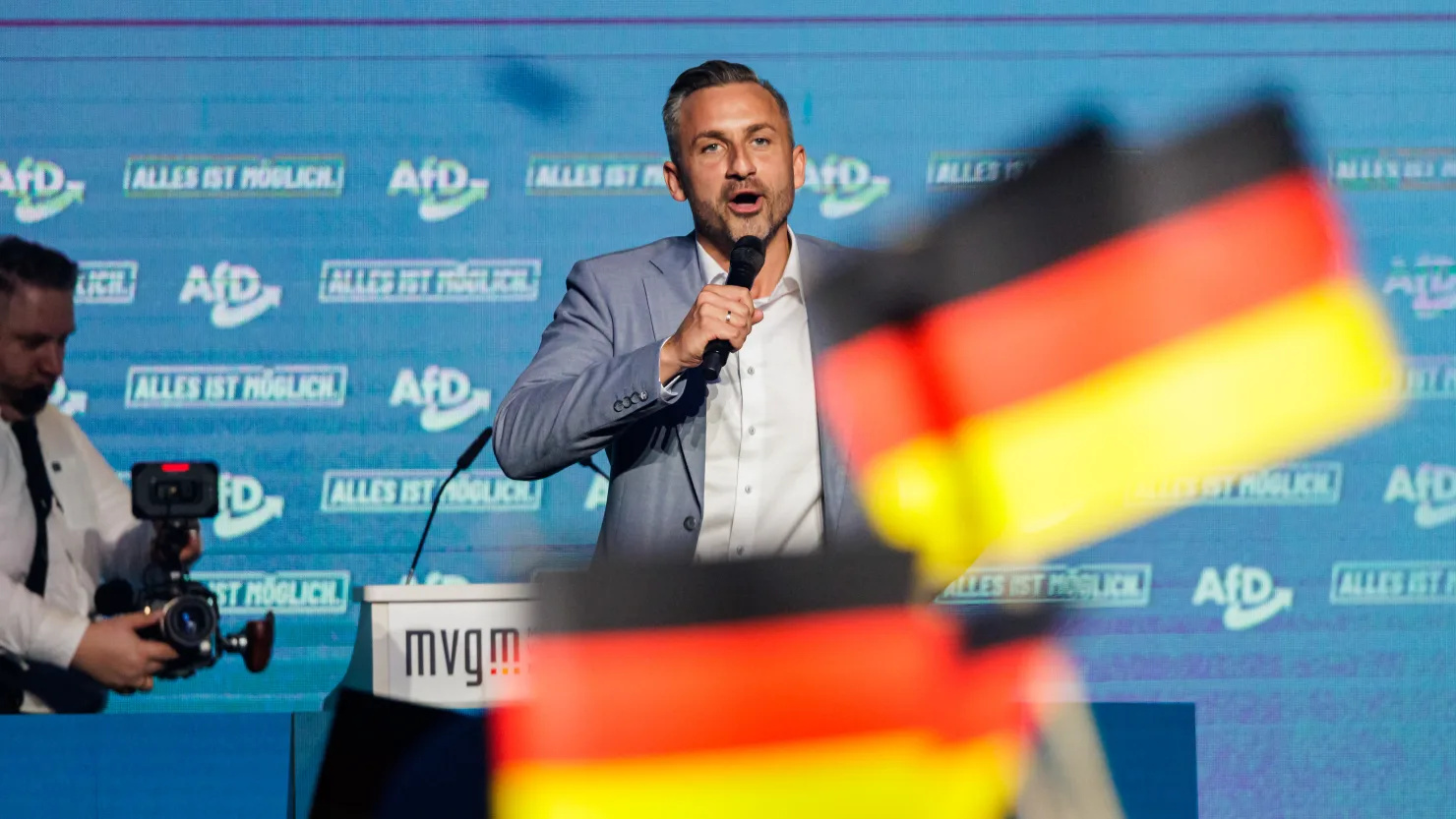
In Sunday’s state election in Saxony-Anhalt, local Alternative für Deutschland (AfD) lead candidate Ulrich Siegmund ran on the slogan “Anything is possible.” Those same words could serve as the headline for political forecasts the day after the vote. For while the election produced a clear winner, it didn’t yield a definitive outcome.
While the far-right AfD scored an impressive 43.8 percent of votes cast, it has not secured an absolute majority. Nor does the anti-AfD camp have a majority, as Sahra Wagenknecht’s party (BSW, a split from the socialist Die Linke) stands in between the two sides. If the AfD’s Siegmund is to be elected Saxony-Anhalt’s minister-president, he still needs three extra lawmakers in the state parliament on his side.
One possibility is that a few Christian Democrats (CDU) who sympathize with the AfD and want nothing to do with Die Linke might switch sides. With its 17.2 percent share, the CDU’s ability to bring people together seems to have hit a low point. Alternatively, the BSW, on 5.3 percent, could be key. Whether BSW will support the AfD, as feared by the anti-AfD camp, or simply cost Siegmund his outright majority (as the AfD itself warned before the election) remains to be seen.
Die Linke did a lot worse than polls suggested, on 8.6 percent; the Social Democrats (SPD) did slightly better with 9.3 percent; and the Greens did significantly better with 8.9 percent. If the Greens had failed to win any seats, as seemed possible, the AfD would likely have secured an absolute majority. Groups advocating tactical voting will likely interpret this outcome as validation of their efforts.
Yet this overlooks the main consequence of this politics of interchangeability within the “democratic camp.” For it is made up of four weak parties that, taken together, are barely as strong as the AfD alone. The fact that this kind of “defense of democracy” is close to bankruptcy is evident from what “democracy” is being defended against here. For this election saw a near-absolute majority, a record voter turnout of 76 percent, and an enormous mobilization of previous nonvoters, the vast majority of whom went to the AfD.
Yes, Majorities Are Democratic
The plight of the “defenders of democracy” was well-illustrated just before the election by the SPD’s top candidate, Armin Willingmann. During a pre-election debate program, he attempted to portray the mere fact of a party pursuing an absolute majority as an inherently anti-democratic threat. You wonder how they come up with this stuff.
Willingmann explained, “Since the founding of the Federal Republic [in 1949] we’ve had good experiences with not having single-party governments, or virtually no single-party governments. Compromise, seeking consensus, and balancing interests is the essence of our democracy.” Referring to Siegmund’s statement that he wanted to become minister-president only on the basis of an absolute majority, Willingmann warned: “I see this attempt to govern without compromise as a path toward authoritarianism.” Someone should remind him that in Saarland, his party comrade Anke Rehlinger is currently leading a single-party SPD government.
But if compromise were, in itself, really so democratic, then politicians wouldn’t hate pre-election questions about possible coalition options so much. After all, they certainly don’t dodge these questions out of “respect for the voters,” as they always claim. They do so because they know they are elected for their broader ambitions, and not out of eagerness to make compromises with opposing parties – compromises that inevitably end up in the trash can.
In fact, the opposite is true: parties that would rather form a coalition than govern alone are rightly suspected of not actually intending to implement their platforms, and of not really being too keen to change the unpopular status quo.
No Democracy Without Visions
The problem is not that the AfD is striving for an absolute majority. Rather, the failure lies with the other parties, which seemingly have no convincing visions to offer. The SPD has no social democracy, Die Linke no democratic socialism, the BSW no “social justice and sound economics,” the Free Democrats no special economic zones, the CDU no status quo, and the Greens no war with Russia capable of inspiring the masses.
Now the bill has come due: of all parties, the anti-democratic AfD is the one managing to inspire the disillusioned masses to participate in democracy. On election night, probably no one used the word “democracy” as much as the AfD’s Siegmund. Any serious left-wing strategy is based on the conviction that the broad majority, which has lost faith in politics, can be mobilized through the struggle for a different society. The AfD has now proven that it is possible to mobilize nonvoters. It remains the Left’s job to do better in this regard than the Right.
This society needs a different vision for the future, one that goes beyond both the ailing status quo and the AfD’s offer of a return to an imagined past. Anyone who wants to fight for democracy should not rely on the constant compromise of many small and shrinking parties, but should instead try to inspire the people to embrace their own vision. For in the long run, there can be no “defense of democracy” against absolute majorities and massive mobilization of nonvoters.
Read the full story at the source →
Source: Jacobin