
Migration Jacobin
Europe Relies on Illegal Pushbacks to Deter Migrants
Pushbacks are a tactic to violently force migrants back across borders. European authorities recognize that the practice is illegal, but this hasn’t stopped pushbacks from becoming increasingly common
English (original) ·Read in Deutsch ⇄
In the video that precipitated his most recent arrest, Daniel Thomas, founder of the Patriot Platform group, can be heard telling someone on a dinghy in the English Channel, “You’re in English territory, this is England,” before proceeding to rather unsuccessfully slash at their inflated vessel. Thomas’s version of English history presumably doesn’t credit it as the first nation to adopt a comprehensive organization for saving lives at sea (later the Royal National Lifeboat Institution), whose routine rescue operation Thomas was interrupting and whose activities, members, and members’ children have been threatened by Thomas and his far-right associates. When Thomas and his group refer to “taking Britain back” to when it was “great,” they must mean to before the 1536 Offences at Sea Act, which brought maritime crimes into common law, or at least to before the 1854 Merchant Shipping Act, which provided rewards for lifesavers at sea, and whose contemporary update Thomas was arrested on suspicion of offending against.
It doesn’t take much effort to paint Thomas as a man with only one oar in the water. But the sad fact is that his was only an attempted civil enactment of what has become European border regimes’ de facto policy: the migrant pushback.
According to the European Commission, pushback refers to “various measures taken by states which result in migrants. . . . being summarily forced back to the country from where they attempted to cross or have crossed an international border without access to international protection or asylum procedures.” As many have pointed out, “pushback” is an essentially euphemistic term, often masking the specific violent mechanics involved in each case.
In his new book, Along the Watchtower: Dispatches from Europe’s War on Migration, journalist Nathan Akehurst charts the development of pushback as a tactic of immigration control at Europe’s borders, alongside the camps, militarization, surveillance, and externalized enforcement introduced by European states and institutions since the peak in irregular migration to the EU in 2015 (and, in fact, in the decades prior). Akehurst deftly weaves this account with testimonies of survivors of these borders, interviews with the organizations and people who work in and against this system, and his own experience as a volunteer with search-and-rescue operations in the Mediterranean and beyond.
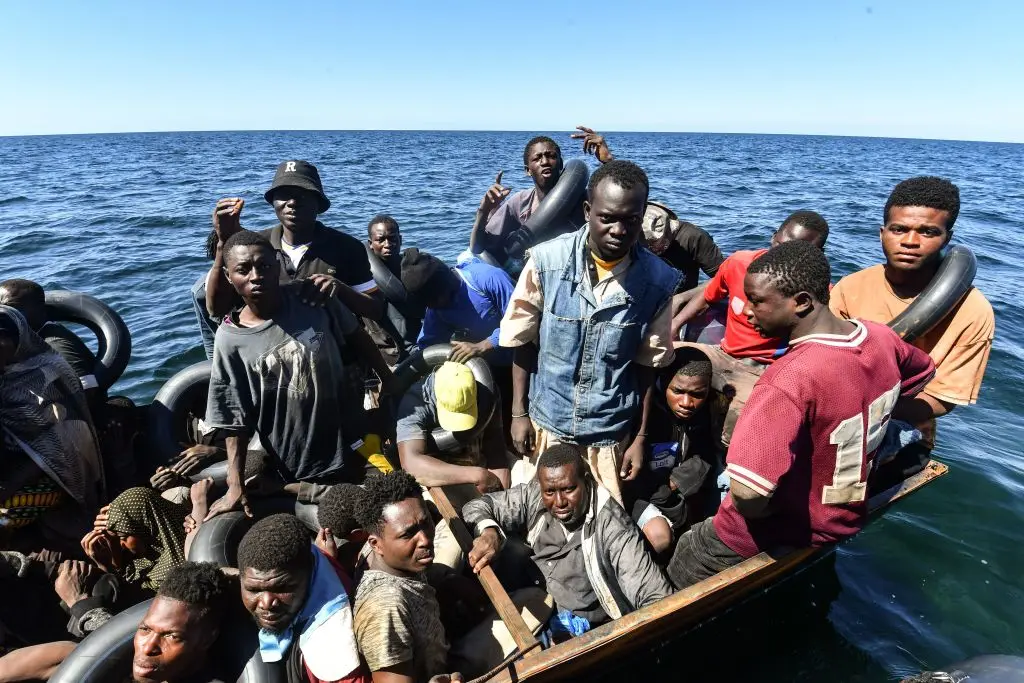
Cases of pushback detailed by Akehurst, as well as in the Black Book of Pushbacks compiled by the Border Violence Monitoring Network, include violent assault, strip search, family separation, sexual violence, dog attacks, detention, abduction, destruction of possessions, use of electric discharge weapons, intimidatory gunfire, ship maneuver resulting in capsize, abandonment in rough waters, and, yes, the stabbing of inflatable vessels. Over 40 percent of recorded cases involve minors, and, while it is impossible to say exactly how many deaths can be attributed to pushbacks, it is almost certainly in the hundreds. These pushbacks have been recorded at almost every EU border, from Turkey-Greece to Poland-Belarus, Finland-Russia to Morocco-Spain, Serbia-Hungary to Libya-Italy, on land and at sea, and even within the Schengen Area supposedly without internal border controls.
From the evidence Akehurst painstakingly gathers in his book, it is impossible to conclude that these pushbacks take place without the knowledge, tacit sanction, and even participation of EU border agency Frontex.
After International Law
Pushback is illegal. It violates the individual’s right to claim asylum under international law and constitutes a deportation without trial. Pushbacks at sea also seem to contravene the universal duty to render assistance to those in distress, enshrined in the 1982 UN Convention on the Law of the Sea and the 1974 International Convention for the Safety of Life at Sea. Given the typical state of repair of the vessels that irregular migrants use to cross, for example, the Mediterranean, their capacity, and the typical condition of the individuals concerned (Akehurst reports multiple instances of pregnant or unconscious passengers), one would think that this duty would kick in automatically for any state agent in a seaworthy boat coming to meet them.
These conventions are only the latest legal formulation of a nautical norm probably as old as seafaring itself. Xenophon’s Hellenica records that it was the failure of the six Athenian generals to rescue shipwrecked soldiers after the Battle of Arginusae in 406 BCE that prompted their trial and execution by the Athenian democracy. In Roman Law, the Lex Rhodia, codified by Justinian I but likely already over a thousand years old by that point, protects the duty to rescue by establishing the principle that any damages from jettison must be compensated by contributions from all those saved (the law of the general average). Similar conventions are present in the medieval pan-Mediterranean compendium the Consolato del Mare and were brought into the new “maritime law” of various states in the seventeenth century. As the concept of “international law” developed in the eighteenth century, influential Swiss jurist Emer de Vattel argued that there was a right of entry into port for a vessel in distress, and that this right existed notwithstanding the opposition of the coastal state. So universally established was the duty to render assistance, so ingrained in the psyche of European sailors, that Nazi Admiral Karl Dönitz felt obliged to issue an order forbidding such rescue after German U-boats repeatedly went to the aid of sunk Allied vessels and most famously attempted to rescue British and Italian survivors of the ocean liner Laconia (when they were attacked by American aircraft).
One can also tell different stories of Europeans’ behavior at sea. The same Rhodian law of the general average was relied upon by the owners of the slave ship Zong when they filed an insurance claim for the loss of 132 enslaved Africans thrown overboard when the ship ran low on drinking water. The same Vattel published an opinion justifying settlement of North America by Europeans who, “finding land of which the savages stood in no particular need, and of which they made no actual and constant use, were lawfully entitled to take possession of it and settle it with colonies.” The development of maritime and international law in the early modern period is inseparable from the development of European colonialism. European states established laws for their mutual conduct and the rights of their people, and in the same sweep drew the physical and ideological lines beyond which they would not apply: the persons who would not be legal subjects and the peoples who did not meet the criteria for statehood, and who could therefore be brutalized. The law was a technology concurrent to military force, economic extraction, and administrative imposition by which Europeans established sovereignty over distant land, in a process Gilles Deleuze and Félix Guattari would call “territorialization.”
At Europe’s borders today, exceptions to its “universal” human rights are still being made. The border as Akehurst describes it has become a bitter, one-sided contest between rival regimes of law. Civil and humanitarian groups, of national and international composition, fight for the application of international but also national maritime assistance and asylum law. They are obstructed by international lawfare. (Akehurst cites cases of search-and-rescue volunteers being charged with offenses such as smuggling and espionage. The cases can halt and frustrate rescue operations for years but rarely make it to court, spurious as they are.) Meanwhile, European governments cooperate to maintain states of exception for persons they deem deserving and outsource their lawmaking violence to foreign state and non-state actors. This is not a conflict between state sovereignty and international law but rather between different transnational agents attempting to undermine each other’s governance over social relations in a geographical area — in Deleuze and Guattari’s language, territorializing and deterritorializing actors.
Parallel to post hoc legal justification runs a tradition of European thought, from Diogenes to Franz Kafka, which examines the law not from the perspective of its writer but from the perspective of its sufferer. For the woman experiencing her twentieth pushback at the hands of men with guns in EU-funded patrol vehicles or the teenager in his second year in an offshore detention center waiting to hear whether his asylum claim will be successful, or whether it is even still “under review” at all, what good would be an invocation of the European origins of humanitarian law? The monolith they encounter just is the law. And this monolith, this Castle, this “Fortress Europe” is getting more formidable each year as the death rate rises. How did we get here?
Strange Bedfellows
Along the Watchtower contains a fascinating and timely history of European politics since the millennium, one that turns received wisdom on its head. The familiar story is the competition between liberal Europeanists, who favor increased powers for pan-European institutions, perhaps with the end goal of a supranational European state, and Euroskeptics, who want to maintain nation-state sovereignty as they see it. But Akehurst argues that what characterizes recent developments in Europe is a strategic accord, or at least a confluence of interests and convergence of policy, between these two factions.
In the economic and political crisis in Europe after 2007, amid mildly rising levels of irregular migration, the Europeanists sensed an opportunity to consolidate the European project with two key material tools of statehood: an army and a border. A minor agency, based in Warsaw as a favor to new EU member Poland, proved to be the answer. This was Frontex, and it quickly grew from a budget of €6 million in 2004 to €90 million in 2014. After the “migrant crisis” of 2015, it was supercharged, and its 2025 budget was over €1 billion of taxpayer money. It is now the EU’s largest agency. The number of its Standing Corps, the EU’s first uniformed service, is set to reach ten thousand next year. They have been increasingly equipped like a military force. Meanwhile, Europeanist politicians such as European Commission President Ursula von der Leyen have toured borders from Poland to Greece and claimed them as “European borders,” capable of being “defended” only by diverting money and power toward the coordinators in Brussels.
In this project, the Europeanists found strange bedfellows in the European far right, on an upward trajectory since 2007. They traditionally opposed European centralization and what they saw as the resulting importation of liberal values into the national body politic. They too spotted an opportunity, and one they too were able to escalate after 2015: to reframe economic downturn and national decline as the fault of immigrants and an overly permissive immigration system. As they started to gain power in countries like Austria and Italy, they worked with European institutions to bring about their desired treatment of migrants. It turned out that Brussels’s liberal values were up for sale, and not for a high price. Through bilateral state agreements, partnerships with illiberal external regimes like in Tunisia and Turkey, and victories for the border lobby within the EU, the far right secured the militarized “hot spot” system that Frontex was only too happy to enforce. This system, in turn, funnels irregular migrants into certain dangerous pinch points, from which emerge the spectacles of large groups of people pushing at fences or overcrowded dinghies making landings, which the far right then uses to campaign on.
And so, von der Leyen and far-right Italian Premier Giorgia Meloni will come together for a photo op on Lampedusa, and both have endorsed the EU’s New Pact on Migration and Asylum that took effect this year. The far right get their ritual violence and their spectacle, and the Europeanists consolidate their transnational power. Whether each side believes they are strategically outmaneuvering the other is by the by: the result is washing up at the shores of the Mediterranean every day. (British pro-Europeans optimistic about Andy Burnham’s recent interventions on reversing Brexit ought to be cognizant that this is the EU to which they would be returning.)
So we are stuck in a vicious cycle of immiseration. Every migrant that fails to get through the border proves that Fortress Europe is working: every migrant that succeeds only proves that more resources, more surveillance, more emergency powers are required. Deeply unpleasant regimes and warlords pocket their fees for maintaining Europe’s external border, which they then use to conduct their own internal repressions, producing more refugees. The arms and surveillance technology companies, often in a revolving-door relationship with European agencies, enrich themselves to the tune of billions of dollars, which they use to lobby for more investment in arms and surveillance technology. The far right surges in Germany, France, Britain, and all over Europe as voters choose the real thing over the milquetoast versions of migrant demonization offered by liberal and social democratic politicians unable to resist the trap their enemies have set for them. Historic landscapes of Europe, Africa, and the Near East, gateways of ancient exchange and adventure, mountain passes, river valleys, and coastlines get covered in barbed-wire fences, tents, and patrolling soldiers. And the Mediterranean continues to groan with blood: the latest count is over thirty five thousand lives lost since 2014.
People Keep Moving
And still people move. It shouldn’t be unfamiliar to Europeans that people move: after all, they’ve always done it. The stories of the European imagination are littered with travelers, voyagers, and migrants: from Homer’s Odyssey to the skaldic poets, from Sadko in the byliny to the Celtic immrama. Without naively imagining this movement as always benevolent, and whatever its rationale, we can recognize that the arduous journeys have been respected; their human cost commemorated; the miracle of rescue honored. In Greek myth, the Aegean Sea is named for the life lost in it. We don’t know all the names of the people who have died in the Mediterranean in the last twelve years. The ones we do know are thanks to the tireless work of legal advocates, humanitarian campaigners, and migrant self-organizations. Akehurst interviews volunteers from I Have Rights in Samos, Mission Wings in Bulgaria, Medical Volunteers International in Serbia, Sea-Eye in the Mediterranean, and many more. We can situate their work in the legacies of civil and socialist opposition to the state, given their utilization of those material concessions won by previous struggles and inscribed within bourgeois law to defend and enact visions of human life beyond capitalist systems of violence. What Akehurst doesn’t give as much detail on is the relation — actual or optimal — between these groups and socialist parties working within national contexts. Nor is his book a theoretical account of the political economy of contemporary migration — a new left-wing popular introduction to which would be welcome. Nonetheless, the stories of these campaigners and the author’s sometimes joyous, normally mad encounters with them and the people seeking safety resonate long after the final chapter.
There are more traditions in Europe than just the imperial, and they include the civil organization of lifesaving at sea, kept alive today by search-and-rescue groups in the Mediterranean. The sea, that “howling infinite,” is not an easy place to territorialize. There is a natural disrule, and everything is more dangerous. This is why it lends itself more to the mythic mode than the juridical. Right-wingers accuse migrants of exploiting this danger in order to claim rescue and asylum. But the reverse is true: it is the European authorities that exploit the remoteness, lack of oversight, and hazard of the water in order to prevent legitimate asylum claims. It should concern us all whether what prevails on the Mediterranean, in the English Channel, and around the world is the law of assistance to those in distress or the law of the pushback.
While we have much to thank these first responders for, they won’t be enough on their own. As migration increases with climate breakdown and capitalism at war, it behooves us all to defend human movement and facilitate its safety. The alternative is becoming increasingly clear: the Mediterranean as mass grave, from the bloody outcrop of Ceuta to Trump hotels on the ethnically cleansed beaches of Gaza; a Europe without enough firefighters to tackle its wildfires, relying on the water cannons of border guards; and a thousand Daniel Thomases in brown shirts patrolling the Channel.
Against such a future, and the present powers who would midwife it, we must build a politics capable of pushing back.
This article originally appeared in Jacobin, a democratic socialist magazine publishing long-form essays and analysis on politics, economics, and culture. Subscribe to the print edition for $20 a year.