
World · Jacobin · · 3h
David and Goliath
English (original) · Read in Deutsch ⇄
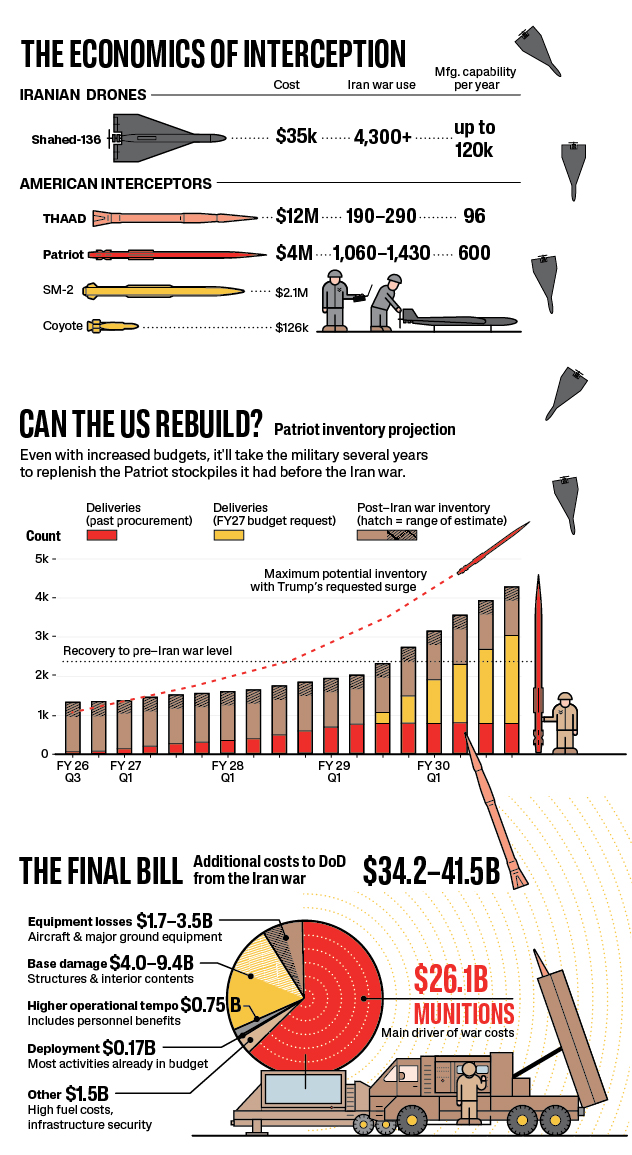
The motor of an Iranian Shahed-136 drone is little more powerful or complex than that of a motorcycle. But stopping one is no simple matter, as the United States and Israel found out after they launched a war on Iran in February. To protect Israel and the Gulf states from Iran’s cheap, mass-produced drones, the United States had to fire off thousands of sophisticated, scarce interceptors. Over the course of the conflict, some $26.1 billion worth of munitions disappeared into the sky, potentially leaving the United States with too few interceptors to sustain its security commitments around the world.
Most sources estimate the cost of manufacturing a Shahed-136 at between $20,000 and $50,000. According to one Phenomenal World writer, the true number could be as low as $4,000 — roughly the cost of producing a tractor in Iran. With minimal investment, and without relying on imported components or high-tech factories, Iran can churn out drones that fly at 185 kilometers per hour and strike targets 2,000 kilometers away. Throughoutthe war, the United States has frequently met the Shahed-136 with Patriot interceptors, which cost $4 million per shot and are fired from $1 billion batteries; sometimes it has even been forced to use top-of-the-line THAAD interceptors, at a price of more than $12 million per shot. Military protocol dictates that troops fire at least two of these eye-wateringly expensive missiles at each incoming threat.
If this cost asymmetry were the only problem, defense analysts in the wealthiest nation on earth might not be so concerned about Iranian drones. Imbalances of scale and speed are major issues too. Whereas some estimates suggest that Iran has the capacity to produce up to 120,000 drones per year, Lockheed Martin can only make 600 Patriot interceptors and 96 THAAD interceptors annually. During the Iran war, the United States may have burned more than half its stockpiles of these missiles, and restoring inventories to prewar levels could take over three years, even as Congress and the Defense Department shower Lockheed with money in an attempt to boost output. Meanwhile, from Ukraine to Taiwan, US allies are bracing for interceptor shortages and scrambling to get their hands on the remaining missiles.
As many commentators have noted, the economics of drones and interceptors point to a major shift in the dynamics of air warfare, in which great powers once held an overwhelming advantage. Since the Cold War, the United States has developed an array of highly capital-intensive military technologies designed to ward off a few devastating strikes from advanced weapons. With the cost of offense falling relative to defense, poorer countries can turn these assets into liabilities simply by launching more and more attacks; Iran’s drone swarms are guaranteed to hit the enemy’s finances and may even land some lucky blows on its forces. The lessons have not been lost on the Defense Department, which is investing in a deadly new toy called LUCAS — a low-cost offensive drone reverse engineered from a captured Iranian Shahed-136.
Read the full story at the source →
Source: Jacobin