
Politics · Jacobin · · 2h
Brazil’s Presidential Election Is Going Down to the Wire
English (original) · Read in Deutsch ⇄
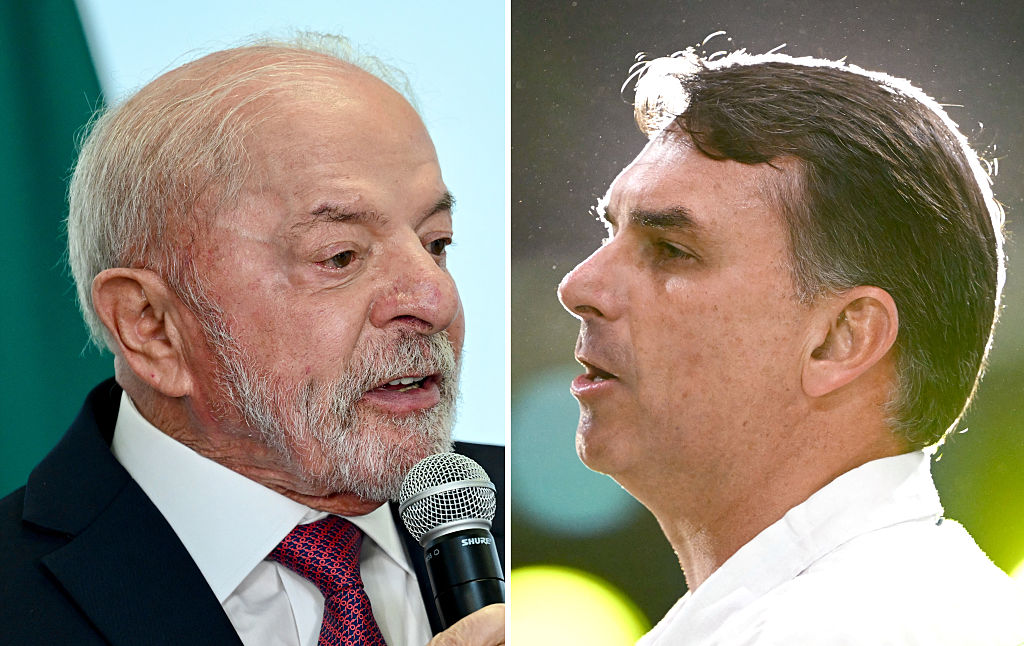
As the Brazilian presidential election on October 4 draws closer, President Luiz Inácio Lula da Silva is in a very tight contest with Flávio Bolsonaro, the son and heir of the Bolsonaro political dynasty. Lula is leading most of the polls for the first round, but the race appears too close to call in the event of a runoff between them.
This election does not merely pit two opposing candidates against each other. It is a struggle between Brazil’s democratic forces and the return to power of a reactionary bloc.
Lula’s Challenge
Lula is seeking a fourth term as president at the age of eighty-one. The Brazilian constitution allows for this: it does not impose any limits on how long one person can be in office, so long as they do not serve more than two consecutive terms.
After his first victory in 2002, Lula went on to complete two highly successful terms. His government lifted millions out of poverty with social programs like Bolsa Familia, greatly expanded Brazil’s education and health care systems, and achieved some notable diplomatic victories at the United Nations.
When he left office in 2010 with an 87 percent approval rating, most people assumed that this would mark the departure of the man Barack Obama described as the most popular politician on earth from the political scene. However, the failure of his successor Dilma Rousseff to deal with a hostile Congress, endemic corruption, and Brazil’s economic slowdown led to her impeachment — which many refer to as a soft coup — in 2016.
Lula was prepared to run again in the 2018 presidential election, but the Lavo Jato (“car wash”) corruption inquiry resulted in his arrest on charges of corruption. With Lula barred from running, the far-right candidate Jair Bolsonaro defeated his Workers’ Party (PT) ally Fernando Haddad and became president. The magistrate Sergio Moro, the main figure behind Lavo Jato, soon accepted a position in Bolsonaro’s government.
When further revelations discredited the investigation against Lula and revealed its chief enforcer Moro to be profoundly biased, the Supreme Court annulled his sentence and he was released. He went on to win the 2022 election after four disastrous years of Bolsonaro’s presidency before fending off a coup attempt by his vanquished opponent. Bolsonaro is now in jail because of his role in the failed coup and prohibited from seeking political office.
Four years after his triumphal (some would say messianic) return to the front of the political stage, Lula’s government only has lukewarm achievements to its credit — in large part due to a hostile Congress — and it has failed to adapt to the age of social media. Lula is a figure rooted in a now bygone age of struggle for democracy during the 1970s and ’80s who reached his pinnacle in the civil and democratic 2000s. His greatest appeal at present derives from his status as the sole defender of democracy in an extremely polarized 2020s Brazil that is rife with disinformation.
Bolsonaro 2.0
This amounts to a tepid appeal that is not enough for many younger voters — opposition to the far right can only carry a politician so far. Flávio Bolsonaro, who is more civilized in style but no less vile in substance than his father, has the evangelical right firmly behind him. He also has the backing of many figures within Brazil’s financial system, not to mention open support from the United States. His brother Eduardo, who is based in Florida, is almost single-handedly responsible for urging Donald Trump to impose tariffs on Brazil.
Bolsonaro has suffered from a series of scandals that resulted in the viability of his candidacy being called into question just a few months ago. He was implicated in a major financial scandal with a bizarre twist, having asked a corrupt banker to finance a biographical film about his father (starring Jim Caviezel of The Passion of the Christ as Jair), Bolsonaro also fell out with his stepmother Michelle, who is herself a powerful figure among evangelicals.
None of this has deterred him from carrying on, and he has bounced back in the polls with a vengeance over the course of September. This in no small part due to the fact that Alexandre de Moraes, one of Brazil’s chief jurists and a hate figure for the Bolsonarist right, has been embroiled in a corruption scandal of his own. This supplied ammunition to the Bolsonarist camp.
In the event of a runoff election between Flávio and Lula, the former will be expecting to win over most of those who voted for the other candidates in the first round. All of those candidates are right-wingers of one kind or another, and the Bolsonaro camp appeals to their base far more than Lula does. In fact, they neatly represent the spectrum of the Brazilian right, with each laying claim to their own niche.
The Miscellaneous Right
Romeu Zema, governor of Minas Gerais, is the candidate (and only noteworthy member) of NOVO, the New Party. This is a libertarian, faux-technocratic party that promises to cut back on government excesses and do away with the corrupt state machinery. In practice, this would mean privatizing all social services and dismantling state institutions before selling them to the highest bidder.
The traditional neoliberal political forces in Brazil have collapsed in the face of the Bolsonarist far right, so Zema is now the closest thing the country has to that old style of politics. His disastrous tenure in Minas Gerais, where the state debt skyrocketed during his time as governor, tells us all we need to know about his approach to managing a government.
Ronaldo Caiado, governor of Goiás, is a representative of the traditional Brazilian Centrão, the “Big Center” — that is, the large, nonideological, profit-based section of Congress composed of figures who care only about preserving their own power, regardless of political positioning or policy.
As governor of Goiás in the midwest, Caiado is extensively connected to Brazil’s agribusiness bloc. This bloc comprises a handful of large landowners whose properties often dwarf small countries in acreage, and who are determined to go on clearing rainforest so they can claim new land. The agribusiness bloc is one of Brazil’s most powerful lobbies, and it is squarely opposed to Lula’s environmental protection policies.
Renan Santos is the political chief of the Free Brazil Movement, a reactionary, Tea Party–style movement that emerged in the early 2010s. It preaches libertarianism, demonizes anything left wing, and argues for “free speech at all costs.”
The movement is heavily composed of dissatisfied young Brazilians, many of whom belong to online subcultures such as the “manosphere.” They are hostile not only to the current Brazilian state but also to many of its democratic institutions. Santos comes out with fiery rhetoric: at a debate held in August, which neither Lula nor Flavio attended, he cursed and insulted both of the leading candidates.
His crypto-fascistic stances, his speeches, and his personality bring back memories of Jair Bolsonaro. However, whereas the former was a reactionary harking back to the 1960s dictatorship, Santos looked forward to a more social-media-savvy, anti-democratic future under the specter of anti-statist tech magnates such as Elon Musk and Peter Thiel.
Capitalist Minds
The most curious figure among the lesser candidates is the best-selling author Augusto Cury, whose self-help book and highly questionable positions on psychology have made him a rich man. Cury presents himself as a centrist candidate with a “capitalist mind and a social heart,” and is at best unclear about any major policy or position.
Cury managed to reach third place in the polls, albeit with a meager 11 percent, for a few days in early September, in the midst of Flávio Bolsonaro’s many scandals, before falling back to 6 percent. Not as radioactive to left-wing and middle-ground voters as the other candidates but firmly separate from Lula and the traditional Left, Cury is the quintessential “independent” candidate.
None of these candidates poll much higher than 5 percent, and all of them draw support from segments of conservative Brazilians who are frightened of Bolsonaro but will take any alternative to Lula. Lula is unquestionably a political and electoral titan, but he has not produced a successor or replacement who could give the sense that there is a younger generation coming forward in Brazilian politics.
Dilma Rousseff now serves as president of the World Development Bank, while Fernando Haddad has been tainted by multiple defeats. Flávio Dino, the former governor of Maranhão, was a popular and charismatic figure, but Lula nominated him to serve on the Brazilian Supreme Court in 2024, which removed him from the political scene.
Instead of grooming a replacement for 2026, Lula chose to run for a fourth term, which pits him against a much younger option. The results of the upcoming election will reveal whether this proves to be a bridge too far in his long career.
Read the full story at the source
Source: Jacobin