
World · Jacobin · · 2h
As Trump’s Coalition Breaks, Can the Left Pick Up the Pieces?
English (original) · Read in Deutsch ⇄
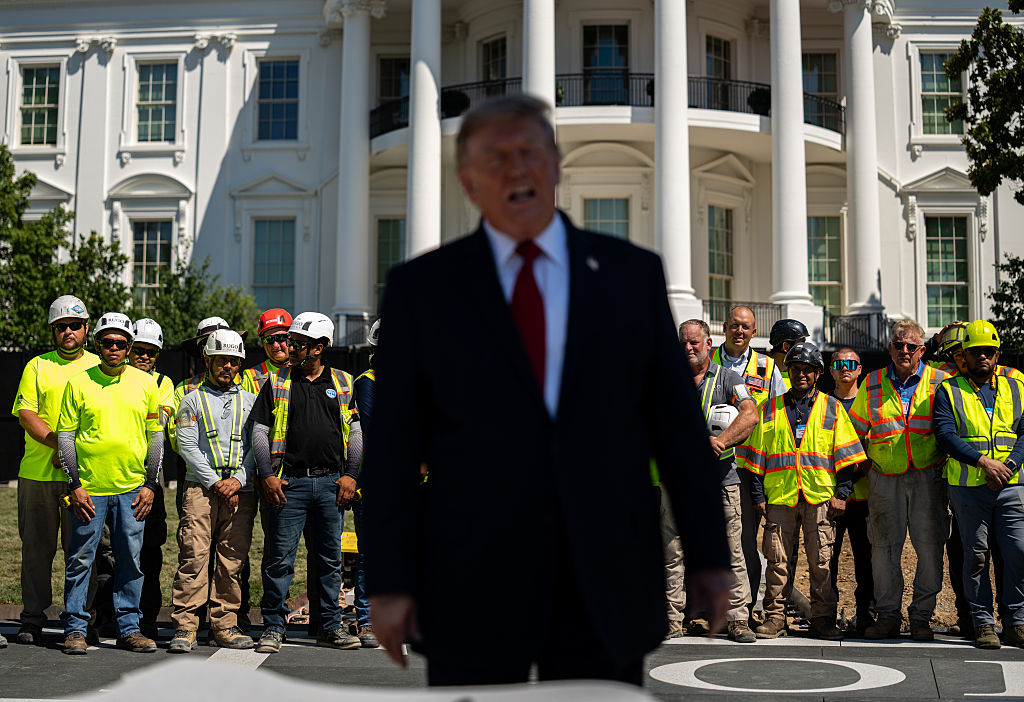
The coalition that sent Donald Trump back to the White House in 2024 marked the culmination of a long-term political realignment that conservative authors and activists had anticipated since the 1970s.
Fifty years earlier, right-wing commentators like William Rusher, then the publisher of National Review, were busy sketching a blueprint for the new majority that they hoped would finally bring them to power after decades of Democratic rule. That majority, according to Rusher and other “New Right” thinkers, would be built around the same working class that had long served as a pillar of the New Deal coalition. In his own words, the Right would construct a “Great Coalition” made up of the “producers of America,” in which he naturally included “businessmen, workers and farmers.” These “producers” would be united in their hostility toward a “rapacious new non-producing class” of “liberal verbalists” and their “huge welfare constituency” — that is, liberal members of the professional middle class and the poor.
Back then, Democrats were still widely considered the party of the working class and Republicans the party of the affluent and college educated. By 2024, these voting blocs had largely flipped. While Kamala Harris captured an impressive 56 percent of voters with a college degree, she lost those without any college education by 13 points. Just twelve years earlier, Barack Obama had narrowly carried noncollege voters by 3 points, while Mitt Romney had won college-educated voters by four. The same trends were apparent for income: Harris won a majority of voters who earned over $100,000, while her Republican opponent won 52 percent of those making between $30,000 and $100,000 (once again the opposite of 2012, when Romney won 54 percent of upper-income voters).
These results led to many predictable claims that the 2024 election would finally usher in a new era of Republican domination thanks to the party’s newfound support from the working class. Yet even at the height of the Right’s post-2024 triumphalism, one basic fact undercut the story of the GOP’s working-class transformation. While Trump had indeed won more working-class voters than any other Republican in the modern era, he was also the runaway favorite of business elites and the billionaire class. According to one analysis, the top three hundred billionaire donors in 2024 donated to Republican candidates by a remarkable five-to-one margin. The fervent support Trump received from some of the wealthiest men on the planet was difficult to reconcile with the GOP’s supposed transformation into a humble party of the working man and woman.
Even though economic issues like inflation and affordability shaped the 2024 election, the Trump coalition was held together more by cultural grievances than by any kind of shared economic outlook. When right-wing populists railed against “elites,” they were almost always talking about cultural and political elites rather than economic ones. In fact, it was sometimes wealthy oligarchs who denounced these “elites” the loudest.
This pattern was apparent throughout the Biden years, when a growing number of right-wing billionaires cast themselves as populist crusaders taking on a powerful cabal of “woke” elites. When Elon Musk staged his hostile takeover of Twitter and immediately fired the majority of its staff (the “laptop class,” he called them), the billionaire was hailed by the Right as a populist hero. Though Musk was following the old playbook of corporate raiders, one commentator celebrated it as a “revolt by entrepreneurial capital against the professional-managerial class regime that otherwise everywhere dominates.”
This portrait of the richest man in the world as an embattled underdog taking on a powerful class of parasitic elites aligned perfectly with the Right’s vision of America’s class divide. According to that distorted vision, it’s not ultrawealthy oligarchs but college-educated professionals and middle managers who make up the country’s true ruling class, leeching off the heroic efforts of industrialists and entrepreneurs at the top and blue-collar workers at the bottom. Another anti-woke crusader, Vivek Ramaswamy (who’s also a billionaire), echoed this narrative during his 2024 presidential campaign, declaring that the real class divide is between the “managerial class and the everyday citizen.”
This was a convenient line for oligarchs, as it all but erased economics from class. In a world where the true elites were college-educated professionals and underpaid bureaucrats in the “deep state,” plutocrats could sell themselves as counterelites taking on the all-powerful ruling class. They could also bill themselves as natural allies of the working class, united in their shared dislike of hypereducated managerial elites and their “woke” ideology (never distinguishing, of course, between basic social justice concerns and more rancorous variants of identity politics).
The big question after the 2024 election was whether the Trump coalition could survive once billionaire priorities and working-class interests inevitably clashed. Not even two years later, the answer has become increasingly apparent.
The cracks that appeared in the Trump coalition early in his second term have since widened into deep fractures. Working-class voters, in particular, are rapidly turning away from the president and the GOP. According to a June review of polling by the New York Times, Trump’s standing with white voters without college degrees has cratered since the start of his second term, especially compared with the same point in his first term. In 2018, these voters approved of Trump’s handling of the economy by 30-point margins ahead of that year’s midterms; today they disapprove in some polls by equally large margins.
Research by Jared Abbott and Joan C. Williams has confirmed the growing fissures in the Trump coalition. The overall number of “Trump waverers” has increased since the start of this year, according to their polling, with about a quarter of Trump voters now saying they are unlikely to vote Republican in 2028. Lower-income Trump voters are by far the most likely to say they won’t vote for a Republican in two years, with nearly a third of those earning under $50,000 wavering, compared with 18 percent of those earning above $100,000. (Unsurprisingly, working-class voters of color have pulled away the most.)
Trump and Republicans are bleeding working-class support for obvious reasons. The cost-of-living crisis has progressively worsened over the past two years thanks to Trump’s own harebrained policies, while the GOP’s signature legislative achievement is widely (and accurately) perceived by voters as helping the wealthy rather than the working class. Trump’s overt corruption and clear favoritism toward the billionaire wing of his coalition have further alienated many working-class Americans.
The Right’s Misfortune, the Left’s Opportunity
The breakdown of the Trump coalition bodes well for Democrats this November, but it hardly guarantees that working-class voters will swing back to the left. What is increasingly certain is that a winning left-wing coalition will have to unite noncollege voters — to use a functional if imperfect class proxy — with the college graduates who now make up one of the most reliable voting blocs for Democrats and the socialist movement.
The good news is that voters across the so-called diploma divide have been converging on economic views, even as many real social and cultural differences remain. Recent polling and new research consistently show that economic populism is the antidote to right-wing populism, which largely succeeds by replacing economic conflict with cultural division. Right-wing populism’s one move, observes Joan Williams in her recent book Outclassed: How the Left Lost the Working Class and How to Win Them Back, is to “take economic anger and direct it away from the Merchant Right, toward people of color and the Brahmin Left.” To counter this playbook, Williams argues that the Left must “redirect the anger toward economic elites, acknowledge the failings of political elites, and learn how to avoid making themselves the target of anger against cultural elites.”
Williams uses the terminology of French economist Thomas Piketty, who famously distinguished between the Merchant Right and Brahmin Left to explain the political realignments across most Western democracies over the last half century. During the postwar decades, liberal democracies were largely bifurcated along class lines, with the working class supporting center-left parties and affluent and college-educated voters leaning right. As we’ve seen, that order fractured in the late twentieth century and evolved into today’s system of “multiple elites,” with business elites moving further to the right and college-educated professionals veering left. Under this new order, elites fought primarily over “post-material” concerns. As Piketty wrote in 2020, both sides were “strongly attached to the existing economic system” because it served the “interests of both intellectual elites and economic and financial elites.”
Today that neoliberal consensus has begun to unravel, in large part because of growing skepticism among college-educated voters toward the winner-take-all economy their predecessors once favored. According to an analysis of the 2024 election and preelection surveys by the Center for American Progress, college-educated voters are now about as likely as working-class voters (defined as those without a college degree) to back progressive economic policies like taxing the rich, supporting unions, and raising the federal minimum wage. This partly explains the recent electoral success of left-wing populists like Zohran Mamdani and Abdul El-Sayed, who have been elevated by younger college graduates who now broadly reject the neoliberal politics of the past forty years.
Many of these voters fall into what reporter Noam Scheiber calls the “college-educated working class” in his recent book, Mutiny, which documents the organizing efforts of college graduates working in historically unorganized and underpaid sectors. “Young, downwardly mobile college grads [appear] to be embracing more radical politics as they [feel] put-upon at work or marginalized in the job market,” notes Scheiber.
These trends are more pronounced among younger graduates and those working in the more precarious and low-paying professions, such as education, social work, and journalism. Yet even some members of the historically more stable and affluent professions appear to be moving away from their traditional conservatism as they confront new economic realities and professional pressures. In the past, college graduates were generally more optimistic about their economic prospects than those without degrees, but today polling shows the reverse. “For the first time in the past three years, college-educated workers are the most pessimistic about the job market, and younger workers are more likely than older ones to say it is a bad time to find a good quality job,” wrote pollsters at Gallup in March.
The discontent that has spread throughout much of the white-collar workforce has long been familiar to members of the working class. After decades of neoliberal policies that have undermined workers’ rights and standards of living, employment has now grown more precarious for college graduates and white-collar employees as well. At the same time, wealth has grown ever more concentrated at the very top. These trends have only accelerated in the second Trump era: while America’s billionaires saw their wealth soar by more than 30 percent over the past year, labor’s share of business output fell to its lowest level on record at the end of 2025.
In her 1989 book on the professional middle class, Fear of Falling, Barbara Ehrenreich described the “defining dream of the American left” as one in which “discontented members of the [professional] middle class might join the working-class majority in a political effort to redistribute both power and wealth downward.” Two years after a very different kind of coalition sent Trump back to the White House, the question now facing the Left is whether a more durable populist coalition can be built from its ruins.
This article originally appeared in Jacobin, a democratic socialist magazine publishing long-form essays and analysis on politics, economics, and culture. Subscribe to the print edition for $20 a year.
Read the full story at the source
Source: Jacobin