
Politics Jacobin
Andy Burnham’s Criticism of Israel Is All Bark and No Bite
Andy Burnham and his foreign secretary, Ed Miliband, have adopted a more critical tone toward Israel in a bid to win back progressive voters to the Labour Party. But the fundamentals of Britain’s clos
English (original) ·Read in Deutsch ⇄
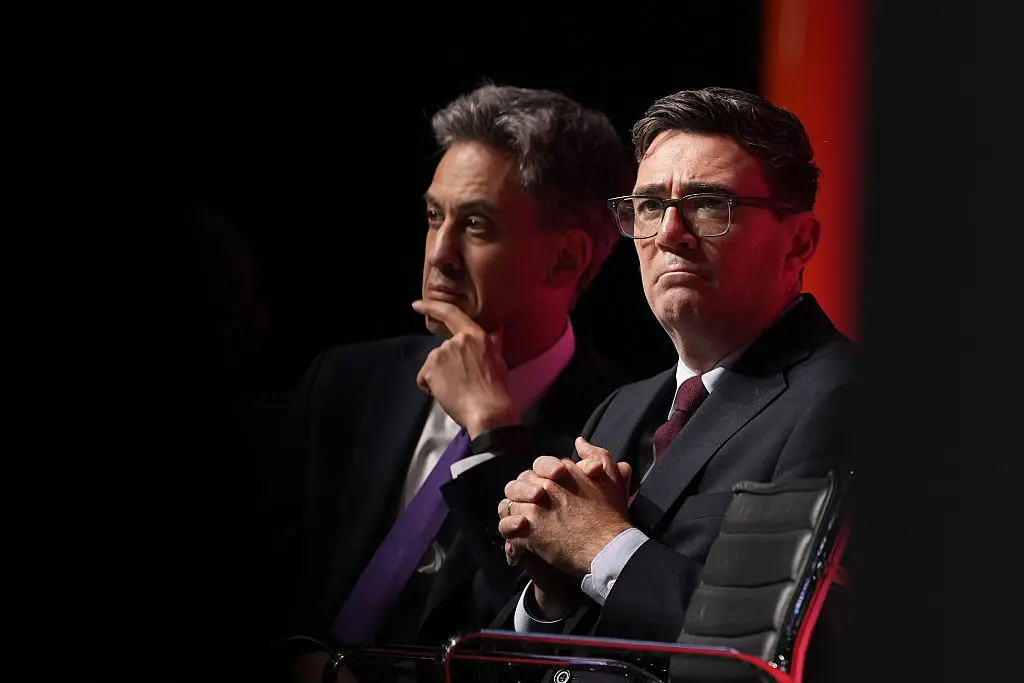
In September, British Foreign Secretary Ed Miliband announced that his government was going to impose sanctions on British trade with Israeli settlements in the West Bank. Miliband also referred to “ethnic cleansing of Palestinians in areas of the West Bank, perpetrated by settler terrorists.”
The Israeli authorities responded by downgrading the 180-year old British consulate in occupied East Jerusalem — it is now merely a “mission” — and expelling twenty British diplomats, including the consul general.
Miliband’s announcement came two months after Andy Burnham replaced Keir Starmer as Labour Party leader and prime minister. He billed it as part of a “comprehensive reset” of Britain’s approach toward Israel: Britain would no longer “acquiesce in the destruction of the two-state solution,” Miliband pledged.
In reality, there has been no such reset: the fundamentals of Britain’s relationship with Israel remain largely unchanged.
Extraordinary Lengths
Naturally, Miliband’s move provoked a roar of condemnation from Israeli political elites. Israel’s president Isaac Herzog, who has been credibly accused by multiple organizations of aiding and abetting war crimes in the Gaza Strip, said that he was “disturbed” by the new sanctions. The Israeli foreign minister Gideon Sa’ar accused Miliband of “outrageous lies.”
Israel’s British supporters were also indignant. Britain’s Chief Rabbi Ephraim Mirvis denounced Miliband’s program, claiming that it was “a dark day for Britain’s Jews,” and that Miliband was seeking to appease “those who harbour a dangerous obsession with the Jewish state.”
This is not the first time Mirvis, an indefatigable defender of Israel, has attacked the Labour government. In September 2024, he denounced a move by Miliband’s predecessor as foreign secretary, David Lammy, to limit the supply of British arms for the Israeli military: “This announcement feeds the falsehood that Israel is in breach of International Humanitarian Law, when in fact it is going to extraordinary lengths to uphold it.”
On that occasion, events proved that Mirvis had little reason to be concerned. The following year, British arms sales to Israel soared to reach the highest level on record. If we look more closely at the details of Miliband’s announcement, a similar picture of tough talk combined with very limited actions reveals itself.
Red Line, Green Line
The sanctions focus on the banning of imports into the UK of goods produced in “illegal” Israeli settlements, an expansion of UK licensing refusals for arms exports to Israel, and the nonspecified “strengthening” of penalties against settlers who “support or incite acts of violence against Palestinian communities.”
If we assume that all of these sanctions are actually implemented — Miliband opted for a grace period of up to nine months before the changes take effect — their impact on Israel’s economy would still be very limited. An Al Jazeera investigation found that, since Miliband’s announcement, his government has awarded more than $14 million in public sector contracts to firms that profit from West Bank settlements.
Miliband coordinated his sanctions package with eleven other Western countries, including Canada, Ireland, France, and Denmark, ten of which have recognized a Palestinian state. In theory, if those countries applied the sanctions in a maximal way, they could hit the sprawling and internationally connected network of Israeli finance, fin tech, and construction firms that facilitate the spread of Jewish settlements in the West Bank.
But that seems unlikely. In his Commons statement, Miliband made clear that his quarrel was with the settler movement and its sponsors in Benjamin Netanyahu’s government, not with Israel itself. “We will continue to support valued trade with green line Israel precisely because we support the two state solution,” he said. “For this reason, I wholeheartedly oppose the Boycott, Divestment, Sanctions campaign.”
This argument draws a convenient distinction between “illegal” Israeli settlements outside the 1967 borders and Israel proper. (In fact, in line with Article 49 of the Fourth Geneva Convention, which prohibits the transfer of civilian populations into occupied territories, all Israeli settlements are illegal under international law). By doing so, Miliband has carefully shielded the infrastructure of British support for Israel from the damage that a broader and more robust UK economic boycott could inflict.
A Lucrative Relationship
That infrastructure is substantial, because the UK is Israel’s largest European trading partner. Israeli companies supply billions of pounds worth of medicines to the National Health Service every year. Elbit Systems, Israel’s largest defense electronics manufacturer, operates multiple factories throughout the UK, while its subsidiaries export engine components to the Israel Defense Forces.
Israel’s state-owned defense giant, Rafael, owns and operates factories in Newcastle and Hampshire. Through Lockheed Martin and BAE Systems, the UK defense sector manufactures approximately 15 percent of the machinery present in every operational F-35 fighter jet, the aircraft of choice for the Israeli military as it has laid waste to Gaza. None of these economic linkages will be negatively impacted by the sanctions.
Israel even maintains investments in the North Sea through Ithaca Energy, which is owned by the Delek Group, a multibillion-dollar Israeli energy conglomerate. Ironically, it may benefit from those investments in the future if the Burnham administration gives the go-ahead for exploitation in the Rosebank oil field, a highly controversial, potentially climate-wrecking development west of Shetland. Ithaca owns a 20 percent stake in Rosebank; a decision on the field’s future is due imminently.
There is also a strong case that the UK has colluded directly on an institutional level in Israel’s campaign of slaughter in the Gaza Strip. As the investigative journalism organization Declassified has exhaustively archived, between December 2023 and March 2025, the Royal Air Force flew a minimum of 518 intelligence, surveillance, and reconnaissance flights over the Palestinian Occupied Territories, including Gaza.
Successive UK governments have insisted that these flights were part of a broader effort at “hostage location.” However, given Britain’s long history of intelligence cooperation with Israel, there is good reason to suspect that the Israeli military could also have used the information gathered during these sorties for other purposes. Miliband has made clear that British-Israeli intelligence sharing will go on despite the sanctions. “I’m confident that our security co-operation with Israel will continue,” he told the BBC in September. “We have important intelligence and security relationships with Israel.”
Burnham’s Pivot
Miliband’s discretely designed sanctions system performs a domestic political function as well as an external strategic one. By publicly picking a fight with Netanyahu ahead of the Israeli elections, and by criticizing his annexationist policies, Labour sent a signal to left-wing voters who had turned away from the party during the Starmer period, when UK criticism of Israel was, to say the least, less forthcoming.
Starmer was a latecomer to Westminster life who appeared to be largely devoid of the ruthless intelligence needed to succeed in the snake pit of SW1. He thought he could build a lasting coalition in the crumbling center ground of British politics. When it became clear that he couldn’t, Burnham stepped in with a plan to reinvigorate Labour by convening a progressive bloc of voters in opposition to the reactionary one rapidly coalescing around Nigel Farage and Reform UK.
In order to do this, Burnham needed to win over the young, left-wing, and vigorously pro-Palestinian parts of the UK electorate that had peeled off in recent years toward Zack Polanski’s “ecopopulist” Green Party. Hence the Labour government’s new and heightened anti-settler rhetoric and its willingness to characterize Israel’s actions against the Palestinians as “war crimes.”
Yet the superficiality of the rhetoric grates against the reality of Labour’s inertia in other areas. In 2025, Starmer’s government imposed a draconian ban on Palestine Action, a campaign group that targeted Israeli defense firms on British soil with acts of civil disobedience and vandalism. It is now legally defined as a terrorist organization, on a par with al-Qaeda and the Irish Republican Army. Since then, the British authorities have arrested more than 3,500 people and formally charged more than 2,250 for peacefully protesting against the ban.
Burnham has not committed to repealing the ban, which the UN Human Rights Commissioner Volker Türk has described as a “disturbing misuse of counter-terrorism legislation.” Last month, his Home Secretary Shabana Mahmood strongly defended the arrest of Palestine Action supporters, comparing them to “a group of skinheads standing outside a mosque.”
“Systematic Duplicity”
In fact, there are growing signs that Burnham may extend authoritarian restrictions on the expression of support for Palestine in British public life. This would include a prohibition on the display of pro-Palestinian symbols by teachers in schools. His government is also urging schools and colleges to adopt the International Holocaust Remembrance Alliance (IHRA) definition of antisemitism, which conflates criticism of Israel with antipathy toward Jewish people.
In contrast to Miliband, who is Jewish and thought to be genuinely sympathetic to the Palestinian cause, Burnham is by instinct a classic Labour Atlanticist who views Britain’s relationship with Israel as a core component of the UK’s strategic loyalty to the United States.
As a junior minister in the Tony Blair government, Burnham was a supporter of Blair’s Iraq adventure who later voted against parliamentary inquiries into the war (though he has since recanted on both fronts). He has also been a member of Labour Friends of Israel since 2015: during his first pitch for the party leadership that year, he dismissed the campaign to boycott Israel as “spiteful.”
None of this will be sufficient to quell Israel’s anger in the face of a remarkably modest set of British sanctions, nor to persuade a skeptical and exhausted Palestinian public that the UK has suddenly become an ally. But British double-dealing on the issue is hardly new.
In his 1993 book Culture and Imperialism, Edward Said reflected on Britain’s pattern of double-talk in the early twentieth century, promising independence to the Arab inhabitants of Mandatory Palestine while simultaneously committing itself to the creation of an autonomous Jewish homeland in the region.
“The history of British imperial policy in the Middle East is a history of systematic duplicity,” Said wrote. “Making promises to all sides that could never be kept.” Time, as they say, is a flat circle — nowhere is this maxim more true than when it comes to the British role in Palestine.
This article originally appeared in Jacobin, a democratic socialist magazine publishing long-form essays and analysis on politics, economics, and culture. Subscribe to the print edition for $20 a year.