
World · Jacobin · · 1h
A People’s Organization Without the People
English (original) · Read in Deutsch ⇄
“When I first saw it, I was like, ‘It’s a block.’” Woodlawn resident Linda Spears had been watching the construction of the Obama Foundation’s sprawling campus from her condo overlooking Jackson Park in Chicago, but it wasn’t until opening weekend, when the barriers came down, that she finally went inside. Sitting on a bench near the Barack Obama Presidential Center’s playground, she recited the former president’s 2015 speech on the fiftieth anniversary of the Selma to Montgomery march from memory, as if echoing the words that appeared on the facade behind us.
Spears explained that the museum tower at the Obama Presidential Center had actually been designed to resemble four hands reaching upward. She pressed her hands against those of a young woman beside her, as if playing patty-cake. “It’s like we’re all coming together,” she said.
I saw this demonstration of the four hands many times during opening weekend, literally gesturing toward Obama’s vision of the center as “not just a monument to my presidency” but “a tribute to all the people and the forces and the community that helped to make this so special.” It’s an inspirational story every American liberal knows by heart: Obama arrived on the South Side of Chicago as a wayward twenty-three-year-old in a junky used car and left as the president of the United States. He envisioned the sprawling Obama Presidential Center campus as a thank-you gift to the city that created him, complete with a playground, a public library branch, gardens, and spaces for democratic education in a basement “forum.”
On opening weekend, visitors lined up for paletas and Obama-themed merchandise at stands encouraging them to “bring change home.” They nodded along to Stevie Wonder’s live performance while inspecting hot peppers in the garden and wrote notes to Obama on index cards in the Forum basement and pinned them to the wall. Even on Sunday, when thunderstorms thinned out the crowds, a DJ shouted over the promenade, “We may be small in number, but we can make an impact.” Meanwhile, a cluster of visitors with umbrellas wobbled through the Electric Slide.
Nowhere had I seen so many slogans: a T-shirt featuring Parks and Recreation’s Ron Swanson with I regret nothing in Impact typeface, Future voter pins for the kids. Some seemed to be handmade — a group visiting from Mississippi had matching traffic-cone-orange shirts with Obama’s head superimposed on a photo of the Obama Center campus; the words “where we come to be inspired and change” appeared in white italics across the bottom. Another woman wore a white shirt with a wanted poster featuring Obama’s face. Above him read the headline “Have you seen this man? If so, can you please let him back into the White House?” Visitors would also see these kinds of handmade slogans and signs in the museum itself, relics from the civil rights movement and Harold Washington’s mayoral campaign as well as a display of 440 buttons from Obama’s 2008 presidential campaign — German-Americans for Obama, UAW for Obama–Biden, Vote Hope.
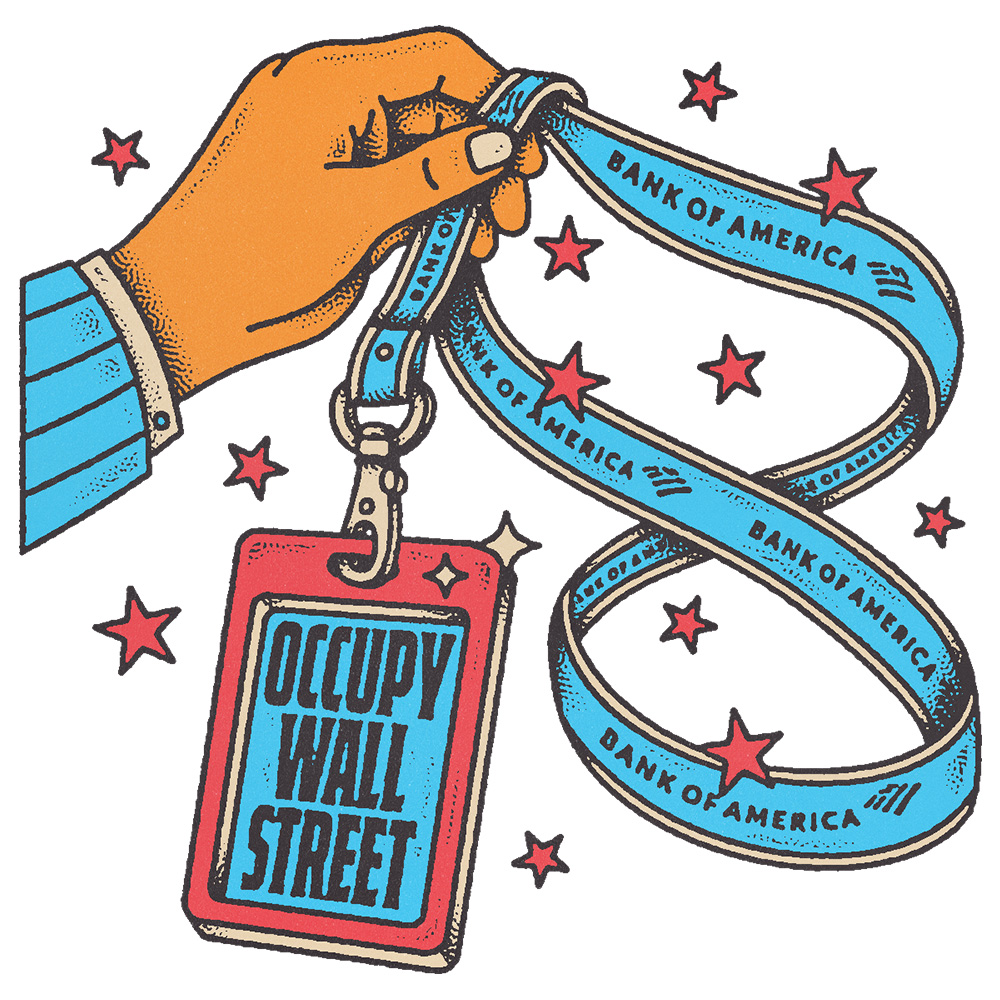
The Obama museum’s celebration of the power of ordinary people may ring hollow, given the high-profile donors required to fund its $850 million budget. It’s difficult to sustain the cognitive dissonance of seeing an Occupy Wall Street display funded in part by Goldman Sachs and Bank of America, or stomach an exhibit about labor organizing after having wandered past a sign thanking Jeff Bezos.
Even more ironic is the Obama Foundation’s apparent hostility to community organizers on the South Side. After the foundation announced in 2016 that the center would be built in Jackson Park, local faith organizations, tenant groups, and neighborhood associations formed a coalition to negotiate a community benefits agreement (CBA), a legally binding contract intended to protect Woodlawn residents from displacement. The foundation made a series of vague, voluntary commitments to community demands but chafed against the request to formalize them into a legally enforceable agreement. During a 2017 meeting, organizer and now alderwoman Jeanette Taylor asked Obama directly why he would not sign a CBA. “I was a community organizer,” Obama replied. “I know the neighborhood. I know that the minute you start saying, ‘Well, we’re thinking about signing something that will determine who’s getting jobs and contracts and this and that’ . . . next thing I know, I’ve got twenty organizations coming out of the woodwork.” It did not go over well. “He’s forgotten who he is,” Taylor later told a reporter. “He forgot the community got him where he is.”
When Obama was elected to the Illinois State Senate in 1996, his wife, Michelle, said, “Barack is not a politician first and foremost. He’s a community activist exploring the viability of politics to make change.” In 2008, Sarah Palin mocked Obama’s lack of government experience from the Republican National Convention stage, sneering that “I guess a small-town mayor is sort of like a community organizer, except that you have actual responsibilities. In his ascent to the Oval Office, Obama brought the question of what it means to be an organizer to the center of American politics. In the form of a near-billion-dollar museum, it seems that he has finally given his answer.
On the third floor of the Obama museum, under a spotlight, is a magazine open to an article entitled “Why Organize? Problems and Promise in the Inner City.” In it, a twenty-seven-year-old Obama reflects on his time on the South Side. He begins the essay with an anecdote in which a public school administrative aide pulls him aside on a “bleak January morning” to ask why “a bright young man like [him] would go to college, get that degree and become a community organizer.” In the gentle, even-keeled mode that would eventually become his signature style, he argued that political and economic representation for black Chicagoans — in the form of elected officials like Harold Washington and “increased hiring of black contractors and corporate managers, or Buy Black campaigns” — had been largely “symbolic.” Only through organizing could the South Side harness its “internal productive capacities” toward systemic change.
It is difficult to reconcile “Why Organize?” with the building in which it lives. The Obama Foundation celebrates the strategies that Obama had himself dismissed in 1988. Press releases proclaim the museum as a totem of Obama’s symbolic victory as the first black president and an engine of economic development on the South Side, “supporting thousands of jobs during and after construction.” The museum’s exhibits breeze past these contradictions. To wrap up Obama’s time as a community organizer, text strewn on the wall explains that “victories were rare,” and “Barack decided he could make a bigger difference in his community if he ran for elected office.”
Filling in these gaps is a series of documents that line the walls. A couple years after “Why Organize?” was originally published in 1988, it appeared in an anthology, After Alinsky: Community Organizing in Illinois, reflecting on the legacy of Saul Alinsky, a towering figure in Chicago organizing. Alinsky tried to systematize the ad hoc techniques he encountered during a lifetime of organizing in Back of the Yards into a set of replicable methods, which he listed in his book Rules for Radicals (on sale at the Obama Center bookshop). Alinsky hoped to bring unions, churches, and other local groups together in a “People’s Organization” that could represent a neighborhood in perpetuity rather than wilting after the end of a particular campaign. At the age of twenty-four, after seeing a help wanted ad in The New York Times, Obama joined an attempt at one such organization, the Developing Communities Project (DCP), a coalition of Catholic parishes on Chicago’s far South Side. Obama’s bosses at the DCP, one of whom described himself as an Alinsky “disciple,” were trained in Alinsky’s methods. The museum displays a fax pinned to a wall, a lesson on Alinsky’s approach to coalition building, with Obama’s handwritten marginalia, notes like “self-interest” and “systemic,” in careful cursive.
The museum includes little information about what Obama worked on at the DCP, save for a newspaper clipping from 1988. A grainy black-and-white photo shows a young Obama speaking to a couple of frowning white men, residents of Hegewisch, a southeastern Chicago neighborhood that borders Indiana. Hegewisch is enclosed by what activist Hazel M. Johnson called the “toxic doughnut,” a ring of landfills, highways, sewage treatment facilities, and chemical plants that pollute the surrounding neighborhoods. In his last months at the DCP, Obama was on a task force to prevent the development of new landfills through regulatory blockades. After he left for Harvard Law School later that year, the campaign won a moratorium on new waste sites. But fifty dumps and more than one hundred industrial plants remained, managed by both city agencies and private companies. The toxic doughnut exists to this day.
In “Why Organize?,” Obama wrote that Chicago was haunted by the “skeletons” of these campaigns, dismayed to find that community organizing at the DCP felt more like cutting heads off a hydra than the David-and-Goliath fights he had romanticized before he took the job. Still, Obama had not abandoned Alinsky’s dream of the “People’s Organization” that could buoy movements across long-haul fights against overlapping public and private institutions. The future president wondered if he could “rework old models” of organizing like Alinsky’s “to fit new realities,” allowing community organizers, elected officials, and private companies to work hand in hand.
The result of such a proposal was 2008��s Obama for America (OFA). OFA sought to imbue a presidential campaign with the energy of community organizing. Washington strategists set the agenda from the top down, but volunteers were encouraged to personalize it. Marshall Ganz, an activist and academic who helped shape the campaign’s organizing model, designed and led “Camp Obama,” volunteer training boot camps that were essentially storytelling workshops. Whether canvassing door-to-door or training new recruits, volunteers were instructed to move from “self” to “us” to “now”: beginning with a personal story, connecting it to the shared values of a community, and concluding with a call to action. Obama’s eventual victory was fueled by one of the largest volunteer organizations in American political history. The 440 campaign buttons lining a semicircle at the center of the museum’s third floor each represent five thousand campaign volunteers. Obama attempted to make OFA’s grassroots power permanent, transforming it first into Organizing for America (a project housed within the Democratic National Committee) and later into the independent nonprofit Organizing for Action. But the experiment proved difficult to sustain. Fundraising and staffing declined after 2012, and by 2018, Organizing for Action had merged into a redistricting committee before fizzling out altogether.
Although it says little about Obama for America or Organizing for Action as institutions, the Obama Center Museum perfectly embodies Marshall Ganz’s three-act canvassing structure. The emotional climax of the campaign floor features a video of people around the world celebrating Obama’s election, complete with a box of tissues provided on a nearby chair. The galleries focused on the presidency years continue this move from “self” to “us” by showing the everyday people who benefited from Obama’s policies. There is the framed letter from Natoma Canfield, an Ohio cleaner who gained health insurance under the Affordable Care Act, and the wedding ring and marriage certificate of Jim Obergefell, the lead plaintiff in the Supreme Court case that legalized same-sex marriage nationwide. In the last few galleries, visitors are invited to design a campaign button of their own on an elaborate digital display before finally ascending to the “Sky Room” to look out at the city and reflect on their own capacity for action.
But the Obama Presidential Center wants to do more than inspire visitors — it aims to be a civic institution capable of reshaping Woodlawn through a grab bag of community initiatives. It’s not as strange an ambition as it sounds. From its origins, the American presidential library has occupied an ambiguous space between public and private. When Franklin D. Roosevelt went looking for a way to institutionalize the preservation of presidential documents, he used the model of the National Gallery, which was then under construction, to structure his own archive: a private foundation would construct the building, while the federal government would maintain the records therein. He called this institution a library, a friendlier, folksier term than the imposing “archive,” with a clear connection to the public good. But as presidential libraries have ballooned in both size and construction costs in recent years — and become opportunities for elite fundraising — this system has been subject to increased scrutiny, as former presidents have saddled the federal government with the responsibility of maintaining increasingly palatial monuments to themselves.
The Obama Foundation tried to skirt these controversies by cleaving the museum itself from the archive. Unlike traditional presidential libraries, the Obama Presidential Center contains no federally operated presidential records. Instead, the National Archives digitized and maintains Obama’s presidential records, while the Obama Foundation operates the museum independently.
But the foundation has muddied the waters between private and public in other ways. In 2014, Mayor Rahm Emanuel, who once served as Obama’s chief of staff, allowed the Obama Foundation to appropriate acres of Jackson Park to build the presidential center. City officials put more than $123 million toward infrastructure improvements surrounding it. Resource appropriation on this scale was not uncommon for a presidential library under construction. The Commonwealth of Massachusetts purchased land from Boston’s transit authority for the JFK Library, while Lyndon B. Johnson’s library was constructed on public land donated by the University of Texas at Austin. Rather than going to war against the tangled web of public and private institutions he faced as a community organizer, Obama joined them. With a ninety-nine-year contract from the city and over $1 billion in assets, the Obama Presidential Center can make greater claims to permanence than OFA or the DCP ever could. Perhaps in that luxurious time frame, it can make good on its promise to transform Jackson Park into a “living, working center for citizenship.”
Obama told The New Republic in 2007 that “people’s hopes and dreams and their ideals and their values were just as important in organizing as people’s self-interest.” His foundation describes the presidential center as “a place of dreaming,” and indeed, the Obama museum follows the tautological logic of a labyrinthine Escher staircase endlessly looping upward. Organizers of the past inspired Obama to become an organizer himself, and the people he met along the way inspired him to run for office, where he could inspire the public to elect him, who then inspired Obama to fight for them as president, who built a museum to inspire the public to take action yet again.
This gives the museum’s anecdotes of public service a flat quality — all they are allowed to do is inspire. On touch screens throughout the building, you can see examples of ordinary people who participated in civic action, from abolishing a luxury tax on sanitary products in the UK to giving legal land titles to indigenous people in the Colombian Caribbean. The museum doesn’t say whether these efforts were insurgent or conciliatory, nor what kind of setbacks they faced or how communities responded, just as it does not dwell on the specifics of Obama’s campaigns as an organizer, the movements of the past that inspired him, or the troubles of his presidency.
At the center’s opening ceremony, Obama remarked that his museum “won’t just be an exercise in nostalgia or looking backwards. We want to look forward.” But one cannot create a museum about something that has not happened yet, any more than one can create a top-down grassroots organization, a People’s Organization without the people.
Read the full story at the source →
Source: Jacobin