
Repression Jacobin
A Palestinian Prisoner on the Nightmare Behind Israeli Bars
Israel imprisoned Khalida Jarrar, a historic leader of the Palestinian left, five times, almost always without charge or trial. She tells Jacobin about how women prisoners copied a library by hand and
English (original) ·Read in Deutsch ⇄
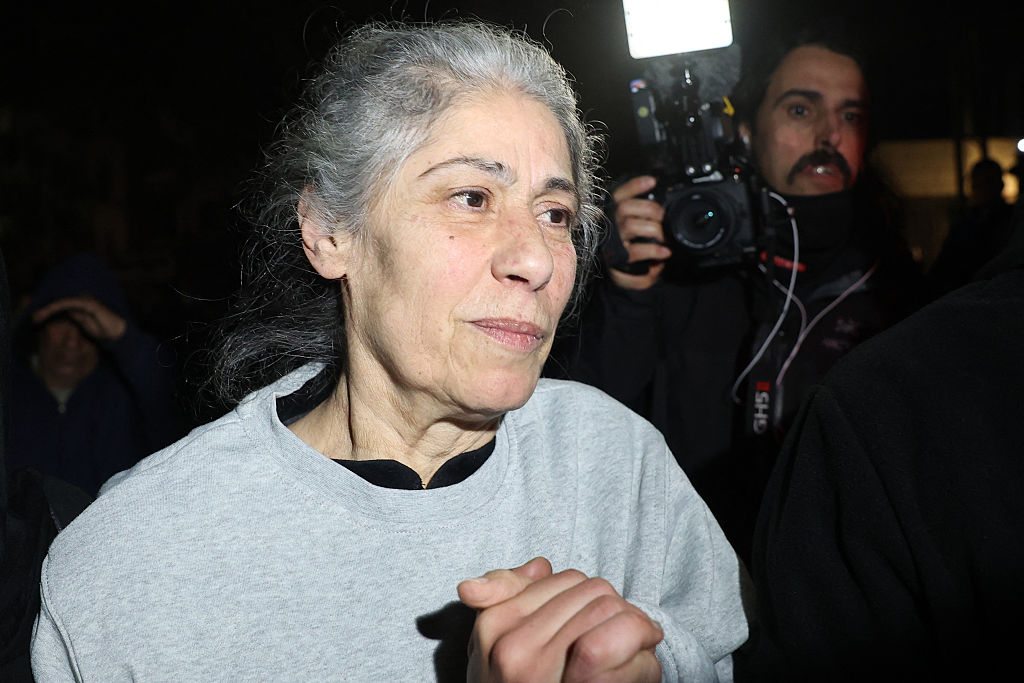
Born in Nablus in 1963, Khalida Jarrar is one of the foremost voices of the Palestinian left — feminist, secular, socialist — and one of the towering figures of the political prisoners’ movement. For more than a decade she led Addameer, the main Palestinian prisoner support organization. In 2006, voters elected her to the Palestinian Legislative Council, where she chaired the prisoners’ commission, and she later served on the national committee that prepared Palestine’s accession to the International Criminal Court. Today she is a researcher at the Muwatin Institute at Birzeit University, where she is conducting a pioneering study of the class and gender dimensions of the women prisoners’ movement since 1967.
She has paid for each of these roles with her own freedom. Israel has imprisoned her five times, for a total of more than six years behind bars. Almost every time, Israel held her under “administrative detention,” a system it inherited from British colonial emergency law. It allows indefinite imprisonment on the basis of a “secret file,” without charge, without trial, and without a lawyer able to contest what cannot be read.
In 2014, when the Israeli army ordered Jarrar’s expulsion from Ramallah to Jericho, she refused and lived for a month in a protest tent until the order fell. In 2015, twelve charges against her amounted to political acts: speeches, attending a book fair, and visiting a released prisoner. In 2021, during yet another detention, her daughter Suha, a thirty-one-year-old researcher, died suddenly — and Israel denied her mother a farewell.
Israeli forces arrested her for the fifth time in the early hours of December 26, 2023, the day before she was due to publicly present a study on Israel’s abuses against Palestinian prisoners during the genocide in Gaza. Thirteen months of administrative detention followed. She spent the last six in total isolation, in a cell two and a half meters by one, without a window or ventilation. Prison authorities moved her there days after Israel’s national security minister, Itamar Ben-Gvir, visited Damon Prison.
When she asked why, a guard replied: “You will not know the reason for your isolation, nor how long it will last.” She walked out on January 19, 2025, in the first prisoner exchange of the ceasefire.
The conversation below took place in English, in mid-August. Israel’s doctrine of destroying refugee camps is spreading from the northern West Bank to the gates of Jerusalem. Israel voted in legislative elections on October 27, and Palestinians face elections in November that many do not believe in. Against this backdrop, Jarrar talks about prisons and libraries, about imperialism and oxygen — and about what a person does, locked alone in a darkened cell, in order not to go mad.
Jacobin
Israel first arrested you on March 8, 1989 — International Women’s Day, at the height of the first intifada. In an essay, you begin the history of the prisoners’ movement not with a battle but with a song: the women of the 1936 revolt who, outside the British Mandate’s prisons, hid messages in coded syllables of folk songs. You also trace an unbroken legal line from British colonial emergency laws to today’s military courts — and Israel has detained around one million Palestinians since 1967, more than fifty thousand of them children. How do you explain that an emergency law older than the Universal Declaration of Human Rights is still, in 2026, putting people in cells without charge?
Khalida Jarrar
When we talk about the colonial system, we have to talk about the colonial system all over the world. In the case of Palestine, there is a direct continuity with the British system: the British Mandate governed through emergency laws — house demolitions, curfews, collective punishment, administrative detention. When Israel came, it continued that system, learned from it, developed it — and today it exports it across the whole world. We are talking about a system tied to all the capitalist and imperial systems.
Since 1967, around one million Palestinians have passed through Israeli prisons, including children and women. And the prison system is the same as under the mandate. In my research, I found that it is also very similar to the Irish experience and to the US system.
It is a colonial system that always seeks the same thing — to colonize, to settle. Within its liberal mechanism, it developed something I call “making it nice”: making violence presentable through the law, through emergency laws, through military orders. That is why administrative detention exists: they arrest anyone on the basis of a so-called secret file, and there are people who spend seven years like that, without anyone ever accusing them of anything.
This struggle against colonial emergency laws no longer belongs only to Palestinians — they have become a worldwide mechanism, and we have to fight them together. And when we turn to international humanitarian law, we find that Israel has violated it in its entirety: the right to life, the conventions on the treatment of prisoners, the right to a fair trial. There is a big question today about this system: Is international law for the weak or an excuse for the strong? I believe we need an international law for the victims, not for the colonial system — a global system in the service of the weak and of the victims to protect, in the end, humanity.
Jacobin
Israel holds more than 9,600 Palestinian political prisoners today, over 3,500 of them without charge and some 350 of them children. More than one hundred have died in custody. Israel bars the International Committee of the Red Cross from visiting, and a new law creates a special court for Palestinians, with the death penalty. You came out of six months of solitary confinement straight into freedom and said that conditions are the worst since 1967 — that Ben-Gvir, Israel’s minister of national security, “treats prisoners as if they were not human.” What has changed?
Khalida Jarrar
In my last imprisonment, I spent thirteen months in administrative detention, six of them in isolation. Ben-Gvir’s policy uses the tools of punishment out loud, not under the table. And he is proud when he enters prisoners’ cells to threaten them. He is proud of the death penalty law — when the world is moving to abolish that punishment, because it is inhuman.
He has reopened cells and prisons that Israel had closed for decades. In Ramle there is an underground prison, the “Rakevet,” which Israel used from 1967 until the mid-1970s and then shut down, because it was too terrible. Ben-Gvir reopened it and put people from Gaza there. For Gaza’s prisoners, there is in fact a kind of administrative detention called the “unlawful combatants” law: six months, renewable for another six, and another six, with no one knowing until when.
From my own experience, I tell you: they treat you like an animal. They attack your humanity — they want you to feel that you are not a human being. I do not want to go into details about the food, the beatings, the strip searches, the punishments.
But imagine: six months in a cell two and a half meters by one, with no windows, in summer, full of humidity. For the first three months the light was always on; then they started switching it off during the day and keeping it on all night. There was no oxygen.
This punishment is revenge, because I did nothing but give some speeches about the political situation. Of course I am Palestinian, I am against the occupation, and I seek the freedom of my people, as I seek the freedom of all the peoples of the world — I believe in that connection. And anyone who lives under the capitalist system also knows the mechanisms that crush people: running to eat, running for a house, living only to survive. What they did to me is a small example of how this system, full of violence, treats people in an inhuman way.
Jacobin
Those who study incarceration — in Palestine and around the world — say that solitary confinement is not an extra degree of harshness: it is a distinct instrument that works by removing the collective Palestinian prisoners spent sixty years building. The question is not how you endured the pain — it is how you kept your political mind intact, your mental health, when they took away exactly the thing that makes it political. And one more: the late prisoner and writer Walid Daqqah wrote that the occupier had moved on from disciplining bodies to trying to dismantle consciousness itself. Is that what you felt they were trying to do to you?
Khalida Jarrar
Yes, of course — that is their aim. From the first moment I entered isolation, which is an extremely hard experience, I made two decisions. The first: how to make my body survive; the second: how to keep my mind working. Because their aim is for you to go mad, or to damage your thinking.
The body I saved with water — drinking water, the only thing I had. And sometimes they cut it off, as punishment: two or three days without water, without being able to shower. Sometimes they brought me a bottle; other times they “forgot” — because the essential thing is to negate you, to pretend you are not there. When the guards passed the door of my cell, they turned their faces away; they did not look at me.
The mind was the second battle. In those few meters, I walked all day long. I decided not to sleep during the day — only at night.
There were no books; there was nothing inside the cell. So I held discussions inside my head. I told myself: they want to destroy you, but you are part of a people fighting for its freedom, and you are part of the strugglers of the whole world — like Bobby Sands, like Angela Davis. You belong to those people.
And I worked. At Birzeit University, I am doing a major piece of research on the class and gender analysis of women prisoners from 1967 until today — I had already written parts of it. So I would discuss the research with myself.
And there is something else: what they did shows their fascism, but it does not make me a victim. I am not an individual; I believe in the collective experience. That is why when people tell me, “we want to write your story,” I answer: no. I write about the collective experience because we are part of a collective experience worldwide.
The root of the fascist capitalist system contains violence. Violence is part of its content — not freedom and democracy, which are the slogans they want to teach us. Lately I have gone back to reading Karl Marx’s Capital, the pages on the violence of the colonial systems, on how many people they killed.
That is how I governed myself inside: always believing that I am part of a whole, that I am not alone. Those were the words I used with myself: Khalida, you are not alone.
Jacobin
The activist Munther Amira tells this story: when Israeli authorities transferred him to a high-security prison, he found in the yard a thin, weakened man he barely recognized who called out his name. It was Marwan Barghouti. The next day, the prisoners were sitting in a circle listening to Barghouti give a lecture — because the guards had emptied the prison library, and the men had answered by teaching one another.
Barghouti pointed him to a chair: “It’s your turn. We want to hear about your nonviolent resistance.” And when they asked him what he thought of it, he replied: “Call it whatever you like, as long as you resist.” Later, Barghouti sent word, through his wife, that Amira should come back to prison for another six months, to give more lectures.
You did precisely this on the women’s side — and wrote it down: “We are transforming the prison into a school.” The censors let in Ghassan Kanafani, Maxim Gorky, and Davis — and never let in [Antonio] Gramsci. How does that world work, from the inside? And why does the jailer fear an Italian intellectual who has been dead for almost ninety years?
Khalida Jarrar
When Israel arrested me in 2015, there were twenty-three of us women in prison. Most were under eighteen, students — and some were facing heavy sentences: ten, fifteen years. I began to think that education was essential for them: so that they would not spend those ten years merely inside a cell.
We discussed how to do it: first a small school, then a university. Seven women finished their studies and, after their release, are now doing their master’s degrees.
We ran into two problems: first, there were no books; second, the official conditions required two women with master’s degrees to teach — and at that moment I was the only woman in the prison with a master’s. At that time it was still possible to discuss matters through the lawyers, and our families visited us — that ended after October 7, 2023.
And there was an opportunity: the prison for underage boys was next to ours, and the prison authorities decided to transfer the boys to other prisons. Through the women’s representative, we got them to leave us their library — with the official schoolbooks. They moved us into the boys’ section, and the books stayed.
But we thought: they may come and confiscate them at any moment. So we copied the books by hand, in full. We divided the responsibility — each woman copied a part. We had pencils and notebooks, and we began.
Through the lawyers we reached the Palestinian Ministry of Education, which agreed to recognize me officially as a teacher. We gave classes in which we tied study to life — theory with practice. And we succeeded: they took the exam and finished high school. Before my release, I chose two women, showed them how we worked, and prepared them to continue.
The dream of those serving life sentences was university — imprisoned men studied at university; the women, never. After my release, I went to discuss it with the minister of higher education. They told me: “three master’s holders are required.”
I answered: What are we to do, if women with master’s degrees are not in prison? It is the men who seem clever to you . . . [laughs] We agreed on a method to get around the problem.
And then Israel arrested me again. Do you know what the women told me? “We are sad that you are in prison again — but, in here, we are happy: we can continue our studies. And we like you.”
That is what Barghouti sent word to Amira for: come back, we want to continue the classes. The prisoners want their teachers back.
[Laughs.] We succeeded. At that time, the prison authorities allowed each woman three books a month, which our families brought in. The guards always searched them, and the censors always read them. And Gramsci they always confiscated; they never let Gramsci in.
Jacobin
Why?
Khalida Jarrar
I don’t know — it is a question I ask myself, not them: Are you afraid of Gramsci? He died so long ago. They let in Davis — alive, a critic of the prison system, an active voice for Palestine. The dead Italian, no.
Jacobin
Let us talk about the Palestinian political situation. The polls are brutal: around 80 percent of Palestinians want Palestinian Authority President Mahmoud Abbas gone. Barghouti leads every presidential poll from his cell; elections are due on November 28, and 60 percent do not believe they will take place.
In 2016, you said that elections within the existing framework “will solve nothing” — that the root lies in the Palestine National Council and the refoundation of the Palestine Liberation Organization (PLO). Do you stand by that? And security coordination with Israel: Can the Palestinian Authority reform it, or only end it?
Khalida Jarrar
If we need elections, we need real elections — not elections that the European Union, the Americans, and the Israelis design to shape the system to what they want. They want, for example, a system without the political parties that did not accept the Oslo Accords. Look at what happened in the municipal elections: Israel interfered directly — they phoned people to say, “if you stand as a candidate, you will be arrested.” And they arrested many.
We need elections that give the Palestinian people the right to decide, not the United States, nor Israel, nor the European Union deciding for the Palestinians. And it is from that perspective that I believe in the refoundation of the PLO: through elections to the Palestine National Council, not to the Legislative Council. Today no free elections are possible: they interfere with the candidates, they want to shape the Palestinian system to their will. That is why I do not think it will go well.
Jacobin
Let me end with the paradox of this moment. The Palestinian cause has never been so popular in the West: for the first time in a quarter of a century, Americans sympathize more with Palestinians than with Israel; some 160 states recognize Palestine. Zohran Mamdani is mayor of New York City. Rashida Tlaib and Ilhan Omar sit in Congress.
Abdul El-Sayed won a Senate primary in Michigan against $30 million of pro-Israel money. Catherine Connolly won Ireland’s presidency with Palestine at the heart of her campaign. Rima Hassan, born in a refugee camp, is a member of the European Parliament. And yet European arms and trade keep flowing, while British police arrest thousands under terrorism laws for holding a placard.
From Damon, you wrote in 2020 that these gestures of solidarity “empower us, prisoners, from within.” What do you ask of this elected generation abroad?
Khalida Jarrar
I dream of a new world. And I think the changes are coming: good changes. What you describe in the United States are changes at the root.
We have not yet reached the point where things collapse, but these accumulated changes become big changes. I think that, after the genocide, the world realized that this fascist genocide can also reach their own houses and their own cities.
That is why I believe, and I dream, that the world will change toward more justice, toward a real democracy, not this democracy. I dream, of course, of my people’s self-determination, of our freedom, without occupation. And I dream, for the whole world, of peace, real justice, and equality among all peoples.
And I hope that the socialist system will be the solution. I know that the practical experience, in some countries, did not work, but I believe in the ideas, and in how to make them live, because I believe in equality and in social justice.
This article originally appeared in Jacobin, a democratic socialist magazine publishing long-form essays and analysis on politics, economics, and culture. Subscribe to the print edition for $20 a year.