
World · Jacobin · · 2h
A Decade After His First Presidential Run, Bernie Isn’t Alone
English (original) · Read in Deutsch ⇄
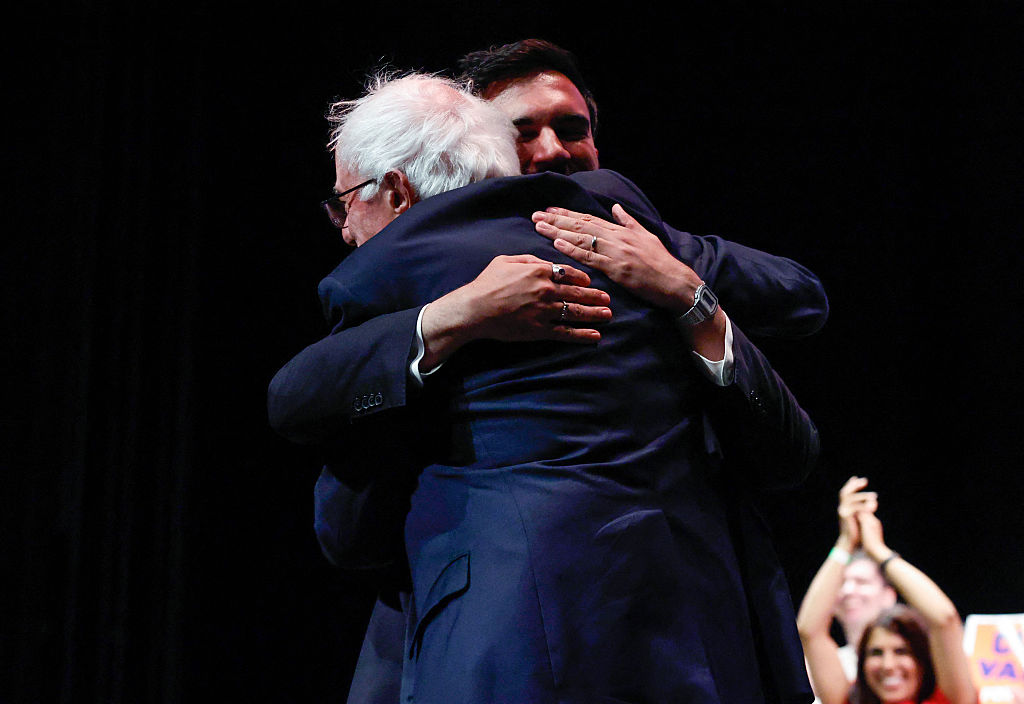
If you’re anyone who veers remotely to the left politically, there are two eras: a time before Bernie Sanders ran for president, and a time after. The US political landscape before Sanders’s first presidential campaign looks today like an alien planet. There were virtually no socialists who held elected office, or at least those who admitted to it. The Democratic Socialists of America (DSA) was an obscure organization with a little over six thousand members across twenty-six chapters. Arguably the most prominent leftist figure was a curmudgeonly linguist who almost never appeared in mainstream media, Noam Chomsky. Only 59 percent of Democrats and less than half of independents were willing to vote for a socialist candidate. And the great progressive hope was a politician who flatly opposed single-payer health care and ran on a platform of stronger regulation and more public investment in key industries.
Within five years of Sanders’s run, dozens of open socialists served in elected office at every level of government, including the US Congress. DSA’s membership had exploded to more than 55,000 with more than 150 chapters in every corner of the country. Socialists like Sanders and Alexandria Ocasio-Cortez were among the most popular political figures in the country. The share of Democrats willing to vote for a socialist candidate had jumped to 74 percent. And that progressive politician, Elizabeth Warren, launched a presidential campaign on a platform of single-payer health care, universal childcare, free public college, and debt cancellation.
Neither Sanders nor his campaign were single-handedly responsible for all this. But it’s not a coincidence that the political landscape transformed this drastically, in this particular way, within less than a decade of his first campaign, nor that 97 percent of DSA’s now 120,000-strong membership joined after 2016 (the majority of its current members joined after 2019, when Sanders launched his second run and a year after Ocasio-Cortez first won election). Before Sanders made his first official announcement — to a small crowd of Capitol Hill reporters, muttering that there wasn’t an “endless amount of time” because he’d have to get back to work — most people, even on the Left, would have told you the world we currently inhabit, with all its horrors but also its sudden possibility, was decades away at best.
There were a few socialists in political office before Sanders ran. Kshama Sawant had won a seat on the Seattle city council in 2013, for instance, while Carlos Ramirez-Rosa was sworn into his Chicago alderman’s seat twenty-nine days before Sanders’s announcement, even if he had not run as a socialist. (Ramirez-Rosa joined DSA a few months after Donald Trump won the 2016 election.) But the broad national appeal of Sanders’s platform was something different. It reminded millions of Americans who had learned to instinctively narrow their political ambitions that the things they assumed were impossible — not because they were actually impractical, but because there seemingly wasn’t the political will — they could and should fight for, because it was what most people wanted.
Sanders’s campaign showed it was possible for a socialist to win over people who had never even flirted with New Deal liberalism, let alone Marxism. Whatever drove it, whether Sanders’ authenticity, his fist-shaking against the establishment, or the fact that even conservative households don’t want to be buried alive in medical bills, Sanders had a crossover appeal that defied the way we tend to pigeonhole voters. It wasn’t out of the ordinary to hear Trump supporters in those years professing that, after the demagogic billionaire, Bernie was their guy.
Ideas and policies were one thing, but Sanders gave today’s socialists a ready-made vocabulary and approach to sell them, too. The Left’s decades in the political wilderness had been an often fruitless, Goldilocks-style search for a political tribune. Before Sanders, the lefty firebrands who championed the causes he became famous for came off, however unfairly, as kooks — like Dennis Kucinich, whose penchant for ventriloquism and claims he had seen a UFO could overshadow his advocacy for single-payer health care, or Mike Gravel, whose antiwar message was undercut by an onstage style that came off as unhinged ranting. Lefty politicians either had vision but not credibility, or, in Warren’s case, credibility but without a sufficiently ambitious vision.
Sanders, by contrast, came off as fairly normal but serious — neither an ideological zealot, nor a doctrinaire leftist who spoke in slogans or obscure jargon, but someone who put socialist ideas into everyday language and made you agree they were common sense. What eccentricities he had built up in the course of a lifetime were either helpful — the uncombed hair, rumpled suits, and distaste for chit-chat that so amused political reporters bolstered his image as a no-nonsense fighter — or ones he swiftly repudiated.
As Americans watched and heard Sanders speak with their own eyes and ears, they didn’t see the caricature of a socialist they had been fed through popular culture, but a pissed-off fighter for the working Americans being perennially screwed by a host of nefarious forces they recognized in their own lives: big banks, health insurers, corrupt politicians, the billionaires that fund them. This had been the secret sauce of Sanders’s breakthrough election to the US Congress in 1990, when he had used the previous year’s savings and loan bailout as a political foil and saw passing motorists yell at him to “Give ’em hell, Bernie!”
They also saw someone who rooted this pitch in a national tradition they understood. Yes, Sanders often pointed to European countries like Denmark and Sweden to show that the policies he was calling for were practical. But crucially, he wrapped himself in the coat of the New Deal, the most well-known historical parallel to what he envisioned for the country, eschewing the tendency of some radicals to dismiss Franklin Delano Roosevelt’s program as a series of mere liberal reforms that had done capitalism a favor.
In his first run, just as he would in his second, Sanders delivered a major address explaining to the nation what democratic socialism meant by casting the national memory back to the New Deal. Sanders had good reason to do it beyond its historical legibility for American voters. After all, for all its compromises, the greatest, longest-lasting achievements of Roosevelt’s program were often demanded, drawn up, and put into motion by left-wing radicals.
It took a little longer for the class of young socialists inspired by Sanders to absorb all of these lessons. Many clung to the judgmental moralism and jargon-littered vocabulary that became accepted as normal on the Left for far too long. And socialists’ self-defeating fixation on “abolition” of police and prisons still persists, in spite of its many political and practical downsides.
But they have been absorbed. We see it in the more plainspoken communication style and more class-focused approach of Ocasio-Cortez, who these days tends to stress the power of billionaires instead of simply racism to explain the Right’s ascent, and who is more likely to talk about how “the American Revolution was against the billionaires of their time” than to talk about “the intersectionality of interconnectedness of all our fights” for a laundry list of types of justice.
And we see it in the mayoralty of Zohran Mamdani, one the most popular politicians in the country, who has charted a different path on public safety and policing that more closely parallels that of Sanders, whose very first election victory rested on poaching the local police union’s endorsement.
Keeping the Light Alive
All of the elements that built and sustained Sanders’s political path through an era vastly more unfriendly to socialism were there in his first campaign. That campaign in turn became a real-world model for socialists in the twenty-first century to both run for office and engage with a skeptical American public — a model that, looking out from the cliffside of 2026, they have used to reshape US politics.
Trump’s two election victories and the weakness of liberal institutions have made it easy to miss this story. It’s been made even easier thanks to a mainstream press perpetually in a hurry to declare the Left dead, confidently telling us over and over again that the socialist movement Sanders’s run helped breathe new life into had finally run out of oxygen.
The reality is that a decade after a time when, generously, only a handful of socialists around the country held any elected office, socialists now hold serious positions of power all over. There will be at least seven socialists in the US House of Representatives next year, growing nearly fourfold since Trump declared to a standing ovation from Congress that “America will never be a socialist country.”
A socialist will almost certainly be elected mayor of the nation’s capital this November. Socialists are presidents of the city councils of both St Louis, Missouri, and Providence, Rhode Island, with the candidate’s slate of progressive allies achieving a near sweep of their city council races in the latter. Socialists also control a third of Portland, Oregon’s city council, occupy nearly a third of the seats on Minneapolis’s — where DSA-backed members serve as both the majority and minority leaders — and have four seats on Los Angeles’s fifteen-member city council. Wisconsin has a socialist caucus again in its state legislature after a nearly hundred-year absence, one of whose members very nearly took the Democratic nomination for governor this year. For years, socialists held a near-majority on the city council of Somerville, Massachusetts.
Numbering in the dozens at the end of last decade, there are now more than 250 socialists holding elected office across the country. You can find them everywhere from the Mountain States (in Santa Fe, Missoula, Aurora, to name a few) and the Midwest (in Toledo, Louisville, Iowa, Chicago, among others) to New England (in places like Portland, Cambridge, the state legislatures of Vermont and Connecticut), and the South (in New Orleans, Atlanta, Knoxville, San Antonio, and more).
And of course, in New York, a socialist governs the country’s biggest city, the home of its financial sector and the largest city economy in the world, helped by four fellow socialists on its city council and a total of sixteen who will sit in the state legislature after November. Long before this, with much smaller numbers, socialists in the state, including Mamdani himself, had already played leading roles in major progressive legislative victories, passing sweeping eviction protections and allowing the state’s largest public utility to enter the renewable energy industry, among other things.
Many of these officials were directly inspired by Sanders. Ocasio-Cortez, Rep. Summer Lee, former fellow Squad member Cori Bush, and Massachusetts state representative Erika Uyterhoeven all volunteered or worked on his 2016 run. Mamdani has pointed squarely at that campaign as the reason he became a socialist. Other socialist mayors-to-be, like Providence’s David Morales and Washington, DC’s Janeese Lewis George, have credited it with their political awakening. So have socialist Squad-member-in-waiting Claire Valdez and St Petersburg city council member Richie Floyd, the first socialist elected in Florida in a hundred years. Go to any moderately large gathering of socialists, whether elected officials, rank-and-file DSAers, or both, and you’re likely to see “Bernie 2016” memorabilia sprinkled throughout.
Attached again to concrete policies and living, flesh-and-blood political figures, socialism is not the boogeyman it used to be. Most Democratic voters, a third of whom now identify as democratic socialists, are perfectly happy to have a socialist as their candidate, or even actively prefer a candidate endorsed by one. Multiple polls show voters across the board are more turned off by MAGA candidates and Trump endorsees than self-described democratic socialists. In both pure numbers and political power, the current crop of socialist elected officials may be far away from the movement’s American zenith in the early twentieth century, but none of this suggests they’re anywhere close to hitting their ceiling yet.
Onward and Upward?
The question is whether they and the movement around them can sustain this upward trajectory. In some ways, Sanders’s path to the presidential race, spread out over thirty-five years in which socialists wandered the desert, was easier than the one his political heirs now have to traverse. Not only is state repression of the Left ramping up to levels far beyond where it was even under Ronald Reagan, but high-profile socialists are today as likely to face attacks and misinformation coming from pockets of the Left as from the Right.
Sanders too spent his career being pelted by many of the same left-wing accusations his 2020s successors now face: that he was a traitor to the cause, an imperialist, a liberal, a fraud, too accommodationist to the Democratic Party, and so on. Lobbed at a time when the Left was small and marginal, none of it stuck by the time Sanders ran in 2015, when he was viewed in the fresh eyes of both friend and foe as a uniquely, even naively, principled and pure idealist — instead of the shrewd, ruthlessly pragmatic operator he actually was.
It was just as well. An unyielding pragmatic radicalism has always been at the heart of Sanders’s approach. As he followed its glow, millions of others trailed after its familiar incandescence. And when the light grew just bright enough, he turned around and saw something remarkable: that he was no longer alone.
This article originally appeared in Jacobin, a democratic socialist magazine publishing long-form essays and analysis on politics, economics, and culture. Subscribe to the print edition for $20 a year.
Read the full story at the source
Source: Jacobin