
World · Jacobin · · 2h
50 Years After Mao’s Death, China Has Left His Legacy Behind
English (original) · Read in Deutsch ⇄
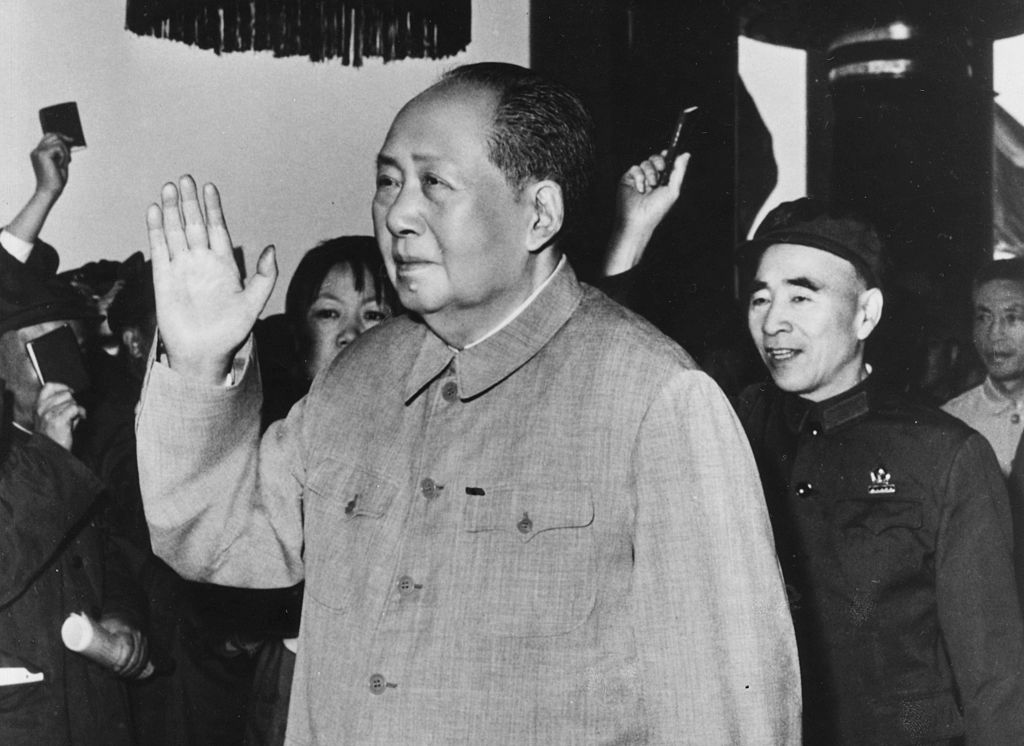
China has created one of the largest working classes in the world — twice. The first time was in the framework of a socialist economic system, fashioned by Mao Zedong after the revolution of 1949. The second time was under a form of state-directed capitalism following Mao’s death, fifty years ago today.
The second transformation is in effect the story of Mao’s legacy undone. The fate of the Chinese peasantry has unfolded in tandem with that of the working class, with a growing number of landless peasants joining the ranks of the urban proletariat.
The Iron Rice Bowl
On October 1, 1949, Mao Zedong stood on top of the Tiananmen Gate in Beijing and proclaimed the establishment of the People’s Republic of China. The dynastic system that had endured for two millennia had come to an end in 1911, but it was far from clear what should replace it.
The new Republic of China soon descended into warlordism that evolved ultimately into a civil war between nationalists led by Chiang Kai-shek and communists headed by Mao. Mao’s first great achievement was establishing effective control over all of China and securing its international autonomy for the first time since the Western encroachments that began with the Opium War (1839–42).
By the time he died, on September 9, 1976, Mao had also revolutionized China’s political and economic structures. Politically, the People’s Republic still looks largely unchanged today: although the personality cult around the Chairman has been dismantled, it remains a party-state, with the Communist Party firmly in charge. Economically, however, it would be unrecognizable to the Great Helmsman.
Over the course of the 1950s, Mao reorganized the two leading classes of the revolution, workers and peasants. The new class of socialist workers was distinct from its bourgeois counterpart. Rather than constituting a subordinate economic stratum, workers toiling in state-owned factories enjoyed the status of a kind of labor aristocracy. Numerically, they were a privileged minority, numbering somewhere between three and five million in the early 1950s out of a population of over half a billion.
The state provided its industrial workforce not only with lifetime job security — known as the “iron rice bowl” — but also with a cradle-to-grave system of welfare, including housing and childcare as well as educational, medical, and cultural facilities, along with retirement benefits. All of this was made possible by a program of land reform that allowed the state to draw resources from the countryside while tying peasants to the collectively owned fields they cultivated.
When Mao grew impatient with the pace of industrial development, he infamously decreed that China must take a Great Leap Forward (1958–62). That campaign ended up mostly producing mountains of useless scrap iron while causing one of the greatest famines in history, as rural collectives were combined into ever-larger communes and were subjected to ever-larger grain quotas. Eventually the communes were downsized, while peasants and industrial workers resumed their prior economic roles.
The single greatest transformation since Mao’s death has been the commodification of both labor and land, effectively unmaking the erstwhile socialist working class as well as the peasantry supporting it. The so-called breaking of the iron rice bowl accompanied the dismantling of most state-owned enterprises, and even the remaining state employees have become subject to the vagaries of hiring and firing. With the commodification of land, ever-increasing numbers of landless peasants are also finding themselves in cities, joining China’s vast pool of migrant labor.
A New Working Class
Together, laid-off state workers and migrant peasants have become the foundation of a new working class. In its current iteration, at some four hundred million, this working class not only far exceeds the former socialist workforce in size, but it is also a proletariat in the capitalist sense: a class possessing no property and thus reduced to selling its labor to the highest bidder. Indeed, the Marxian term “proletariat” is rendered into Chinese as wuchanzhe — literally, “the propertyless.”
What is more, these workers toil not only for China but have in effect become a global proletariat subsidizing consumers everywhere. Especially after China joined the World Trade Organization in 2001, foreign investment has poured into the country in one wave after another, in an endless search for cheap labor.
Mao also had a global vision, but it was one of worldwide revolution. After the Sino-Soviet split, he offered himself as the leader of the Third World, united against the imperialism of both the United States and the Soviet Union. Although his efforts fell short of revolutionizing the world, the ideological force of Maoism was contagious. Over the course of the global ’60s, it led to the establishment of Maoist factions in socialist movements around the world, including even among the Black Panthers on the faraway shores of North America.
This was indeed a global extension of the Cultural Revolution he had ignited at home, a deployment of culture as a diplomatic and political weapon, meant to contrast with the ultimate reliance of the United States and the USSR on military force. Mao dismissed imperialism as a “paper tiger” that could not stand up to the global insurgency led by China.
Ultimately, the Chairman came to view Moscow as the greater threat, and Richard Nixon’s visit to China in 1972 opened the way toward a rapprochement with the United States. Yet this move did not signal an abandonment of Mao’s ideological commitment to socialism, and today he would surely be sickened to discover that China’s influence in the world, while redoubtable, is founded on its workers’ willingness to work at cut-rate wages for global capital.
Ideological Demotion
This economic counterrevolution has ideological manifestations as well. The commodification of industrial labor has also transvalued the public standing of the Chinese working class. Under Mao, factory workers stood at the apex of the ideological hierarchy. Though the figurative masters of the factory were not rich, they did not experience their work as dishonorable.
Much as capitalism transformed penury from a Christian badge of holiness to one of social shame in Europe, in China, too, poverty has evolved from a political virtue to a moral stain. There is no better symbol of this moral reversal than the Communist Party’s decision in 2001 to admit millionaires into its membership. If “to get rich is glorious,” as Deng Xiaoping famously advocated, then being poor becomes a humiliation.
In short, as a result of five decades of post-Mao reforms, there now exists, for the first time in China’s history, a vast industrial proletariat of both urban and rural origin. But despite its unquestionable existence in a socioeconomic sense, it has not yet emerged as a political subject with a collective identity, through a process similar to the one E. P. Thompson described in his classic The Making of the English Working Class.
Although Chinese workers do not lack self-awareness, there is no adequate public idiom to describe or address their circumstances that would allow that self-awareness to solidify into an organized political identity. For now at least, workers remain mostly too isolated from each other for a collective consciousness to congeal and take an overtly political form — perhaps analogous to the condition of the French peasantry analyzed by Karl Marx in The Eighteenth Brumaire of Louis Bonaparte, to make another historical comparison.
Hence the Chinese working class today is more likely to appeal to the idiom of social justice rather than Maoism, a telltale sign of the diminished nature of Chinese socialism. Indeed, the absence of class discourse is not an accident. In 1978, the party announced that class struggle had ended in victory, thus allowing the nation to turn its attention to economic development.
Euphemizing Class
Ironically, it was this official retirement of “class” (jieji) from the political lexicon that made it possible for China’s current proletariat to emerge. In the meantime, the term “class” has been replaced with euphemistic concepts such as “strata” (jieceng) and “vulnerable groups” (ruoshi qunti) — not dissimilar from the language of social movements in the United States, for example.
To be sure, Maoism hasn’t disappeared completely from official political discourse. After his death, the party no longer considered the Great Helmsman to be infallible — in 1981, its leadership declared officially that he had been 30 percent wrong and 70 percent right — but it is still the case that there is no Communist Party of China without Mao.
Xi Jinping’s ascendancy has in fact coincided with the rise of neo-Maoist rhetoric. After Deng Xiaoping’s singular emphasis on economic development and the need to allow some people “to get rich first” — another famous slogan of his — Xi has spoken of the need for “common prosperity” (gongtong fuyu) and the construction of “an ecological civilization” (shengtai wenming).
However, the selective and opportunistic nature of Maoist discourse by China’s leaders is underscored by their simultaneous and seemingly inconsistent turn to neo-Confucian rhetoric. In lieu of waging class struggle, the people are called on to build a “harmonious society” (hexie shehui). Evidently, the less protest and less class struggle, the better. All of this would surely be enough to make the Chairman spin in his mausoleum on Tiananmen Square — only a stone’s throw from where he first announced the birth of a socialist China.
Read the full story at the source →
Source: Jacobin