
World · In Defence of Marxism · · 3h
Lenin and Trotsky: ideas for a new generation of fighters
English (original) · Read in Deutsch ⇄
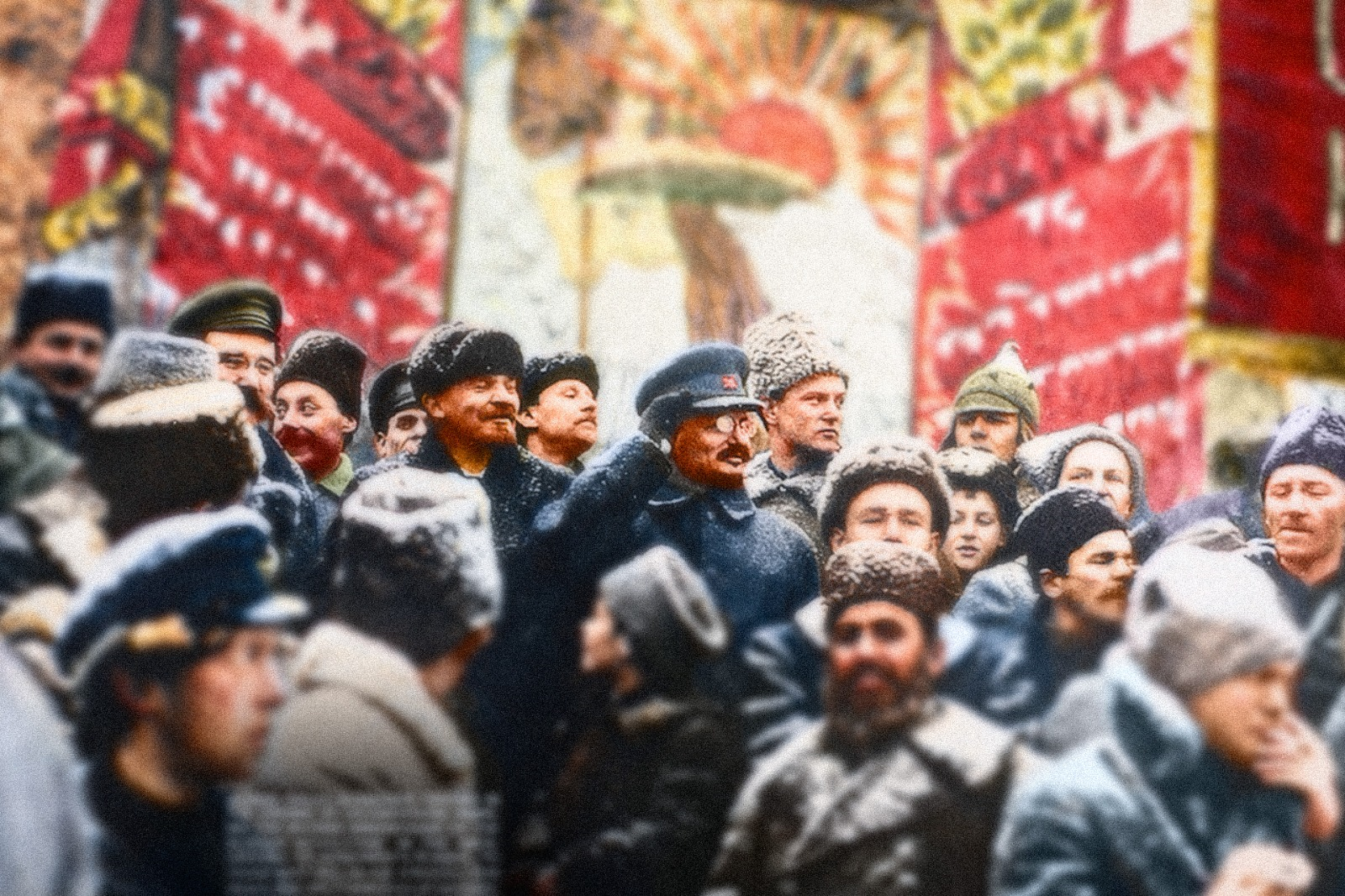
There are few figures in history whose legacy has been more distorted and attacked than Lenin and Trotsky. This is just as true today as it was in 1969, when Alan Woods and Ted Grant wrote Lenin and Trotsky – What They Really Stood For to set the record straight.
We publish below Alan Woods’ introduction to our brand new edition of this masterful defence of the two greatest revolutionaries of the 20th Century. Get your copy of Lenin and Trotsky – What They Really Stood For from Wellred Books here!
The republication of Lenin and Trotsky – What They Really Stood For comes at a very appropriate time.
This book, which was written in close collaboration with my great friend, comrade and teacher, the late Ted Grant, first came out in English in 1969 and received a very positive reception.
It has since appeared in many different languages, including Spanish, Russian, Greek, Danish, Dutch and Bahasa Indonesia.
The book’s raison d’être is sufficiently dealt with in the original introductory remarks written by Ted and myself. I therefore see little point in repeating them here to any extent.
I believe that the book served its purpose in clarifying the historic record. This task was absolutely necessary, given the avalanche of slanders and distortions to which both these great revolutionaries have been subjected, not only by the open enemies of communism and socialism, but also by a horde of unprincipled revisionists from the camp of both Stalinism and sectarianism.
However, more than half a century has passed since the book came out and many dramatic events have occurred, which strikingly confirm the analysis we made at that time.
Today, interest in communism is enjoying a remarkable resurgence, particularly among young people. This is no accident. Whatever anyone may say about the Bolshevik Revolution, it is impossible to deny that it made a profound worldwide impact. More than any other single event, it changed the whole course of world history.
For the first time the working class had come to power and held on to it, fighting against tremendous odds. And, in the last analysis, that great event was only possible thanks to the work of two outstanding individuals: Vladimir Lenin and Leon Trotsky.
Hence, despite the monstrous campaign of falsification to which Lenin has been subjected for decades, today the reputation of that great revolutionary stands higher than ever, while the reputation of Trotsky has also enjoyed a welcome recovery in recent decades.
It therefore seems both necessary and appropriate to restate some of the main ideas contained in our book, and to comment on those events which have occurred since it first appeared.
Historical materialism teaches us to look beyond the individual players on the stage of history and look for deeper causes for great historical events.
But this by no means denies or belittles the role of the individual in history. In given moments the role of a single man or woman can be decisive. The working class needs a party to change society. If there is no revolutionary party, capable of giving a conscious leadership to the revolutionary energy of the class, this energy can be wasted, in the same way that steam is lost if there is no machine that can use its power.
Lev Davidovich Bronstein (known to history as Leon Trotsky) was, alongside Lenin, one of the two greatest Marxists of the twentieth century. He devoted his whole life to the cause of the working class and the struggle for international socialism.
The role of Trotsky both during and after the October Revolution was central. In fact, Trotsky was universally recognised as second only to Lenin in the party leadership.
It is sufficient to record that at that time, both the masses and the enemies of the revolution habitually referred to the Bolshevik Party as the “party of Lenin and Trotsky”.
However, individuals can only play such a role when all the other conditions are present. The concatenation of circumstances in 1917 enabled Lenin and Trotsky to play a decisive role.
But the same men had been present for more than two decades before and were not able to play the same role. In the same way, when the revolution ebbed, despite their colossal personal ability, Lenin and Trotsky were not able to prevent the bureaucratic degeneration of the Bolshevik Party. This was caused by objective forces, against which even the greatest leaders were powerless.
In every great revolution in history, the motor force is always the active participation of the masses. We see this process very clearly in the case of the great French Revolution of 1789-93.
Formerly backward and inert layers of the oppressed rise up against their oppressors. They discover an immense reservoir of unknown qualities of confidence in their own power and are driven ever forward by an untamable revolutionary spirit that storms every barricade and overcomes every obstacle.
But, as Trotsky pointed out, revolutions are great devourers of human energy. After an initial period of immense struggles and sacrifices, beginning with the more backward elements, a mood of tiredness begins to set in.
Exhausted by their superhuman efforts and sacrifices, the masses begin gradually to fall into a mood of depression and apathy, and gradually sink back into the old passivity.
Against this background, the counter-revolutionary classes begin to recover their shattered nerves. Proceeding at first with great caution, they slowly begin to elbow aside revolutionaries and insinuate themselves into positions of power and authority in the state.
However, it is necessary for the agents of counter-revolution to disguise themselves, masquerading under the false banner of defenders of the revolution.
This was the case in France, both with the ‘Thermidorian’ reactionaries who took power after the execution of Robespierre (most of whom were to be found in the ranks of the Jacobins) and Napoleon Bonaparte, who advertised himself as the foremost representative of the French Revolution, while systematically trampling underfoot all the basic principles of that revolution.
The years of revolutionary upswing were characterised by the rise of outstanding figures. But a period of reaction requires people of a far smaller stature.
The Great French Revolution of 1789-93 produced a series of great orators, statesmen, and courageous representatives of the revolutionary masses. Mirabeau, Danton and Robespierre receive a grudging acceptance even by modern-day critics of the revolution, while the most consistent leaders of the masses, Marat and Hébert, continue to be treated as dead dogs, if they are mentioned at all.
But the period of ‘Thermidor’ that followed produced figures of a very different sort. It was the age of the unprincipled opportunist, the conformist and the cowardly apostate. The roar of the lion was silenced by the hoarse croaking of the ‘frogs of the Marsh’ in the National Convention. The age of giants was succeeded by the age of pygmies.
We see analogous processes in Russia following the death of Lenin. The exhaustion of the masses following years of war, revolution and civil war, combined with the isolation of the revolution in conditions of frightful backwardness and poverty, led to the rise of a privileged bureaucracy, which gradually raised itself above the working class and even the ruling Communist Party itself.
This is something that Lenin not only identified but warned against repeatedly.
Under such circumstances, bold visionaries and leaders of Lenin and Trotsky’s stature were no longer required. Instead, the bureaucracy needed a man in its own image. That man was Joseph Dzhugashvili, also known as Stalin.
In a period of counter-revolution the mediocrity rules supreme, and Stalin was the supreme mediocrity. In every sense, he was only a provincial politician. Other leading Bolsheviks spoke foreign languages fluently. Aside from his native Georgian, Stalin only spoke Russian, and with a strong Georgian accent. His narrow nationalism was later to play a fatal role in his dealings with the national question in the Soviet Union.
Lacking any broad vision, a man of little or no culture, he was what we might describe as a ‘practico’ – a man whose main interest was organisation in the most limited sense of the word. His natural sphere was that of the apparatus.
Of course, this definition does not exhaust his qualities. He also possessed an iron will and determination, a stubborn, indomitable thirst for power and personal advancement and an innate skillfulness in manipulating people, manoeuvring and intriguing.
But he foresaw nothing and merely followed the processes that flowed objectively from the ebb of the movement that followed the Russian Revolution.
After the revolution, the organisational side of the work necessarily assumed a much greater importance. After all, the Bolsheviks now had the responsibility of running a huge state apparatus, feeding the population, keeping the transport system operational etc., while a brutal civil war was raging. This work naturally absorbed a considerable part of the party cadres.
There were clearly dangers in this situation and Lenin in particular was anxious that the party should keep a firm political control over this work.
Sverdlov, as general secretary of the party, fulfilled this task admirably. He was not a theoretician, but he was a marvellous organiser, honest, completely devoid of personal ambition and wholly dedicated to the cause of the revolution and the party.
When Sverdlov died in 1919, a collegium of three people were appointed to carry out his work. Significantly, Stalin was not included. When the post of general secretary was created in 1922, it was Zinoviev and his allies who pressed for Stalin’s candidature, not without a hidden thought of a struggle against Trotsky. While Lenin valued Stalin’s firmness in administrative matters, he was very uneasy about his appointment. When he was told about it, he uttered the words: “This cook will prepare only peppery dishes”. However, as the position was regarded as simply administrative, Lenin did not carry his objection any further. Stalin went on to use his position in the party and state apparatus (which were now increasingly identified one with the other) to promote his cronies and concentrate power into his own hands.
When Lenin realised what was happening, he immediately opened up a struggle against Stalin. But he also feared that the differences in the leadership might develop into a split along class lines, which would weaken the dictatorship of the proletariat and lead to a capitalist counter-revolution.
For that reason, Lenin was forced to proceed with great caution. Nevertheless, in this moment of danger, he based himself on an alliance with the only man in the leadership he could trust to carry on the struggle against Stalin and the bureaucracy: Trotsky.
In his so-called Testament, Lenin says that Trotsky was:
"… distinguished not only by outstanding ability. He is personally perhaps the most capable man in the present CC."[1]
"Comrade Stalin, having become Secretary-General, has unlimited authority concentrated in his hands, and I am not sure whether he will always be capable of using that authority with sufficient caution."[2]
Here Lenin was expressing himself in very guarded language. But a few weeks later he added a postscript, describing Stalin as rude and disloyal, and advocating his removal as general secretary.
Lenin’s advice was not put into practice. With the factional support of Zinoviev and Kamenev, as well a great deal of behind-the-scenes manoeuvring, Stalin continued in his post as general secretary, which he used to launch a vicious and unscrupulous struggle against Trotsky.
After Lenin’s death in January 1924, Trotsky took up the leadership of the fight against the bureaucratic degeneration of the Soviet State – a fight that Lenin had already begun from his death-bed.
View this post on Instagram A post shared by Revolutionary Communist International (RCI) (@revcomintern)
Historical parallels can often be highly illuminating, but they have their limits. And this fact is even truer in the case of comparison of individuals.
Trotsky described the Stalinist dictatorship as a regime of ‘Soviet Bonapartism’ – that is to say, a regime under which capitalism has been overthrown, but the proletariat has been deprived of political power. And Ted Grant used the term ‘proletarian Bonapartism’ to denote the same phenomenon. This definition is scientifically impeccable, but like all definitions has its limitations.
When we use the expression ‘proletarian Bonapartism’, the inference may be drawn that a comparison is made between Stalin and Napoleon Bonaparte. That comparison may be correct to some extent, but only if we refer to the fact that both these men acted as the gravediggers of a great revolution.
However, these limits completely exhaust the content of any real comparison. Whatever one might think of Napoleon Bonaparte in the military sphere, he undoubtedly displayed outstanding qualities. This can hardly be said of Joseph Dzhugashvili!
Devoid of any capacity for inspiring the masses, either as a revolutionary orator or on the field of battle, Stalin’s real field of operation was limited to the four walls of his office, his telephone, and his endless ability to intrigue, manipulate and manoeuvre.
The figure who most closely resembles Stalin is not Napoleon Bonaparte, but Joseph Fouché, who, like Stalin, was a man without any principle, a consummate bureaucrat and intriguer, driven by an all-consuming ambition and thirst for power.
Fouché was, without a doubt, the most representative figure of the Thermidorian reaction.
After Thermidor, the pendulums of reaction moved ever further to the right, passing from the Directory to the dictatorship of Bonaparte, and after the defeat of Napoleon at Waterloo, it ended in the restoration of the Bourbon monarchy.
These convulsive changes were inevitably accompanied by the rise and fall of political leaders. But throughout, one man succeeded not only in maintaining his position, but of concentrating immense power into his hands.
After Lenin’s death in January 1924, Trotsky took up the leadership of the fight against the bureaucratic degeneration of the Soviet State / Image: public domain
Fouché began his career as a particularly bloodthirsty supporter of the Jacobin Terror, earning the nickname, “the executioner of Lyon”. But like a chameleon, he later managed to transform himself into an accomplished agent of reaction. The former Jacobin revolutionary terrorist became the chief of police, first in the service of Napoleon and later of the restored monarchy.
The Soviet Thermidor under Stalin did not end in the overthrow of the Communist Party and the complete restoration of capitalism – although at one point, in the late 1920s, that was a distinct possibility. As Trotsky wrote:
"The Russian Thermidor would have undoubtedly opened a new era of bourgeois rule, if that rule had not proved obsolete throughout the world. At any rate, the struggle against equality and the establishment of very deep social differentiations has so far been unable to eliminate the socialist consciousness of the masses or the nationalisation of the means of production and the land which were the basic socialist conquests of the revolution…
"Although it undermines these achievements, the bureaucracy has not yet ventured to resort to the restoration of the private ownership of the means of production."[3]
In the end, the October Revolution survived, but only as a monstrously deformed, bureaucratic and totalitarian caricature of a workers’ state.
Stalin and the bureaucracy answered Trotsky’s political arguments with the mailed fist of repression. Members of the Russian Left Opposition were sacked from their jobs, harassed, and later arrested and imprisoned. But these methods proved to be insufficient.
In order to consolidate its power, the bureaucratic usurpers of October needed to eradicate completely the traditions of Bolshevism and the Russian Revolution. This required the physical extermination of Lenin’s party, which was accomplished by the monstrous Purge Trials.
Trotsky described the Purges as a one-sided civil war, waged by Stalin and the bureaucracy against the Bolshevik Party. Stalin framed, tortured and murdered all the leaders of Lenin’s party.
From his exile in Mexico, Trotsky witnessed the massacre of his friends and collaborators inside and outside the USSR, and the destruction of the political gains of the October Revolution.
Stalin’s thirst for revenge even extended to the families of his victims. One by one. Trotsky saw the murder of his sons and other members of his family. Yet he remained defiant: one man against the whole world.
In the teeth of the ferocious Stalinist counter-revolution, he continued to defend the revolutionary, democratic and international traditions of October.
He continued to speak out bravely, fearlessly, denouncing Stalin’s crimes. But at the same time, Trotsky continued to be a staunch defender of the USSR and the gains of the October Revolution – a position he held until the end of his life.
Trotsky continued to be a staunch defender of the USSR and the gains of the October Revolution – a position he held until the end of his life / Image: public domain
At the beginning of the Second World War Trotsky predicted that the Soviet Union would inevitably be attacked by Nazi Germany, and advanced the slogan of unconditional defence of the Soviet Union.
He explained that it was the duty of all workers to rally in its defence. But he also warned that the greatest danger for the future of the Soviet Union did not come from foreign military intervention, but from the intolerable contradictions that resulted inevitably from the existence of the Stalinist bureaucratic regime.
Subsequent history has proved that he was correct.
As early as the 1920s, Zinoviev and Kamenev had warned Trotsky: “You think Stalin will answer your ideas. But Stalin will strike at your head!”
That prophetic warning finally became a tragic fact on 20 August 1940, when an agent of the NKVD, Ramón Mercader – alias Jacson – succeeded in penetrating the Trotsky household under false pretences.
He persuaded Trotsky to read an article he had written, and as he was reading it, Mercader stood behind him, raised his arm and brought it down with full force, driving an ice pick through the skull of this defenceless man. Trotsky fought back courageously and the assailant was overpowered by the guards. But the murderer’s bloody work was accomplished.
The man who, together with Lenin, led the Russian workers to the conquest of power, who built the Red Army and defeated the combined forces of the counter-revolution, died the next day in a Mexican hospital.
When Stalin heard the news he must have been very pleased with himself. He had solved this problem, just as he had solved every other problem – by the use of brute force.
It was really not so difficult. We humans are weak creatures. Anything can cut the fragile thread that ties us to life: a bullet, a knife, or an ice pick. It is easy to kill a man or a woman. But it is not possible to kill an idea whose time has come.
Of all the many myths concerning Stalin, the most persistent – and most mendacious – is the myth of Stalin as a ‘great war leader’. This does not stand up to the slightest scrutiny.
Stalin’s purges led to wholesale destruction of the leading cadres of the Red Army, which seriously weakened the Soviet Union’s defence.
When Hitler’s generals objected to the attack on the Soviet Union, Hitler answered that it was not a serious force, because “they have no good generals”. He claimed that the Soviet Union was a rotten edifice, and that one good kick would bring it down.
For his part, Stalin placed all his hopes on the non-aggression pact that he had signed with Hitler in 1939. So much so that when Hitler invaded in the summer of 1941, Stalin refused to believe it and, fearing a provocation, ordered the army not to resist. The result was catastrophe.
The Soviet Air Force was destroyed on the ground, while millions of Red Army soldiers were surrounded, captured and sent to death camps, where most of them perished.
As a result, the German army advanced deep into Soviet territory without initially meeting any effective resistance. The Soviet leaders were in disarray. Stalin initially panicked and went into hiding. His actions amounted to an abject capitulation.
The true position was later exposed by Khrushchev, who wrote:
"It would be incorrect to forget that, after the first severe disaster and defeat at the front, Stalin thought that this was the end. In one of his speeches in those days he said: ‘All that which Lenin created we have lost forever’."
The Soviet Union was placed in mortal danger. But, on the basis of superhuman sacrifices, the Soviet masses demonstrated their tremendous willpower and unshakeable loyalty to October.
The glorious victory of the Red Army also demonstrated the viability of the new property relations established by the October Revolution. It is thanks to the colossal superiority of a nationalised planned economy that the USSR was able to survive the first disasters of the war and reorganise production beyond the Urals.
By 1942 the economy was recovering fast. By 1943 the Soviets were outgunning the enemy, producing equipment and weapons of first-class quality, often superior to that being used by the Germans, the British and Americans. This is the secret of their success and gives the lie to the oft-repeated claim that a nationalised planned economy is incapable of producing high-quality goods.
The fact is, despite all the problems of the Soviet Union under Stalin, a backward semi-feudal economy in a few short decades became a powerful modern, industrial state, which proved its vitality by defeating the forces of Hitler’s Germany in the Second World War.
In reality, the USSR won the war against Hitler single-handedly. The British and Americans were mere onlookers in a titanic battle between the Soviet Union and Hitler’s Germany with the combined productive forces of Europe behind it.
Stalin’s purges led to wholesale destruction of the leading cadres of the Red Army / Image: public domain
But the war was won by the Soviet workers and peasants, not thanks to, but in spite of the Stalin regime.
The Soviet Union paid a terrible price, with 27 million dead and a wholesale destruction of the productive forces in a vast swathe of its territory. Yet, despite the colossal destruction inflicted upon it, it recovered rapidly after the War. In a couple of decades, the nationalised planned economy succeeded in creating the second greatest power on earth.
The Soviet Union achieved miracles in the fields of economic, social and cultural development, rapidly overcoming the extreme backwardness it had inherited from the past.
But the question has to be asked: after all these great achievements, nevertheless the Soviet Union ultimately failed and collapsed. Did it fail because socialism cannot work?
This argument has been endlessly repeated by the defenders of capitalism as a means of justifying the continued existence of their own decrepit and bankrupt socio-economic system.
But the argument that socialism does not work is contradicted by the entire experience of the Soviet Union following the October Revolution. Never in history has such a colossal transformation been seen.
The successes of the planned economy are not seriously open to contradiction. They were brilliantly demonstrated by the remarkable successes of the Soviet space programme, which launched the first space satellite in 1957, and shortly afterwards succeeded in sending the first man into space. As late as the 1980s, the CIA admitted that the Soviet space programme was decades ahead of that of the USA.
What failed in the Soviet Union was not socialism, in any sense that would be understood by Marx or Lenin, but a monstrous bureaucratic caricature that suffocated and strangled all creative initiative, and eventually cancelled out the advantages of the nationalised planned economy and therefore insured the collapse of the entire system.
Trotsky pointed out that a nationalised planned economy requires democracy just as the human body requires oxygen.
Every worker knows that in private firms there is no shortage of mismanagement, bungling, swindling and corruption. But if a given enterprise carries this too far, eventually it will go bust.
That is to say, under capitalism, the mechanism of the market acts as a rough and ready ‘control’. It is extremely wasteful and destructive, but it sets a limit on unproductive enterprises.
However, in a nationalised planned economy, the market mechanism does not apply, or only applies in a very limited way. The only way to keep corrupt and unproductive practices in check is through conscious participation and control by the working class itself.
Without the active participation of the working class through workers control and management of industry, the level of incompetence, corruption and bureaucratic mismanagement will inevitably act as a constant and unbearable burden weighing heavily on the further development of the productive forces.
Bureaucratic control can succeed for a time in a primitive economy, where the tasks of reconstruction depend mainly on the building of heavy industry. That was the case for the Soviet Union in the 1930s.
Even at that time, the bungling, mismanagement, swindling and corruption at the top undoubtedly had a negative effect, but it did not prevent the USSR from achieving high rates of growth during the first five-year plans.
But as the Soviet Union developed into a modern economy, where the relations between different branches of production and the task of management become ever more sophisticated and complex, the planned economy entered into conflict with the stranglehold of the bureaucracy to an ever increasing degree.
The existence of a privileged bureaucratic caste, free from all control from below, became transformed from a relative to an absolute fetter on the development of the productive forces.
When I was a student in the Moscow State University in 1970, every day the Soviet press was full of reports of the most scandalous misuse of resources, mismanagement and colossal waste that represented a very serious drain on the economy.
This fact reveals itself strikingly in the slowing of the rate of growth, from up to 20 per cent before the Second World War, to 10 per cent after the war, falling to around 6 per cent under Khrushchev in 1960, and then approaching 0 per cent in the years of stagnation ten years later.
In the years of stagnation under Brezhnev, the gap between the Soviet Union and the United States grew ever wider. Even in terms of the rate of GDP growth the Soviet Union was no longer able to achieve better results than the capitalist West.
Once this stage had been reached, the bureaucracy had ceased to play even the relatively progressive role it had played in the past. This fact ultimately sealed its fate. Ted Grant was the only Marxist to draw the necessary conclusion from this at the time. He predicted that the fall of Stalinism was inevitable as early as 1972.
By coincidence, at the time of preparing this introduction, I happen to be working on the production of a new book on dialectical materialism.
Following in the footsteps of Lenin, I made a careful study of Hegel’s great dialectical masterpiece, The Science of Logic, in which we read the following:
"Everything has its sufficient ground."[4]
If something exists, it does so of necessity. But equally, if something loses its ‘ground’, then it will necessarily cease to exist.
When a particular state or its institutions have outlived themselves, they lose their ‘ground’ and have no reason to exist / Image: public domain
In his book, Ludwig Feuerbach and the End of German Classical Philosophy, Engels deals with Hegel’s statement, “All that is real is rational; and all that is rational is real.”[5] This statement is correct, as far as it goes, but taken out of context and presented as a justification for the existing order at all times, it becomes one-sided, and therefore false.
"Now, according to Hegel, reality is, however, in no way an attribute predictable of any given state of affairs, social or political, in all circumstances and at all times."[6]
When a particular state or its institutions have outlived themselves, they lose their ‘ground’ and have no reason to exist. The ideal no longer corresponds to reality. As Hegel put it:
"Wholes like the state and the church cease to exist when the unity of their Notion and their reality is dissolved."[7]
Things that previously made perfect sense, no longer make any sense at all. To quote Goethe’s Faust: “Reason becomes Unreason”.[8]
The theory no longer corresponds to the practice. Words do not correspond with deeds. The old beliefs crumble away and dissolve into nothing, and with them, the very foundations of the state itself begin to totter.
What would ideas be worth if they did not correspond to objective reality? All that remains is an empty shell, hypocrisy, pretence, which must be swept away.
And that was precisely the situation that existed in the Soviet Union on the eve of its collapse. The Stalinist bureaucracy had lost all claim to rule, all the authority that they had usurped from the October Revolution and converted into a bureaucratic caricature was used up and the whole rotten edifice was tottering to a fall.
Trotsky had hoped that the Stalinist regime would be overthrown by the working class in a political revolution, preserving the nationalised planned economy. But if that did not happen, he raised the possibility at a certain stage that the process of bureaucratic counter-revolution could lead to the restoration of capitalism.
The old Stalinist leaders of the so-called ‘Communist’ Party of the Soviet Union in its final stage presented a lamentable picture of decline and decrepitude.
In the end, only a gang of drunken army chiefs stood by it and it fell from their trembling fingers. Despite all its military might and power, in the moment of truth, a seemingly all-powerful, solid and monolithic edifice collapsed like a house of cards.
The main responsibility lies with the Stalinists themselves. This fact is difficult for the present-day Stalinists to accept. But it is a fact nonetheless.
How is it possible to explain the collapse of the Soviet Union and the monstrous betrayal of virtually all the leaders of the so-called Communist Party?
Were they all suddenly afflicted by some mysterious mental aberration that transformed them instantly into a counter-revolutionary gang, ready to betray everything they claim to stand for?
Such ideas, bordering on mysticism, have nothing in common with the scientific method of Marxism, which bases itself on fact, not convenient fictions.
No! This was no sudden aberration, but the inevitable consequence of decades of retrogression and betrayal of the genuine Leninist ideas of Bolshevism, which inevitably ended up in the complete degeneration of the Russian Stalinists. And this, in turn, had a material basis.
The bloated caste of millions of officials, together with their wives, children and hangers on, based themselves on the nationalised planned economy, as long as it remained the source of their wealth and privilege.
But when that was no longer guaranteed, they inevitably looked around for an alternative. And as Trotsky predicted, in order to preserve their privileges, the bureaucracy “must inevitably in future stages seek support for itself in [capitalist] property relations”.[9] History proved him to be correct.
Just as Trotsky predicted, the bureaucracy was not satisfied with the colossal wealth and privileges it had obtained through plundering the Soviet state.
Men like Boris Yeltsin and Eduard Shevardnadze who for decades sang the praises of socialism and communism, and occupied leading positions in the so-called Communist Party of the Soviet Union immediately became fervent converts to capitalism.
They passed over to the camp of capitalist restoration, transforming themselves from a parasitic caste to a ruling class without batting an eyelid. This included not just the managerial section and those who have become billionaires, but also the majority of the tops of the army, the police and the state bureaucracy.
The disgusting spectacle of long-standing Communist Party leaders, managers and officials suddenly transforming themselves into capitalist ‘entrepreneurs’, with the same ease as a man moving from one compartment on a train to another, shows how far the Stalinist regime was divorced from genuine socialism.
This is a devastating comment on the rottenness of the Stalinist bureaucracy. But all this is passed over in an embarrassed silence by the Stalinists today. It is a silence that is only a hypocritical mask to cover up their complicity in a monstrous historic crime.
The laws of mechanics tell us that every action has an equal and opposite reaction. The same law is applicable to society and the class struggle.
As the realities of class barbarism became increasingly evident, there was an inevitable reaction against the new order, based on the wholesale theft of state property by a greedy gang of parasitic oligarchs.
During the crisis of 1998, large sections of the petty bourgeoisie had lost their jobs and incomes and were turning against capitalism. There were mass strikes and protests of workers. If the ‘Communist Party’ (CPRF) had wanted to lead a movement back to a nationalised planned economy, this was the moment to do so.
This could have been the basis for a powerful communist opposition in Russia, leading to the overthrow of the new and hated regime. But it was not to be the case.
The reason for this is not to be found in the Russian working class, but in the complete rottenness of the Stalinist leaders of the so-called Communist Party.
The CPRF remained a powerful party with a mass base. But instead of mobilising the working class against capitalist restoration, Zyuganov and the other leaders spent all their time manoeuvring and intriguing with the ruling elite and the oligarchy.
Zyuganov and the leaders of the CPRF made no attempt to support re-nationalisation / Image: public domain
All along, the party has confined its activities to parliamentarianism of the worst sort. Its deputies are much more interested in maintaining their careers, salaries and privileges than in fighting for the working class.
Zyuganov and the leaders of the CPRF made no attempt to support re-nationalisation. In order to conduct a serious struggle against capitalist restoration the leaders of the CPRF would have had to mobilise the workers.
But these so-called ‘communists’ were terrified of any movement of the working class. They showed themselves to be incapable even of fighting for a return to the old bureaucratic system, which most people would probably have supported at that point. They had made their peace with capitalism.
At that time, Ted Grant was convinced that there would be such a reversal, and that the movement towards capitalism could be halted. But he had greatly underestimated the degree of degeneration of those leaders.
I well remember how Ted would come into the office in the morning, carrying a copy of the Morning Star – the daily paper of the British Communist Party. He could hardly restrain his incredulity and indignation at the conduct of the leaders of the CPRF. “It’s incredible!”, he would exclaim: “look what they are doing!”
But it was not incredible at all – merely the inevitable result of decades of degeneration, backsliding, and the systematic abandonment of every single one of Lenin’s principles and ideas.
The moment for decisive action passed. The economy began to recover from the collapse. Seeing no alternative, the masses sank back into the state of passivity, and the Putin regime was able to consolidate itself.
In the 1930s, Trotsky had predicted that the crisis of Stalinism would express itself in a polarisation between the openly pro-capitalist wing of the bureaucracy, which he called the Butenko faction, and a left wing, which he called the Reiss faction (after Ignace Reiss, an officer of the NKVD, who broke with Stalin and proclaimed his allegiance to Trotsky, before he was assassinated).
Leading up to the collapse of the Soviet Union, the existence of a powerful pro-capitalist tendency in the upper ranks of the bureaucracy became increasingly evident, finding its main spokesman in the person of Boris Yeltsin.
However, one cannot speak of anything remotely resembling a Reiss faction, although there were some isolated cases of people who sometimes referred to themselves (without much real foundation) as ‘Trotskyists’.
Three generations of Stalinism had an effect on the consciousness of the working class. As a result things turned out differently to what we had expected.
Stalin succeeded better than he could have expected in destroying the last vestiges of the real tradition of Bolshevism. As a result of the general confusion, the small numbers of youth who sympathised with Trotskyism found it difficult to obtain a clear idea of what Trotsky really stood for.
Of course, there was a significant number of young people who were honestly striving to recover the genuine traditions of Bolshevism and Leninism. But the Trotskyist groups, both small in number and ideologically confused, were frequently influenced by anarchist ideas and methods.
The most striking feature of many of these groups in Russia was a deep-seated antipathy, bordering on outright hatred towards Stalinism. Given the long history of Stalin’s crimes, this may be understandable. But Trotsky himself always insisted that his followers should attempt by all means to approach the Communist workers and youth who were under the influence of Stalinism.
He was always opposed to the kind of hysterical rhetoric of the ultra-left sectarians. Trotsky’s slogan was always that of Lenin – patiently explain.
Trotsky’s slogan was always that of Lenin – patiently explain / Image: public domain
At the time of which we are speaking, there were quite a few Stalinist parties, which emerged as the result of many splits in the CPRF. Many workers and young people, looking for a fighting organisation to lead the struggle naturally turned towards the Communist organisations, which had a certain base in the working class.
In general, the masses do not understand small organisations. Minuscule Trotskyist sects could not offer a serious alternative – even if these workers and youth noticed their existence.
Under these circumstances, there can be no doubt that if Trotsky was alive he would have insisted that his followers in Russia should offer a united front to the Stalinists for a joint fight against capitalist restoration.
There were good prospects, on condition that the Trotskyists worked correctly and did not make too many mistakes. Unfortunately, they made every imaginable mistake – and not a few that are unimaginable.
I recall one incident, which left me absolutely astounded. There was a big Stalinist demonstration in St Petersburg. This was at the time when the capitalist counter-revolution was in full swing. But the small group of Trotskyists that existed in St Petersburg decided to turn up at this demonstration with a huge banner, decorated with the slogan: Stalin is the gravedigger of the socialist revolution.
Now, whatever one might think of the content of the aforementioned slogan, it must be accepted that this was hardly the best way of establishing comradely relations with the rank-and-file of a Stalinist party!
Unfortunately, this kind of action was all too common on the part of many who falsely identified themselves as followers of Trotsky.
Let us consider a possible parallel. Imagine that the supporters of liberation theology called a demonstration to protest against the murder of workers, peasants and left-wing priests, and we turned up with a banner proclaiming: Religion is the opium of the people.
By acting in this way, we would ensure that we would be completely cut off from the rank and file of the movement. Such methods have absolutely nothing in common with the methods of Leon Trotsky and genuine Bolshevism-Leninism.
By these means, the self-styled Trotskyists merely discredit the very idea of Trotskyism and ensure that they are forever marginalised as insignificant sects.
It is essential that the genuine followers of Trotsky work patiently to convince the rank-and-file of communist organisations that Trotskyism is only another name for Bolshevism, and that we have every right to be considered as a genuine tendency in the communist movement.
The fall of the Berlin Wall and the collapse of Stalinism in Russia and Eastern Europe provoked a wave of euphoria in the West.
The enemies of communism believed that they had successfully exorcised the ghosts of October. The collapse of the Soviet Union seemed to confirm their suspicion that communism was dead and buried. “The Cold War is over,” they gloated, “and we won.”
Drunk with their illusions in success, the defenders of capitalism spoke about the end of communism, the end of socialism, and Francis Fukuyama even spoke of “the end of history”. But history cannot be disposed of so easily.
The crisis that now affects the entire world economy has shaken the capitalist system to its very foundations.
The Soviet leaders spoke of socialism and communism in exactly the same way that the capitalists and their apologists now speak of democracy. But that word sounds increasingly empty and meaningless on their lips. Nobody believes it any more.
The billionaire class is staring at their own future as in a mirror. Just like the Soviet Union on the eve of its collapse, the capitalist system finds itself in a terminal crisis – an empty shell, devoid of all real content, which has long since lost any reason to continue its existence, and is doomed to be swept into the dustbin of history.
It is deeply ironic that during the deepest crisis in 200 years, the so-called ‘Left’ parties have completely abandoned socialism and are clinging to the coattails of the bourgeoisie.
The reformists and trade union bureaucrats fear the revolutionary struggle of the working class as the devil fears holy water. This also applies (perhaps even more so) to certain ‘Lefts’, who hide behind radical socialist or even communist phrases, but in fact represent only the left flank of a conservative, bureaucratic trend in the workers’ movement.
Their hatred of ‘Trotskyism’ is driven not only by fear for their own positions, jobs and salaries, but also by their inability to answer the Marxists with political arguments. As always, a man with confused ideas hates a man with a clear head on his shoulders.
Things are even worse with the former ‘Communists’ who have thrown the ideas of Lenin and Marxism overboard and capitulated to the parties of the ruling class.
Under the guise of “popular frontism” and “lesser evilism”, they try to ensnare the working class into a class collaborationist alliance with its enemies, the bourgeois liberals. The result has been the same everywhere: defeat and demoralisation.
The same false policy is pursued by the Stalinist Communist Parties under the banner of “a multipolar world”, by which they attempt to subordinate the international class to the machinations of this or that group of imperialist states.
In all of this, they reveal their complete lack of faith in the working class, their poisonous scepticism and their complete abandonment of the revolutionary struggle for socialism. The old Stalinists were at least a caricature of the genuine article. Now they are only a pale imitation of reformism.
Today, more than thirty years after the much-vaunted ‘death’ of communism, the representatives of the bourgeoisie in politics, the press and in academia are churning out a deluge of anti-communist propaganda. The reason for this is not difficult to understand. The worldwide crisis of capitalism is giving rise to a general questioning of the existing system.
There is a revival of interest in the idea of communism, which is alarming the bourgeoisie. The new campaign of slanders is a reflection not of confidence but of fear.
A new generation is entering onto the path of class struggle, and instinctively turning towards communism for a way forward. This is a fact of enormously progressive significance.
To this new generation of fighters the ideas of Marx, Engels, Lenin and Trotsky offer a priceless heritage: a guide and compass that they will need in order to find their way to the road that leads to socialism – the revolutionary road.
I hope that the publication of this book will provide them with the ideological ammunition they need to carry the struggle forward to the final victory.
[1] VI Lenin, ‘Letter to the Congress’, Lenin Collected Works, Vol. 36, Progress Publishers, 1977, p. 595.
[3] Trotsky, Stalin, Wellred Books, 2016, p. 692.
[4] GWF Hegel, Science of Logic, George Allen and Unwin, 1929, p. 73.
[5] Engels, Ludwig Feuerbach and the End of German Classical Philosophy, Progress Publishers, 1973, p. 12.
[8] JW Goethe, Faust, Reclam, 2023, p. 55, our translation.
[9] Trotsky, The Revolution Betrayed, Wellred Books, 2022, p. 182.
Read the full story at the source
Source: In Defence of Marxism