
Politics · In Defence of Marxism · · 3h
Germany: why did the AfD win in Saxony-Anhalt?
English (original) · Read in Deutsch ⇄
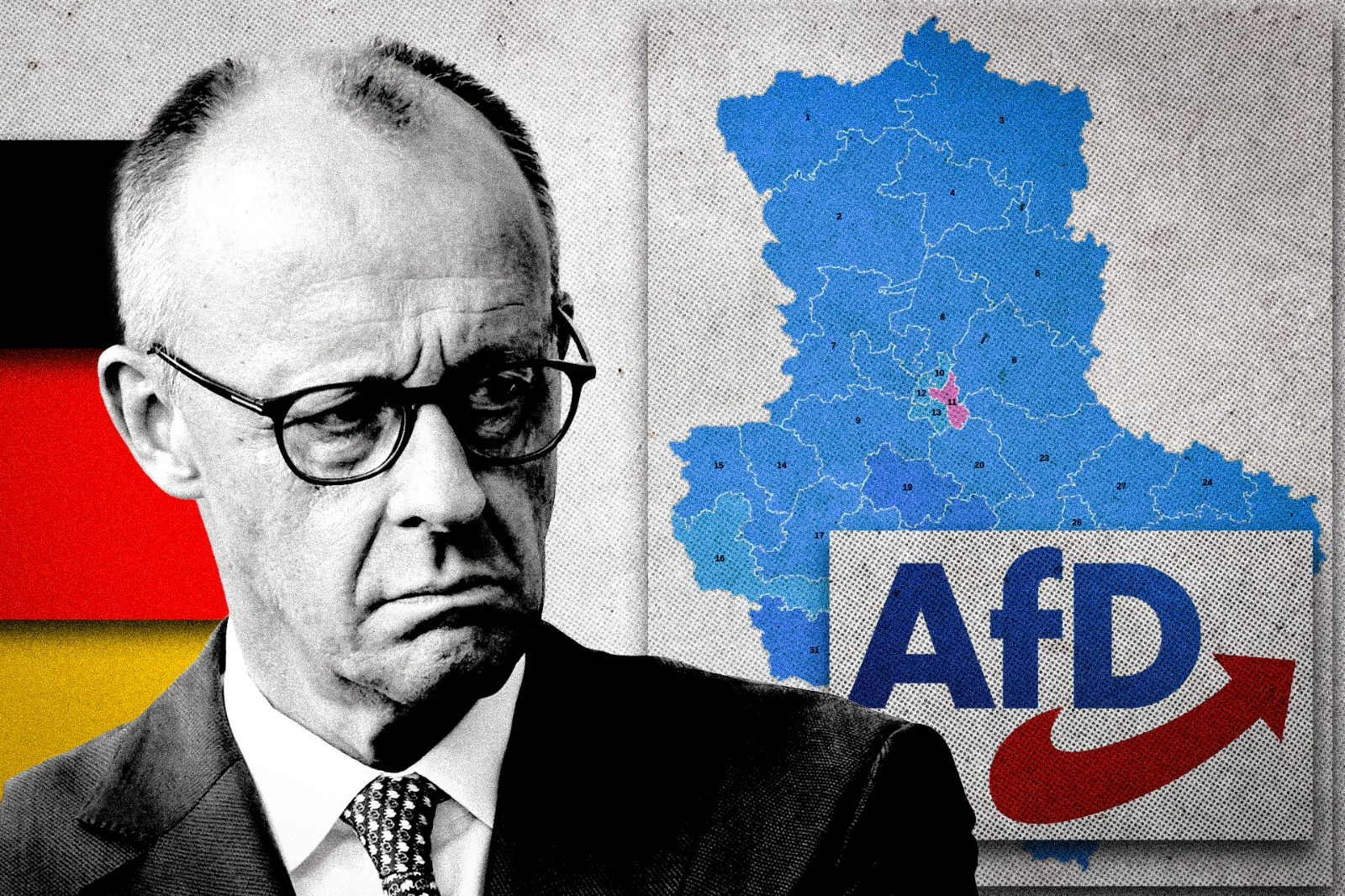
The election result in the poor, rural East German state of Saxony-Anhalt, home to just 2.1 million residents, has hit the German ruling class like a thunderclap. Alternative für Deutschland (AfD) has won nearly 44 percent of the vote, up from just over 20 percent. The ruling CDU meanwhile fell from 37 percent to 17 percent. The voters have cast a damning judgement on the whole German establishment.
When we dig down into the astonishing result, we find a complex mix of feelings. There’s confusion. There are racist, anti-migrant sentiments. That’s all very real. But while the result has caused natural alarm among many young people and left-wingers, we must caution against the idea that this represents a ‘shift to the right’, much less a rising tide of ‘fascism’.
What we above all find is a groundswell of anger, bitterness, hatred of the establishment, and resentment from mostly working-class voters who feel that the system is rigged against them.
This election had the highest turnout of any election in the state since reunification: 78 percent of voters turned out. While the AfD took a lot of votes from the conservative ruling CDU (roughly 83,000 votes), 170,000 of its votes were from previous non-voters: those completely alienated with the system and from politics.
We saw a big swing of workers to the AfD. They performed significantly above average among manual workers (gaining 59 percent). Among those who say their financial situation is ‘bad’, 65 percent voted AfD. This compares to only 37 percent of those who said they are doing ‘well’.
The only age group where they significantly underperformed was among pensioners, where the traditional party vote is holding up best.
What does this reflect? Enormous, accumulated rage at the bottom of society, and the AfD being used, in a confused kind of way, as a stick to hit the establishment that is the object of that rage.
At present, Friedrich Merz, the German Chancellor, is the most hated head of government in the world. 78 percent of Germans disapprove of his work. It’s not hard to see why. Germany has been in recession or flatlining since 2022. The cutting off of Russian gas since the outbreak of the Ukraine War has seen a wave of deindustrialisation sweep the country, with tens of thousands of jobs being lost every month. German industrial output is down over 11 percent since 2023 and 15 percent since the end of the pandemic.
A government coalition involving both the major traditional parties is carrying out a programme of cuts in social spending, attacks on the welfare system, while handing over millions for the war in Ukraine – a war which is correctly seen as linked to the loss of cheap Russian energy sources which is decimating German industry.
The AfD, meanwhile, has never been in government. Its programme is utterly reactionary, of course, and includes hair-raising, pro-business, anti-worker policies, anti-migrant scapegoating, as well as a raft of nauseating culture war crap.
But there are several reasons why the party, nevertheless, connected with this mood of anger. The first is their anti-establishment aura. For this, they have to thank the establishment parties themselves!
Friedrich Merz, the German Chancellor, is the most hated head of government in the world / Image: Steffen Prößdorf, Wikimedia Commons
That the parties responsible for the attacks on the German working class now come together to denounce the AfD as a special evil, and to construct a ‘firewall’ around them, has only benefited the AfD. Seeing all these established parties line up on this question – including left-wing Die Linke! – has convinced many that they all represent the same interests.
Among the policies of the AfD, there are two which are chiming with many workers.
The first is, of course, their policy on migration. Ironically, Saxony-Anhalt shows exactly why their policy is a red herring. This is one of the poorest regions of Germany, and yet, it also has one of the lowest migrant populations in Germany. Just eight percent of the state’s population is foreign-born, roughly half the national average.
Clearly, migrants are not the cause of the poverty of German workers. They are a convenient bogeyman, blamed for taking up hospital beds, housing, school places, and jobs. 89 percent of AfD voters say “prices are rising so sharply that I can’t pay my bills”. 80 percent say “I can no longer maintain my standard of living”. These are the real anxieties for which migrants are being blamed.
Then there is the other question that the AfD is increasingly tapping into: weariness towards the war in Ukraine. This is causing real alarm among the dominant, anti-Russian wing of the ruling class.
Since Merz came in, the Europeans (the Germans foremost among them) have taken on almost the full cost of the proxy war in Ukraine. He has also massively increased military spending. Meanwhile, and not unconnected to this fact, he is trying to push the pension age up to 70, and the working week up to 40 hours.
The deindustrialisation that has come with rising cost of gas, the consequent loss of jobs, longer hours, work-until-you-die policies – these are a price worth paying, in the opinion of Merz, the CDU and the SPD, in order to defend the imperialist interests of the German capitalist class.
Saxony-Anhalt has been particularly hard hit by the deepening crisis of German capitalism. As the comrades of the Revolutionäre Kommunistische Partei (RKP) explain in their post-election article:
“It is easy to see why they are angry. Saxony-Anhalt is in debt to the tune of €23.7 billion and has effectively no financial room to manoeuvre. Over the past six years, the state has had the lowest economic growth of all the federal states. It has the lowest wages and the lowest economic output per capita. It also has the oldest population – so much so that the incumbent CDU Minister-President, Sven Schulze, felt compelled during the election campaign to take a stand against the federal CDU’s plans to cut pensions.
“The largest economic sector is health and social care. It is precisely here – in hospitals and care homes – that further substantial cuts are planned. The chemical industry [Saxony-Anhalt is known for its so-called ‘Chemical Triangle’] is in crisis due to high energy prices. Local automotive suppliers are being dragged down by the slump at Volkswagen and BMW. A huge Intel chip factory in Magdeburg was supposed to provide relief from the economic hardship – but this project failed.
“Some commentators have tried to paint a rosy picture of the situation: whilst hourly wages may be lower than in the west of Germany, so too is the cost of living. Rents, in particular, are said to be affordable.
“One statistic makes it clear where this ‘affordability’ stems from: since the 1980s, Saxony-Anhalt has lost a third of its population. From three million at that time, now only 2.1 million people live in the state. Consequently, Saxony-Anhalt has the highest vacancy rate for council flats. The catch is that these need to be renovated, and there is no money for that. The result: cheap living in dilapidated flats.
“Only Bayer, which manufactures aspirin for the whole of Europe in Bitterfeld, is doing well. In the last quarter alone, the group’s profit in its pharmaceuticals division amounted to just over €1 billion. Naturally, this does not benefit ordinary people.”
This is the grim situation facing workers. And yet, every day the ruling class demands more sacrifices for the war, as it ratchets up its hysterical anti-Russian campaign.
The vote for the AfD is the clearest expression of the fact that their war propaganda is losing its effect. The party has promised it will end the war, reestablish relations with Russia, and get cheap gas flowing again, thereby bringing down prices and bringing back jobs.
It’s not just in Germany that right-wing parties are tapping into this mood. In France, the vice president of Le Pen’s party, Rassemblement National (RN), has said if his party came to power they would “turn off the tap” to Ukraine:
“The healthcare system, the education system, the entire economy – everything is stretched to the limit. Yet money is found to keep funding weapons. That’s all well and good, but who is paying for all this? You also have to know when to stop a war.”
Unsurprisingly, this sort of talk is connecting. On top of that, we must point to the strike wave of Dutch workers, including dockers in Rotterdam, who have shut down what is by far Europe’s biggest container port in a strike directly linked to cuts being made to fund militarism.
The success of the AfD is all the more astonishing when you consider how loud the anti-Russian chorus is becoming in the West. The latest chapter is the drone hysteria and unsubstantiated suggestions of a Russian attack on Leipzig airport.
And yet, this war propaganda is giving diminishing returns. At its peak in 2022, 29 percent of Germans felt that the country should throw more resources into the Ukraine War, whereas 23 percent felt that Germany had gone too far. Today, only 14 percent say the government is not doing enough in Ukraine, whereas 42 percent say they have gone too far. And only 56 percent believe that Germany is ‘strongly threatened’ by Russia – which, whilst a majority, is scarcely encouraging, when you consider the vehemence with which the West is depicting Russia as the devil.
This is class anger, confused class anger. It should be being expressed by the left. Here is precisely the point: it is the failure of the left to take a clear stance on the Ukraine War and NATO militarism; the failure of the left to give an alternative to the hell of German capitalism in decay; and the failure of the left to present itself as the real anti-establishment voice that has given room to the AfD.
Die Linke has participated in the same firewall against the AfD, as if the CDU is a ‘lesser evil’. They have failed to understand that the rise of the AfD is a direct result of hatred and anger towards the CDU, SPD and Greens, and that if one is to tap into the anger, they must stand apart from all those parties.
It is the failure of the left to present itself as the real anti-establishment voice that has given room to the AfD / Image: Olaf2, Wikimedia Commons
Yet, what have they done since this election? In an interview with the Frankfurter Allgemeine, co-leader of Die Linke Ines Schwerdtner was asked, ‘would you be willing to cooperate [with the CDU]?’ To which she answered: “Yes, under certain conditions,” adding that “to keep the AfD away from the levers of power… democratic parties must talk to each other.”
What a gift for the AfD. If the parties are seen as lining up together against the AfD, or worse if they go into coalition together to keep the AfD out, the AfD alone will come out the winners.
In Italy, before the election of Meloni, all the parties from Forza Italia on the right, to the Five Star Movement and Democratic Party on the left, all joined together under a technocratic government to attack the working class. Only Meloni’s right-wing Fratelli d’Italia stayed out of the coalition, and thus gained from the anger towards this reactionary coalition.
Die Linke has completely failed to learn this lesson. It is even more evident that they are being punished for this in Saxony-Anhalt.
Since the 1990s, alienation and a sense of being ‘left behind’ has predominated in East Germany. Traditionally, Die Linke was the party that expressed that feeling of anger. No more. Interestingly, one poll showed many AfD voters liked the party because they felt it “ensures that we East Germans can once again be proud of our achievements.”
Fifteen years ago, Die Linke was the second-largest party in this state, with 23 percent of the vote. It has now collapsed to fifth place and just 8.6 percent. To a large extent, the success of the AfD in East Germany is possible precisely because of the vacuum that Die Linke has left open to it!
Nevertheless, this is not a mood confined to East Germany. In March, the state elections in the southwestern state of Baden-Württemberg reflected a similar trend, with the AfD increasing its vote from 9.7 percent to 18.8 percent.
The mood among most of the left is alarm at the AfD’s rise. Again, that is natural and healthy. The party is utterly reactionary, from head to toe. However, would the AfD in power presage a period of reaction or even ‘fascism’, as some have posed?
No. This is not the perspective. The AfD’s programme is chock-full of extreme reactionary measures. However, it has in common with other so-called ‘far-right’ parties in Europe that it is riding a tide of confused working class anger.
The AfD stands for slashing taxes on the rich, abolishing the minimum wage, abolishing collective bargaining, as well as attacks on women, migrants, LGBT people, etc.
But if it gets a taste of power, it will find itself on the horns of a dilemma. If it attacks the working class, support will evaporate, putting it in the same weak position as every other weak bourgeois government that Germany and Europe has seen.
Look what has become of Meloni in Italy. Or Trump, for that matter. Trump attempted to focus on the question of migration because he was unable to deliver on any of his other election promises. And for his efforts, he received a bloody nose in Minneapolis and was forced to back off.
The rise of these right-wing demagogues will, of course, embolden bigots and even small, outright fascist elements. The threat that even these small, putrid groups represent mustn’t be dismissed.
But another layer is being radicalised. The crude, reactionary programme of the AfD and alarm at their rise is galvanising a layer, particularly amongst the youth. It is very interesting to note that only 39 percent of women, as against 50 percent of men, voted for the AfD in Saxony-Anhalt, precisely because of the misogynistic crap in the AfD’s programme, which blurts out that it expects them to pay for the crisis of capitalism by returning to the home and taking up more carework.
For the broader layers who voted for the AfD, the party cannot offer anything but false promises. The party’s shine will wear off for them eventually.
The policy of a ‘democratic firewall’ is the surest way to disaster, because in practice what it means is the defence of the current government, which is the one carrying out an assault on the working class. What is required is a clear, really anti-establishment, revolutionary alternative, that strikes at all the main parties of German capitalism and at rotten German capitalism itself.
Read the full story at the source →
Source: In Defence of Marxism