
Politics · In Defence of Marxism · · 2h
Germany: elections in Berlin and Mecklenburg-Western Pomerania another blow to the CDU
English (original) · Read in Deutsch ⇄
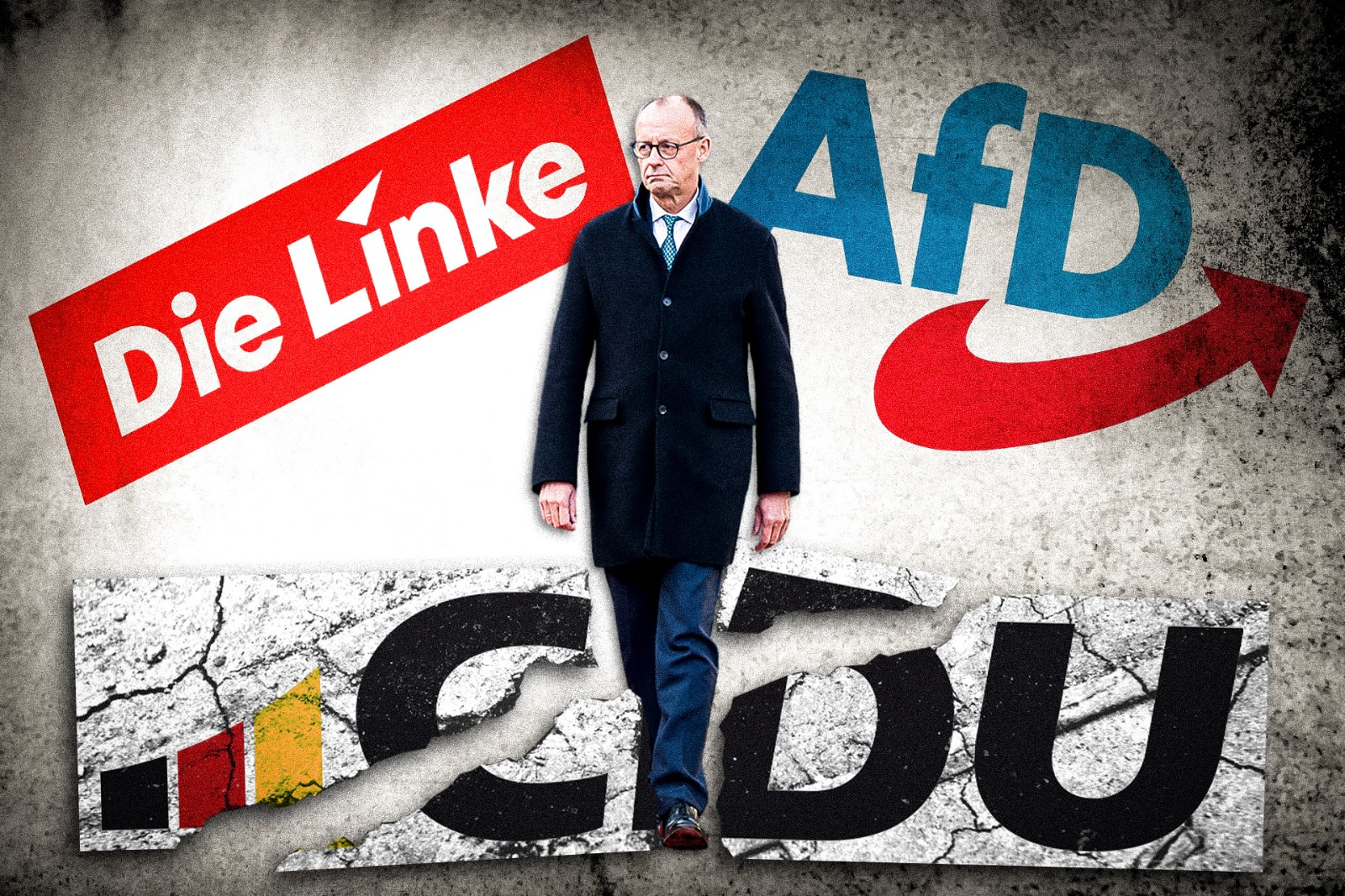
Two weeks after the political earthquake in Saxony-Anhalt, the state elections in Berlin and Mecklenburg-Western Pomerania have dealt another blow to the ruling CDU-SPD coalition. Chancellor Friedrich Merz is in a difficult position. Visibly shaken on election night, he vowed to continue with his government’s programme of ‘reforms’ – read: an all-out assault on pensions, the health service, and long-term care.
Let’s recap. On 6 September, the bourgeois CDU, which heads the ruling coalition government, was decisively defeated in the state elections in Saxony-Anhalt, dropping 20 percentage points, from 37 percent of the vote in 2021 to just 17 percent. The reactionary right-populist party AfD won a clear victory, gaining over 43 percent of the vote.
On Sunday, in Mecklenburg-Western Pomerania, the CDU received less than five percent of the vote, a crushing defeat. Failing to reach the necessary threshold, for the first time in history, the party will not be represented in the state parliament! As was the case in Saxony-Anhalt, the AfD came first in the northeastern state, winning over 38 percent of the vote, 21 points more than they won in the 2021 elections.
In Berlin, it was the left-wing Die Linke who won the election with 25 percent of the vote, over twice its previous result in 2023 – in an election with a higher-than-normal turnout, they increased their vote share from 185,000 to 480,000. In the 2023 elections, the CDU was the largest party with 28 percent of the vote, but now it has collapsed to 18 percent. Its national coalition partners in the SPD also collapsed by a third, to a paltry 12 percent.
Part of Die Linke’s electoral appeal in Berlin was that it campaigned heavily on the crucial question of housing, promising to strengthen tenants’ rights, to nationalise all large corporate landlords, and to introduce rent controls – as demanded by a popular referendum five years ago.
The results in both regions represent a slap in the face of the CDU-SPD coalition government, which was formed in May 2025. Parties that are seen as anti-establishment are gaining ground dramatically, whether they are to the right (as in the case of the AfD) or to the left (as in the case of Die Linke in Berlin).
There are a few other interesting points which emerge from the election results. In both cases, there was a clear 10 percent gender gap, with men more likely to vote for the AfD, and women more likely to vote for left and centre-left options. The sexist rhetoric of right-wing populist parties is quite rightly seen as a threat to women and particularly young women, which pushes them towards the left.
In terms of age, there is also a clear difference in voting patterns. Older voters were more likely to support the old established parties, such as the SPD and CDU, whilst the youth overwhelmingly voted for parties seen as more extreme, on both the right and the left, such as the AfD and Die Linke.
For example, in Mecklenburg-Western Pomerania, while Die Linke lost votes overall (coming fifth with eight percent of the vote), among 16-24 year olds it is the second party and received 24 percent of the vote – second only to the AfD with 34 percent.
It was even more striking in Berlin: the youth overwhelmingly voted for Die Linke – 43 percent among 16-24 year olds, and 48 percent among 25-34 year olds.
When it comes to occupation, the AfD was the main party amongst blue-collar workers in both elections: 51 percent in Mecklenburg-Western Pomerania and 29 percent in Berlin.
These results will put the ruling CDU-SPD coalition under increased pressure. Nationally, the AfD is now polling at 29 percent (9 points up from the election last year), whilst the CDU is at 20 percent (8.5 points down), and the SPD at 13 percent (three points down).
It is not difficult to see why. A coalition of the main establishment parties is presiding over an extremely serious economic crisis, in which 15,000 industrial jobs are being destroyed every month. This coalition is carrying out a massive programme of counter-reforms to health care and pensions, whilst at the same time increasing military spending, whipping up anti-Russian war hysteria, and funnelling billions into the black hole that is the war in Ukraine.
The Ukraine War plays a crucial role in the political and economic crisis. Sanctions on Russia have delivered a serious blow to German industry and consumers in the form of higher energy prices. Industrial output in energy-intensive sectors has gone down by 15 percent. This is compounded by the rise of China as a technologically developed industrial giant that is increasingly outcompeting German industry – Germany used to have a trade surplus with China, but now it has a trade deficit.
The AfD’s agitation against funding the war in Ukraine and for restoring trade relations with Russia has proven to be very popular. How could it not be? Of course, this agitation is combined with reactionary scapegoating of migrants and other reactionary policies against women, in favour of ‘traditional family values’, and so on.
The strategy of a ‘firewall’ – composed of all of the unpopular establishment parties – with the aim of stopping the rise of the AfD, has completely backfired. If ‘democracy’ and ‘the Republic’ mean job cuts, inflation, crumbling infrastructure, it is not surprising that many are choosing to ignore calls to defend these discredited institutions.
Die Linke’s victory in Berlin is significant. It demonstrates in practice that the anti-establishment mood can also be channelled towards the left if the left offers radical policies to address social and economic problems facing working class people and the youth – in this case chiefly the question of housing affordability.
Merz finds himself in an impossible situation. He is now the most unpopular chancellor in modern German history, and the most unpopular elected world leader today / Image: Stenbocki maja, Wikimedia Commons
But the party is held back by its willingness to participate in this so-called ‘democratic firewall’, which in effect means that it is propping up the reactionary capitalist government that is carrying out an assault on the working class. In Mecklenburg-Western Pomerania, Die Linke is already the junior partner in a coalition with the SPD. In Saxony-Anhalt, the party has said that it is open to allowing a minority CDU government.
Die Linke is also clearly divided on the question of solidarity with Palestine and opposition to Israel’s genocide, with the leadership opposing these policies. This can have a serious impact on forming a government in Berlin, where the Greens have already said that they are not prepared to collaborate with an ‘antisemitic’ party.
These three elections – and the ones to come in the future – provide a snapshot of the situation in Germany. Europe’s most powerful capitalist economy, which from 2011-2015 used the Euro debt crisis to impose hard monetarist anti-working-class austerity on the weaker economies of Portugal, Spain, Italy, and above all Greece, now finds itself at the centre of the storm of an unsolvable crisis of capitalism.
The rapid collapse of support for the CDU-SPD grand coalition government, which only came to power in May 2025, is the product of this situation. Within the limits of capitalism, there is no solution.
Merz finds himself in an impossible situation. He is now the most unpopular chancellor in modern German history, and the most unpopular elected world leader today. This is not down to any of his personal features, though these may add to it, but rather the fact that he is presiding over the worst crisis in German capitalism in decades. Whether he stays or is unceremoniously booted out, that fundamental fact will not change, and this will only provoke further political instability and class struggle. Greece 2011-15 is coming to Germany.
The rise of the AfD is a distorted, reactionary reflection of the anti-establishment anger that is developing in German society. The rise of Die Linke in Berlin, particularly among the youth, reflects a similar anger on the opposite side of the spectrum.
However, Die Linke is not a new party; it has been in power in several states as part of coalition governments carrying out anti-working class policies. It has a dreadful position on Palestine, and voted in the regional representation chamber (Bundesrat) for the modification of the debt brake which Merz’s cabinet required in order to massively increase the military budget.
What is required in Germany, and elsewhere, is a clear revolutionary communist alternative against the rotten capitalist system as a whole. That means an intransigent struggle against the ‘liberal’ and ‘democratic coalition’ governments in power that are carrying out austerity attacks against the working class, not collaboration with them in so-called ‘democratic firewalls’.
Read the full story at the source
Source: In Defence of Marxism