
Anti-fascism Green Left (Australia)
Why the far right’s favourite target is Indians
Far-right protesters yelled “F*** India” at a Naarm/Melbourne rally for Indian democracy. Maharnav Bhuyan argues the hatred has little to do with migration numbers and much to do with skin colour.
English (original) ·Read in Deutsch ⇄
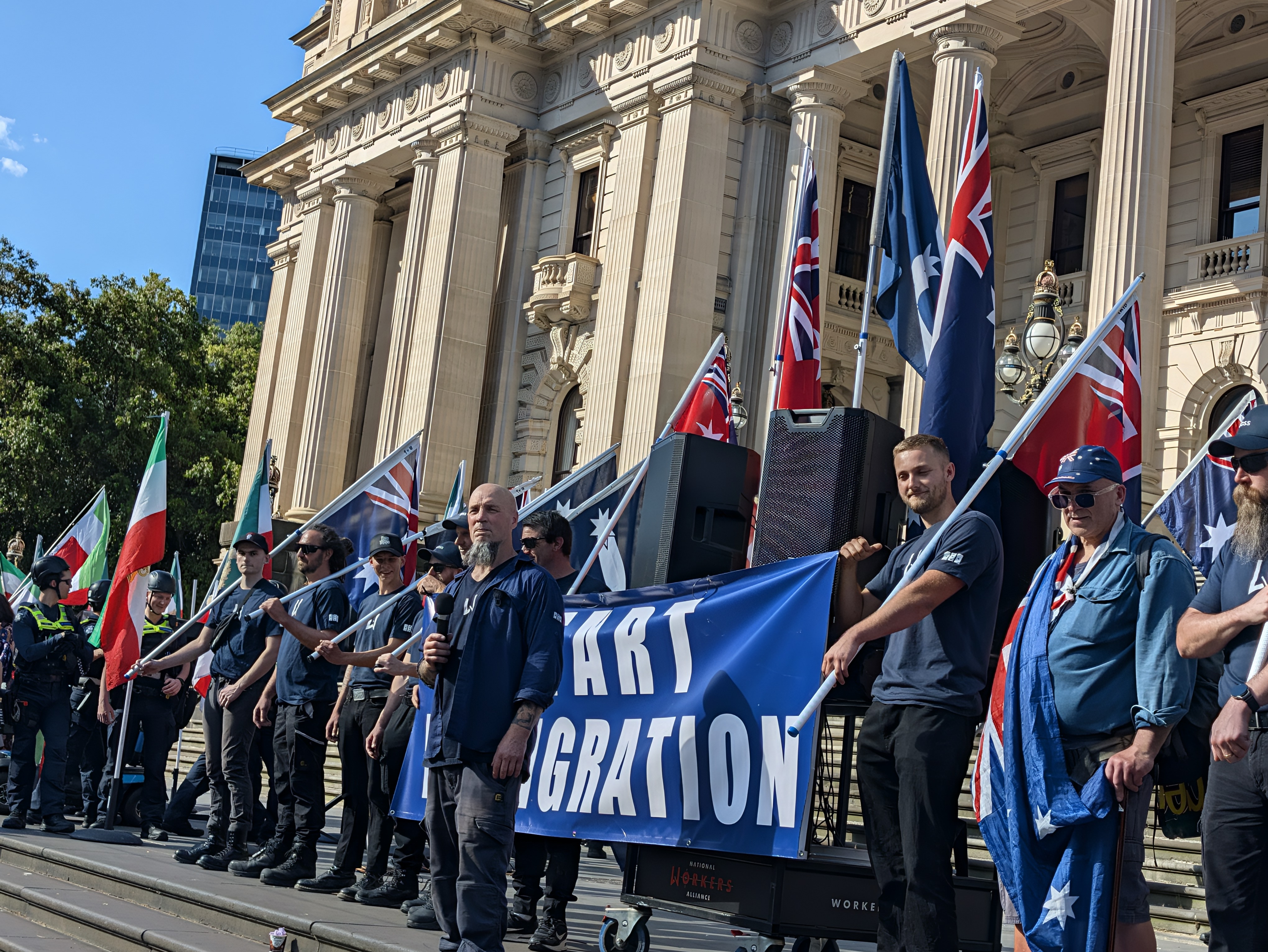
A handful of men from the far-right National Workers Alliance yelled this at a rally for Indian democracy near Victorian Parliament on October 18. They chanted “Go back, go back” and held a blue banner stating “START REMIGRATION”, the right’s euphemism for mass deportation.
Police removed an uninvited speaker and moved the group aside.
The rally, backed by The Humanism Project and Hindus for Human Rights, answered with a chant of their own: “We welcome migrants.” The protest was called to support the youth-led protests that have filled India’s streets since early October, demanding Chief Election Commissioner Gyanesh Kumar resign because the electoral rolls dropped more than 130 million names.
The Indian Express revealed in September that two of Kumar’s fellow commissioners had objected at least 14 times in 10 months, including to decisions allegedly made without their knowledge. The commission insists its revision decisions were unanimous.
Kumar was appointed under a 2023 law that removed the Chief Justice from the selection panel and handed the government two of its three seats. In April, the presiding officers of India's parliament refused to admit opposition notices, signed by 193 MPs, to remove him.
One placard in read: “They deleted my name, not my voice.”
Nativism is the idea that a nation belongs only to its “native” people. One Nation and India's ruling Bharatiya Janata Party (BJP) speak it fluently.
One Nation leader Pauline Hanson told the National Press Club in June that Australia should be a “monocultural society”. Prime Minister Narendra Modi told a 2024 campaign rally that the opposition would hand people’s wealth to “infiltrators”, remarks widely condemned as an attack on Muslims. Hanson has twice worn a burqa prop into the Senate and was suspended last November for seven sitting days.
Both parties offer an anxious majority “civilisational” pride and an “enemy” within.
The anthropologist Arjun Appadurai named the engine beneath both, in 2006, as an “anxiety of incompleteness”, in which a majority turns on a small minority because it reminds it that its dream of a pure nation is unfinished.
Hindutva (the BJP’s Hindu nationalism) and Hansonism rise in different mountains and meet in the same muddy confluence. I call this mirror nativism: one grammar, two peoples, each able to see the other only as a threat.
That is why Australia’s far right has never warmed to Modi.
Before he addressed more than 20,000 people at Marvel Stadium on July 9, the far-right March for Australia promoted an anti-migration protest. Outside the stadium, a small far-right contingent protested Indian immigration and Modi himself.
Nearby, the Alliance Against Islamophobia protested his record on Muslims. One protest opposed what Modi does and the other opposed what he is.
It is often assumed that the far right hates Indians because there are so many of us.
The numbers say otherwise. The Australian Bureau of Statistics (ABS) in June last year counted 971,020 India-born residents — 3.5% of the population — and, for the first time on record, the largest overseas-born group.
Second came the English-born at 970,950. Seventy people separate the two communities. Nobody marches against the English!
The far-right’s favourite statistic fares no better. March for Australia flyers claimed: “More Indians in 5 years, than Greeks and Italians in 100”. AAP FactCheck found that net migration from Greece and Italy over the century was 517,883, almost double India’s largest-ever five-year figure of 279,450.
India supplied 48,326 of the 185,001 permanent migration places in 2024-25 and more new citizens than any other nationality over 2023-2024.
About 110,000 Indian students, or 16% of all international students, studied here in the first half of this yea. It is roughly one India-born resident in nine. We pay full fees and a $2000 visa charge. We keep university budgets afloat. We are told our rooms are why rents go up.
We cannot vote. But those who are citizens can, which is what alarms Liberal Senator Jacinta Nampijinpa Price, who told the ABC last year that “there is a concern with the Indian community”, citing its numbers and its Labor vote. She was removed from the opposition frontbench.
In Truganina, in Melbourne’s west, more than a quarter of residents were Indian-born at the 2021 Census.
Hated as transients and hated as voters makes us the convenient stranger. Sociologist Georg Simmel, in 1908, defined the stranger as one who “comes today and stays tomorrow”.
Australia’s visa system manufactures strangers who come today and must leave tomorrow, and the far right condemns both those who leave and those who stay.
The variable is not the visa. It is the skin.
Indians are not uniquely disliked. The Scanlon Foundation’s 2025 survey found 30% of respondents held negative views of migrants from India, against 43% for migrants from Sudan.
African Australians were hit with a crime panic in 2018, when then home affairs minister Peter Dutton claimed Melburnians were “scared to go out to restaurants”.
That script does not fit us. Although India is now the largest overseas birthplace, it is not among the three most common overseas birthplaces of prisoners, which is New Zealand, the United Kingdom and Vietnam.
The far right reaches for a target it expects will not fight back. Alan Gamlen, director of the Australian National University's Migration Hub, said Indians become a “convenient target” in times of tension.
The reason is not temperament; it is the visa.
Temporary migrants avoid reporting exploitation for fear of jeopardising their visas, the Human Rights Law Centre has found. “For international students, our visa is everything,” one student told the centre. Silence under a visa condition is not docility; it is precarity and a racist can read a visa condition as easily as a face.
Our cultural continuity makes us conspicuous.
A sari or a turban on a suburban train is read as a refusal to dissolve into the global uniform of Nike and Adidas.
Melbourne has been here before. In 2009, attacks on Indian students drove thousands into the streets and a sit-in outside the city’s main railway station that lasted almost 20 hours.
Ghassan Age’s White Nation, written in 1998 as One Nation first rose in the polls, read such hostility as the white nationalist’s fantasy of managing national space and named the multicultural bargain in a chapter title: “A Manual for the Proper Usage of Ethnics”.
Our food is welcome but our faces must not linger.
Sara Ahmed argued in 2004 that hate does not live inside its object; it gathers force as it circulates.
Social media now sells that circulation. In a study of 2.7 million posts, each word referring to a political “out group” raised the odds of a post being shared by 67%.
The Center for the Study of Organized Hate found that 680 anti-Indian posts on X drew more than 281 million views in 10 weeks last year, mostly from the United States, with clips of Indian people in public places passed around as proof of “invasion”.
There is no public evidence that any platform has deliberately tuned its algorithm against Indians. One hypothesis does deserve testing. India banned Ticktock in June 2020, removing more than 200 million Indian users. On a platform emptied of India’s own voices, Indians are easier to film than to hear.
Victorians go to the election on November 28.
One Nation, led in Victoria by Partaken candidate Warren Pickering, polled 27% in June and 24% this month in Red Bridge surveys. Roy Morgan’s seat modeling has it winning more than 10 lower house seats.
Liberal leader Jess Wilson has yet to say publicly whether her party’s how-to-vote cards will rank One Nation above Labor.
Labor passed a law banning serious vilification on September 20 last year and stronger civil protections began on April 15. Premier Ben Carroll told an Indian community round table in September: “As Premier, I will always stand with you.” But that is not the same as standing between us and those who want us gone.
Before polling day, Labor should commit to: A firewall, so that visa holders who report racist abuse to Victoria Police or the Victorian Equal Opportunity and Human Rights Commission are not referred to immigration authorities unless they themselves face serious charges, plus pressure on Canberra to extend its Workplace Justice Visa to victims of racial violence.
It must also fund reporting and legal support in Hindi, Punjabi, Gujarati, Tamil, Telugu, Malayalam, Bengali, Assamese and Urdu.
It should release a quarterly publication of how many complaints and charges the vilification laws produce, and which communities they protect. It should put One Nation last on every Labor how-to-vote card and challenge the Liberals to do the same.
It must tell its federal colleagues to stop blaming students for the rent.
Prime Minister Anthony Albanese told the Marvel Stadium crowd: “We are a better nation because we have you in it.” His government charges a student $2000 just to apply.
Hate does not need numbers. It needs a face it can call foreign and a crowd it believes will not answer back. On October 18, the crowd answered.
[Maharnav Bhuyan is a Naarm/Melbourne-based writer and communication scholar. He is the author of Fabricated Communicative Immortality (WissenMonk 2026).]