
World · Green Left (Australia) · · 1h
The story of the League of Revolutionary Black Workers
English (original) · Read in Deutsch ⇄
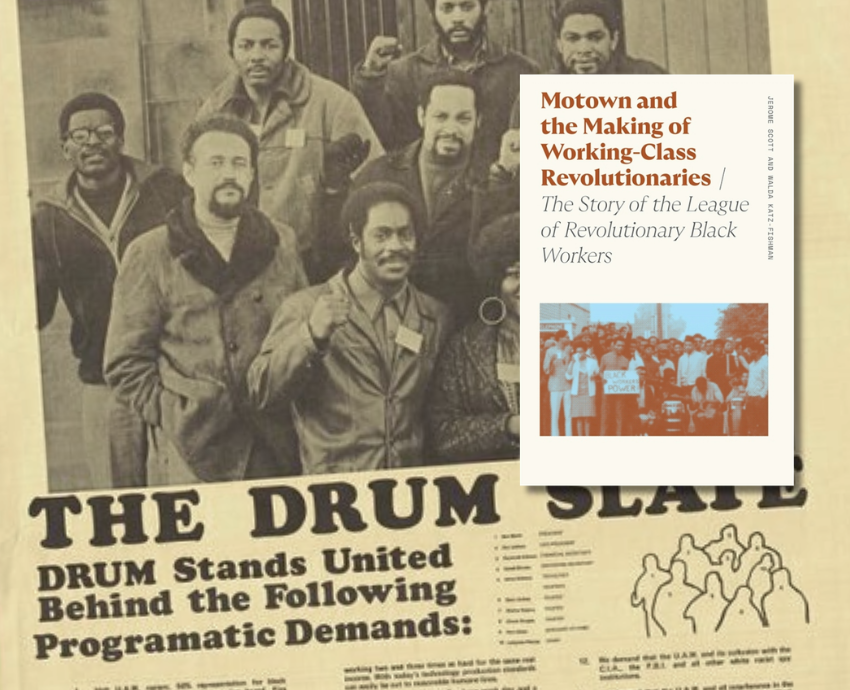
Motown and the making of working-class revolutionaries: The story of the League of Revolutionary Black Workers By Jerome Scott and Walda Katz-Fishman University of Georgia Press. 2025
Of all the radical groups to emerge in the United States in the 1960s, one of the most interesting was the League of Revolutionary Black Workers, which began organising in the car industry in Detroit, Michigan.
Jerome Scott and Walda Katz-Fishman’s book, Motown and the making of working-class revolutionaries, is based on extensive interviews with the surviving members of the league.
Before and after World War II, large numbers of African Americans moved north from the southern states to escape segregation and police violence, and in search of the $5-a-day industrialist Henry Ford was promising in his car factories. They were used to earning about $6 a week.
However, what they discovered in the car plants was that white workers got the pick of the jobs and Black workers did the dirty work. Management was white and so was the union. Both were racist.
Those who went north might not have experienced the legally sanctioned discrimination they’d experienced in the south, but there was plenty of discrimination nonetheless; in housing, education and employment. And the police were just the same.
Things came to a head in what is known as the 1967 Detroit Rebellion, which the media naturally referred to as “race riots”. President Lyndon Johnson called in the National Guard and the military, which opened fire with machine guns, killing 45 people.
Black workers in Detroit had had enough. They started organising in their workplaces. A few student workers got together and created the Dodge Revolutionary Union Movement or DRUM, in May 1968, at the Chrysler Hamtramck car factory.
Later on, other Revolutionary Union Movements (RUMs) were set up in other plants and industries, such as FRUM at Ford, ELRUM at Chrysler Eldon Avenue and UPRUM at the United Postal Service.
At the time, the union traditionally representing car assembly workers, the United Auto Workers (UAW), had effectively become a branch of management. The UAW and the company had a convenient arrangement whereby the union would give advance notice of a strike. This enabled the company to prepare and plan around strike action, effectively undermining the strike. In return, the union got financial and other kickbacks.
The first thing DRUM members did was stage a wildcat strike over speedups on the car assembly line. They also protested the racist practices of the company and the union. Four-thousand workers walked off the job and stopped production. Wildcat strikes became their main tactic.
The league was established to bring the various RUMs together and coordinate their activity. Its leaders were Marxists. While most production-line workers didn’t start out that way, many became radicalised on the shop floor.
None of the white officials counted on Black workers having learned strategies and tactics through the Civil Rights movement, the Black Nationalist movement and a range of socialist groups that many belonged to.
They were experienced in mass meetings, collective decision-making and direct action, and believed strongly in grassroots leadership.
From the start, these revolutionaries set up newspapers to communicate with other workers and the Black community at large. The Inner City Voice and South End became major sources of information.
They were prepared to use whatever methods worked. It didn’t matter whether they’d originally come from the International Workers of the World, the Communist Party, anarcho-syndicalism or Maoism.
They held demonstrations and rallies, issued plant bulletins and leaflets, picketed union headquarters and forced union executives to listen to their demands. They also boycotted nearby bars that refused to hire Black workers.
Activists quickly moved pickets from one factory to another to outsmart the police. They studied Mao Zedong’s On Practice and On Contradiction, analysing situations dialectically in order to decide what to do next.
The league lasted from 1969–71, before it split. But it achieved a remarkable amount in just two years.
The split was primarily over a difference of opinion about priorities. Figures such as General Baker and Scott, the book’s co-author, felt that the league should stick with what it had set out to do: improve conditions for Black workers in the car industry. Others, such as Mike Hamlin and Ken Cockrel, wanted to broaden the league’s focus to include areas like education, healthcare, publishing and filmmaking.
By and large, organised production-line workers who belonged to DRUM raised concerns that its Executive Branch was separating itself from the rank and file and no longer listening to their grievances. They wanted more democracy; as it had been in DRUM at the beginning, when everyone had a say, and there wasn’t a gap between the “thinkers” (the Executive Branch) and the “workers” on the shop floor. Eventually, some of them, such as Ernie Allen, were expelled for raising complaints, and the organisation didn’t last long after that.
In spite of the organisational split, members of the league didn’t give up and become pro-capitalist or drop out, rather they, each in their own way, kept up the struggle.
Some leaders, such as Scott and Baker, joined the Communist Labor Party, which eventually became the League of Revolutionaries for a New America, along with die-hard radical Nelson Peery (1923–2015). They stuck with production workers in the factories and then, as automation and offshoring took over, increasingly concentrated on organising and educating unemployed and under-employed workers.
The Hamlin and Cockrel group went into community work, legal support, health work and local government.
Both groups have made long-standing contributions.
As one of the original league members, Luke Tripp, said in 2017, “The system in this country keeps me in a revolutionary orientation. The criminality and immorality of the system. Billionaires just sucking up all the wealth — super greedy, selfish and mean spirited. That’s what keeps me in a fighting spirit — a lot of outrage and anger. Revolutionaries are fighters.” (p155)
Another excellent book about the league is Dan Georgakas’ and Marvin Surkin’s Detroit: I do mind dying, originally published in 1975 and available at the Internet Archive, along with the documentary, Finally got the news, produced by the league in 1970.
Read the full story at the source
Source: Green Left (Australia)