
World · Green Left (Australia) · · 3h
‘The Return’ uses magical realism to confront Israel’s genocide
English (original) · Read in Deutsch ⇄
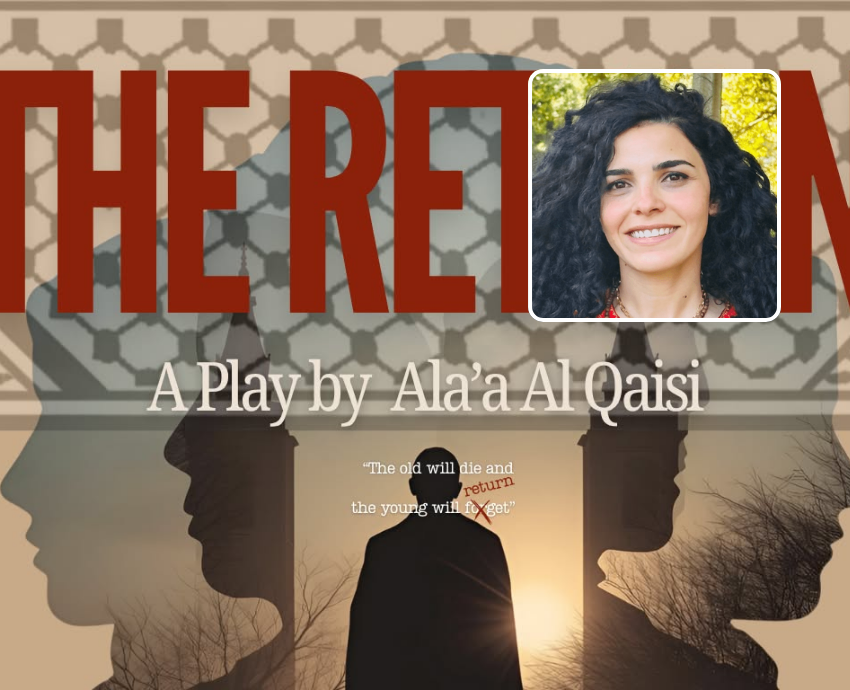
The Return Written and directed by Ala’a Al Qaisi Touring Sydney, Melbourne and regional Victoria Visit thereturnproject.com.au for details
Green Left’s Jordan Shukri AK Armaou-Massoud caught up with award-winning Palestinian writer director Ala’a Al Qaisi about her play, The Return, which has been touring Sydney, Melbourne and regional Victoria since September 1.
“As war tears through Gaza, a father waits for the clouds to bring his daughters home.”
So reads the synopsis for The Return, a powerfully surreal stage play written and directed by award-winning Palestinian writer director Ala’a Al Qaisi.
Al Qaisi told Green Left her idea for the play started early into Israel’s genocidal war on the Palestinians, when she saw a video of a father from Gaza whose name is Marwan Abu Samra.
Marwan was in a hospital next to his daughter Nagham — a famous karate champion who represented Palestine whenever she could leave Gaza to travel. Nagham’s leg had been amputated and she was in a coma — the result of an Israeli airstrike.
“[Marwan] already lost Rozan, his other daughter, in the same strike, and he was cleaving to the wall to help him get Nagham out of Gaza to get treatment because, at the time, they didn’t even have any antibiotics to save her,” Al Qaisi said.
“So, I learned about his story, I was really moved by this video and I told him … I want to come and talk to you…”
Marwan was eventually able to leave Gaza for Egypt with Nagham, but she only survived for three days before succumbing to her wounds.
“So, he stayed in Egypt and I looked him up … and said ‘I want to come to you and document your story’. He was very welcoming and supportive.
“I dug so deep with my questions with him. I tried to understand how he could rebuild himself after losing everything … his two daughters, his home, his security, his money, everything.”
“I start editing the documentary but, at the same time I felt the urge to write his story and to add layers from a psychological perspective...
“In The Return, Marwan is in Gaza and believes that God issued a decree where all martyrs are returning and they’re returning through the clouds.
“He goes on a very surreal journey where he confronts the killers of his daughters and it’s through his daughters that this surreal journey happens where he can explore his grief, he understands the pain that he goes through, the wisdom behind all of this.
“It’s my way to express this pain, express his helplessness, express how we let a genocide happen in front of our eyes, live-streamed in 4K on our devices, and we let it happen for that long.”
There have been many films, books and other texts created responding to the genocide in Gaza. Some creators have approached the subject using realism, while others have used fantasy or sci-fi. I asked Al Qaisi why she chose magical realism.
“Part of it is… it’s really difficult, it’s impossible to comprehend, and we are witnessing the effects of this genocide on us and the generations to come. So it was, for me, an escape.
“I tried to create a different reality from the cruel reality, but in this reality I tried to zoom out and to see things from a wider angle ... it wasn’t really a conscious decision ... I just want to express myself and bring hope, because I really needed to cling to hope that things will change, that justice will prevail.
“My faith also believes that [for] all those people who were killed unjustly; there will be justice one day...”
I asked Al Qaisi how she sees the relationship between art, politics and resistance and how this influences her praxis.
“I believe all art is a form of resistance, if it has a meaning, of course, not empty art; if your art tries to awaken people, if your art tries to make people stop and think, if your art tries to makes people relate to one another, this is a form of resistance and I think it’s so powerful...
“To make art about Palestine, or any injustice around the world, is a duty if you’re able to. I think God created us in different ways, some people love art, they can make art, some people can excel in politics … some people can have the power of money and relationships.
“I think everyone should use their tools to serve justice, to stop the killing, to help people...”
I asked Al Qaisi what she hopes people will take away from seeing the play and what sort of conversations and actions she hopes audiences will engage in after seeing it.
“My target audience will be, first of all, the Palestinians who endure all of this and any human being who really can’t understand how this is happening … I want to create a space for them to sit together, to feel everyone’s energy, and to reflect, to come closer to the reality. It’s a space to breathe, an attempt to heal.”
“[Secondly] are those who are on the edge between not knowing what is Israel, what is Palestine… the ‘bothsides-ism’ … or [those who] think; Okay, those people have been killing each other for many years, why should I care?”
“I really want them to come and watch the play, because that could open their eyes to different perspectives, and to also reflect on their humanity.
“So, no one is exempt from this [genocide], we are all part of this, we all let it happen, even if you don’t want to be in politics …
“Genocide is actually happening everywhere, it’s not just in Palestine…
“In this country, they tried to cover it up, they even try to still whitewash the Israeli genocide...
“I want to get the people who are actually on the other side, the ones who still think Zionism is a good thing, or they think Zionism’s okay and they support that or they support Israel. I want them to come because this is a space where they will be confronted...
“Because if you support Israel, that means you don’t relate to the other side as humans...”
“And of course, with everyone after leaving the play, I want them to do something. I want them to carry this message and do something about it within their field.
“I’m sure everyone will be able to think [of] and to do something from their own capacity…
“All of us can do something, I don’t believe there’s any one of us who can’t do anything.”
[The Return performs at the Ballarat Performing Arts Centre on September 18, the Chandler Community Arts Centre, Keysborough on September 19, and The Phee Broadway Theatre in Castlemaine on September 22. Tickets are available via Humanitix and thereturnproject.com.au.]
Read the full story at the source
Source: Green Left (Australia)