
War & Militarism Green Left (Australia)
Phil Monsour’s 'Time of Monsters' is a call to action against Israel’s genocide
Jeff Rickertt reviews Phil Monsour's new album, Time of Monsters , which foregrounds the trauma, resilience, courage, fears and hopes of Palestinians resisting Israel's genocidal war and the millions
English (original) ·Read in Deutsch ⇄
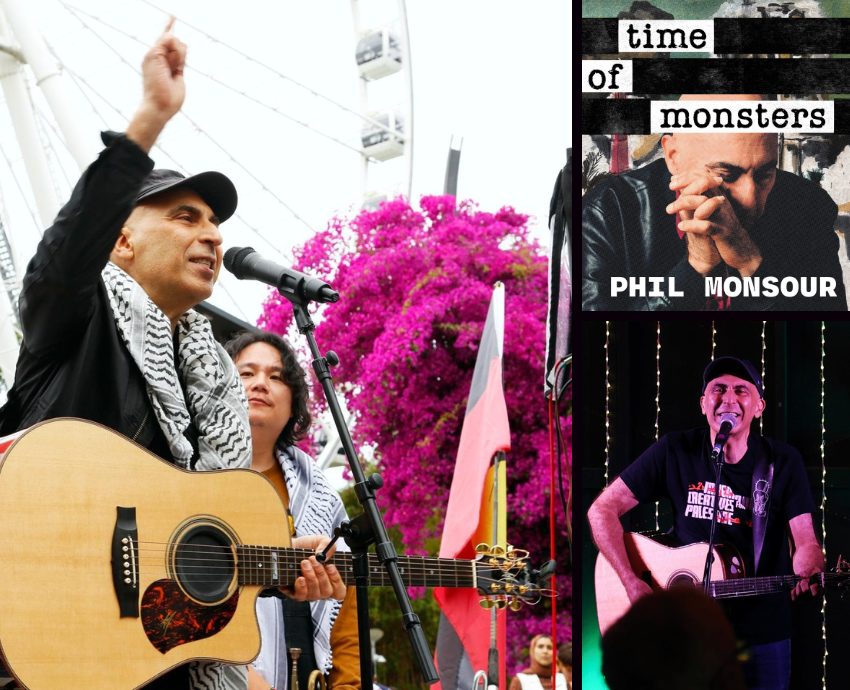
Time of Monsters Phil Monsour October 2026 Pre-order online Listen on Bandcamp
In the mythical Anglo-Saxon poem Beowulf, an entire population is subjugated by a bloodthirsty and seemingly invincible monster, Grendel. He “ruled in defiance of right, one against all”. “Malignant by nature, he never showed remorse.” (Seamus Heaney, Beowulf: A New Verse Translation, New York, WW Norton & Co, 2000, p11.)
With the genocide in Gaza now into its fourth year, and with Israel extending its military savagery to Lebanon, Syria and Iran, and tightening its bloody grip on the West Bank and East Jerusalem, it is clear the peoples of the Middle East are also living under the sway of a monster, malignant by nature, never showing remorse.
Unable to resolve the crisis of legitimacy generated by its founding act of land theft and dispossession, unable to quell the desire of the land’s indigenous people for liberation, the Israeli state, like Grendel, lashes out in rage, resorting to ever-increasing violence to sustain its power.
Halfway across the planet, in Magan-djin/Brisbane, Australia, a new album by Phil Monsour foregrounds the trauma, resilience, courage, fears and hopes of those resisting this evil; first and foremost the Palestinians themselves, but also the millions who have mobilised globally in solidarity with them over the past three years.
This album, Time of Monsters, adds to Monsour’s already impressive body of music about colonisation and war in the Middle East. It comprises 12 songs written over the past three years, each a response to Israel’s latest genocidal escalation of its never-ending war of subjugation.
One track is a rousing cover of Macklemore’s “Hind’s Hall 2”, the only song on the album not by Monsour. Another track, “Song for Fatima Hassouna”, honours the Palestinian photojournalist murdered by the Israel Defense Forces, alongside six members of her family, in April last year. The other songs respond to the genocide and Western complicity thematically. They invoke the visceral monstrousness of it, framing their narratives around recurring motifs: barbarism, loss, grief, survival, love and hope. The style is acoustic rock, although closer to Bruce Springsteen than Billy Bragg.
Monsour’s music is inscribed with activism. He is a founder and coordinator of Justice for Palestine Magan-djin, the Palestinian solidarity organisation that, since October 2023, has spearheaded the movement in Magan-djin, organising hundreds of rallies, pickets, vigils and public meetings. The size and intensity of this mobilisation has surpassed anything before it in the city’s history, including the struggle against the United States war in Vietnam.