
World Green Left (Australia)
Karina Lester: ‘AUKUS is a radioactive waste nightmare’
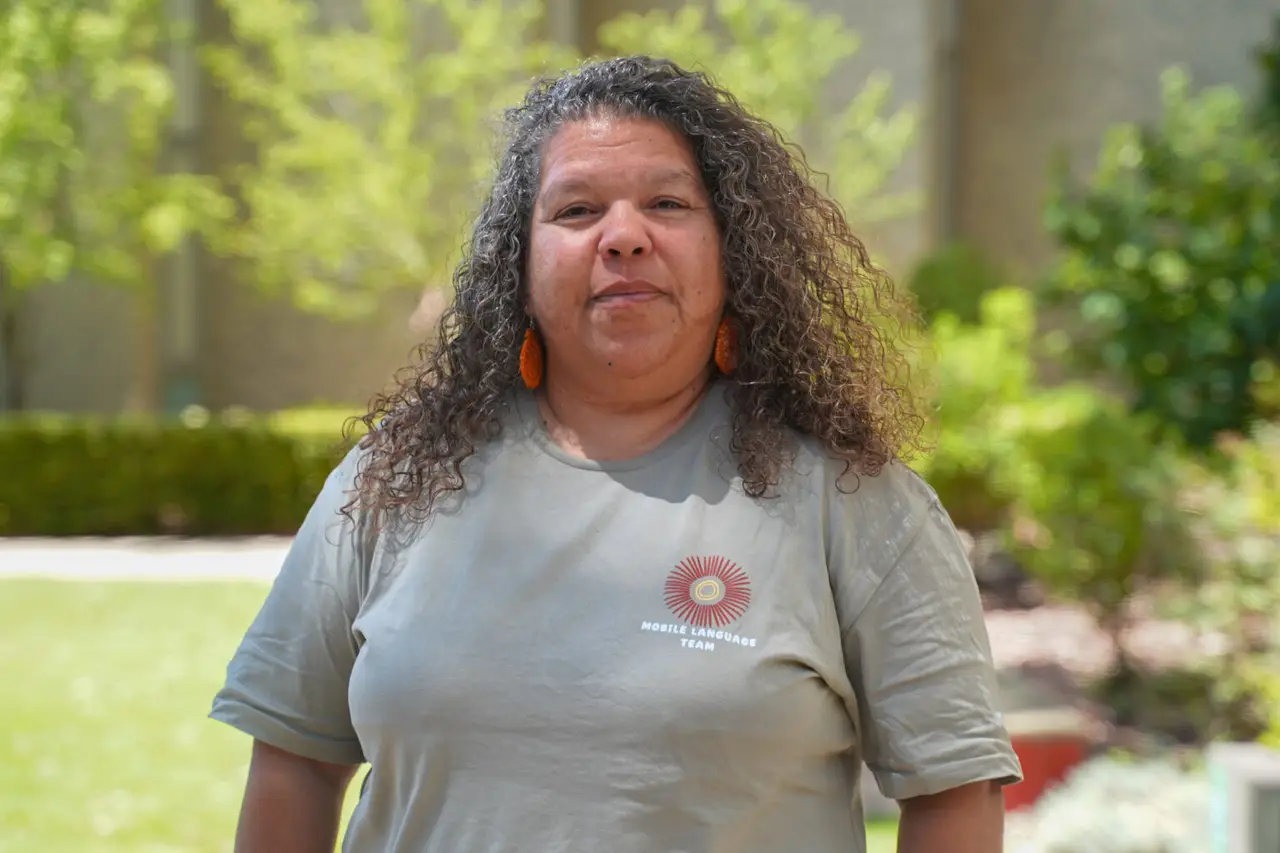
Paul Gregoire spoke to Karina Lester , one of the AUKUS inquiry commissioners and a second-generation survivor of the British nuclear testing at Emu Field in South Australia, about the report’s findin
English (original) ·Read in Deutsch ⇄
The AUKUS public inquiry released its final report on November 4. The five commissioners presented some stark realities about the “defence” pact between Australia, Britain and the United States, which is supposed to deliver eight Australian-owned nuclear-powered submarines (SSN).
A key issue the inquiry has brought to the fore is radioactive waste storage.
The AUKUS commissioners identified a massive cost — an estimated $180 billion — that taxpayers will have to foot, to store the radioactive waste.
This is on top of the $368 billion for the eight SSNs, which the inquiry said are not guaranteed to ever turn up.
The AUKUS report said that this additional, and never referred to, $180 billion outlay brings the total cost of AUKUS to around half a trillion dollars. It also advised that Australia has already gifted $3 billion to US and British submarine shipbuilding yards, with no guarantee of a refund if the deal collapses.
AUKUS Public Inquiry commissioner Karina Lester said that First Nations communities are concerned about the radioactive waste management plan, as there is no indication of where the waste site for highly-enriched uranium will be. It also remains highly volatile for hundreds of thousands of years.
Pillar I of AUKUS also establishes the Submarine Rotational Force – West, which involves US and British SSNs rotating out of HMAS Stirling, off the coast of Perth from 2027.
Even if the Australian-owned SSNs do not materialise, the Americans will have their own here at the ready.
The AUKUS commissioners recommended scrapping the AUKUS submarine deal entirely.
While Australia is expected to store its own waste, it turns out that the US and Britain have a decades-long issue of not being able to store their own waste.
Sydney Criminal Lawyers spoke to Karina Lester, one of the AUKUS Commissioners, who is a second-generation survivor of the British nuclear testing at Emu Field in South Australia.
The Yankunytjatjara Anangu woman said many First Nations communities are concerned about how and where the radioactive waste is going to be buried on Country, along with the fears over a base in Port Kembla.
The Surrendering Australia: The AUKUS Deception report clarifies many of the concerns about AUKUS. Fellow commissioner Peter Garrett told the National Press Club that the $368 billion works out to be $33 million a day for the next 30 years. He noted an additional estimated $180 billion will go towards managing radioactive waste disposal — a largely unaddressed aspect of the AUKUS deal. This is of particular significance to First Nations peoples.
What did the inquiry uncover regarding the storage of radioactive waste?
The AUKUS Public Inquiry found that it will be Australia’s responsibility to store the nuclear waste produced by these nuclear-powered submarines. The detail is yet to be defined or worked through.
Currently, Australia is going through a consultation process run by the Australian Radioactive Waste Management Framework. Last week, it was having consultations, which will provide feedback and clarity around waste management. But this was not about site selection.
From a First Nations perspective, if the AUKUS agreement says it is Australia’s responsibility to store this nuclear waste, we are concerned it will be stored somewhere in the outback, as we heard from former minister Kim Beazley. This, of course, will be First Nations traditional lands. So we are concerned about this.
At this stage, there is no site for the waste. But we’ve heard from defence minister Richard Marles that it will be somewhere on defence land, or future defence land. But there are no guidelines around where that future defence land will be.
At this stage, we know that we are responsible for the nuclear waste. This will be weapons’ grade nuclear waste, which will be concerning, as the waste will be high level and out on First Nations traditional lands.
So, there are unknowns coming out of the public inquiry and one of those is the site for nuclear waste.
When Marles refers to “future defence land”, does this mean that they could choose anywhere that is not currently defence land?
Yes. And there are no guidelines or criteria around how that selection process is going to be done, or where the future Defence land could be.
As Traditional Owners in South Australia, we have what is known as the Woomera Prohibited Area. That area is south of where my traditional lands are.
I’m up on the Anangu Pitjantjatjara Yankunytjatjara lands. The bottom end of those lands touch into the Woomera Prohibited Area. This is a fairly large area that is used for rocket launching. It is from the mid-north of the South Australian state, around Pimba and Woomera. It goes off into a north-westerly direction, which is currently defence land.
The site could also be on future defence land. So, there are some unknowns around this. This includes site location, number of sites and whether it is low- or high-level nuclear waste.
The public inquiry was unable to find out the answers to these questions.
The US and Britain have had these types of nuclear-powered submarines for decades but have not developed permanent sites for their waste disposal. What will it mean for Traditional Custodians to have such matter buried on Country?
The United Kingdom hasn’t dealt with its waste. We know there are nuclear-powered submarines docked in their shipping yards containing this waste that have been sitting there for quite some time.
We know that the US has also struggled with issues around safety and management of its nuclear waste.
So, this raises concerns from a First Nations perspective. No location has been identified, we don’t know where the waste is going to go and we also don’t know whose waste it is going to be.
The AUKUS agreement says it will be Australia’s nuclear waste. But there is a real fear from mob in South Australia, that it will be opened up to bringing in UK and US nuclear waste.
These are the fears and concerns we have. Again, it would be highly enriched uranium, the weapons grade uranium, which is of real concern.
When you do have highly enriched uranium, it does add a complex layer around keeping the waste secure and managing the facility. As Peter Garrett, our lead commissioner pointed out, there is an additional question around who is going to pay for managing this waste facility.
This is in addition to the $368 billion for the submarines. The cost of waste will be around $180 billion. That estimate involves identifying a location, building the facility, additional infrastructure and, potentially, having security there as well.
The AUKUS deal involves establishing the Submarine Rotational Force – West at HMAS Stirling, on Noongar land, off the coast of Perth in Western Australia. It appears to be shaping up to be a US submarine base, involving vessels that may be carrying nuclear warheads.
Despite SRF-West being slated to start next year, USS Colorado, the US submarine, is parked there now. How do you see HMAS Stirling?
When you know that a US submarine is currently docked there, it certainly looks like it is [a US base]. There is a real concern, which was echoed by many throughout the public inquiry, that Australia itself, as a nation, will potentially be a US base.
We know there are already US operations here, such as Pine Gap [in the Northern Territory], Tindall, also in the north of the NT and there is a potential eastern base, possibly located at Port Kembla, as well as HMAS Stirling off the west coast.
There is real fear that Australia is turning into a US base. That was made loud and clear from locals in WA, the NT and also, from the east coast in Port Kembla.
The inquiry heard from people living on Dharawal land in the NSW town of Port Kembla. There are fears that another US base might be established there.
How are the locals in Port Kembla preparing?
The Port Kembla community is very concerned about becoming a US base. This was a strong message. Many women were concerned about their safety and that of the children. So, there is an uneasy feeling because no decision has yet been made around whether Port Kembla will become a US nuclear base.
People have been talking about identifying a location on the east coast, where submarines could rotate. Port Kembla is a busy port currently. The commissioners considered how busy the port is to get an idea of how a US base with nuclear-powered submarines could be located there.
This is going to be an ongoing conversation.
After hearing more than 150 testimonies, what do you think the AUKUS deal is all about?
One of the strong messages coming from the inquiry is that the AUKUS agreement was formed out of a concern that China is a real threat to Australia. But this is concerning as many who addressed the commissioners pointed out that this risk wasn’t there.
We need to know where the intelligence that China is a “threat” is coming from.
China is one of our biggest trading partners, and Australians need to know whether there is a threat.
Former defence minister Linda Reynolds said that Australia was already under threat from China. This was worrying and concerning. But we don’t know how real that threat is.
There is a real concern that the AUKUS agreement is taking us towards a conflict, with the US dictating.
There are still a lot of unknowns around how the AUKUS agreement is going to roll out across Australia.
Australia has already invested billions into the British and US submarine building shipyards. Taxpayers should be concerned that these nuclear-powered submarines could potentially be managed and controlled by the US on Australian soil.
Australians need to be asking their local members of parliament questions around what AUKUS is getting us into.
We created a space with this AUKUS public inquiry to hear the voices of Australians as our own government didn’t allow us to have a say. They did not run a parliamentary inquiry.
AUKUS is a concern for all Australians. It is not just a First Nations issue because of the radioactive waste problem. It is local communities that are going to be impacted if US bases are going to be put on local soil.
[This slightly abridged piece was first published by Sydney Criminal Lawyers, for which Paul Gregoire writes.]