
Politics · Green Left (Australia) · · 30m
High Court’s landmark climate ruling counts true cost of coal
English (original) · Read in Deutsch ⇄
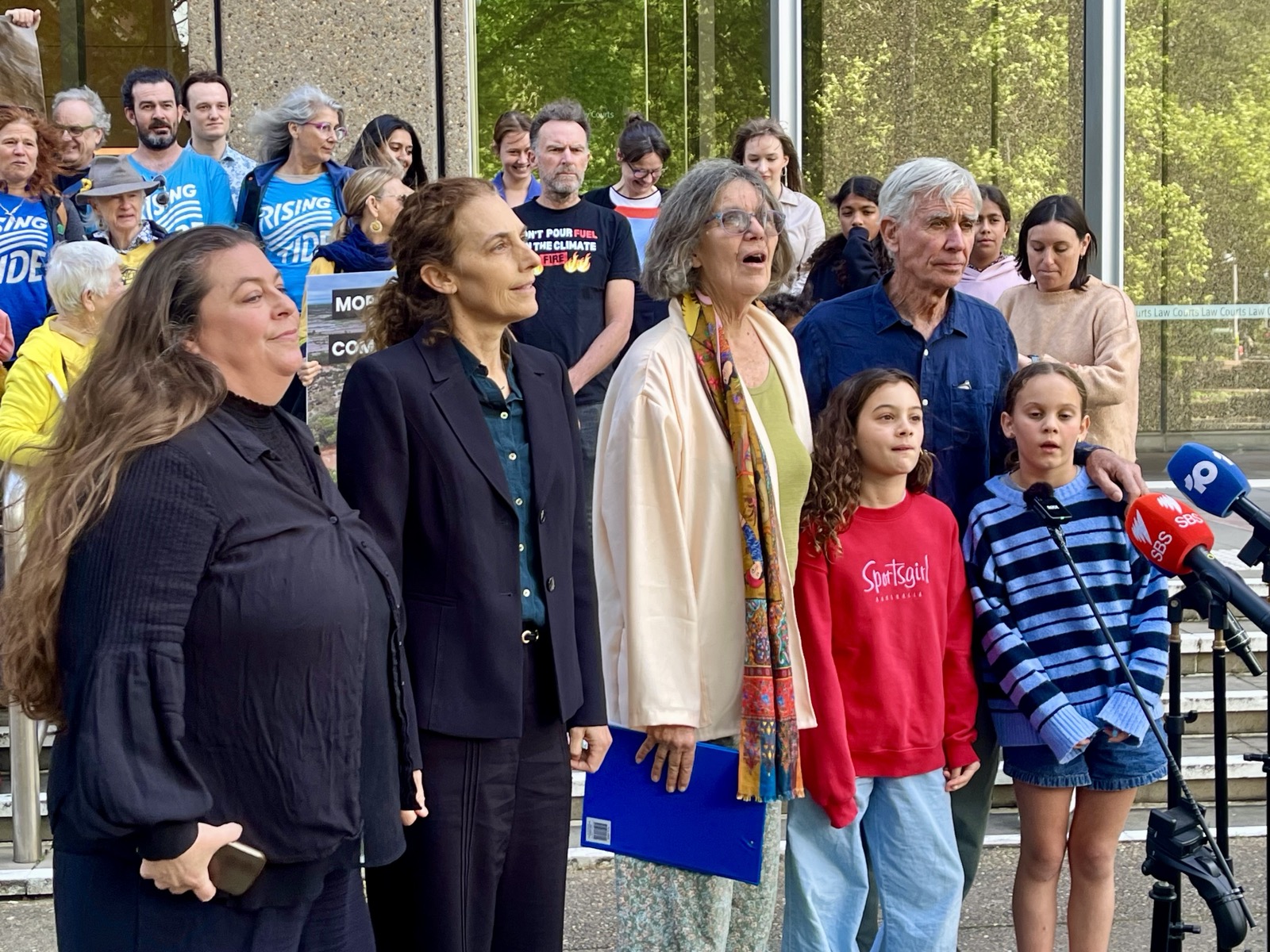
The High Court of Australia ruled on October 7 that the New South Wales Independent Planning Commission (IPC) must consider how the burning of fossil fuels, exported from this country, contributed to climate damage.
It upheld an earlier unanimous NSW Court of Appeal ruling that the expansion approval of MACH Energy’s open-cut thermal coal at Mount Pleasant was invalid.
The Denman Aberdeen Muswellbrook Scone Healthy Environment Group (DAMS HEG), from the Upper Hunter Valley, had battled for four years over the coal mine’s expansion.
Climate activists believe this is a landmark judgement. Judging from the negative responses from One Nation and NSW Labor, that would seem to be the case. Prime Minister Anthony Albanese also weighed in on the side of MACH Energy in May, telling 2HD Newcastle Radio that he supported the expansion.
The campaign group, motivated by broader notions around climate justice, is also concerned about the transition for those working in the coal industry. Tony Lonergan, from DAMS HEG told a media conference on October 7 that NSW Labor had failed to put in place, and properly fund, a fair transition plan for affected communities.
Wendy Wales, president of DAMS HEG, said: “Today the High Court has said what we have always known: We cannot dig up coal, ship it overseas, watch it drive climate change and then pretend the consequences have nothing to do with us and won’t be felt by us.
“The droughts, the bushfires, the floods — are directly connected to greenhouse gases, and massive fossil fuel projects like Mt Pleasant Optimisation simply add fuel to the fire.”
Wales and Lonergan, both retired science teachers, live on a farm in the Upper Hunter Valley adjacent to the Mount Pleasant mine.
The Hunter Valley community group has been fighting MACH Energy’s expansion plan — to double Mount Pleasant’s output to 21 million tonnes a year and extend operations until 2048.
The community group initially lost its challenge last year in the NSW Land and Environment Court, after the IPC approved the 22-year expansion. It then successfully appealed that decision, prompting Mach Energy to take the case to the High Court.
The High Court dismissed MACH Energy’s appeal, saying the IPC had not considered how pollution from its coal would affect the region, through increased bushfire risk, drought, flooding and extreme heat. MACH Energy argued that Scope 3 emissions (emissions produced from burning the exported coal) from its mine should be considered through Australia’s pre-existing obligations under the Paris Agreement.
Three of the five judges found that the NSW IPC needed to “consider imposing conditions to minimise to the greatest extent practicable all greenhouse gas emissions, including Scope 3 [emissions produced from burning the exported coal] emissions”.
The judgement means that the Mount Pleasant coal mine expansion approval to 2048 is invalid. But MACH Energy was given approval, in August, to operate until 2032. It had sought to double the output to 21 million tonnes a year.
Wales said the court decision “has finally made a change in direction in our laws. The [planning rules] will now have to reflect the need to consider climate impacts of our scope three emissions from the coal that we export.”
Lonergan said: “This ruling is in line with the International Court of Justice ruling [in July 2025] that said countries that use fossil fuels are responsible for the mitigation of emissions.
“We cannot just say, ‘Well, 98% of emissions comes from the burning of the coal overseas — that’s somebody else’s problem. Nothing to do with us!’ That’s just not going to work any more.”
Nic Clyde, coordinator of Lock the Gate Alliance NSW, said the ruling would affect 17 coal projects currently in the state’s planning pipeline. “Today’s decision sends a strong message to the planning system: the price households and communities are paying for coal pollution must be weighed properly in the planning system,” he said. “It’s no longer okay to ignore the climate cost of coal revenues.”
“The upper hunter economy needed to be diversified away from coal mining,” Lonergan said. “The area is completely dependent on coal mining, and everyone is pretending that we are just going to carry on.
“There’s the Future Jobs and Investment Fund which has stalled in the Upper House because the Labor Party won’t pass legislation to assist in the transition of the economy, diversify the economy.
“This landmark case shows that governments have to start getting serious about emissions from the coal and gas that we export from this country. We know what happened in Nepal. Those kinds of events are going to get more and more frequent, and more and more disastrous. There have been horrific heat waves in the Northern Hemisphere this year. That doesn’t stop when we get to net zero,” Lonergan concluded.
Environmental lawyer Elaine Johnson said: “We cannot simply rely on global international agreements and mechanisms to satisfy our own legal obligations. The ICJ has said exactly the same thing.
“Australia needs to start taking responsibility for our contribution and, in particular, through its contribution to continued expansions of coal like the Mount Pleasant coal mine, owned by MACH energy, that has just been overturned by the NSW Court of Appeal and now again the High Court of Australia.”
Wales said the ruling “acknowledges that many Australian communities have already suffered extreme weather devastation. Now the true and complete long-term costs of export coal on Australians, via the climate impact from burning that coal, must be considered.
“People in the Torres Strait, Pacific nations and countries like Nepal, which are not significantly contributing to greenhouse gas emissions, are already being seriously impacted by climate change. The International Court of Justice has determined they are within their rights to seek full reparation from states ‘acting wrongfully’.”
Lonergan said: “This isn’t the end of coal overnight. But it is the end of coal mine approvals that look the other way on climate. Every planning authority in Australia now has to take this seriously. That is a fundamental change.”
Read the full story at the source
Source: Green Left (Australia)