
World Green Left (Australia)
Defending human rights in Turkey
Sarah Glynn spoke to the Human Rights Association of Turkey co-chair Cihan Aydın — on a visit to Strasbourg, and ahead of the COP31 meeting in Antalya.
English (original) ·Read in Deutsch ⇄
Leading members of the Human Rights Association of Turkey (İHD) have been visiting Strasbourg to talk to key figures at the Council of Europe, so I took the opportunity to carry out a brief interview with Cihan Aydın, the Association’s co-chair.
The İHD was founded in 1986, in the aftermath of Turkey’s 1980 coup and subsequent purges. More recently, as Aydın noted, Turkey has undergone a big backsliding in human rights since the failed coup against President Erdoğan in 2016.
The day we met – November 4 – was the 10th anniversary of the arrest of Selahattin Demirtaş and other politicians from the pro-Kurdish Peoples’ Democratic Party (HDP, now the DEM Party).
Nearly six years ago, in December 2020, the European Court of Human Rights ruled Demirtaş’s detention illegal: that the case against him was legally baseless and being pursued for political reasons. They called for his immediate release, but although the European Court is the highest legal authority in Turkey (as it is in all member states of the Council of Europe) Demirtaş is still behind bars and has been given a 42-year prison sentence.
Aydın explained that, normally, national courts would act according to the law and implement the European court’s decision, but in Turkey the judiciary is not independent. The courts follow the decisions of the government, and Erdoğan thinks that keeping these political prisoners locked up — in defiance of the European Court — helps him remain in power.
Aydın insisted that the Council of Europe could and should put more pressure on Turkey to abide by the law it has signed up to. He cited the example of Azerbaijan, against which the Council of Ministers launched Infringement Proceedings in 2017 for failure to release opposition politician Ilgar Mammadov.
This was the first time this additional legal procedure had been invoked, and Azerbaijan was eventually persuaded to quash Mammadov’s conviction. But, as Emilia Klebanowski explains in the Strasbourg Observers Blog, this required a further year of sustained political pressure, and, even so, it did not extend to other political prisoners convicted in the same manner.
Turkey’s continued imprisonment of businessman, philanthropist, and human-rights defender, Osman Kavala, has given rise to the second use of Infringement Proceedings; but in this case,the Council of Europe appears reticent about applying further pressure, and Turkey is refusing to budge.
The European court has repeatedly ordered Kavala’s immediate release. Instead, he remains locked up with an aggravated life sentence that allows no possibility of parole, a form of sentence that is in itself a breach of the European Convention on Human Rights.
The Parliamentary Assembly of the Council of Europe, made up of deputies from the parliaments of member countries, called, in 2020, for further action in support of Kavala through a Complimentary Joint Procedure.
This would allow for sanctions on Turkeys’ participation in the Council of Europe, alongside intensified diplomatic pressure. However, the Council of Ministers (the foreign ministers of the member states, or their representatives) and the Secretary General have yet to act on this.
At any suggestion of pressure from the other European states, Turkey threatens to withdraw from the Convention altogether. Noone wants this to happen, including Turkey, but it is a serious threat that exposes the weakness at the core of international law.
Asked about the impact of the worldwide crisis in international law, Aydın said: “Turkey is becoming a central actor in this crisis. In the world, the system of checks and balances that sustains democracy has been lethally eroded. And the concept of human rights is unfortunately losing its importance in the world. And in interstate relations, economic and political interests have become much more prominent. Authoritarian regimes are taking advantage of this. This is exactly the situation in Turkey.
“The human rights crisis, the global human rights crisis, has unfortunately spread here as well. That is, the Council of Europe and the European Union no longer value or prioritise human rights issues as much as they used to. We can feel and see this.”
In addition to the ineffectiveness of international diplomacy for promoting human rights, when international meetings are held in Turkey, these can become a focus for further attacks on protesters.
The İHD website details: “Ahead of the NATO Summit held in Ankara on 7–8 July 2026, at least 225 people were detained in house raids as part of a large-scale operation launched by the Ankara Chief Public Prosecutor’s Office on 23 June 2026. At least 178 people, including human rights defenders, journalists and lawyers, were remanded in custody on charges of ‘membership of an armed illegal organisation’, while 34 others were placed under house arrest.”
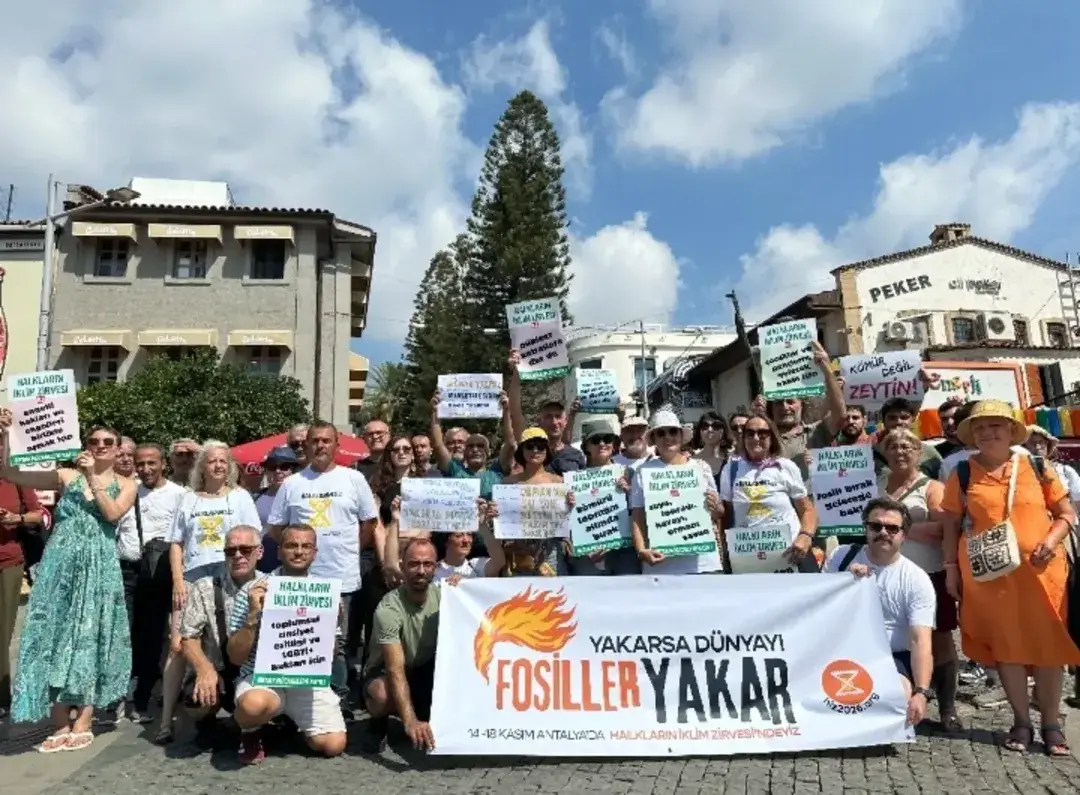
Now attention has turned to protesters preparing to demonstrate at the COP31 summit in Antalya from November 9 to 20 — despite Turkey’s poor ecological record.
Aydın observed that during just the two days they had been in Strasbourg, many ecological activists had been detained and hundreds put in prison.
Human rights activists are amongst the first targets of an authoritarian regime, and Aydın estimates that at least five of the İHD’s former executives are in prison.
The association has always campaigned for Kurdish rights, and Aydın explained that,with the Kurdish-Turkish Peace Process,“the pressure on human rights associations has eased somewhat. But periodically, the state very quickly reverts to its old settings, to its old habits.”
When there were major protests in January against the attacks on Rojava, hundreds of people were detained and many arrested. He expressed his fear that “if this peace process fails, many of the activities and statements we made during this period could be used against us in the future and could turn into a lawsuit against us.”
[Sarah Glynn is an activist and writer based in Strasbourg. Visit her website at sarahglynn.net and follow her writing at newsfromkurdistan.wordpress.com.]