
Climate Green Left (Australia)
COP31 week one: A summit without discussion of fossil fuels
COP31 President Murat Kurum, Türkiye’s environment minister, did not say the word “fossil” once in his opening speech to the summit. The Turkish and Australian Prime Ministers barely touched the word
English (original) ·Read in Deutsch ⇄
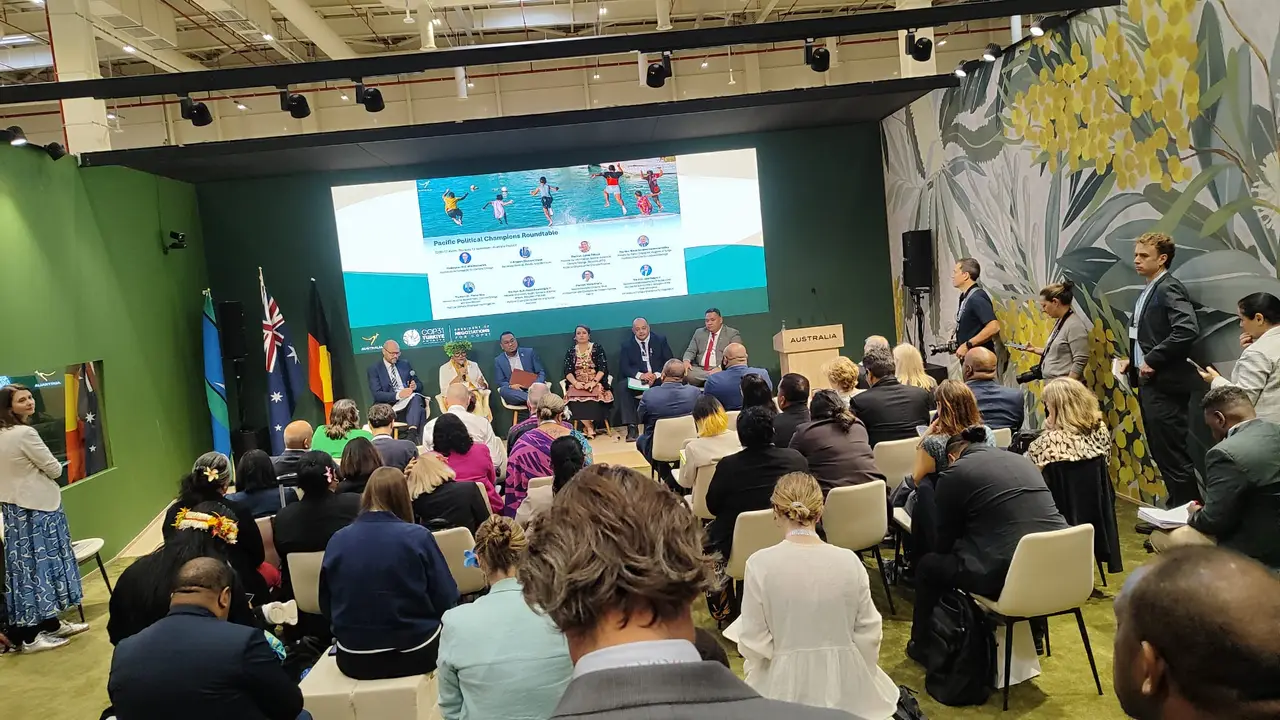
If you followed the first week of COP31 from Australia, you probably heard about the $32,000 coffee cart at the Australian pavilion and the hot mic that caught Prime Minister Anthony Albanese and energy minister Chris Bowen joking about where to keep their phones.
Much less was said about what happened in Türkiye on the opening day.
On November 9, while the summit opened with a lavish ceremony in Antalya, President Recep Tayyip Erdoğan came out of a cabinet meeting in Ankara with good news: 135 million barrels of new oil potential had been found at Gabar, in Türkiye’s south-east.
The same day, at the HABAŞ steel plant in Aliağa, near İzmir, an overhead crane fell and ruptured a gas line. The explosion that followed killed 19 workers.
This workplace disaster did not make the agenda of the climate summit. HABAŞ runs its arc furnace on electricity from coal and gas, and supplies steel to the construction and car industries.
But COP31 does not talk about fossil fuels as a material order made of steel, cement and workers. It talks about an abstract “emission” to be managed from a distance. A worker killed in a fossil plant falls, by definition, is outside the frame.
Three days later, union confederations met inside the COP31 venue to discuss “just transition”. Nineteen workers were killed and Türkiye is speeding up its transition to fossil fuels but neither was on their agenda.
Türkiye, which holds the COP31 presidency, prepared well for a climate-changing summit. Since it was named host, it has signed 19 fossil fuel supply and exploration agreements, plus six nuclear and mining deals. It kept signing during the summit.
Australia, which presides over the negotiations, is no different. Labor had already approved 37 new or expanded fossil fuel projects. Weeks before the summit it made it 38, clearing the Boggabri coal mine to dig another 30 million tonnes.
In Antalya, Albanese put the Pacific Island nations at the centre of his speech and then spent more time on home batteries than on coal and gas.
Bowen told the ABC that coal and gas exports have not damaged Australia's standing in the talks, and that his job is to land “the most ambitious outcome that consensus will allow”.
Tuvalu’s Prime Minister Feleti Teo described new fossil fuel projects “a death sentence for us”.
The Pacific Resilience Facility, Australia’s showpiece, reached US$200 million in Antalya. By Albanese’s own account, 46% of the money, so far, has come from Pacific countries themselves.
Meanwhile, according to Climate Action Network, Australia has joined the European Union, Japan and Norway in opposing a commitment to triple adaptation finance, in the very text it is supposed to be steering.
This is what I call climate-changing policy. Once you know it, you can see the climate-changing summit behind the “climate summit” and the transition to fossil fuels behind the “just transition” slogan.
COP31 President Murat Kurum, Türkiye’s environment minister, did not say the word “fossil” once in his opening speech. Bowen said it twice. At the leaders’ summit, Erdoğan and Albanese barely touched it.
In the first week, 56 negotiating documents were published; draft texts, informal notes, draft conclusions and decisions. They run to 268 pages. Coal and oil do not appear in them. “Fossil” turns up, at most, in a heading.
The only text that plainly mentions transitioning away from fossil fuels is a non-binding summary of views from the presidency. It repeats the 2023 Dubai sentence, limited to “energy systems”, so asphalt, cement and plastics are out from the start.
Brazil’s road map is voluntary. Even so, the Arab Group reportedly objected from day one to any reference to the road map in decision texts.
The words are missing because of how COP31 works. Decisions are taken by consensus, so a single bloc can strike it. The hosts are sitting on their own fossil expansion and have no wish to force it. The silence suits everyone.
Instead, Türkiye and Australia are selling another target: Lifting electricity’s share of final energy use to 35% by 2035. Whether that electricity comes from renewables or from fossil fuels is not the question. Bowen says tying it to renewables would be too hard for many countries.
Türkiye generates much of its own electricity by burning coal and gas, and Australia is among its top five coal suppliers.
The other big topic is finance: Extra money for climate projects, while the public keeps paying for the fossil order. Free public transport would cut urban fuel use sharply, and it is not on the table for discussion.
Next door, at the trade fair, you can buy green cement.
The hot topic among delegates for the first three days was traffic.
Antalya is the capital of Türkiye’s car republic: A city of 2.7 million with 366 municipal buses and three tram lines, carrying about 300,000 passengers a day. The summit registered 92,000 people. With one direction of the access road closed for official convoys, people spent three and a half hours covering 30 kilometres.
The fix? The governor sent schools online in seven districts for two days and put public servants on leave.
A city built for cars is a city that has guaranteed its fossil demand. Every jam is answered with more asphalt and more vehicles, and public transport is always postponed. The negotiating table works the same way and so do Australia’s car-built cities.
Kick Big Polluters Out counts 103 polluting companies and industry bodies with delegations at COP31. Sixty are from the fossil fuel sector. Forty-five came as guests of Türkiye.
The climate question is a coal, oil and gas question, and it is three wars at once.
There is a war over meaning, in which fossil fuels are renamed “electrification” and destruction “just transition”.
There is a war of capital over who sets the table.
And there is physical war: The attacks on Venezuela and Iran belong to the same fight over energy.
Australia and Türkiye fought on opposite sides in World War I. Today, they trade coal and gas, share a summit and wage war on the climate together.
If they will not talk about fossil fuels, we have to.
In Antalya, that means talking about free public transport and how we change the fossil order. In Australia, it means talking about 38 approvals and the coal ships, not the coffee cart.
Otherwise COP31 will be remembered as an exercise in populism and inaction.
[Önder Algedik is a climate researcher and activist with 350Ankara. His new book, Ya Fosil Düzen Ya Devrim (Fossil Order or Revolution), is published by İletişim.]