Germany · CrimethInc. · 1970-01-01
Gord Hill, indigenous artist and anarchist
Deutsch (original) · Auto-translated to English
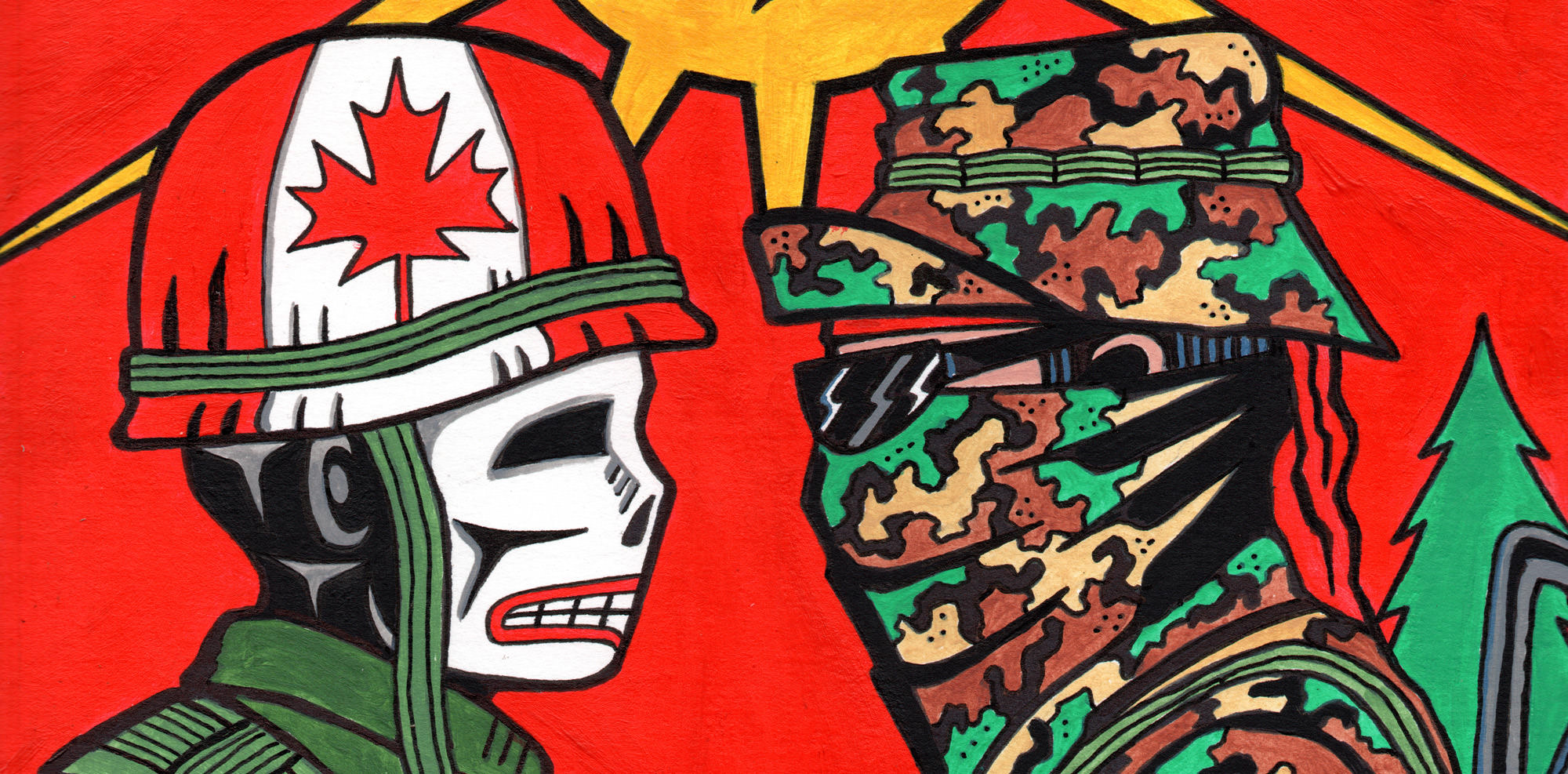
Gord Hill is an anarchist artist and member of the Kwakwaka‘awakw Nation who has been active in anti-colonial and anti-capitalist struggles for decades. Over the years, his art and criticism have become a source for us to draw inspiration from but also help us question ourselves. Gord is the author of two comic books, Five Centuries of Indigenous Resistance (comic) and Anticapitalist Resistance, as well as 500 Years of Indigenous Resistance. He also runs the homepage Warrior Publications. He also draws and writes under the pseudonym Zig Zag.
CrimethInc: It is clear that there have always been overlaps between art and resistance, but we would like to hear from you about how you see these overlaps in yourself and where they can be found in today's society.
Gord Hill: I think art is an important part of resistance in that it contributes to the development of a general culture of resistance. Art inspires, educates, motivates and at the same time helps to maintain a history of resistance.
Thanks to modern communication media - with new forms of expression such as memes and GIFs - art today perhaps plays an even greater role in social movements, although I have to say that these new forms seem more fleeting than classic art forms such as posters, banners, t-shirts, etc.
My main focus is the visual arts, but I think it is important to also recognize the strength of other media - such as literature and music - which all play their part in building and sustaining a culture of resistance.
Are the aesthetic choices you make in your works political per se?
In some cases yes, because I consciously use images that - I hope - have an empowering or inspiring effect. I also often work with iconic images of specific actions or events. Images that people are already familiar with and that help to breathe originality into my works of art.
Another example is sayings on banners that convey a message, especially in comics where I have very limited space for text. I also very consciously use images to “normalize” militant actions, for example when I draw masked people who are part of a rally or protest.
Are there other artists or traditions from which you have drawn political or aesthetic inspiration?
Sure... there are a few artists who have inspired me, including Louis Karoniaktajeh Hall (the Mohawk artist who designed the Warrior's Flag and wrote The Warrior's Handbook), Art Wilson (a Gitxsan artist who draws on traditional Northwest Coast art forms to depict current struggles in his book of published prints entitled Heartbeat of the Earth: A First Nations Artist Records Injustice and Resistance), Joe Sacco (who created the Palestine comics ), and also more traditional Indigenous artists, including Tony Hunt (Kwakwaka'wakw) and Mark Henderson (Kwakwaka'wakw).
Old school comic artists who have inspired me include Jack Kirby, Alex Toth, Berni Wrightson, Alex Nino and Frank Frazetta.
As an artist and historian, can you speak about the differences between written history and oral tradition and how the use of imagery might interact with these processes?
Written history is useful to historians because it provides dates, names, and places that are helpful in understanding chronological history. From these chronologies we can, for example, understand the process of colonization or the expansion of an empire.
The European states did not appear out of nowhere, but were the result of a long history of Roman colonization and centuries of war between feudal kingdoms that emerged after the collapse of the Roman Empire. This story - much of it recorded by contemporary witnesses - is helpful for us to understand how the world we live in today was created. The oral history of indigenous people was described as a world of legends or in fantasy images. But today we know that events told in oral history are actually real facts that happened.
For example, there are widespread oral histories of an 18th-century earthquake and tsunami along the northwest coast, which scientists now know to have actually occurred and which resulted in significant destruction in many villages. The oral history of this event portrays it as the result of the actions of spiritual forces. Until scholars linked the stories to current events, they were generally dismissed as myths.
In the context of oral history, it can be said that indigenous people had many ways of telling these stories: using images such as pictographs, paintings, beadwork and carving. Songs and dances were another way of passing on oral history.
Today there are examples of oral history that are still used, including poetry and hip hop. Even videos with interviews and testimonials can be understood as oral history.
I believe that comics represent a good “middle ground”. They combine written history with graphic representations.
Where do you see overlaps between indigenous and anarchist struggles?
I would say they meet in resistance against the state and capital, which is understood by indigenous people as anti-colonial or anti-capitalist resistance. And it may be that the anti-capitalist concept is less pronounced than the anti-colonial one... I think this is perhaps the biggest overlap, but there are also concepts such as anti-authoritarian or egalitarian forms of organization. And although this varies in degree by indigenous nation, overall (with few exceptions) it is a significant part of our traditional culture.
What can non-indigenous anarchists learn from indigenous struggles and how can they support them?
By knowing the history of European colonialism and taking this into account in their analyzes and actions.
What movements from the past have you learned the most from?
I would say definitely from the '68 generation: the American Indian and Red Power Movements, the Black Panthers as well as the black civil rights struggles of the 1950s to 1960s, the Zapatistas. I was also inspired by the autonomous movements in Europe and learned particularly much from those in Italy and West Germany.
Have you ever been torn between your role as an artist and your responsibility for other forms of political resistance? If so, how did you resolve this dilemma?
No, I have never been torn between being an artist and other forms of political resistance… Everything is part of a variety of strategies, and I believe that propaganda is a central part of resistance movements and the building of resistant cultures. However, I am also convinced that people who are active in art, writing or other forms of propaganda have to be part of a specific movement if they do not want to lose contact with what is happening and with current developments.
The topic of political strategies has repeatedly occupied you over the years. Do you feel there are similarities in the debates in Indigenous contexts and in non-Indigenous circles? Have you noticed any changes in these discussions over the years?
In some respects, the strategy discussions are quite similar. For example, in some parts of the indigenous movements there are discussions about wearing masks and carrying out illegal direct actions. There are discussions about militancy, the maintenance of blockades and occupations, questions of security and counter-surveillance. I don't think these discussions have changed over the years since, say, the Oka crisis of 1990. Instead, they appear at some point and then disappear again depending on the state of the movement. There have been changes particularly in relation to the topic of internet security and the use of social media such as Facebook. The latter medium in particular is used a lot, but also by the cops for investigation purposes and to bring charges.
The fight against the Dakota Access Pipeline (NoDAPL) at Standing Rock is arguably the most high-profile fight for Indigenous sovereignty we have seen in recent memory. Do you think there are important theoretical or strategic lessons from the way this fight played out?
Yes, I would argue the NoDAPL campaign was very important for a variety of reasons. While there have been a number of anti-pipeline campaigns in Canada - and in British Columbia in particular - this was the first fight against a proposed pipeline to take place at the time construction began. In Canada, the planned Enbridge Northern Gateway Pipeline was ultimately abandoned at the planning stage after several years of indigenous resistance. And the natural gas pipeline that was planned through Unis'tot'en-Land was ultimately not supposed to be built there. That's why the NoDAPL campaign was the first to actively prevent the construction of a pipeline.
I believe that the NoDAPL campaign was very important, particularly for Natives in the US, and I am sure thousands of Native youth were radicalized to some degree during its participation.
Ultimately, however, the NoDAPL campaign failed. I would suspect this happened for several reasons. The main reason was that the resistance - despite some militant actions - mainly consisted of "non-violent resistance" and pacifist forms of action.
In addition to the lack of experience on the part of members of the Standing Rock Reservation, it was primarily NGO staff who dominated the strategy discussions and prevented any attempt to find an action consensus based on a variety of tactics.
As a counterexample, I would like to point to the resistance organized by the Mi'kmaq in New Brunswick in 2013 against preparatory work for fracking processes. They didn't have thousands of people gathering together. They had no celebrities attending. And they didn't have tens of thousands of dollars to spend. They mobilized their community and after a brief attempt at non-violent civil disobedience, they organized more militant things, including sabotage actions and road blockades.
Their main blockade was cleared by police in October 2013, resulting in six police vehicles being torched. They then increasingly used mobile blockades made of burning tires to disrupt the preparatory work. Ultimately, SWN Resources pulled out before completing the work. And the following year, a regional election was held in which the pro-fracking faction was voted out in what was widely seen as a referendum on fracking.
The new government issued a moratorium on fracking. And although they were far fewer in number and had far fewer resources than at Standing Rock, the Mi'kmaq still prevailed.
There are many lessons to be learned from comparing these two campaigns and I would even warn against repeating the example of Standing Rock, because it was ultimately defeated.
Translation: madalton and jt / Published in Gai Dao 9/17
A Video and Poster Campaign to Counter ICE Recruitment
A New Full-Length Record from an Uncompromising Hardcore Band
Read the full story at the source →
Source: CrimethInc.