
Germany · CrimethInc. · 1970-01-01
A History of Contemporary Israeli Anarchism
Deutsch (original) · Auto-translated to English
In conversation with us, an anonymous person traces the history and development of contemporary Israeli anarchism from its origins through the punk and animal liberation movements to a critical analysis of the career of Anarchists Against the Wall. Finally, she_he reflects on the function of nonviolence rhetoric in relation to Israel and Palestine. We strongly recommend this interview to anyone interested in the conflict between Palestine and Israel or in the strategic challenges of creating an anarchist opposition under adverse circumstances.
Is there a continuity between today's Israeli anarchist movement and the anarchist currents that preceded the countercultural wave of the early 1990s?
Unfortunately not at all. Maybe that's not such a bad thing after all.
Over the previous hundred years, Israeli anarchists have been involved in some successful endeavors, but always at a high price: the subjugation of the political to the social, which was essentially BuberSpeak for attempting to build new worlds around the existing one rather than on its smoldering ashes. The kibbutzim (Jewish socialist agricultural settlements) serve as a cautionary example, if such an example is needed, of how anarchists become handmaidens of authoritarian projects through timid collaborations based on a “temporary” compromise of our confrontational and political rejection of hierarchy.
As strange as it may sound today, many secular European Jews at the turn of the last century saw a tacit connection between Zionism and anarchism. Living in ghettos and excluded from the national ethos of their own countries, they were drawn to tendencies that - in their personal lives, if not in the eyes of history - offered opposing magnetic poles with which to fight back: anarchism, Marxism and Zionism. Ironically, as documented by anarchist writers in Russia, large sections of the people in the Jewish ghettos considered Zionism to be the craziest and most utopian of the three movements.
The old anarchists' attachment to their Jewish identity made it possible for them to integrate their umanità nova, their vision of a new humanity, into Zionism's vision of a new Jewishness, as "muscle Jews" of Israel to replace frightened ghetto residents, which could be seen as a precursor to modern identity politics. On the ground, this displacement was reflected, among other things, in the fact that the egalitarian kibbutzim communities were rapidly transformed into strategic colonial instruments of an emerging state that wanted to drive the local population from the land.
Given this background, it is not surprising that the first vinyl release of the first Israeli anarchist hardcore band in 1994 was simply called “Renounce Judaism”.
With the founding of a Jewish state, the anarchists of Worker Zionism discovered that the operation was successful and the person treated had died. Much like their comrades in the October Revolution, the Chinese May Fourth Movement, and that of Madero's Mexican uprising, and perhaps the Occupy movement of yesterday, their only reward was that they participated as forgotten actors in the birth of an entity they considered irrelevant.
The end of the Second World War and the subsequent immigration of additional European Jews, including some anarchists, into the newly founded Israeli state increased the tension between the political and the social, between freely chosen and innate identities, between “anarchist” and “Jewish” - a tension that is, of course, nowhere more critical than within the confines of a Jewish archos.
Coming from the Polish ghettos, they proved unwilling or unable to extricate the ghetto from their own émigré selves, and instead of defiantly raising the black flag, they isolated themselves. They organized themselves into historical societies, cultural associations, philosophical discussion circles, literary study groups and communicated primarily in Yiddish, a choice strangely reminiscent of that other closed, black-clad Jewish milieu that turned its back on society, the Orthodox Hasidic Jews, and in stark contrast to the earlier anarchists of the kibbutzim who spoke Hebrew. In the 50s and 60s there was the Freedom Seekers Association, the main anarchist group in Israel. It published a bilingual monthly magazine called Problems, maintained a library of classic anarchist literature (mainly in Yiddish and Polish), and maintained a large hall in central Tel Aviv that attracted hundreds of participants to innocuous conferences where anarchy and Hasidic parables were theorized to death.
Of course, the introverted, self-contained cultural events came at the expense of agitation, public relations and organization, which reminds us all too well of certain punk rock scenes. There doesn't even seem to have been an attempt to build a political anarchist movement at the time.
An anecdote from that time illustrates it perfectly: a Shin Bet agent (the Israeli domestic secret service) came to an anarchist meeting one day. “I heard that you were discussing the possible consequences of an assassination attempt on the prime minister,” he said worriedly.
"Yes, we did," they replied, "but we were talking about the Polish Prime Minister. The agent left and they were never bothered again.
I should note that not everything was so calm on the Middle East front at that time. For example, the famous sailors' strike, the most radical and violent in Israel's history, which paralyzed the country's only commercial port for 40 days, took place in 1951. Incidentally, it was led by a young sailor whose grandson would become one of the most important organizers of Israeli anarchism from the 1990s. In 1962 there were a series of wildcat strikes due to the devaluation of the Israeli pound. Throughout all of this, there was also serious unrest against ethnic discrimination, led by Jews from Middle Eastern and North African countries living in Ma'abarot, the refugee reception camps. In 1949, an angry mob smashed the windows of the makeshift Israeli parliament building and ripped the doors off their hinges. A year later, a leader of similar protests by Yemeni Jews became the first citizen to be killed by an Israeli police bullet. Not to mention the various forms of resistance that Palestinian Arabs were involved in at the time.
As far as I know, there was no involvement or material support from the Israeli exile anarchists, who seemed to have more to do with the Yiddish workers' struggles in New York's Lower East Side than with those of their new surroundings.
Aside from Zionism and Judaism, another key issue on which the anarchists of the 1990s broke with the old guard was our blasphemous attitude towards the IDF, the Israeli “defense” forces. The anarcho-syndicalist American painter Sam Dolgoff, who visited Israel in the early 1970s, summarized the prevailing attitudes of the elders (and apparently his own) as follows:
"...The Israeli comrades are forced to accept the fact that Israel must be defended. [...] In discussions with Israeli anarchists, it was emphasized that the unilateral destruction of the Israeli state would not be anarchist at all. On the contrary, it would only strengthen the immense power of the Arab states and even accelerate their plans to conquer Israel. [...] the necessity of defending Israel, which is of course recognized by our comrades, depends on the indispensable military, “The economic, legislative and social measures necessary to keep Israel in a constant state of preparation for war are to be taken. Israeli anarchists […] know only too well that curtailing the power of the state is not a real alternative in such circumstances.”
When an anarch@punk collective sparked controversy in 1996 with an anti-IDF edition of their fanzine “War of Words,” they were harshly criticized by Joseph Luden, the late editor of the aforementioned “Problems” and author of the book “A Short History of the Anarchist Idea.” He expressed deep disappointment and insisted the armed forces were “not the enemy”. To us, this showed that the primal Jewish fear of the pogrom, of Rome, of the Crusaders or the Cossacks, of the Arabs waiting to rob us in our sleep, is strong enough to cloud the judgment of even lifelong anarchists, like other cultural poisons that we absorb with our mother's milk and never quite get out of our system.
Of course, attacks on the existence of the military apparatus itself - and not just its presence - have become a more common feature of Israeli radicalism since the Palestinian death toll has reached dizzying heights. Virtually all of our fellow radicals at the time, unless they were preoccupied with topics such as the then popular and extremely safe topic of “religious coercion,” made an adamant distinction between military deployment within the Green Line (Israel's de facto borders), which they viewed as a moral obligation, and the deployment of troops outside that line in the occupied Palestinian territories, which, in their opinion, we should strategically reject and also go to prison for fighting against. Even anti-Zionist, Trotskyist factions and offshoots, essentially in the same boat as us, encouraged their people to join the army, albeit with the aim of establishing better contact with average Israelis.
The generation of Israeli anarchists of the 1990s was able to create something completely new, and that's what we did. At first glance, one might diagnose it as oppositional defiance or revolution for fun: a collective finger directed at the army with no plan, analysis or concept to replace it. Of course, “serious” revolutionaries disapproved of this. But in retrospect, I think that singling out militarism showed good instinct, a keen sense of the changing nature of an important battlefield, a battlefield that was and is extremely important in both symbolic and practical terms.
It also showed that we knew enough to trust our immediate experiences and let them guide our decisions. We were all at an age when the state's attempt to force us into Israeli military service and the scars we had suffered in that battle were still fresh.
To be clear, I do not want to appear overly critical of the older generations of Israeli anarchists. They were extremely good at many things, just not particularly good at being anarchists, or rather, being anarchist, at identifying and prioritizing the projects that are exclusive to anarchist thought and that no one else can offer. In a country where not long ago all political groups - left, right and center - started out as radical subversives, perhaps "anarchist" should mean rebel rather than revolutionary. Still, I have a lot of respect for the old school.
How did Israeli anarchism emerge with or emerge from the countercultural surge of the early 1990s? What characteristics from this period did he retain? What are their advantages and disadvantages?
Although I myself was involved in both the anarchism of the 90s and the Israeli counterculture of the time, I am not sure whether modern Israeli anarchism emerged from the punk explosion, as was the case in other countries during that decade, or whether both were equally children of the zeitgeist.
I think we should leave this to the social historians, or perhaps the physicists, because Newton's third law clearly states that all forces are interactions between different bodies.
Speaking of physics: If nature really hates the vacuum, then it must have been pretty mad at us in the 90s. The first Palestinian intifada had lost momentum and direction after three long years and essentially ended with the Madrid Conference in 1991 (although officially only with the Oslo Accords in 1993). This period, leading up to the assassination of Prime Minister Yitzhak Rabin at the end of 1995 and the right-wing election victory six months later, was marked by a strong feeling of euphoria and optimism on the left: the uplifting feeling that peace, always elusive, was now within reach, just a treaty away. The radicals - including the anarchists, with the exception of one person, if I remember our meetings correctly, were completely absorbed by the so-called peace process and accepted it as the only possible path.
There were two reasons for this. For one thing, Fatah's resistance to the trial had collapsed and Palestinian society seemed to fully accept it, so we were hesitant to seem more "Catholic than the Pope." Second, the right's bitter opposition led us to believe that it would be a largely positive process. Lesson learned: Never choose a political path based on who opposes it.
However, our clouded judgment also gave us a ray of hope elsewhere. As peace slipped a few places down the list of most pressing issues, other issues moved up, and unknown concepts were sucked into the vacuum, revealing new ways to solve old problems. And because people are not one-dimensional, the political changes went hand in hand with cultural ones: radical ecology and animal liberation, for example, which were previously unknown, appeared alongside a new counterculture of noise, zines, street art, international contacts, do-it-yourself ethics, shared apartments, information shops, independent media, cross-issue alliances and activist practices. Anarchy, explicit or implicit, but always allied, was at the center.
Punk is a good reference point, although this countercultural wave was aesthetically more diverse and broader. Contrary to what many assume, the influence of punk was already felt in the Israeli subculture of the late 1970s. In the 80s, Israeli punk bands formed, gave concerts and released demo tapes. The concept of a “scene” as a social unit did not yet exist at that time. Punk remained outside of cultural identity, and so punks remained atomized and fragmented, bound together primarily by that very separation that, I suspect, was part of how they thought punk should "feel."
There were also a handful of anarchists in the 70s and 80s, something I only touched on when answering the previous question, but they failed to move beyond their characterization as isolated outsiders. In fact, this characterization was mostly self-imposed. For example, in 1973, on the eve of the Yom Kippur War, a three-person commune calling itself The Black Front - Freaky Anarchist Group released a humorous, one-off publication with strong influences from R. Crumb-, Freaky, while in the 80s three Israeli-Palestinian brothers NILAHEM "Youth for Liberty and Struggle", a small anarchist group in the northern city of Haifa founded. One of these brothers, our compañero Juliano Mer-Khamis, was murdered by a masked gunman in the Jenin refugee camp last year.
1973 Black Front, Freaky Anarchist Group release.
It was only in the 1990s that there was a conscious effort to expand anarchist practice by pushing it further in the direction of group—>organization—>network—>movement. In a heartwarming case of quantum wishful thinking - or was it an attempt to confuse the enemy? - the main anarchist group of the early 1990s had no formal name and simply called itself the “Anarchist Movement”.
Like a chiasmus in real life, the punk of the 90s borrowed from the anarchists the autonomous self-organization, the do-it-yourself scene, while the anarchists of the 90s adopted from the punk the chromosome of expansion, of spreading through a cultural sense of urgency. With a logic like “Build your dreams and the people will come,” everyone cured each other of their respective delusions of smallness. And of course they reinforced each other's idea that people shouldn't give a damn about rules.
The question of what characteristics today's Israeli anarchism has retained from the 1990s is interesting, but a more pressing question would be what characteristics it has lost. In four words: the element of surprise.
In the early 90s we tried our best to avoid becoming “radical left,” trapped on this or that edge of the political spectrum where we could only end up in the middle; instead, we didn't fit in there. Our natural habitat may have been the left, the progressives, the “bleeding hearts,” the peace camp, but we moved within it like some kind of new and wild exotic animal. We were composed of post-leftists and ex-leftists, but we all agreed that we did not want to reduce anarchy to the conjugation of a leftist verb. Some pigeonholed us as a different kind of communist, while others understood our unconventionality to mean that we had nothing relevant to offer to those who ultimately saw their lives as conventional. But many people, especially young people, were fascinated and open to new messages. That changed again in the 2000s.
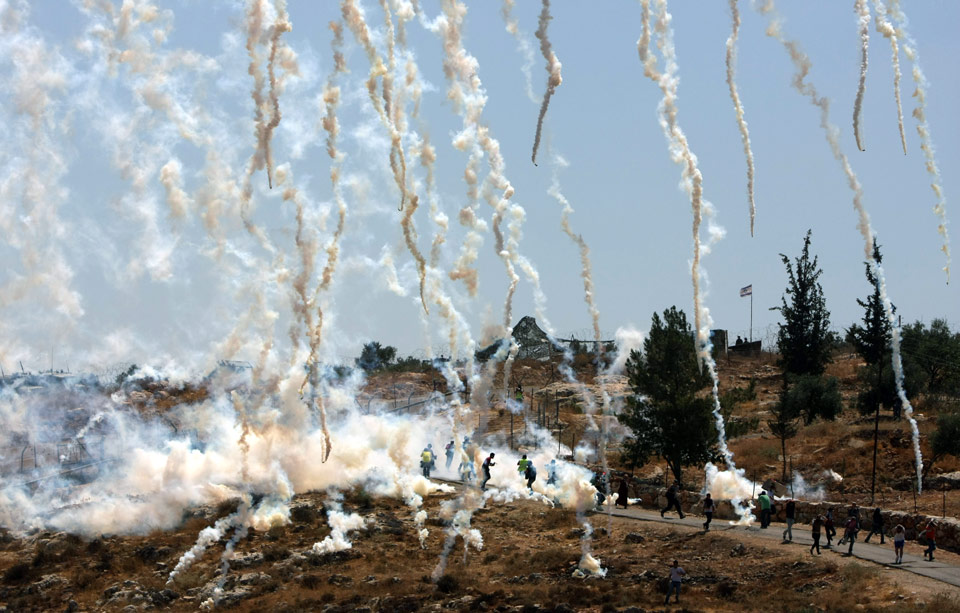
Around 2003, during the ebb of the second intifada - one might say parallel, but at the bottom - a struggle against the Israeli wall broke out that can be seen as a kind of other, third intifada. It began - and still rages - in a handful of small West Bank villages whose lands were confiscated, either to build the wall or to fatten the ever-growing Jewish settlements. Almost immediately, Israeli anarchists realized that our position as Israelis, coupled with our particular brand of confrontational practice, could make an important contribution, and so Anarchists Against the Wall was born.
It was a calculated game. In many ways it was worth it, but the extreme intensity of this particular battle made it foreseeable and inevitable that all other areas of our politics would be eclipsed by it, and that is exactly what happened. Soon, “anarchist” became synonymous with one thing and one thing only - Palestinian - through a polarizing dynamic we knew we couldn't escape. The possibility of engaging with the state in a violent, bloody and charged conflict, and not in an ideal environment for anti-nationalists, came at the expense of our effectiveness in virtually all other areas. We were, if you will, forced to choose between an attractive prospect for the Israeli public and a threatening one for the Israeli state; We were unable to reconcile both.
The back cover of issue 4 of the first Israeli punk fanzine, Necrophilia for Youth, published in 1994; the text reads “No Government Can Offer You Liberty”.
Cover front page of issue 4 of the newspaper The War of Words, published in 1996 by the Isra-hell collective and reporting on punk, animal liberation and conscientious objection; The banner reads “No surrender to political terror.”
In addition to Anarchists Against the Wall, what other initiatives emerged during this time? For example, describe the origins and history of today's animal liberation movement in Israel.
I think the most interesting part of the Israeli animal liberation movement, and certainly the most relevant to radicals, is its beginnings. I don't want to overstate it, but it was one of the few real structural anarchist conspiracies that I know of in the last 140 years, and a prescient one at that. And it worked, perhaps too well.
When I talk about real anarchist conspiracies, I am of course cautious, because law enforcement tends to conjure up false conspiracies, be it in Bologna, Moscow, Cleveland or the French village of Tarnac. But this was a conspiracy of a completely different kind.
The concept of animal liberation emerged late in Israel, in the early 1990s, by anarchists. There had been an anti-animal testing society since '83, but it was trapped in the scientific perspective and was afraid to draw further conclusions from its own ethical concerns. To show how late things got going here: the first Hebrew book on animal testing appeared in '91, the first law even mentioning the subject was passed in '94, and a translation of Peter Singer's Animal Liberation didn't appear until '98.
As mentioned, in the early 1990s new perspectives took precedence over Palestine-focused policies, a trend that reversed quite sharply at the start of the new millennium. Because we anarchists have left no stone unturned to find new ways to increase our influence on society, some have concluded that it would be more effective to present anarchism through the prism of a single issue rather than promoting it as a package. And so began constant discussions, formal and informal, in sun-drenched public parks as well as in poorly guarded high school dormitories at midnight, all centered on a single question: What topic could provide the most robust door opener through which to spread the widest range of radical ideas?
Some made brief tactical forays into the terrain of nuclear disarmament, Israel's taboo state secrets, and social ecology with the group Green Action, but ultimately it became clear to us that a new and unspoiled lump of clay was needed. And nothing was more suitable than the previously unknown, seemingly safe concept of fighting for seals or elephants; fur shops and circuses were the first two major topics of local animal liberation campaigns.
This shift in focus was conscious and intentional, but should not be seen as a manipulative ploy or cynical “The Man Who Was Thursday” posturing. Tactical considerations aside, we were actually genuinely passionate about ending non-human suffering, the other motives were an added bonus, the realization that of all the various injustices we could organize against at that time and place, animal exploitation happened to be the most appropriate.
Our first group was simply called Anonymous, a strange, somewhat dark name for an animal rights organization, unless you consider that it was some kind of anarchist front. In addition to the goal of radicalizing young animal lovers who might join her, she had another, more practical goal: recruiting people for the Animal Liberation Front's secret activities. Anonymous's small headquarters, filled to the brim with information about various radical struggles, non-human and human, was also the nightly meeting point for almost all ALF activity in Tel Aviv during this period; it was even conveniently located on Ben Yehuda Street, the same street where most of the city's furriers were based! According to interrogators at the neighboring Dizengoff police station, it was at least Anonymous activists who introduced Israeli shopkeepers (and police officers) to the superglue locks.
Today, Anonymous for Animal Rights, as the organization now calls itself, is the Israeli equivalent of PETA, the largest and best-known mainstream organization in the field, with lobbyists and reform-oriented consumer campaigns. This was the result of a gradual influx of activists who were not privy to the original plan, people whose entire spectrum really began and ended with animal rights. Once enough of them were in the core group, the inevitable power struggles and infighting began, leading the anarchists to accept that their work was done - the wooden dummy had become a real boy. It was time to take a different approach.
Of course, it is not a sustainable strategy for radical activists to work both above and underground at the same time, to say the least. But as these years have shown, it is possible if the group is small enough, knows its coordinates and reads the political map carefully. Then it also has its advantages: At some point in the middle of this time, for example, I distributed self-made stickers that called for shooting Jewish settlers in the head and were signed with a circled A. The largest Israeli newspaper at the time made the mistake of reporting that the symbol stood for Anonymous, so of course we sued them for libel and settled out of court for a hefty sum that continued to fund our political activities for a while. Who says you can only wear one hat at a time, right?
A final point regarding development is the elegant dance of cyclical synergy between anarchism and animal liberation. I'm not sure how well known this is outside Israel, but just as the animal liberation movement was conceived by anarchists, Anarchists Against the Wall was in turn conceived by animal liberation activists, two waves of carriers in small congruent circles that would fit well into the dialectical materialism of scientific socialists, if by "scientific" we mean chaos theory.
One Struggle was a veganarchist group founded around 2002 by some of the people who left Anonymous in the aforementioned split. Although her stated goal was to carry out anti-speciesist agitation from an anti-authoritarian perspective, she was particularly successful in bringing anti-speciesist perspectives into the anti-authoritarian agitation.
In late 2003, One Struggle activists joined Palestinians in an attempt to dismantle one of the separation wall gates near the West Bank village of Mas'ha, four miles from the Green Line. As with previous One Struggle campaigns, the accompanying press release was signed with a fictitious name chosen at random at the last minute: in this case “Anarchists Against the Wall.” Israeli soldiers responded during the operation, which was successful, by using live ammunition and seriously injuring an activist; It was the first time ever that the Israeli army opened fire on Jewish citizens. In the heat of the ensuing media frenzy, the name “Anarchists against the Wall” (sometimes referred to as “Anarchists against Barriers”) became indelible in the public consciousness. A few years later, when One Struggle had fulfilled its historic role, it disbanded, but AAtW continued with full force.
Comrades who visit Israel are often surprised at how widespread anti-speciesist discourse is among local anarchists. In fact, even Israeli radicals of the non-anarchist variety took a few good years to adapt. For example, when Ta'ayush (a radical Israeli organization) tried to organize the reconstruction of the laying batteries destroyed by Israeli soldiers in the village of Hirbet Jbara, this was met with fierce resistance from anarchists; The same thing happened when Gush Shalom organized an action in solidarity with the fishermen in the Gaza Strip. The historical context for this was highlighted in the previous sections.
What dynamics existed between these campaigns and the anarchists against the wall as they began to dominate Israeli anarchism?
When talking about today's Israeli anarchists, it is important to note that we are not talking about thousands or hundreds of people, but dozens. Terms such as “movement”, “characteristics”, “dynamics” or “currents” should therefore be scaled down to an almost intrapersonal size. Honestly, two roommates and a small wireless router can become an anarchist movement here, for better or worse.
As to the question: As I have already lamented - and despite its crucial contributions, AAtW has written us back into the binary left/right code that defines and limits Israel's political spectrum, the same spectrum that we had tried to escape a decade before. We have been “far left” ever since, and unsurprisingly this has limited our scope for action in other areas. Additionally, this binarization was swallowed and internalized, slowing down our political metabolism as we increasingly rejected everything and everyone whose name was not clearly pronounced in the language of the left/right, Zionism/Intifada dichotomy. One Struggle was also a good example of this at times, as was Black Laundry, an anarchist LGBTQ group that around the same time began protesting against gay pride events under the slogan “There is no pride in the occupation.”
For example, as AAtW gained momentum, simply participating in radical queer actions without mentioning the occupation became “pinkwashing.” When the 9th International Queeruption Meeting, held in Tel Aviv in 2006, coincided with Israel's heaviest bombing of Lebanon in 24 years - also known as the Second Lebanon War - and the annual WorldPride events that were scheduled to take place in Jerusalem (but were later canceled), tensions flared at an anti-homophobia and anti-militarism demonstration in Jerusalem; You can read more about this in the Queeruption Fanzine, especially about the debate “You Can Call Me Gay”/”You Can Call Me An Anarchist”.
In general, I felt that the failure to explicitly and relentlessly link everything to the Palestinian question was seen as a sin of omission, as if all other struggles had lost their intrinsic value. In a sense, this was a repeat of the mistakes made by the New Left in all its Marxist-Leninist glory when it relegated every struggle except third world and black liberation to secondary status. However, unlike the radicals of the 1960s, we did not pretend to follow scientific social analysis, so our strict prioritization was informal and rarely articulated or even acknowledged, a result of group dynamics and political definitions in which action meant re-action. If people always react instead of initiating, there is of course a higher risk of reflecting the state's priorities instead of their own heart's desires.
The willingness to combine struggles and to reconcile them is still widespread among us. The social justice tent protests that swept Israel in the summer of 2011 were a local version of the Occupy movement, largely inspired by the Arab Spring. The anarchists who took part in them had as their sole goal the advancement of the national Palestinian cause and were willfully blind to the countless other possibilities that the protests opened up for us. While tens of thousands of ordinary people marched through the heart of the white city of Tel Aviv with a broad, high banner that read “When the government is against the people, the people are against the government,” the anarchists limited themselves to waving anti-occupation posters from the sidelines and conveying the message that nothing, not even genuine popular protest, has any value unless it carries the West Bank and Gaza Strip around it like strangler snakes. Things were no different for the anarchists during the social justice protests in 2012.
Attempts to identify this tendency and thereby recognize AAtW as a manifestation of a refined political prioritization usually resulted in emotional and personalized representations that showed, at best, half of reality. It is true that these times were very trying for us personally and that the Palestinian struggle, then as now, is fraught with highly charged situations that burn so strongly that they obscure almost everything else if you let them. But there is also a more abstract, mental component at play.
Anarchists often use theoretical frameworks that make everything seem intertwined and equally important in order to avoid putting their priorities on struggles and issues on the table. Since we reject both formulas and hierarchies - not to mention formulaic hierarchies! - we tend towards integrative, circumscriptive political perspectives in which the constant affirmation of commonalities trumps the notorious need of revolutionaries to identify a main problem, a main contradiction. Despite our intentional vagueness, we all set priorities in our struggles, only our self-knowledge differs. As with hypocrisy, the only sure way to avoid this is to sit at home and do nothing. So the important question is not whether we prioritize fights, but rather what criteria we use to do so. Geography? Story? Moral? Mass psychology? And how do we conceptualize such prioritization - which is by definition a process of stratification - in order to make it compatible with concrete, everyday anarchist politics?
It seems to me that the wrong way to do it is the inertia of letting things go as they do from the start. Like structures, priorities are most dangerous when they are invisible. And that takes us back to the example of Anarchists Against the Wall.
“Return Serve,” a photo by Hamde Abu Rahma, from a 2013 art exhibition benefiting Anarchists Against the Wall.
AAtW owe the strength of its tactical diction - I would say, its very existence - to the unspoken idea that the Palestinian question crystallizes the general crisis of Israeli society, that this national conflict is the main seismic fault line. As far as I know and can remember, there was no concerted effort on our part to step back and question the reasoning that anointed this idea as self-evident truth. From what perspective does the general crisis emerge in this question? From what perspective is this question the most important seismic fault line?
We know that politicians, their media and the phantasm they call “the mainstream” all cling to this idea and work diligently to enforce it, even though its criteria are rarely ever discussed objectively. It cannot be the number of deaths when, for example, more than a thousand Israelis die every year as a result of environmental pollution, and car accidents have claimed more lives in the entire period of the country's existence than all wars combined; it cannot be the extent of the suffering inflicted, if that can be meaningfully quantified, when nearly 200,000 Israeli women* are abused each year. No, the question we should ask ourselves instead is simple yet profound: cui bono? Who benefits most from our acceptance of armed, territorial conflict along ethnic, religious and national lines as the center of political gravity?
I assume that most anarchists don't need to be shown the answer.
And yet the political priorities that AAtW embodies remain essentially the same as those propagated by the Israeli state, its media, etc. Very few Israeli anarchists in the last decade have rejected these priorities in favor of economic, feminist, migrant, environmental, gender or non-human struggles, to name just a few alternatives.
In the adrenaline rush of becoming an opposition, we should have been more careful not to lose the qualities that also make us a complete, well-rounded alternative. In many ways, circumstances and a lack of analysis have resulted in AAtW becoming an inverted or fractured reflection of the state's position, rather than reflecting something completely different. This explains why it is so natural for us to work with even the most racist, misogynistic, homophobic and intolerant religious zealots that the Palestinian resistance has to offer. The philosopher was right when he warned us not to look into the abyss and emphasized that everything that is unconditional is a pathology - solidarity included.
I readily admit that this whole discussion about prioritizing struggles, even prioritizing struggles itself, only serves to remind us of what matters least in life: political reductionism. Since the need to set priorities is inversely related to the number of activists and available resources, anarchists in countries with larger movements cannot understand these problems.
What role has the rhetoric of nonviolence played in Anarchists Against the Wall and in the Palestinian-Israeli conflict more generally?
The rhetoric of nonviolence works - or rather, it doesn't work - the same way around the world, so there's probably no need to delve into the universal flaws of it all. In the case of the Palestinian resistance and the AAtW, however, the story has taken a turn: it is no longer just about non-violence versus violence, but about the rhetoric of non-violence, which is used primarily by external forces to muddy the waters and obscure the violent aspect of the Palestinian resistance, not just its legitimacy or its scope or its successes, but its very existence, its definition as such.
Although this question probably refers to nonviolence as a tactical approach and not to its absolutist, theosophical variant, pacifism, for the sake of clarity we should start with the latter.
It probably won't come as a shock to learn that pacifists have not played a significant role in this region since around the time of the Essenes. On the Palestinian side, Muslim people who advocate pacifism come exclusively from a very specific Islamic context: the Sufi tradition or the mystical tradition (yes, like Hakim Bey). However, Sufism was long ago pushed to the margins of Palestinian society by Salafist/Wahhabi Islam, and over the course of the 20th century its sphere of influence here has been reduced to a few forgotten highland tombs and mountain shrines scattered across the landscape. Some Palestinian Christians, who make up about 3% of the people living under occupation, are also known for preaching pacifism, but always heavily watered down and ultimately overshadowed by tactical arguments. More on that later.
As for the Israeli side, over the last three decades, starting with the 1982 Lebanon War, hundreds of people have been imprisoned for refusing military service (the standard sentence is 28 days) but to my knowledge only one person has cited genuine pacifism as a motivation; it was, somewhat unexpectedly, the nephew of Prime Minister Benjamin Netanyahu. In general, conscientious objectors - or “refusniks” as they are called here - can be divided into two categories. The more conventional conscientious objectors, characterized by the organizations Yesh Gvul and Courage to Refuse, are older reservists and officers who advocate selective refusal of service in the occupied territories, but strongly identify with and maintain militaristic and nationalist discourses, even believing that it is precisely this fervent patriotism that legitimizes their critical voice. Younger activists, represented by the organizations New Profile and Shministim (literally “twelfth graders”), view any military position in the army as a direct or indirect continuation of the occupation and reject the prevailing Zionist narratives, militarism and male chauvinism due to a more radical and comprehensive criticism. New Profile is explicitly feminist, in contrast to Yesh Gvul and Courage to Refuse, whose members are almost exclusively male. Neither group shows any clear pacifist traits.
Aside from conscientious objectors or pacifist morals, things get a little more complicated when it comes to nonviolence as a strategy. Here too I would like to start with the Palestinian side.
Like most other national liberation fighters, the Palestinians have used a wide range of nonviolent tactics against the invading Zionist movement, even before the founding of Israel, when all were still under Ottoman and British rule. In the 1930s, for example, local trade came to a standstill for six months due to general strikes against the coercive British government.
The first intifada produced some of the most memorable examples of Palestinian nonviolence. In the Christian Palestinian city of Beit Sahour, for example, a tax revolt against Israeli occupation led to the entire city being under siege for 44 days, ending with Israeli soldiers entering and “seizing” (looting) $2 million worth of goods from stores. But even during the Second Intifada, a predominantly violent and militarized uprising made famous by Qassam rockets and suicide bombings, there were numerous boycotts, vigils, hunger strikes, mass demonstrations, protests and marches, many of them following the almost daily funeral processions, all examples of nonviolent resistance that went largely unnoticed in Israel and the West. Unnoticed, that is, until the fight against the apartheid wall took shape and involved both Western and Israeli activists.
However, and I cannot emphasize enough the importance of understanding this, the Palestinian definition of nonviolence - often within the broader and unique Palestinian concept of sumoud (steadfast persistence) - bears only a passing resemblance to the nonviolence fetishized by the liberal "peace police" types one encounters in the West. The two definitions are as far apart as the everyday realities in which the two groups live and fight.
First and foremost, Palestinian nonviolence has nothing to do with “moral superiority” and “stooping to their level,” which should be a breath of fresh air for Western anarchists. Simply put, she is less concerned with smoothing her own reflection and more concerned with achieving her goals. In addition, Palestinians have not been guided by concerns about negative media coverage for decades. History has clearly shown that sticking to non-violent resistance has not won them the support of the so-called international community - not even before the madness of the War on Terror.
The famous “Arab Gandhi” Mubarak Awad, a Christian Palestinian-American and key proponent of nonviolent Palestinian resistance, founded the Palestinian Center for the Study of Nonviolence in the 1980s. He was upfront about the fact that this was a pragmatic rather than a Gandhian issue (although he is still politically savvy enough to occasionally conflate the two):
"For Palestinians in the West Bank and Gaza, nonviolence is the most effective strategy. This does not mean […] a rejection of the concept of armed struggle. Simply put, the thesis is that in this particular historical period and only in relation to the 1.3 million Palestinians living under Israeli occupation, nonviolence is the most effective method to halt the policy of 'Judaization'."
His student Nafez Assaily, who now runs his own small non-violence project in the city of Hebron, makes this just as clear. Referring to Yasser Arafat's speech at the UN, in which he held a gun in one hand and an olive branch in the other, Assaily points out that "no hand cancels the other."
My experience has been that “non-violent” in the Palestinian political vocabulary is synonymous with “unarmed” - and even then only when “weapons” mean rifles and not bottles filled with gasoline and motor oil. Nonviolence is a term used to describe broad resistance, actions in which everyone can participate, as opposed to armed struggle, which is led by a few.
Unlike liberals, the Palestinian advocates of nonviolence I quoted do not equate nonviolence with throwing stones or breaking windows, but only with picking up a firearm. David Graeber, in his open letter to Chris Hedges, reports an encounter with an Egyptian activist who took a similar position regarding the uprising there last year: "Of course we were non-violent. Nobody ever used guns or anything like that. We never did anything more militant than throwing stones!
If I can use the American New Left for comparison: the anti-war organization SDS defined itself in the 1960s as “not violent, but not non-violent either,” which is a bit tongue-twisting, but much more precise, not to say more honest. This is the definition that Palestinians have in mind when they speak of a nonviolent struggle, especially in the context of the ongoing demonstrations against the apartheid wall.
Palestinians, like almost everyone except the domineering nonviolence doctrinaires in the West, do not view self-defense as a form of violence; this greatly expands their definition of non-violence. And since they happen to live under military occupation, any harm they inflict on the occupiers - soldiers, bureaucrats, police, machine operators, border guards or settlers - is essentially a form of self-defense. This is true even by the conservative standards of international law, particularly the 1960 UN Declaration on the Granting of Independence to Colonial Countries and Peoples, not that we should give a damn about legal issues. This broader, fluid definition may make it harder for nonviolence zealots to maintain their rigid and moralistic boundaries, but for the rest of us it is simply a confirmation of common sense. For all their stupidity, American libertarians have a clearer, self-explanatory term for it: the principle of nonaggression. You don't start shit, but you reserve the option to respond.
Taking a step back to look at the rhetoric of non-violence in Palestine from a broader socio-political perspective, it seems clear that a significant part of the reason why it has not gained a firmer foothold in the resistance movement lies in the fact that the concept was introduced into Palestine in the 1980s. At that time, the unchallenged representative body was the Palestine Liberation Organization (PLO), whose charter explicitly mentioned armed struggle as the only means of liberation. It was a time before religious organizations began speaking in nationalist terms and entering the political arena, before Hamas turned Islam into a liberation theology. Suggesting a path of resistance outside the PLO was taboo and amounted to a direct challenge to the organization's authority, especially when it involved an outsider like Mubarak Awad. Indeed, the PLO leadership, then living in exile in Tunis, viewed the rhetoric of nonviolence as a potential threat to their power and was extremely hostile to it. During the tax revolt in Beit Sahour, for example, the PLO denied logistical assistance to participants, actively discouraged other communities from joining, and withheld financial assistance to those persecuted for their tax resistance while offering it to the families of those killed or wounded in the violent clashes.
Of course, violence has also been the dominant motif of Palestinian resistance because of its obvious symbolic value: the empowerment it offers to a people who, like Israeli Jews, carry within their national identity a strong historical sense of powerlessness, almost ontological victims. Come to think of it, this could also be true for many anarchists. The PLO's largest faction, Fatah, included in its internal charter the telling sentence that "armed struggle is a strategy and not a tactic" (Article 19), and one of its first pamphlets was a translation of Frantz Fanon's Wretched of the Earth, in which violence is known to be a means of restoring self-respect, freeing the "natives" from their inferiority complexes, and even a means of "unifying the people." All of this has somewhat blurred the line between means and ends and made it highly unlikely that the rhetoric of nonviolence could gain a solid foothold in the Palestinian resistance, even in its purest tactical form.
On the Israeli side, the Anarchists Against the Wall and the International Solidarity Movement are among the main propagators of the myth of Palestinian nonviolence, knowing full well that Western audiences, practically our only audience, understand this term in a different context and in a much narrower way. It is done not so much by outright lying, but by omission, by tacitly exploiting ambiguity, or by clinging to formalities, real or imagined, but either way insignificant: for example, the assertion that the stone-throwing shebabs are not technically part of the protest marches or demonstrations. This claim is disingenuous. First, because the committees that organize the protests in individual villages actually work with the stone-throwing youths and coordinate the movements of the crowd - perhaps not in advance, but in real time, perhaps not always, but often enough. Secondly, because the alleged categorical distinction between “stone-throwing” and “demonstrating” exists only in theory and there is no trace of it in practice. And finally, because even if they existed, both groups are equal parts of the broader phenomenon of the Palestinian struggle.
There are other reasons why the myth of Palestinian nonviolence is spread ad nauseam and becomes truth through repetition. For the more liberal or mainstream parts of Palestinian society, for example, it is a question of cold money: 30% of Palestinian GDP comes from foreign aid. Of course, the various foundations, charities and governments that fund hundreds of Palestinian non-governmental organizations in the West Bank and Gaza unanimously insist on non-violent policies and the rhetoric that goes with them. As Palestinian NGOs push this line, activists in the West are only too happy to stick to it, regardless of the facts.
Among Israeli radicals, AAtW included, you would be surprised how often it all boils down to unresolved liberal complexes and a tendency to simplify things for the politically correct masses with banal (false) conclusions: a) the good guys are not violent, b) the Palestinians are the good guys in this conflict, c) ergo the Palestinian struggle is non-violent. In other words, since Israeli soldiers breathe in oxygen and breathe out carbon dioxide, Palestinians are expected to do the opposite.
Today, with hundreds, perhaps thousands, of videos from ten years of weekly demonstrations available to all online, it is a true testament to the power of cognitive dissonance that people can continue to describe this struggle as “nonviolent.” Politically speaking, however, the most worrying aspect of all this is the delegitimization of violent Palestinian resistance that comes with the perpetuation of the myth of non-violence. Instead of telling ourselves that Palestinians should or do respond nonviolently to the violence inflicted on them, we should admit, embrace and wholeheartedly support Palestinian violence against the far greater violence of Israeli apartheid.
Furthermore, the dominant rhetoric of non-violence in relation to Palestinian resistance stands in stark contrast to the general acceptance of violence by Zapatista communities defending themselves against paramilitaries, or by Naxalites in the forests of India defending themselves against infrastructure companies with landmines and automatic rifles, or by MEND rebels in the Niger Delta who fight Western corporations by attacking oil wells and pipelines, killing workers, security guards and kill soldiers. That doesn't make any sense at all. As some Palestinians themselves have called for recently, I urge everyone to seek treatment once and for all for their obsession with nonviolence when it comes to Palestinian resistance.
As far as AAtW's own tactics are concerned, non-violence has always been the default setting for us as Jewish citizens and unequal partners in the common struggle. From the beginning we were careful to play a strictly supportive role and never to take the lead or take initiatives, as the avant-garde tendencies latent in political power usually lead us to do. We originally decided not to adopt nonviolence as a collective guideline, but rather to let everyone answer this question at their own discretion. However, after the first few years, some key activists began to push for a formal resolution in favor of non-violence, and this actually became the main point of contention within the AAtW.
On the face of it, the reasons for this requirement were purely practical and make sense. The first reason is that nonviolence allows us to offer a safer network for less militant activists, as well as for those on the mainstream left who wish to participate in demonstrations in West Bank villages. This is an important function because before the common struggle, many Israelis had not seen with their own eyes the reality of the occupation and the apartheid wall. The slogan of nonviolence was instrumental in allowing hundreds of Israelis to witness first-hand the brutality of the Israeli army, something AAtW would never have achieved if they had not been perceived as nonviolent. The second reason has to do with the fact that we as Jewish citizens, by our presence at Palestinian demonstrations, can prevent soldiers from using certain types of lethal force, such as live ammunition, since soldiers have different and stricter rules for use against Jews than against Palestinians. Fundamentally, some at AAtW believed that if Israeli activists actively committed violence against soldiers, it would gradually undermine our ability to use our Jewish privilege as a deterrent, until we eventually lost it entirely.
These are legitimate concerns, but I can't help but feel that beneath the tactical surface lie not too far away the usual liberal sensitivities and fears of the use of force; and also that behind the political justification for using our Jewish privilege lies an all-too-common personal fear of giving up that privilege, period. I also think our role as a kind of “human shield” is completely wrong: in my experience, most soldiers already assume that Israeli anarchists will throw stones at them along with Palestinians or, if not, that they will at least support and facilitate the stone-throwing, which in their eyes is already bad enough. Israeli soldiers do not place as much emphasis on complicated ethical distinctions between a person throwing stones at them and another person standing nearby and defending the former's right to do so. In other words, the soldiers' desire to avoid the legal problems associated with shooting Jewish citizens plays a much larger role in their reluctance to open fire on us than their feeling that Israeli anarchists “don't deserve it.” I have no doubt that combat soldiers believe we deserve it, regardless of whether we are actually joining the stone-throwing people or just protecting them.
It's All Lies [PDF, 44 MB], a collection of underground publications from the last three decades of the 20th century in book form, which spawned a website that is still in use today.
A Video and Poster Campaign to Counter ICE Recruitment
An Incomplete Biography and Translation of His Work
Read the full story at the source →
Source: CrimethInc.