
Germany · CrimethInc. · 1970-01-01
The Fire Rose has returned!
Deutsch (original) · Auto-translated to English
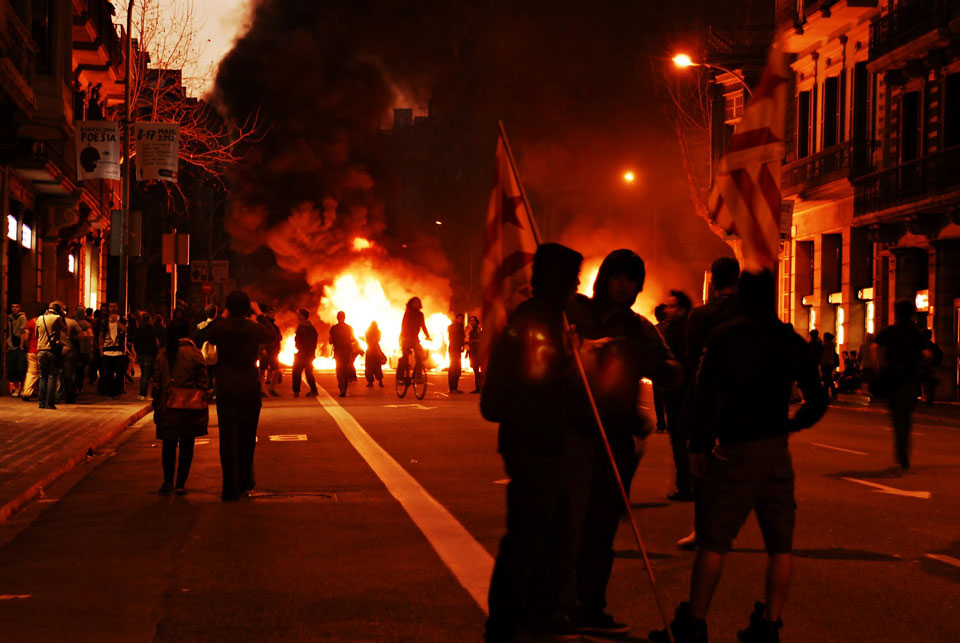
“The Rose of Fire Has Returned!”, The Struggle for the Streets of Barcelona.
On March 29, 2012, a nationwide general strike took place in Spain against the austerity measures decided by the government due to the economic crisis. In Barcelona, the passivity of orderly mass demonstrations desired by the union officials did not remain the same: in the early hours of the morning, streets were blocked by mobile pickets in various districts and shops that wanted to open despite the strike were prevented from starting work; During the demonstrations there was considerable damage to property, numerous fires were lit and ultimately a diverse crowd, which far exceeded the usual suspects, fought an hour-long battle with the police, with the law enforcement officers being able to repel them for the first time in a long time in this city.
Events like this mark the transition from the relatively pacified social situation that has been the norm in Spain and the rest of Europe in recent decades to an increasingly incalculable situation in which social contradictions are becoming more apparent again. But how do the radical minorities who want to intensify the social war with the ultimate goal of overcoming it once and for all behave in the face of this development? Are they able to meet the new opportunities and challenges? – These questions are at the heart of the text The Fire Rose Has Returned, a detailed history of the general strike of March 29th, as well as its antecedents and aftermath, written by an anarchist comrade from Barcelona.
Since even in the German-speaking territories the pacified state will not last forever and we have to prepare for more turbulent times, we consider these reflections to be useful for local subversives, especially since the event to which they refer was largely ignored in this country by both the official and the underground media.
“La rosa de foc ha tornat!” With these words many people expressed their enthusiasm during the general strike across Spain on March 29th. Unions estimated turnout in the strike at an impressive 77%, but it was the fires darkening the skies over Barcelona that everyone was talking about.
In the late 19th and early 20th centuries, when Barcelona carried out more anarchist assassinations and bombings than any two countries combined, and when dozens of churches and police stations were burned there, the city was affectionately known as la rosa de foc, "the fire rose." The period of “revolutionary gymnastics” in the 1920s and 30s made the city a laboratory of subversion for anarchist struggles worldwide, a role that was reinforced by the revolution of July 1936. The struggle of the Catalan maquis - guerrillas - during the Franco years was the forerunner of the guerrilla struggles that flourished in Europe and Latin America in the 1960s and 70s; in some cases, experience and material were passed on directly from them. However, due to the break forced by fascism and democracy, this history has largely been lost and Barcelona has lost its importance on the stage of the revolution.
Supported by the democratic powers, forty years of dictatorship and repression have successfully suppressed the anarchist movement in Catalonia and the rest of Spain. A pro-anarchist feeling remained to a large extent, but petered out when the recurrent social revolution of the 1970s was distracted by the transition to democracy. Hundreds of thousands took to the streets hoping to pick up the torch that had been dropped in 1936, but the government played its hand skillfully, the returned CNT played its hand miserably, and democracy triumphed. Since then, the city has been tamed, not to say completely pacified, and the fire rose has been forgotten.
Fierce neighborhood struggles continued into the 1980s, but they were largely confined to marginalized immigrant neighborhoods1 and were calmed by the political and economic integration - or demolition - of slums and shantytowns. There were several intense riots instigated by squatters and anti-fascists in the 1990s, but the media was successful in portraying these as isolated phenomena. In the 2000s, social control and pacification progressed in leaps and bounds. A new police force trained in democratic control tactics, the mossos d'escuadra, was established, and at the same time a vigorous campaign was waged to enforce the authorities' rules of conduct. The riots disappeared and with them the know-how of street fighting, the use of Molotov cocktails and the resistance to building evacuation. The police became untouchable: as soon as they attacked - or even swung their clubs - people scattered.
A militant spirit was still widespread, at least among anarchists, some squatters and a part of the indepes, the Catalan independence movement2, but the means to express it had been lost. In 2007, when the police attempted to gain unchallenged control of the streets once and for all by encircling and suppressing an unauthorized protest, the so-called antisistemas3 were able to stop this attempt by seeking broader alliances, returning to the streets and emphasizing the contradiction between the state's presumption of power and its democratic self-image. This persistence was not entirely unsuccessful, but no one had a plan for getting back on the offensive.
When the economic crisis eroded the state welfare system that had guaranteed social peace, many more people than the few thousand antisistemas began to become active. Neighborhood meetings began to form, initiated by well-meaning reformists, indepes and closet libertarians, which attracted a few Trotskyists and the like. The anarchist CNT and the anarcho-reformist CGT, kept in shape by small industrial disputes in a supermarket chain and among bus drivers, were preparing for a battle more befitting of their history. The indepes were angered by their years of insignificance despite widespread support for independence from Spain. With the emergence of a new political party that has not yet entered the government to betray them, they sensed the dawn and also prepared for a new offensive. The anarchists of the black bloc, finally able to take the initiative after years of action-repression-prisoner support, moved from the limited field of clandestine actions, anti-social propaganda and self-organization in autonomous ghettos to a more permeable terrain in which the skills they had trained could have a greater impact.
Barcelona General Strike, September 29, 2010
The general strike on September 29, 2010 was called by the major unions (CCOO and UGT) together with smaller unions such as the CNT and the CGT. However, a large part of the organizational work was also undertaken by district assemblies, non-union anarchists, indepes and others. At the national level, the strike was a success from a union standpoint, with the majority of workers taking part, even though it was the first general strike in eight years. In Barcelona it was a success from an insurrectionary point of view, as it gave rise to a violent riot in which attacks on representatives of the government and capitalism became generalized. The riot was largely spontaneous, involving many more people than the usual suspects, and reached a scale and intensity not seen since at least the La Cine Princesa riots of 19964. A large number of arrests with serious charges and an intense demonization campaign by the media became the basis for future actions and attitudes. Nevertheless, September 2010 gave many actors more strength and greater social support.
Banco Español “discredited” after the general strike of 2010
CCOO and UGT immediately went to the negotiating table and sold away much of this support for the privilege of being involved in the socialist government's pension reform. Both unions were completely in their element. The UGT played a significant role in obstructing proletarian struggles in the 1920s and 30s; it was the mass organization that gave the poor handful of Stalinists the support they needed to sabotage the revolution. The CCOO (Comisiones Obreras, Workers' Committees) is the institutionalization of the libertarian-communist workers' autonomy movement of the 1970s. When the fascists, who had transformed themselves into the partido popular, looked for leftists to bring into government to help them prevent the revolution by putting on a democratic mask, they found their people in the CCOO and the newly formed Socialist Party (PSOE).
On the other side of the barricade, the CGT (a split from the CNT) and the two CNTs (another split) overcame their age-old enmity and began to work more closely together. Black Bloc squatters and anarchists also began collaborating with CNT anarchists or joining neighborhood meetings and working with indepes, clandestine libertarians and community activists. The widespread isolation, which was certainly as much a result of a shared social situation as of individual decisions, began to dissipate.
In January 2011, the latter groups decided to organize another general strike without the two major unions. Most people considered this second strike a defeat due to the low turnout. They understood the purpose of a strike in terms of the quantitative, organizational mentality of the unions. However, the historical significance of the January strike was to show that things were slipping away from CCOO and UGT. He showed that those operating from a more insurgent logic can take the initiative, bring about a significant disruption of business as usual, and spread radical ideas if they are willing to go beyond their narrow circles of like-minded people and address the immediate questions of material livelihoods usually monopolized by reformist discourses. This discovery goes to the heart of two tensions that have recurred throughout the history of the events of March 29th. These tensions have to do with how the principle of affinity changes its operation depending on whether one is dealing with times of isolation or times of union; and that immediate concerns are usually associated with reformist methods and idealistic concerns with revolutionary methods, leading to a false juxtaposition. This will be discussed in more detail in the last section.
After January 27, 2011, the next significant date was May 1, when the anti-capitalist protest march, consisting of anarchists from the Black Bloc, the CNT and many indepes, moved from Gràcia to the rich Sarrià district, where it destroyed hundreds of banks and luxury shops before the police managed to disperse it. May 1, 2011 demonstrated the strength of this new coming together of previously separate sectors of the antisistemas. The people did not yet have the strength to resist the police and they had not yet regained the know-how of street fighting, but they managed to go on the attack. In the years before 2011, the Black Bloc anarchists in Barcelona had tried to reclaim May Day as a militant holiday, failing despite creative and varied attempts, while the CNT anarchists were content to hold peaceful marches in memory of a faded history. The success of 2011 was an important breakthrough. It also apparently sparked a fear that anti-capitalist violence against the rich would become widely popular - the media suppressed almost all news and images about the protest.
On the other hand, the criticism of some of those involved in the protest showed that these new relationships would be lost if the masked people instrumentally viewed heterogeneous, multifaceted spaces as a silent and comfortable terrain on which to cause chaos and nothing else. This criticism was not pacifist and did not come from people who dislike seeing a rich neighborhood being devastated. It had more to do with who the main victims of the repression were, who held the line against the police and who broke the windows; it was also about whether people stick to shared goals and whether they share information so that others are not unprepared for a confrontational situation. Nevertheless, after years of facing widespread social rejection of their violence, it was natural for the more insurrectionalist antisistemas to ignore this criticism.
Shortly after May 1st, the May 15th Square Occupations Movement began. How the M15 movement developed and how the Democrats had to mask themselves just to participate in their own creation showed the influence of anarchists that far exceeded their numbers. Politicians were not allowed. The practice of open meetings and the idea that “no one represents us” were generalized. Every group and organization had to pay at least lip service to decentralization, horizontality and mutual aid, and in some new groups and forms of action these ideas were actually put into practice. A rapidly growing minority within the movement broke away from the view that the media were allies and responded to it with criticism, disgust and even physical attacks. The pacifist hegemony was defeated within months. The district meetings experienced a quantum leap: instead of six, there were now over twenty of them, in which hundreds took part rather than dozens and which moved from closed rooms to central squares in each district. Some neighborhood assemblies even allowed for autonomous direct action by participants and practiced pluralistic, non-uniform decision-making, going beyond the petty authoritarianism of direct democracy.
Protest marches, and with them the practice of marching in columns from each part of the city to the starting point of the demonstration in the center - with even a group of as few as 50 people able to take over a main street - became so common that the police no longer tried to stop unannounced demonstrations. Solidarity and support for prisoners became a shared responsibility: thousands, including entire neighborhood assemblies, took action when those who had previously remained isolated as antisistemas were arrested for mocking politicians. Various neighborhoods created “mutual aid networks,” loosely based on a model developed by anarchists in Seattle and Tacoma. The first of these networks, in the Clot district, caused a stir throughout Catalonia by organizing the first action against a foreclosure eviction that physically resisted the police.
Some people only changed their choice of words, but overall the practice changed. Although more and more people began to call themselves anarchists, anarchists remained a small minority - but an influential one.
Anarchists fanned out across an expanded territory, often fighting alongside new friends in the neighborhood or workplace. At the same time, they intensified internal communication through debates and meetings, sharpened their practices, shared ideas, and developed a sense of collective strength. Some sought a unification of all anarchists, but most rejected this, leaving the anarchist space fragmented but communicative. Most of the coordination was spontaneous – based on shared information rather than through joint planning.
However, this development was never a smooth process. Anarchist principles were already very influential, but anarchist arrogance prevented even further fruitful effects. The criticism of recuperation – that is, the criticism of reformist activists and institutions that neutralize social struggles – was widespread among anarchists in Barcelona; In the 1990s and 2000s, even the CNT was accused of recuperation by other anarchists. The majority of Catalan libertarians have never seen themselves as part of the left. But now anarchists discovered undeniable value in working with people who had reformist leanings or whose ideas about revolution tended toward recuperation.
It was difficult to decide who to work with, how to argue against a reformist position without the message condemning its messenger, how to deal with a situation in which anarchists suddenly had great influence and other people were now needed to put our noble principles into practice. Many anarchists were changed by these experiences, but few were heard from who admitted how much they learned through contact with other people or how necessary the struggles of non-anarchists were to the contradictory, chaotic whole. On the other hand, it suddenly became less cool to be openly arrogant, and many anarchists criticized their comrades and themselves and called for more modesty. Some argued that sincerity was more important than group membership or political agreement when deciding with whom to cooperate.
A four-day strike on Barcelona's public transport was scheduled to take place at the end of February 2012. The labor leaders - those who spoke loudest and most eloquently in the meetings - called for a major traffic disruption and a united struggle by subway and bus drivers and passengers - that is, everyone who is not rich enough to own a car. These proposals met with broad support and were adopted after a vote. Since the CGT is one of the largest unions among bus drivers and supporting a bus drivers' strike has worked well in the past, most anarchists decided without hesitation to throw themselves into activities in support of the strike.
Despite public support organized through neighborhood assemblies and other bodies, transport workers became hesitant as the media painted a fictitious general disapproval of the strike. Just before it was about to begin, the union bureaucrats played dirty games and the workers broke their promises, negotiated private agreements and abandoned those from whom they had demanded solidarity. The strike did not get off the ground and efforts to prepare for it proved a major failure. Some comrades saw this as a sign that people should be more careful, others as a warning to be more uncompromising. Significantly, it became clear that many anarchists, such as the Trotskyists and socialists, saw themselves in the strike not as protagonists - as passengers who had been fighting for months against tariff increases - but as supporters of a struggle that was not their own. On the one hand, this view obscured the populist failure to criticize an open breach of a promise of solidarity. On the other hand, it showed an openness to self-criticism on the part of those who had engaged in a reformist struggle only because of the possibility of confrontation it implied. This incident also raised the question of the legitimacy of decisions made in meetings - or the question of how seriously one should take such decisions when people vote for one thing after a rousing speech and the opposite after a week of bad press.
The failure of the transit strike, just a month before the planned general strike on which so many people pinned their hopes, could easily have been demoralizing. Unexpectedly, however, a small but important riot broke out on Wednesday of the same week. The riot occurred during a demonstration by students and teachers on the occasion of a one-day university strike. This event raised morale and conveyed an important message regarding the origins of resistance. This spread after the student leaders who had controlled and pacified movements in the past were effectively silenced - with libertarian students literally snatching the microphone out of their hands. As a result, rowdy students went wild, many of whom had no involvement in anything political, while many others gave them symbolic support and flocked to conflict zones rather than fleeing them. In retrospect, the speakers of the platform against the privatization of universities were forced not to condemn the riot, knowing that otherwise they would have suffered a dangerous loss of support.
Finally, the CCOO and the UGT called for a general strike on March 29th. Smaller regional unions in Galicia and the Basque Country had already mobilized for a strike that day; Now the two major unions jumped in, so that the day of the strike became a nationwide general strike. The CNT and CGT, no longer wanting to strike alone after the experience of January 27th, soon followed suit and also took part. The matter had essentially been forced upon CCOO and UGT. Since the previous summer, as the crumbling M15 movement sought effective targets and tactics and the rich and powerful continued their onslaught, everyone had been talking about the need for a new general strike. The unions dawdled and explained pedantically how difficult it was to pull off something like this. Ultimately, it is said in jest, President Rajoy inadvertently brought about the strike when, during an important EU summit in January, he told the Dutch and Finnish prime ministers how good and "aggressive" his new labor market reform was, how it would make it easier to fire workers - but it would "cost him a general strike." He didn't know his microphone was on.
The strategy of the major unions was to sabotage their own strike. During the last general strike in September 2010, people had had months to prepare so they could make their own plans independent of the unions. This time, CCOO and UGT announced the strike day less than three weeks in advance. They put up almost no posters until a day or two before the action, leaving the debate to the media. The ideal outcome would have been for them to have a large turnout in their own protests, but without riots and great chaos. Given the widespread anger among the population, however, it was all but impossible to gather crowds in the streets and maintain control; but if the unions limited the antisistemas' ability to promote disorder, while at the same time keeping their own constituencies away from the mobs in the streets, they would be able to keep their losses low.
The anti-capitalist preparations for the strike took a variety of forms. Anarchists collaborated with indepes, socialists and others in the neighborhood meetings, strike committees and the assemblies of workers or unemployed; or they prepared in their own affinity groups, assemblies or unions (the CNTs). Nobody, neither the police nor the antisistemas, could make reliable plans for the day. They could either try to maintain order or move amidst disorder.
In many neighborhoods, the general strike began at midnight: small groups closed bars and set off traca, long series of noisy fireworks. In Casc Antic, a picket supposedly belonging to the CGT entered a casino, apparently to shut it down - and made off with €2,000 in cash. The union quickly denied any connection with the perpetrator. As a result, the casino had to unexpectedly close on the day of the strike, reporting damage of 50,000 euros. From 6:30 a.m. barricades blocked the main motorway and railway entrances to Barcelona: Av. Meridiana; GranVia; Diagonal; la Ronda Litoral; metro Zona Universitaria; metro Llacuna and others.
Roving pickets began gathering as early as 4 a.m. in some neighborhoods and as early as 7 a.m. in others. They closed the streets and blocked businesses that tried to open - mainly bakeries, bars and supermarkets. In Horta, 200 people blocked streets, stopped and sabotaged buses, and smashed the windows of Mercadona, a large supermarket chain notorious for threatening and harassing its workers. In Sants, the picketers broke into the train station and beat up a businessman who had tried to grab one of the picketers. In Clot, pickets went up and down the neighborhood blocking every single street with dumpsters until riot police attacked and made three arrests. In neighboring Poble Nou, a small CCOO and UGT picket symbolically blocked the street, while a larger neighborhood picket closed shops until riot police showed up hunting for pickets from Clot who had taken shelter there. In Sant Andreu, police attacked pickets in front of the town hall and arrested three people. In Raval and Eixample, in addition to the pickets, there was a morning protest.
At 11 a.m. people from four different neighborhoods met at Plaça Glories to march together to the center. Along the way, they blocked Gran Via and insulted a small group of CCOO and UGT pickets standing on the sidewalk. At the center, thousands of people gathered in a “unified picket line.” This is exactly where the riots began during the strike in September 2010. However, this year there were more people and the plan was to march from the center to Gràcia. Unfortunately, the most direct routes chosen were the broad main roads designed specifically to control rebellions. The large crowds made slow progress in the hot sun, far from any sidewalk shops.5 The result was neither a protest march nor a picket line. Nonetheless, most businesses in the area were closed as a safety precaution. A luxury hotel that had once been collectivized by anarchists in 1936 was pelted with paint bombs, but the atmosphere was generally calm. Already at the beginning of the parade, a few people had fanned out and lit garbage fires in front of the stock exchange - they quickly retreated when the riot police showed up. At the Jardinets de Gràcia the march stopped for almost an hour, although the crowd still stretched back to Plaça Catalunya.
Then people with flags and banners finally managed to move the crowd and turn left towards Eixample. Soon, someone threw a beacon onto the eaves of a hotel, starting a small fire. The sight of smoke had a magical effect. The passive, helpless crowd was suddenly transformed as masks appeared and people covered their faces. Tools emerged or were taken from the surrounding area, and soon every bank and luxurious shop was destroyed. Dumpsters were overturned and set on fire. “But they closed their shop!” asked an older protester, surprised that a luxury store had been thrown in. "What are you doing?" – Sure, some people wanted the picket line to remain a picket line and didn't understand the willingness to go on the attack.
A fire engine arrived and riot police vans were seen speeding around in the distance; it would later be discovered that they pushed back the main mass of people coming up from Pl. Catalunya to prevent support when the time came to attack the rioters. Many people hesitated, but thousands pressed forward, destroying more banks and closing the circle to return to the Jardinets. At this point the mossos (the Catalan police) attacked, racing forward with their transports to both flank the streets and cut off part of the jardinets. Several people were run over and many more beaten up as they suddenly found themselves running the gauntlet. A few people were also arrested, but the crowd was so large that it was difficult for police to maintain the space needed to catch and take people away. Most of the rioters, mostly anarchists, retreated to the streets of Gràcia, where they could potentially have taken over the entire neighborhood and destroyed the town hall. This was only guarded by a few police officers who had locked themselves in at the sight of 500 black-masked demonstrators. But the latter were still in panic mode after the police attack and they scattered. Over the following hours of hiding and trying to regroup, many anarchists commented on the well-known weakness of street situations in Catalonia: people always run from the cops.Elsewhere, further down the city, a group with dumpsters, rocks and beacons advanced without being immediately dispersed; however, a significant increase was necessary.
At 4:30 p.m. the demonstration of the CNTs, the CGT and other anarchists started in Jardinets to march back to Pl. Catalunya. It was around 10,000 people strong and there were tens of thousands more people nearby who stopped the police. People strolled leisurely down the fashionable street of Pau Claris, burning garbage containers at every intersection, deglazing every bench and throwing in beacons and trash. The riots also led to conflict within the demonstration as some protesters confronted the rioters and attempted to unmask them. Eerie scenes played before their eyes: spectators stared at the ruins, the numerous columns of smoke and the firefighters who left garbage fires five meters in diameter to one side as they raced past to put out the fires in the burning banks. At the corner of Pl. Catalunya near Corte Inglés, one of the country's most important shopping centers, the mossos attacked and formed a chain to protect the mall.
The anarchists dispersed and most of them joined the immense crowd in the square. There was silence for over an hour, journalists mingled with the crowd and filmed freely. Then young people and hooligans6, many of whom were not even masked, gradually began to escalate the confrontation with the police in the upper right corner of the square. They threw trash and set a dumpster on fire. When the container fire became so large that the police had to withdraw their personnel carriers to prevent them from catching fire, the wild mob attacked and chased the police an entire block back to Plaça Urquinaona. Then the police pretended to launch a counterattack and the protesters panicked and ran away. This time, people with more street experience calmed the panic and urged everyone to stand firm and resist, which the hooligans and a few others quickly did. The tools necessary to turn the street and sidewalk into projectiles finally appeared or were created from what was at hand, and the police were met with a hail of stones. In nearly an hour of freedom on a violently conquered street, hooligans, anarchists and indepes deglazed a Starbucks and set it and a bank on fire. With an almost mad determination, they broke through first a glass and then a metal wall to open a back entrance to the Corte Inglés and set a fire in the shopping center. The scene was filmed by media and passers-by, some out of curiosity and others as a deliberate attempt at intimidation.A few people also shouted at the rioters, but thousands of others applauded and stayed on site rather than panicking and running away, leaving the rioters isolated, as usually happens.
Due to the huge crowd protecting the rioters, intentionally or unintentionally, the police could not get around them to attack them from behind. They advanced slowly under a hail of stones. As another group of riot police moved along Corte Inglés from the lower right corner of the square, the crowd retreated and the police retook the entire block that had previously been taken from them, including Pl. Catalunya.
But people still didn't give up. They attacked several press vans and stole a gas tank from the generator on one of them, intending to use it straight away. They began improvising barricades and breaking up the sidewalk in search of rocks. For an estimated hour more, police continuously fired a hail of rubber bullets, injuring many protesters. One person lost an eye and another was hit in the lung. A four-year-old child was shot. But people made shields or took shelter behind a series of road barriers and other obstacles to continue throwing stones at the police. In most cases, hooligans and migrant youth were on the front lines, along with a handful of anarchists, and their courage was inspiring.
In the end, the mossos had to use tear gas for the first time in their ten-year history to retake the square. The gas wasn't that strong, but as something unknown it caused fear. The first few canisters were kicked back, the next few chased the masses back to Placa Universitat, lighting more fires and throwing banks along the way. For the next hour, all the streets around Placa Universitat belonged to the people, until the police finally managed to advance two more blocks. Fires next broke out in Passeig de Gràcia (above Pl. Catalunya) and Raval (the migrant neighborhood below Pl. Universitat). In the latter area, immigrants and anarchists lit fires throughout the night, built barricades, attacked banks and collected stones in the hope that the police would come. Apart from a few civilian cops who were quickly chased away, there were hardly any confrontations, but only because the law enforcement decided to avoid them. Across the city, people on the outskirts of the main conflict points robbed supermarkets, hit banks, burned garbage cans and beat plainclothes police. The fire brigade raced back and forth, in the center or in the suburbs, until late into the night. For a day, the police lost control of the city, like on September 27, 2010; perhaps for the first time since the Cine Princesa riots of 1996 - although this time it was on a very different scale - a large number of people had now learned how to push back the police in an ongoing battle.
The riots were an event of great importance. It was obvious that it had been possible to shut down business operations, even if some shops had not closed. Perhaps a thousand trash cans were turned into barricades, alongside countless tires and other objects. 295 garbage containers were burned, which caused damage to the city of one and a half million euros, not counting the broken streets and sidewalks and the smashed or set fire to banks and department stores. However, the experience of winning the road was the most important thing. In the aftermath, the anarchists felt victorious, while the Catalan Interior Minister acknowledged that this was a sign of times to come - a picture of the future, so to speak. When preparing for the general strike, no one believed that a one-day action would solve any problem, and that belief has remained, even though the strike has far exceeded everyone's wildest expectations. However, what was gained will be of enormous importance for future battles.
The Barcelona Stock Exchange at the end of the day
In Tarragona, another city in Catalonia, the antisistemas took advantage of the fact that all the riot police were in Barcelona and rioted: they burned down the offices of several political parties and attacked police cars. The next day, police arrested nine known radicals, from indepes to anarchists; the lack of evidence was made up for by their desire for revenge.
In total, there were 79 arrests across Catalonia on March 29, including 56 in Barcelona. Many of those arrested were beaten and injured at police stations. Two had their spleens removed as a result of the beating. At a solidarity rally in front of Modelo prison a few days after the strike, police made an arbitrary and particularly cruel arrest of a protester, removing him from his wheelchair and leaving him standing on the street while riot police cleared an alley for the prisoner transport vehicle through the angry crowd, fracturing at least one protester's bone.
Most of those arrested are now out on bail or on conditions, awaiting trials on serious charges that are likely to drag on for two years or longer. Three of those arrested were refused bail: two indepes who had been arrested that morning with incriminating material and one of the picketers who had been arrested in Clot earlier in the day. A trial is already underway against the latter for harassing politicians during the siege of parliament in June. During the most intense moments of the fighting, police were barely able to make arrests, and there is little evidence to link those arrested to the day's most egregious crimes. Nonetheless, the courts understand the political necessity of exemplary punishments – and they will take the necessary precautions.
Meanwhile, politicians are looking for new instruments of repression in order to defy an increasingly rebellious future. The Spanish government in Madrid is pushing ahead with changes to criminal law and the Generalitat in Catalonia is calling for tough new measures. The basic features will be familiar to anyone familiar with repression and they were summarized by Catalan Interior Minister Felip Puig, who complained that the law was too tolerant of "violent perpetrators" and appealed to the good citizens of Catalonia to help isolate them. First and foremost, the criminal law should be changed, probably with the following results: The right to assembly will be restricted by a ban on masking; In the future, the offense of “disturbing public order” should also be applied to people who enter a public facility to protest or block the entrance to one; the minimum sentence for this offense will be increased to two years, although it will be possible to keep the defendant in prison awaiting trial for the duration of these two years; the offense of “forming a criminal organization” is handled more flexibly; “Resistance against state power” will in future also include passive resistance against the police; There will be much harsher charges for throwing objects at police and penalties for vandalism will be aligned with those for similar offenses covered by anti-terrorism laws7. Special measures in Catalonia include increasing the number of riot police officers by a quarter and appointing a special prosecutor to deal exclusively with “urban violence”.More surveillance cameras are being installed in public places and the police are stepping up filming of demonstrators.
As a further measure, the Generalitat will set up a website to encourage and facilitate reporting and perhaps also provide a technique to involve the population in identifying rioters in photos, as is already done in other countries. It will also seek to close websites, blogs and Twitter accounts that call for violent protests, and it will urge citizens not to encourage such violence by sharing personal footage on their blogs or on Facebook. 8 The media, in turn, will continue to demonize the “perpetrators of violence” in the hope of isolating them. And the new criminal law will allow prosecutors to charge any organization with a serious crime that calls for a protest that ends in violence.
The anarchists wasted no time in responding to all this. On the two days after the strike there were solidarity demonstrations in front of the prison and the courts. On April 2, a solidarity demonstration with perhaps five hundred participants marched from the University Square to the Modelo Prison. Less than a week after the strike, thousands of copies of at least two different anarchist posters justifying the riots appeared on city walls. One asked, “What did you expect?” while the other declared, “The end of obedience.” There is talk of linking these cases of repression to other recent examples of repression for which protests and support actions are already planned - the arrests during the strike in September 2010, the eviction of Plaça Catalunya on May 1, the battle against the eviction in Clot in July 2011, the arrests in front of Parliament. Coordinated efforts to publicize and reject the new laws are also underway.
There are also attempts at criticism and shared learning, as some arrests could have been avoided and in some moments people provoked confrontations when it was not prudent to do so or others wanted a safer atmosphere. In Plaça Catalunya, those who wanted to seek safety could easily move to the side of the square and away from the street fighting, and in fact there were many families with children or older people there who symbolically supported those fighting against the police. However, this was not possible in other places, nor were there any promising opportunities to attack the police even if everyone had wanted to.
It is much easier to understand and act on such criticisms now that the pacifist insidiousness that arose with the 15M movement has been overcome. And it seems that rather than denouncing such concerns in the single-minded pursuit of constant confrontation - a strategy that has been tried and abandoned here - anarchists are willing to listen and change their behavior because they have had good experiences working with the people who voice such criticisms. Any changes would not be towards pacification, but towards mixing different spaces and forms of struggle in order to go on the offensive in a way that does not endanger others and can spread.
The events of March 29 made some important insights abundantly clear.
When it comes to street fighting, some observations are more immediately salient than others. The most important prerequisite for action is neither having a plan—since plans always fall apart in such situations—nor showing up materially prepared, even if that doesn't hurt. The most basic need is the ability to push back against the police. Those who directly seize a room from the police can then do anything. The ability to beat the police comes primarily from attitude, secondly from experience and thirdly from equipment. The first two conditions can generate the third from the urban landscape if no one has prepared it in advance.
Those who were most effective at repelling the police were composed of young people from diverse socioeconomic and ethnic backgrounds who had little or no prior street experience. Their effectiveness multiplied when they were joined by people with more experience and preparation. Likewise, the anarchists fighting alongside them had more street experience in one day than in all of the previous year's protests combined. Experience does not accumulate passively. It only falls to those with the appropriate attitude.
Less obvious is the importance of those not on the front lines. The sine qua non of the March 29 riots was the crowds that physically and emotionally supported those at the center of it all. The forms of this support must broaden, the intensity must increase - necessities that are inhibited by the idea that anarchists must either fight on the front lines or run away. The anarchists in the third row raising their hands and telling people to stay quiet are just as important, along with those further back pounding the pavement into projectiles - too often the latter activity is carried out right on the front line, where the people and the piles of rocks they amass are more vulnerable. It is also necessary to have comrades who do not take part in the fighting, but who argue on their behalf against those who want to pacify or isolate the rebels, and others - even further back, in places safer for children and the elderly - who applaud the fighting or cheer every time a new fire breaks out, and who encourage people not to abandon the fighters, but rather to see them as “ours”.
“Against the aggression of the rich and their politicians: self-defense”
Gaining support for this type of street fighting was a gradual but steady process following the mass emergence of pacifism in the 15M movement. In many ways this movement was designed to attack the memories of the fighting here, and from the indepes to the anarchists, many people had an interest in bringing that same history back to the center of the new movement, as it was at the center of the trajectory of the struggle from the 29S general strike to May Day 2011. This history contains a deeply rooted anti-capitalist analysis and a combative practice. By highlighting the superficiality of pacifism and democratic populism, these two aspects of popular history legitimize the radical struggles and the actions that must accompany them.
In the first weeks of the March 15th Movement's square occupations, anarchists had to repeatedly confront pacifism, handing out flyers and texts and justifying every small deviation from the tamest and most civic forms of action. Police violence accelerated this learning cycle. In all subsequent large-scale demonstrations, the anarchists defined the central conflicts and sought to advance the cause, placing more emphasis on visible rather than clandestine actions. In the first few months, the conflict was sparked by graffiti. Almost everyone had already taken on the formally illegal action of blocking the road, in almost every single protest. But when people masked up and started painting banks during protests, others in the crowd became angry and even tried to physically protect the banks. For two people spraying, you needed five or more people to defend their actions and sometimes physically protect them. Protest after protest, fewer people opposed the political graffiti — as long as it targeted banks, government buildings, and other hated institutions — and more people in the crowd argued in favor of the graffiti. The crucial action was not the wanton defacing of a bank, but the public debate that arose to legitimize it.
The next point of conflict revolved around masking. From October onwards, hardly anyone criticized the spraying at the demonstrations, but people suggested that they should do it without a mask. Again, anarchists defended this practice and distributed literature about it. But masking was less likely to create open conflict than spraying, and so there were fewer opportunities for engagement. During this time, police arrested people who had been filmed harassing politicians during the siege of Parliament in June. This made it easier to explain the practical reasons for masking, even though the media was abuzz with rhetoric against the cowardice of those wearing masks. Fortunately, this practice is easily self-explained, especially among the youth; but in Barcelona it still creates a divide between those who automatically sympathized with the practice and those who automatically felt repelled by it.
In other demonstrations, people adopted a more offensive tactic, throwing paint bombs at particularly despicable targets - such as the stock exchange and political party offices. Outside the demonstration space, masked people appeared in random neighborhoods on random days, vandalized a bank, and quickly disappeared again, providing another way to normalize attacks. But before this process could continue in this way, it was suddenly accelerated by the student riots and then by the general strike. On the one hand, these events normalized offensive popular resistance by giving more people the opportunity to participate. On the other hand, they allowed those sympathetic to such attacks to move forward quickly and separate themselves from those who tended to condemn the violence. While a few thousand may be able to win on the streets for an hour or two, in the long run they will inevitably be isolated and pacified unless such a group continues to expand and undermine the barriers of legitimacy built around it. Be that as it may, at the time of the strike, a large part of the Catalan population was already used to low levels of street conflict and property destruction, and the darkening prospects gave some of them the anger to support a sudden escalation of this conflict.
Spectacularization – the practice of reducing practice to images – is a powerful force for isolating troublemakers. While opposition to the press and awareness of the need for defensive measures is slowly spreading - in the form of attacks on journalists and efforts to persuade viewers not to film - there is still a dangerous level of spectacularization during the riots. The spread of new chants - an effective tactic for radicalizing the 15M movement and fighting pacifism - was also used against the media. An example: “The press takes aim, the police shoot” became popular since October. However, there is still no ruling against filming by ordinary people, although some propaganda has been distributed on the subject. Nevertheless, the most dangerous form of spectacularization will be eliminated once journalists can be pushed out of protests and they are increasingly seen as equivalent to the police.
It is also necessary to ask, beyond the immediate demands of street fighting, what was achieved and what was the crucial point. The most important components of the conflict were emotional and symbolic, not economic. The state - itself the source of currency - cannot be destroyed by economic losses, but only by popular attack. If the CCOO and UGT had achieved a 2% increase in strike participation and prevented all riots and property damage, the overall economic loss would have been much greater, but the social struggles would have gained nothing. What was achieved was an interruption of the narrative of social peace necessary for governance, and the temporary broadening of participation in open resistance; The experience was gained that will make it possible to surpass this shock in the future and create relationships with strangers who have become our comrades for a day.
The latter activity has rarely been attempted, despite being one of the most promising opportunities offered by insurgent moments. Anarchists live in the same neighborhood as the hooligans who led the fight against the police, but they are completely alienated from each other unless a riot occurs. People who take part in street fighting should not be idealized, but many of them suffer police violence every day and at least some of them have strong anti-authoritarian tendencies. Anarchists should approach them and others as people with whom they will live side by side and with whom they will attend meetings after the revolution.9
In order to bring the revolution closer, it will be necessary to overcome the natural division between night and day and learn to sustain the riots over several days. Only if they expand over time will they have the chance to grow into an uprising that spreads from city to city. Otherwise, they will only serve as emotional release. In the meantime, as normality returns, the question is how to build on what has been gained, how to harness the collective experience of the riot and stop the social pendulum from swinging towards reaction.
Only the last part of this question already finds an answer within the collective body of thought: support those affected by repression; forges relationships across the divisions established between good and bad protesters, as well as between spectators and actors; counter the media backlash by emphasizing the role of the media in social war; and oppose the new repressive measures adopted by the state.
Historically, the Catalan anarchist movement has formed its identities around common practices and places rather than through unifying ideologies. It is inaccurate and inaccurate to speak, as viewers from a distance tend to do, of insurgent anarchists and anarcho-syndicalists as two opposing and separate groups. These ideologies exist, but as a fluid exchange together with other positions and not as opposing poles. This is more about practice than ideology.
The CNT was undoubtedly the most important revolutionary organization in Spain until the end of July 1936, when it became a class-compromising and essentially state-supporting organization. However, it functioned equally as a union and as a pillar for the formation of informal, combative, neighborly networks. Important people in the organization positioned themselves across the spectrum from insurrectionalists to syndicalists, and the latter's departure was an important step in their radicalization. Cenetistes fought for libertarian communism, collectivism and cooperativism or they simply fought against the current conditions without knowing what would come next. Many activists changed their positions and forms of action depending on the success of the social struggle, so that those who were most rebellious at one moment became the most moderate in the next moment, as in the case of Garcia Oliver. Ascaso and Durruti, perhaps the most principled of the most influential members, were both staunch syndicalists - in that they saw unions as an important tool for agitation and organization in the workplace - and insurrectionalists, in that they believed that the time to attack and therefore to build the capacity for armed struggle had always come; They fought for it and acted on it in the 1920s, at a time when most people thought it would be more prudent to wait. At times their practice was very much in line with the individualistic, illegal anarchists who often established their base in the Raval district; then they appeared again like pure union activists.
To give another example: probably the most important anarchist social center that was formed in Barcelona in the years before 1936 was the aptly named L’Ateneu Eclèctic. It wouldn't have gotten past the censorship with the more traditional description ateneu llibertari, but the adjective "eclectic" was just as apt. As Abel Paz, the anarchist historian from the same neighborhood (Clot), would later write: This was a social center where pacifists mingled with practitioners of the propaganda of the deed, where an influential anarchist individualist held study courses alongside the libertarian youth group, or where CNT activists made propaganda or carried out acts of sabotage in the nearby textile factories. It was the main base of the large anarchist collective Sol i Vida, which practiced vegetarianism, nudism and free love, as well as conducting excursions into the mountains to practice with firearms. It also gave the local Mujeres Libres group a space to form.
Today, the anarchists in Barcelona typically refer to themselves with imprecise caricatures (the black bloc, the reformists, the hippies) or with references to a place, such as a neighborhood or a social center, whose participants are diverse and change over time, but whose respective composition gives a specific character. In this way, they accommodate the inevitable need to label themselves and each other, and they do so in a way that is susceptible to stereotypes and even irreverence, but which remains equally flexible and blurred. This allows individuals to move between labels, facilitating debate between different groups, rather than turning the differences into a competition between irreconcilable ideological opposites.
One of the two CNTs is jokingly compared to a union of insurrectionalists, while some "black bloc" anarchists have ideas about unity, formal organization and technological civilization that would make Anglophone insurrectionalists cringe. Almost all of Barcelona's anarchists recognize the importance of the CNT in building the revolutionary movement that made July 1936 possible; they also blame the CNT for the failure of the revolution. Most anarchists outside the CNT blame that organization's dynamism for the lost revolutionary opportunity during the transition to democracy in the 1970s, while the Cenetists tend to acknowledge some mistakes and otherwise blame state repression. Italian insurrectionalism, brought to Spain by the Córdoba bank robbers in 1996, found its most active supporters among the FIJL, the youth organization that then split off from the CNT. The CNT's position of refusing to support the bank robbers also caused many others to leave, but some who left later rejoined and the CNT's character has changed over the years.
In the aftermath of the strike, the CNT from Savadell (a town just outside Barcelona) published a statement criticizing the Barcelona section of the CGT for distancing itself from the riots and speaking of good and bad protesters. The title of their communiqué was “Against the System, its Defenders and its False Criticism,” a direct reference to the insurrectionalist classic In Open Hostility to the Existing System, its Defenders and its False Critics.
The tensions in strategy expressed throughout the M29's long history do not mark a contest between two ideological poles; Readers who attempt to search this report for what promotes such competition will miss the discussions currently taking place among comrades in Barcelona. The points highlighted here have been raised in debates here; they are based on momentary needs and not on abstract competitions.
The main strategic tension suggested above has to do with unity and commitment. An important theoretical debate is between anarchists who see unity as a goal and those who do not. In times of isolation, such tension is unlikely to arise. Considering the spaces in which they can work, both those who prefer to work in affinity groups and those who prefer to work in popular or open groups have few options. The projects of one type of group will likely seem inconsequential to the projects of the other. Those who favor different approaches are likely to reject or ignore each other, while internal tendencies toward disunity are usually overcome by the need for cooperation resulting from the lack of potential comrades.
In times of greater dynamism and unification, these different approaches meet and overlap as many more potential comrades emerge. In this new dynamic, some anarchists see differences as creative, while others see them as disorganization. Some will believe that fragmentation is a natural characteristic of non-disciplined groups, while others will believe that greater similarity of spirit will be the natural result of collaboration. Some will seek to maximize the spectrum of possibility by creating a chaotic social struggle, while others will seek to coordinate and unify to produce a disciplined social struggle - or, lacking strength or a general identity to impose discipline, they will build an organization that attempts to encompass or represent the entire struggle.
The other theoretical debate results from the erroneous association of reformist practices with addressing immediate concerns on the one hand and the association of revolutionary practices with adherence to abstract ideals on the other. In times of weak social struggles, it is easiest for anarchists focused on immediate concerns to adopt reformist language and practices, and for anarchists committed to revolutionary practices to frame their actions in terms of long-term ideals. Once a wider range of people start talking more angrily and decisively about their immediate problems, some revolutionary anarchists will jump to the opposite pole and suddenly talk about immediate problems - and about powerful, perhaps even revolutionary solutions - without expressing their long-term longings and radical analysis.
Meanwhile, the others will despise the popular struggles and retreat further towards purely anarchist projects. Bringing together uncompromising anarchist ideals with the complexity of immediate problems is the most difficult option and consequently the rarest.
Both tensions have everything to do with the movement from an anti-social to a populist position. The mistake is fundamentally not to transcend the self-imposed and imposed boundaries of times of social isolation and instead to take refuge in the simplest, most superficial communication practices as soon as new approaches make this possible. Anarchist populism is the result of comrades who abandon the good instincts of the antisocial position but retain the bad habits of the same.
In the kind of unification that Barcelona experienced between 2010 and 2011, the anarchists faced a changing environment and inevitably changed with it. Whatever they gained, they gained through instinct or through a strategic commitment that let them explore new spaces of protest and intervene in heightened social conflicts. Anarchists have influenced the ideals and practices of the new social movements in ways disproportionate to their numbers. However, many errors arise from the limitations of populist or anti-social tendencies. There remains the possibility that anarchists will remain outside these movements and be left behind as reformists steer them toward institutionalization. It could also happen that anarchists lose themselves in these movements, abandoning their principles for fear of being marginalized. These two wrong paths are taken in parallel and complement each other.
After the September general strike and the 15M movement, anarchists saw the possibility of working in much larger groups, and this was the tightrope they had to walk. In the beginning, 15M had the appearance of a broad social awakening. When most of the participants found no means to continue in this direction and returned to the soporifics of normality, the wave flowed back, but left the previous formations of social struggle in disarray. They were more populated, more numerous, more heterogeneous and more entangled.
In response to the inevitable decline of the social movement that suddenly expanded during the summer of 2011, and in response to the fact that new spaces of protest and action were still much larger and more diverse than before - and therefore, according to conservative logic, more prone to attrition and factionalization - some anarchists formed a populist tendency. Fearful of losing their newfound support, they downplayed their anarchist identity and sought greater unity based on a necessarily watered-down anti-authoritarian analysis. Other anarchists consolidated their antisocial position, convinced that participation in these new heterogeneous spaces would require compromising their principles, just as their populist comrades seemed to do.
The anarchist space of Barcelona is fragmented and communicative. It is neither united in a single organization or identity, nor divided into isolated, non-communicating scenes. Fragmented and communicative anarchist spaces tend to be particularly strong at developing new practices and adapting to changing circumstances.
The anarchist propaganda surrounding the recent general strike was less overtly anarchist and correspondingly less radical. Many issues and principles important to anarchists have been almost entirely omitted from recent anarchist propaganda, at a time when more people than ever are open to radical ideas and drastic proposals are needed. Giving up this opportunity, many anarchists focused on one-point propaganda that highlighted immediate problems facing ordinary people: jobs, health care, housing, education, the police. They attribute these problems to capitalism and the state, but in a way this promotes a convenience-based criticism that might disappear once someone gets a good job. This tendency was more about avoiding isolation than exhausting all possibilities. It may be able to avoid repression, but the relationships it creates and the criticism it spreads are probably superficial.
Other anarchists have resorted to publications and actions that were fundamentally intended only for themselves and other anarchists. Some have produced propaganda that criticizes the disappearance of the welfare state in a way that makes fun of the hardship people are suffering because of this disappearance. Nevertheless, this position promotes a certain strength and independence of the action, which is probably partly responsible for its victory on the street.
These tensions are unresolved and form a balance rather than a competition. How can we share a radical critique of this society without alienating other of its members? How can we participate in heterogeneous spaces without supporting our own recuperation? How can we counter the narratives fed to us by the media without ceasing to be dangerous to the existing order?
In any case, the anarchists now have more and stronger connections than two years ago, and they are armed with more fruitful experiences. The debates are ongoing; There are already attempts to counter the criminalization carried out by the state in the aftermath of the riots. And there are attempts to summarize the lessons of that day of spontaneous frenzy.
More innovations are likely to emerge as comrades in other countries prepare for their own general strikes, and these innovations may find their way back here. Perhaps the convulsions generated in Barcelona will help to shake the illusion of stability that still prevails in other countries, showing the whole world that it was not the rioters in the streets who were surrounded by the forces of order, but the ruling classes clinging to vanishing islands in the midst of a swelling sea of anger.
The essential difference between an influential, insurgent minority and a vanguard or populist group is that the former values its principles and horizontal relationships with society and seeks to spread its principles and models without preserving them as a property. An avant-garde, on the other hand, tries to control them - be it through coercion, charisma or hiding their true goals. A populist group offers simple solutions and feeds the prejudices of the masses out of fear of isolation. In fact, the populist group never overcomes isolation because that would require the formation of strong relationships that can withstand differences of opinion. Instead, she simply imitates the masses.
Because they both seek the warmth of the hearth, the avant-gardists and the populists often lie in the same bed, as did the Stalinists and the UGT during the Spanish Civil War. In such a partnership, the former will be more effective and the latter will be used.
Since their idealism conflicts with the unprincipled pragmatism of the majority, the influential minority tends to develop an antisocial tendency and become accustomed to the role of a calf-biter. If this tendency manifests itself as contempt for the rest of society and a determination to realize its principles despite and against the masses, it is likely to find common ground with vanguard groups, which will probably use it as shock troops for offensives - as in the October Revolution. But if she takes the easier anti-social route of relegating her principles to the realm of abstraction, she will limit her influence because nothing and no one around her will reflect her ideals or invite her to become involved. Only if they consistently relate their principles to the complexity of their surroundings can such minorities serve as a model for others to become agents of their own accord.
The minority that exerts influence works through resonance, not through controls. She takes risks to create inspiring models and new possibilities and to criticize convenient lies. It enjoys no essential superiority, and to fall back on the assumption of such would lead to its isolation and irrelevance. If her creations or reviews inspire no one, she will have no impact. Their purpose is not to gain followers, but to create social gifts that other people can use freely.
Text from an anarchist poster that appeared before the strike:
What is a general strike? It is the disruption of the normal functioning of the system. It blocks the flows of people and trade. He sabotages the gears that are necessary for the system to function. He attacks those responsible for our oppression. He confronts the defenders and false critics of the current paradigm. It means fighting in our everyday spaces (neighborhood, work, school, etc.). He goes out into the streets and shares what little we have: anger, bread and dreams. He uses the entire arsenal of tools that the history of the oppressed has made available to us.
A general strike can only be wild; everything else is self-parody. See you on the streets on March 29th!
Text of a leaflet distributed to young people before the strike:
They stole your future. They can no longer promise you the superficial welfare, the American dream, with which they impressed previous generations. No diploma, no healthcare system, no credit, no career, no car, no pension, no iPod, no ski vacation. Forget everything. Now they are burdening you with this future: a merciless competition between all those who strive to get a permanent job as cops, as bankers, as metro guards, managers or engineers, and those who will have to make a living by moving from one precarious short-term job to another, handing out advertising flyers, cleaning up after tourists and rich people, working as waiters, cashiers, whores, cooks, scrap collectors, working their asses off in construction or working their eyes off ruin in front of the screen. In other words, the bastards without consciousness who want to work as mercenaries, scabs or exploiters will triumph and everyone else will be left behind with no pension, health care or wages.
Take a close look at your friends: Which of them would kick you out of your apartment if you couldn't pay the rent? Who among them would put you in prison for stealing or dealing drugs as a means of survival? Which one of them would fire you just to increase their profits? These are the ones who will take over the world and control your future, while all of you who are honest, solidarity and humble will be treated like dirt.
They have destroyed the world you will inhabit. They have poisoned the water and air through their greed and disregard for nature. They cut down the forests to turn them into goods. They destroyed the climate – out of pure whim and arrogance. They have contaminated our minds with an authoritarian, pedantic upbringing and a stultifying culture. They have stolen our knowledge of how to feed ourselves, heal ourselves, build our own homes, and resolve our own conflicts, leaving us dependent on their wage labor, their police, and their justice system. So that all we have to learn is to serve them, to obey them, and to use the machines they impose on us instead of our own tools. They made history disappear so that we do not understand how this could have happened, how we lived before capitalism and how we could live in our own future, created by us and not by them, this greedy pack of exploiters, authorities, torturers and murderers.
The lost history is the history of our resistance, our struggle against all authority, and therefore it is the soil for the seeds of a future without it. But if they destroy the whole world, if they turn it into an uninhabitable place, we will be dependent on their technology and their control forever, and there will be no future for anyone.
So burns. Burn the future they have assigned to you. Burn the plans they want to impose on you. Burn their inhuman authority, burn their false wisdom. Burn everything that is a lie to create the possibility, however unlikely, that the seeds of a new world will sprout from the ashes of the old. And trust no one except your friends, those who show solidarity, those who feel anger. And when they call you "violent," when they call you "unreasonable," when they demand that you stop, or when they try to recruit you, they do it because they fear losing control or simply being exposed as authoritarian idiots who have destroyed the world and the future.
Burn everything to start again - without her.
For the indefinite strike, for the return of sabotage, fire, revenge and for permanent insurrection.
“The fight gives back to us what power takes away from us!”
Text of an anarchist poster distributed after the strike:
The End of Obedience You had to beat us, shoot us in the face, gas us. You had to arrest us and mistreat us, imprison us and isolate us. You had to threaten us with new laws and tell everyone we were “terrorists.” You had to do all that and more to get us to put our heads down. But despite everything you did, you didn't get what you wanted.
In the face of all your threats, all your orders and blackmail, we lit bonfires in the streets on March 29th. We weren't a small group, we weren't 300 or 2,000. There were a lot more of us. We were the ones you trample on every day, thinking we wouldn't defend ourselves. We were the ones you squeezed to the last drop in precarious jobs. The ones you throw out on the streets when you want to confiscate their houses or when they can't pay the rent. Those you manage like resources, like numbers in your statistics. On March 29th we disobeyed you and suddenly everything began to shake. Now we are aware of our strength. We feel your world crumbling and we will not help you rebuild it.
We prefer to build our own. The end of obedience!
Documentary about the general strike in Barcelona on March 29th
Most immigrants at the time came from southern Spain. ↩
Catalans who reject the Spanish occupation of their country. There are many different indepe organizations, most of which see themselves as socialist, as well as numerous youth organizations. Left-wing Catalan political parties involved in the Spanish government (e.g. the ERC) are generally viewed as indepes, but are often not viewed as their own by radical and socialist indepes. Catalan fascists, on the other hand, are not counted among the indepes. ↩
The term was invented by the press to summarize all social rebels who deserved repression and not a political voice. Due to Catalan history, neither anarchists nor indepes can be explicitly declared the target of repression, as both groups are considered to have political legitimacy by broad circles. ↩
The Cine Princesa riots were a reaction to the eviction of an occupied social center, the Cine Princesa on Via Laietana, on October 28, 1996. ↩
In Barcelona, the major highways consist of a wide street lined with green belts and narrower side streets. Large demonstrations therefore usually run on the middle street, leaving a buffer zone on either side that is useful for police operations or maintaining a peaceful atmosphere. The green belts make it difficult to take all three streets at once unless there is great determination to do so, as large crowds always tend to walk down the middle path. ↩
In this case, this does not mean sports hooligans in the strict sense, but rather marginalized and rowdy youth, as opposed to people who consciously and habitually participate in social struggles, revolutionary projects, activist campaigns or politics. ↩
The Spanish state was one of the first to develop a domestic anti-terrorism policy. This was directed against the struggle for independence in the Basque Country, which was also viewed by the Franco regime as a central internal enemy. Many victims of the anti-terrorism laws were young people involved in militant street protests against the Spanish authorities. Under these laws, they could be arrested, tortured and sentenced to long prison sentences, just like the members of ETA. The application of anti-terrorism laws in Spain had already been transferred from armed guerrilla groups to horizontally organized street protests or autonomous acts of sabotage. ↩
It is noteworthy that both anarchists and those in power feel threatened by the growing spread of riot porn through blogs, Facebook and similar media. The anarchists warn against a spectacularization of the confrontation and fear that the publication of images could lead to arrests, while the state fears that the autonomous, self-organized distribution of images could undermine media control. ↩
While we should not base our struggle on the expectation that we will win - since we probably won't - we should certainly use the promise of future freedom from domination as an active image that guides and colors our current practice. ↩
CrimethInc.com Now Fully Functional in Portuguese
Including Books, Zines, Posters, and Articles
Eight Myths that Keep Your Eyes on the Clock and Your Nose to the Grindstone
Read the full story at the source →
Source: CrimethInc.