
Germany · CrimethInc. · 1970-01-01
The revolution in Egypt.
Deutsch (original) · Auto-translated to English
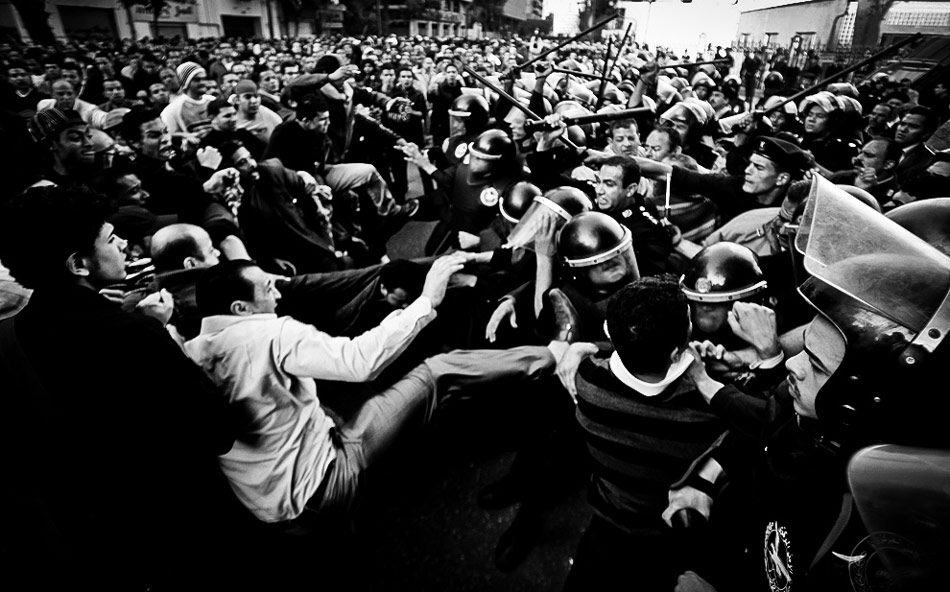
Revolt in North Africa. As usual, the most startling thing is how familiar it all seems: the young men with prestigious degrees working in the coffee shop, the unemployment and bitterness, the protests sparked by police brutality - because the police are to the unemployed what the boss is to the workers. These details indicate that what is happening in Egypt does not belong to any other world, but entirely to ours. There are no exotic overseas revolutions in the 21st century. Let's not be mistaken - even if the events in EgyptRiots in Greeceandthe student movement in Englanddwarfed, they arise from the same source. To generally keep up to date with events, recommendto read on anarkismo.netto read. But in order to have hope in these uprisings, we must see ourselves as part of them and think and act accordingly. For this reason, we asked a comrade in North Africa for the following analysis.
The Revolution in Egypt: The End of the New Pharaohs?
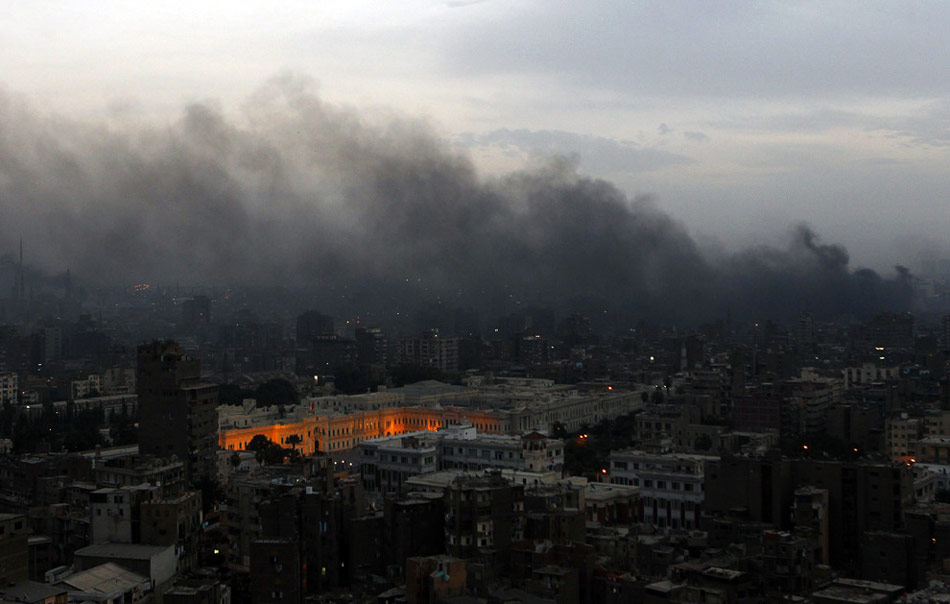
What is happening here - first in Tunisia, then in Egypt - is the beginning of a wave of widespread revolutions that will inevitably lead to theglobal financial crisisfrom 2008 will follow. In the wake of the failed “war on terror,” these revolutions combine the latent power of huge numbers of unemployed youth with the dynamics of modern communications networks. They signal the end of the decade of counter-revolution that followed September 11, 2001. Although these revolutions continue to explore the new technologies and decentralized forms of organizing that theAnti-globalization movementwere introduced, they are unprecedented in form and extent. Largely nameless groups are using the World Wide Web to spark leaderless rebellions against the pharaohs of the global empire of capital.
The world's self-proclaimed leaders are indeed blinded by the question of how to understand the new social and technological forces at play; The aging dictator Mubarak is a perfect example of this, but he is certainly not the only one of his kind. You can almost smell the fear, not only of the despots in China and Saudi Arabia, but also of the supposed leaders of representative democracies. Of all the contortions, those of the US government are the most grotesque; The people in Egypt are not indifferent to the fact that the bullets that are striking down their comrades come from the USA. Egypt receives annually1.3 billion dollarsMilitary aid from the USA. The suppression of “democracy” in the Middle East was and is the deliberate policy of the US government; knowing that popular sentiment would never support their agenda of military enforcement of global capitalism.
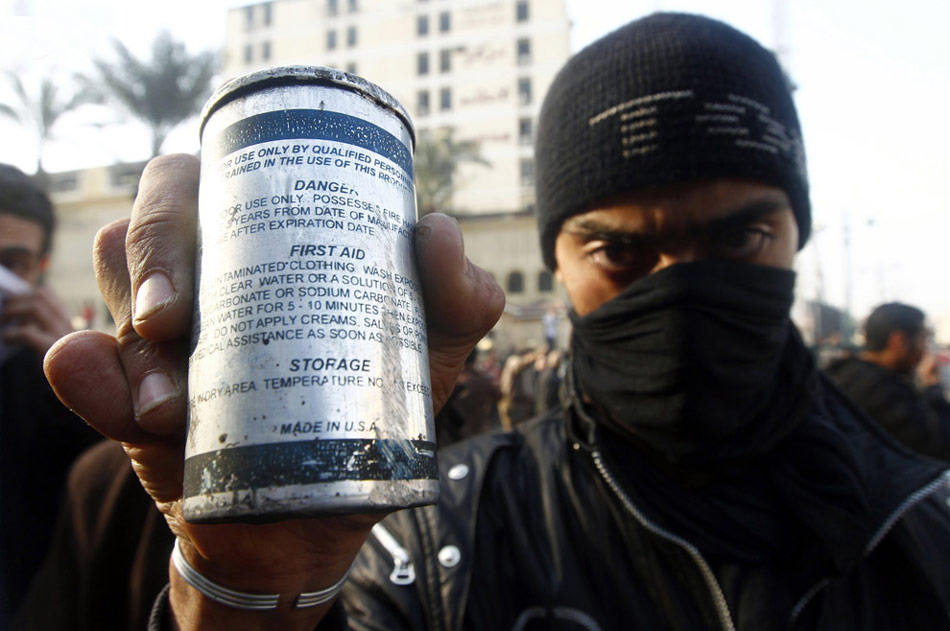
But even the best efforts of Mubarak's dying regime to shield the world's senses from events have not silenced the people in the streets of Cairo. Even blocking cell phones and trying to shut down the entire Internet has proven fruitful for the resistance. For generations, Arabs and Africans have been silenced, represented by various colonial governments, and portrayed as “primitives” and “terrorists” in Europe and the United States. Today, the people of Egypt speak out in thunderous unison for freedom - not political Islam, as demagogues from Iran to Israel would have the world believe. By doing this, people are realizing the ideals to which the U.S. government only hypocritically pays lip service.
From Tunisia to Egypt, general living conditions are now characterized by almost universal unemployment - especially among the younger generations, i.e. the vast majority of the population. This is increasingly the case in Europe and the USA. Unemployment is not an accident, it is the inevitable result of the last thirty years of capitalism. Capitalism reached its internal limits at the end of the 1970s; Today, factories in all industries are producing ever more goods, while increasing automation is increasingly replacing workers. The only way to profit from these goods is to get rid of the workers or pay them next to nothing. In order to discipline the skyrocketing number of unemployed and prevent revolts, the police are waging a never-ending war against the population. We live in a world awash in cheap shit - where human life is the cheapest of all.
Under these conditions, people no longer have anything to lose. Nothing, that is, nothing but their dignity - and it turns out that they are not going to give it up. It was precisely this inner core of dignity thatMohammed Bouaziziled him to set himself on fire rather than face the humiliation at the hands of the police, who had deprived him of his only means of feeding his family by confiscating his fruit stand. The fire that ignited Mohammed Bouazizi has spread, carried on by other unemployed people who are themselves transforming themselves from miserable beggars into heroes of world history. People in Egypt not only set police cars on fire, they organize popular committees to clear police and other trash from the streets, and the streets of Cairo have never been perceived as safer.
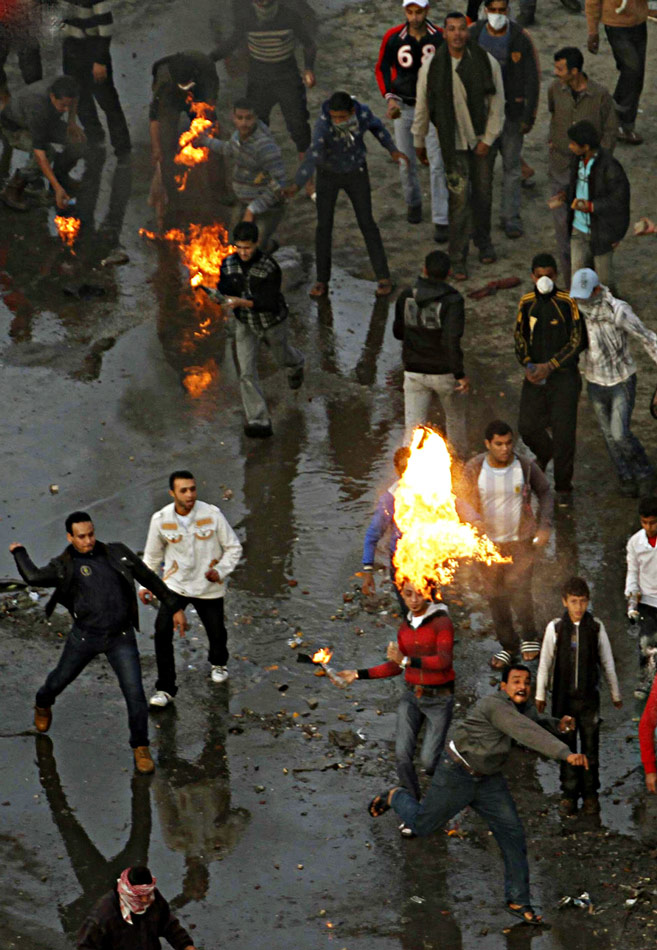
It is not surprising if a wave of revolutions should occur today. Not since the days of pharaohs and monarchs has the world been controlled by such a senseless force as the global financial market. Over the last few decades, as capitalists became more and more unable to generate profits through industrial production, they had to invent means of profiting from expected future returns. But in a world of increasingly cheap goods and poor consumers, how could capitalists keep people buying - how could they keep profiting? They had to devise a way for consumers to keep buying even though their wages weren't making enough to live on: hence the invention of mass debt. When the sale of real goods can no longer generate profits, the profits must be made from increasingly fantastic future expected returns - in other words, in finance.
But like any other house of cards, debts cannot be piled up forever. At some point, someone wants their money back - and so in 2008 the whole house of cards collapsed under its own weight. The financial crisis signals the deeper metaphysical crisis of our current order: capitalism is proving unable to meet the real material needs of the global population. The high level of poverty in Egypt is not simply the result of Mubarak's mismanagement, it is the unavoidable consequence of the contradictions of our time.
Hopelessly clouded by their own ideology and lack of vision, world leaders can only stand silent and surprised as the crisis continues. Their lame hope of getting the financial markets running again with “austerity” or “green capitalism,” their refusal to think about systemic change; despite the fact that the system cannot even provide people with jobs or affordable goods – let alone a good life. Just as it took an age of revolution to overturn the sacred right of kings, it will take new revolutions to overthrow the sacred right of things: the power of finance capital and its puppet dictators.
Revolutions are never brought about by technologies, but by people acting collectively who radically change their relationships with one another and with the world they share. Nevertheless, the important role that the WorldWideWeb has played in Egypt and Tunisia cannot be denied. In particular, the Internet made it possible for cybernetically experienced and largely unemployed youth to call for mass mobilizations and to take part in them themselves, without ever needing a leader. The January 25th demonstrations in Egypt were reported on the Facebook pageWe Are All Khaled Saidcalled, named after a victim of police violence, similar to the murder ofAlexis Grigoropoulosin Greece. The site itself was set up by an anonymous “El-Shaahed” – which means “martyr” in Arabic. Meanwhile, youth all over the world are mobilizing as “Anonymous”; in the battle forWikileaks, as well as recently in theActions against the Tunisian governmentshowed upAnonymous) as a powerful new international force that is awakening to political maturity beyond message boards like “4chan”. The ability of protesters to communicate with large numbers of people via cell phones, Twitter, and Facebook and respond immediately to events is making previous forms of left-wing and workplace-based political organization instantly obsolete, along with other hierarchical formations, such as political Islam.
This revolutionary use of social media shouldn’t surprise us. In the hands of a small elite, expensive communications technology is of course used for self-aggrandizement and consumerism. In the hands of the unemployed youth and other excluded classes, this technology can be repurposed to organize the revolution. The Internet is the new global factory floor and we are seeing the first workers' councils forming - a new kind of collective intelligence that allows people to organize directly and without representation.
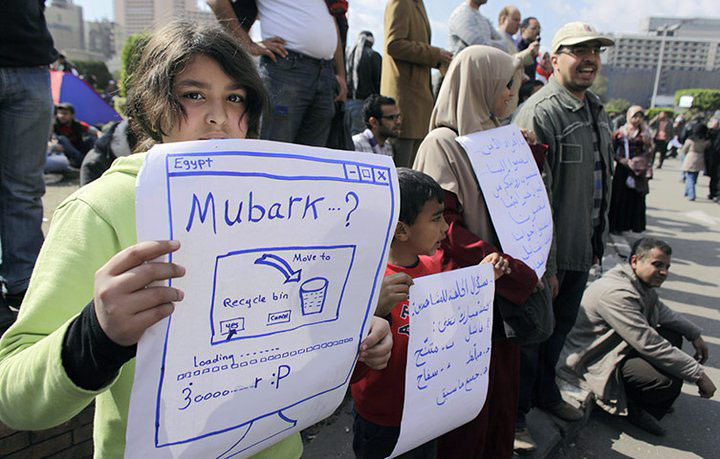
The sheer confusion of global capitalists over who is “actually behind” the mysterious resistance in Egypt and Tunisia is revealing. It's obvious how desperate US politicians are to have someone, someone like themMohamad ElBaradei, with whom you can negotiate. These revolts are anarchist in form if not content – and even the content is becoming increasingly radical. The absence of any organized group or leader in the early days of the protest speaks volumes: spreading access to information technologies has destabilized not only the left's old forms of organization, but also the justifications for having a hierarchical government in the first place. If people can communicate, they can organize their own lives. Extending such horizontal structures to a global scale no longer seems impossible, although it has not yet been well thought out.
What makes things worse for capitalists and nation-states is that the state's vast secret apparatus has been exposed in all its incompetence by websites like Wikileaks. While Wikileaks had nothing to do with the revolution in Egypt, internal cables about the luxurious food Ben Ali was feeding his pet tiger while people were starving further fueled the fire in Tunisia. Wikileaks produced paranoia within the global state apparatus itself, in that the state cannot function without a subjugated population that believes it is necessary and grants it the right to exercise violence. Now the Empire stands without clothes - and its naked, corrupt power is disgusting to see. There is a growing consensus that the state apparatus is an archaic remnant that no longer deserves respect.
Mubarak's regime made the classic mistake of confusing technological structures with the people who use them, a typical mistake of Silicon Valley as well as some theorists. In a poorly covered train, the regime blocked all four of the country's ISPs, shutting down the Internet. In addition, cell phone networks were blocked by disruptions before the large demonstrations. If this had any effect at all, it was to make the people of Egypt even angrier. Maybe it even took them out of their role as spectators - it's easier to watch a demonstration over the internet than to take part - and drove more and more people onto the streets.
The lesson to be learned is clear: the supposedly decentralized Internet is quite centralized, and while it may be useful, it is a mistake to become dependent on it while it remains in the hands of the capitalists. But leaders like Mubarak face a no-win situation. If you leave the communication technologies on and functioning, they will be used to organize against you - if you turn them off, you will provoke a global outcry.

How to organize yourself without the internet? One will start from the existing institutions. In Egypt that meant from the mosques. The “Days of Rage” were marked by street battles with police that were far more intense than those of the 2008 Greek uprising; they culminated in the burning down of Mubarak's party headquarters. Afterwards, in a brilliant move, the protesters called on people to gather at mosques after prayers - where most Egyptians would be anyway. In this respect, the mosques served the same purpose as the social centers and occupied houses in the Greek uprising, but for a much larger portion of the population.
While communications technology can be beneficial in the early stages of organizing, once a movement takes to the streets it must become strong enough to no longer need the Internet. In Egypt, the intensity of the revolt increased after the internet was shut down.
If there is one thing in which the Internet is essential, it is in spreading the news of the riots to other places. As the power of empire has become increasingly spectacular, it has become more vulnerable on the terrain of spectacle. Obama's initial response to the uprising was to call for an end to the "violence" - even though it is his administration that routinely commits violence in Pakistan and Afghanistan and imposes the world's largest prison system on U.S. citizens. He and Mubarak are not against violence, but they seem to be afraid of _images_ of violence. When these images take on a life of their own, they undermine the narrative of the state maintaining order.

At the same time, the state is absolutely dependent on people distrusting and fearing each other. This explains why Mubarak sent police in plain clothes to pose as looters to justify his crackdown. When that failed, he shut down the internet and denied media access to the protests, creating the conditions for the massacre that would be needed to bring the situation back under control. But as things stand today, it is questionable whether the army is prepared to carry out such a massacre.
The uprising, which began with the burning of police stations, subsequently shifted to large-scale peaceful demonstrations in an attempt to rally the army to its cause. Leaflets circulated at the demonstrations show that the organizers planned from the start to position the army against the police. Insurrectionalists in Europe and the US should pay attention to this clever strategic move. With the front lines of law enforcement effectively defeated, the Egyptians clearly understood that the only force that could stop them was the army. Instead of attacking them directly, which would certainly have resulted in a massacre, they tried to win the hearts and minds of the soldiers. So far they have been successful; they are showing that they can organize themselves and carry out a leaderless yet disciplined rebellion that will make the streets of Cairo safe and clean for the first time in years.
This deprives the army of any reason for its existence, let alone an excuse for a massacre. As a friend put it: Once an insurgency reaches a certain point, weapons become unnecessary. For a revolution to successfully overthrow the state, the army must refuse to fire on its own people and instead join the revolt. In Egypt the army is at least so paralyzed that it does not start firing; it could join the people, although it is more likely that it will seek to act as a mediator in the transition to representative democracy.
All of this shows that billions of dollars worth of military equipment cannot stop a revolution. Once things reach a certain point, military force is no longer the determining factor. If the people of Egypt continue to revolt undeterred, the military is unlikely to be able to bomb its own cities.
But even if military defeat is avoided, the insurgent process begun in the “Days of Rage” is more likely to be sidelined with a representative democracy than with a serious oneCommunizationof society - that is, in the direct sharing of production for people's survival. That doesn't mean that you have to be pessimistic - the neighborhood meetings and defense committees are already reminiscent of nothing less than the Paris Commune. But Mubarak is a dictator and Egypt's youth have not yet tasted the bitter fruits of representative democracy. Maybe they have to go the hard way to get to know her. And even if a representative democracy is established, it won't be the end of the story - let's look at the continued protests in Tunisia. Sooner or later a new uprising would inevitably occur, even if it could take years or decades to get there.
In this context, it is promising that many young Egyptians seem to be aware that representative democracy will only restrict their movement and revert them to another form of slavery. This is evident in many ways – for example, the message to self-proclaimed leader ElBaradei, “Should we just call you on your cell phone when we have made the revolution for you?” The uprising also demonstrated the unprecedented power of the women involved in it, who will no longer return to subservience to the Muslim Brotherhood.

But the population's occupation of Tahir Square cannot last forever; The moment will come when food will have to be produced, train connections will have to be reactivated, and the internet will have to be switched on again. These are the real keys to the success of the uprising, to preventing the return of capitalism, even under the guise of representative democracy. It appears that steps in this direction have not yet begun.
Now let’s take a step back and ask ourselves bigger questions. If Egypt is not fundamentally different from Europe and the USA, why have such uprisings not occurred there? First of all, we shouldn't rush into this - the dominoes are already falling, with massive protests taking place in the streets of Jordan, Algeria, Yemen and Mauritania. One reason why the uprising is developing with such force among the population is that the Egyptian way of life, and with it that of many Arabic-speaking countries, has not yet been fully capitalized. For example, in many cases you only pay as much as you “feel” that you should pay for the goods in question. Haggling is less about maximizing micro-profits and more about ensuring an affordable and ethical price in a trade. The trade in goods itself is often less important than the social relationships symbolized in the goods. The collective responsibility and power of the family binds people together across generations, in contrast to the alienated individuals in the United States and much of Europe. The vibrant and public life of the streets of the Middle East is a natural fuel for insurrection.
But aren't there dark forces waiting for their moment? It seems unlikely because the protests are much more about “freedom” than about Islam, and those who want to chant religious chants are shouted down if necessary. This is not to say that Egyptians are not Muslims - in fact they are - but there are subtle distinctions. Political Islam is something like the Tea Party of Egypt, a hierarchical religious movement that primarily includes the older and conservative generations; but Islam also exists in other forms, connecting social relationships and promoting a collective ethic. The Islamic commandment to give alms can also be interpreted as a ritual of avoiding extreme wealth. “Allah” does not necessarily refer to a God of command; the term can also refer to the unspeakable, to the invisible surplus of life that refuses to be reduced and resists the catastrophic exploitation of everything under the imperative of profit.
It is clear that trends older than Islam also have some influence in Egypt. Unlike those in Europe or the United States, many Egyptians are acutely aware of their history since ancient times and feel deep-seated shame about their current impoverished condition. TheDignity and respect, which they express to each other in the streets in the midst of the uprising, testifies that this revolution is not abstract, but rooted in everyday life. The deep metaphysics of these life forms provides the subjective prerequisites for transformation.
Communism is older than Marx, just as anarchy is older than Proudhon. The age of revolutions neither begins with the Paris Commune nor does it end with the fall of the Berlin Wall. As capitalism now spans the globe, the collective rejection of capitalism, along with the police that defend it, can become the one thing that unites the world. Marx's communism was trapped in the abstract metaphysics of economics and poisoned by the misunderstanding of the danger posed by the state, which sabotaged the revolutions of the early 20th century and led to the catastrophe of Soviet state capitalism.
But the age of revolutions is not over, on the contrary. In a Tuareg song - "The earth is our mother, we will not sell it" - we can catch a glimpse of a form of communism far more alien and hostile to capital than anything Lenin imagined. Many of the cries for “freedom” have little to do with the freedom to elect a president or choose goods at a market, but rather a desire to live with one's head held high, unintimidated by any ruler. They are prepared to die for this, whether by self-immolation or together on the streets.
Already these days one can sense a resonance outside the Middle East, a strong need for a common revolutionary goal, for something truly universal that can fill the void left by capitalism. The protesters' nationalist flags were tactically effective in confusing the army, but they also reflected a lack of criticism of the conceptual apparatus of the state and capital. While the conditions for revolution are right, revolutionaries over the last thirty years have largely failed to create and disseminate the organization and analysis necessary to turn uprisings into genuinely anti-capitalist revolutions. What will it take for people to realize that their neighborhood committees are not just a means to temporarily replace the police, but a precursor to the abolition of all police in all countries?
No event occurs in a vacuum; Events arise from concrete conditions and, as a result, they tend to occur in waves. The events in Egypt show that the center of the revolutionary momentum is no longer “the West”. The new period of revolution will find its first climaxes in areas where living conditions are becoming unbearable and ways of life have not yet been completely colonized by capital. Nevertheless, it would be a mistake to see this as merely the conclusion of the unfinished anti-colonial revolt. It is something far greater and deeper. The financial crisis is a sign that capitalism is on the decline. The conditions that brought about the events in Egypt are rapidly becoming a universal condition throughout the globe; meaning another cycle of revolution and possibly war. Eventually, the same forces will hit Saudi Arabia, Europe, China and ultimately even the United States with the force of a tidal wave.

Make no mistake, we are entering a time of revolt. These revolts will reject and attack capitalism in their concrete practice, even if the systematic destruction of previous revolutionary currents has left a vacuum. It remains to be hoped that the people taking part will realize that freedom is impossible without the destruction of the state and capital and that a new generation of revolutionary thought will renew the concept of revolution for the dawning times. We are at a point today where it should be clear to everyone that we can direct our own lives - that the state is a historical fossil that is holding us back. As Egypt shows, the stranglehold of the state and capital on the streets must be broken; Over the next few decades, the results of this final battle will likely decide the fate of humanity itself.
All power to the people!
- Translated byTranslation Collective
- Another translationfrom FAU

Read the full story at the source →
Source: CrimethInc.