
World · Counterpunch · · 2h
Under the Stars in Old New Mexico: the Growing Resistance to Uranium Mining
English (original) · Read in Deutsch ⇄
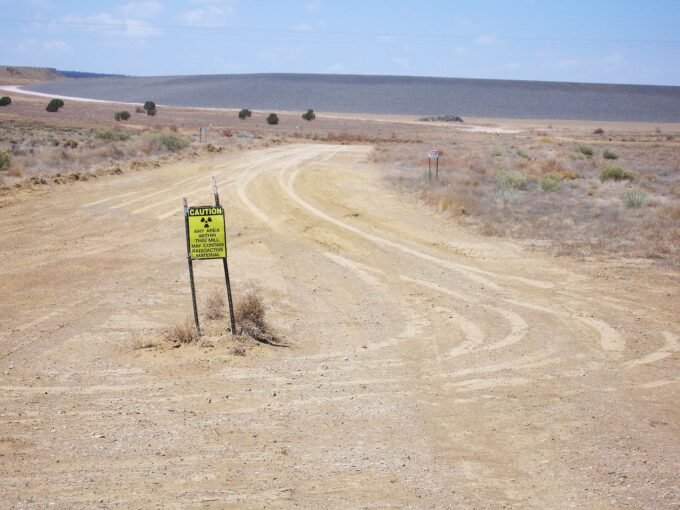
Radiation warning sign at Ambrosia Lake uranium mining area, New Mexico. Photo: Netherzone. Wikimedia. CC BY-SA 4.0
In New Mexico, resistance to Trump’s demand to resume uranium mining appears to be growing, from local protests against mines, mining-permit proposals and a processing mill in Utah, to statewide and congressional action.
Most recently, on September 4, New Mexico Commissioner of Public Lands Stephanie Garcia Richard signed an executive order that bans all new uranium mining projects on the more than 13 million acres of state trust lands she oversees.
“New Mexicans have been overlooked by the uranium industry and the federal government for far too long,” Garcia Richard said, “and now the Trump administration is once again completely ignoring these communities and pushing for aggressive uranium development nationwide, despite the fact that there still remain thousands of sites that are abandoned and need to be remediated.”
U.S. Sens. Martin Heinrich and Ben Ray Luján, along with U.S. Rep. Teresa Leger Fernández, wrote Carson National Forest Supervisor James Duran in April to protest exploratory uranium drilling by a Canadian-based company within the forest near Canjilon. They urged the Forest Service to conduct a full environmental review before taking any further action. They also asked the Forest Service to suspend that review pending legislation they intended to introduce into Congress to protect the Chama watershed from further development. The April letter also emphasized the important role of the Chama River, which supports agriculture and provides drinking water to numerous towns across northern New Mexico.
“This watershed is not simply an environmental amenity. It is critical water infrastructure — as essential to the communities of northern New Mexico as any road, pipe, or reservoir,” the members of the state’s congressional delegation wrote. The water has “continuously sustained agricultural production and community identity for more than 400 years …Tribal nations have exercised cultural, ceremonial, and subsistence ties to this landscape since time immemorial.”
Garcia Richard has only four months left in her term and is running for lieutenant governor; however, Juan Sanchez III, the Democratic Party candidate running to be her successor, said he would continue the policy.
The proposal by the Vancouver uranium company Gamma Resources Ltd., also drew opposition from Rio Arriba County Commissioner Moises Morales, who lives near Canjilon, and Tirzio Lopez, who serves on the governmental Upper Chama Soil and Water Conservation District board and is on the board of the New Mexico Game Commission.
Garcia Richard summed up a widespread public opinion in New Mexico, saying, according to Source New Mexico, that “the long-lasting environmental and public health impacts of uranium contamination outweigh any potential revenues to state coffers uranium mining could provide.”
The congressional delegation concurred in its April letter to Duran, writing that New Mexico “bears a disproportionate and well-documented legacy of harm from uranium mining. Hundreds of abandoned uranium mines on and near tribal lands, particularly within the Navajo Nation, have contaminated water sources and resulted in elevated rates of kidney disease and cancer among affected communities.”
US Senators Heinrich and Luján. U.S. Rep. Teresa Leger Fernández, and “all New Mexico Democrats,” the Abiquiu News reported on August 6, sponsored theChama Basin Watershed Protection Act. “If enacted, the act would prohibit all forms of uranium mining through much of Rio Arriba County , including in the Santa Fe and Carson National Forests.”
Garcia Richard’s executive order and the congressional delegation’s proposed act are symbolic at the moment because there are no proposals to mine uranium on land controlled by the New Mexico State Lands Commission and because Republicans control both houses of Congress, at least until Jan. 3, 2027. On the other hand, Richard’s order should prevent any uranium-mining proposals on state lands in the future; and the New Mexico delegation’s bill should flourish in a Democratic House of Representatives and succeed if Democrats take the Senate, too.
Less symbolic is the silence this weekend of front-running Democratic Party candidate for governor, former member of Congress and Secretary of the Interior Deb Haaland, whose campaign issued a press release about the campaign’s first television ad. The ad emphasized the needs of working families and Haaland toured northern parts of the state with the same national Democratic Party message. Perhaps Haaland’s federal experience (she was a congresswoman before she went to Interior) has wrapped her in the mendacious aura of National Security, erasing from her memory the 3,141-acre Jackpile Mine, one of the largest open-pit uranium mines in the world, which adjoins the Laguna Pueblo. She is an enrolled member of the Laguna Tribe. In Congress, she could be eloquent on the evils of the Jackpile, but as Interior Secretary her office referred local press to the Environmental Protection Agency for information.
Meanwhile, President Trump has proclaimed that he has renamed New Mexico “New America,” which he lacks authority to do. Outgoing Governor Michelle Luján Grisham, also a former Democratic Party member of Congress, took this opportunity to rebuke a president driving new uranium mining in her state and to praise her own leadership.
“Under Democratic leadership here in New Mexico, we’re providing families with free childcare and college, protecting access to health care and investing in housing,” she wrote on X last weekend. She said nothing about progress on a plan she proposed in 2024 with Arizona Governor Katie Hobbs to streamline decision-making regarding the cleanup of abandoned uranium mines.
“New Mexico is committed to nimble decision-making while ensuring safe cleanup and disposal of these legacy wastes,” Grisham said.
Quietly, beyond nimble political rhetoric, real political resistance grows to the resumption of the terribly destructive mining of uranium on the Colorado Plateau. The evidence of this resistance and the political pressure it can create so far consists of the political events described above. But the roughly agreed-upon reality is that there are something like 1,100 abandoned uranium mines and mill sites in New Mexico, about 500 of which are on or near the Navajo Reservation. Efforts have been made through the years since the industry dried up in the 1980s to deal with the radioactive waste lying outside these mines for children to play with, for people to use as building materials, and to deal with the contaminated water sickening sheep and human beings. And some remediation has occurred; some wastes have been buried and planted over or removed. The Radiation Exposure Compensation Act helps victims, both miners and their families and downwind victims of nuclear testing.
But all of this is very expensive; there is never the money necessary, and the paperwork is daunting. In short, the bastards got away with polluting much of the Colorado Plateau with the worst kind of toxicity and left the federal government, their only customer at the time, to deal with the damage. Add to that the political squalor of National Security and the administration of Indian reservations. Now add Trump and his new friends, Canadian transnational mining companies, and old friends, dim-witted racists who want nukes.
Yet, there are clear, strong people who live near the sources of contamination and disease; they see the damage and they actively defend the old, the young, and the unborn. The battle goes on, local residents fighting transnational uranium-mining corporations; in the middle are politicians and the national public anticipating increasing amounts of nuclear waste in years to come.
Bill Hatch lives in the Central Valley in California. He is a member of the Revolutionary Poets Brigade of San Francisco. He can be reached at: [email protected].
Read the full story at the source →
Source: Counterpunch